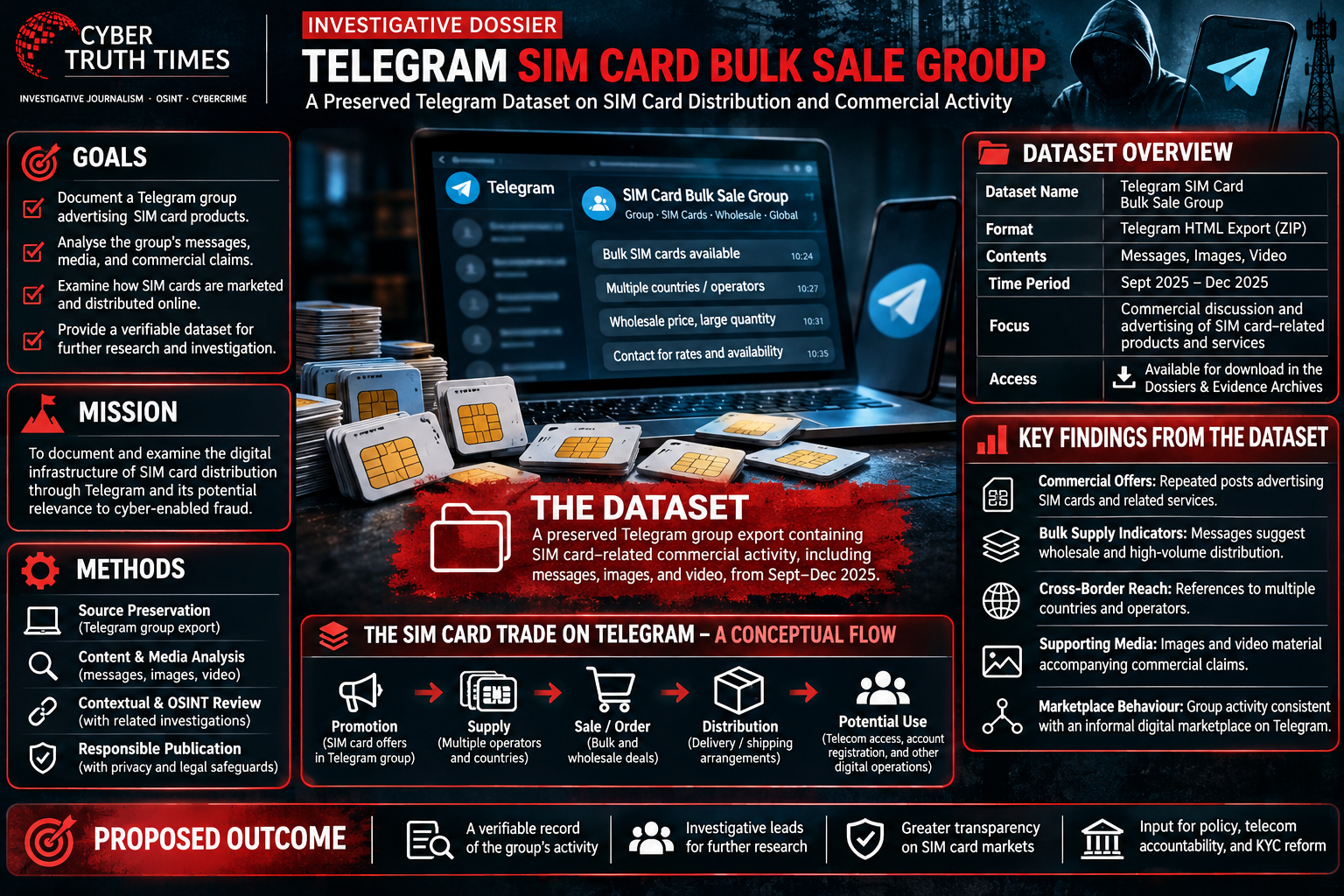
Explore a preserved Telegram SIM card bulk sale group export. Cyber Truth Times examines marketplace claims, digital evidence and the wider SIM-card supply chain. An evidence-led investigation into a Telegram group advertising SIM-card-related services, and what the preserved export reveals about the digital marketplace, the role of messaging platforms and the broader SIM-card supply chain.
Introduction
SIM cards remain a fundamental component of modern digital connectivity. They enable telecommunications access, facilitate account verification and support a wide range of digital services. Yet, the commercial distribution of SIM cards through informal online marketplaces raises important questions about supply chains, identity verification, accountability and the potential misuse of telecommunications infrastructure.
Cyber Truth Times has preserved and published a Telegram group export associated with SIM-card-related commercial activity. This dataset provides a documentary record of messages and associated media from a group in which SIM-card-related commercial claims and offers were communicated.
The evidence release forms part of a broader investigative series examining Telegram-based SIM-card marketplaces, bulk SIM distribution, the role of telecommunications infrastructure in cyber-enabled fraud and structural challenges surrounding telecom Know Your Customer (KYC) systems.
This particular dataset focuses on one Telegram group. Its messages, media and commercial presentation are the primary subjects of this evidence release.
The objective is to document the material, examine its context and make the preserved source available for further research and independent scrutiny. The publication does not assume that every commercial participant or SIM-card transaction described in the source material is connected to unlawful activity.
1. What is this dataset?
The dataset consists of a preserved Telegram group export containing messages and associated media connected to SIM-card-related commercial activity.
The archive contains an HTML-based message export, photographs and a video file. The export’s apparent chronology spans September through December 2025.
The preserved material provides a source record of communications within the group, including commercial messaging and claims relating to SIM-card products and services.
Rather than treating these claims as independently verified facts, Cyber Truth Times is publishing the material as documentary evidence that can be examined, contextualised and corroborated.
The dataset may help researchers examine:
- How SIM-card products and related services are presented within the group.
- How commercial claims are communicated through Telegram.
- The role of images and video accompanying the messages.
- The nature of the group’s marketplace-oriented communications.
- The context in which SIM-card-related products are discussed.
- Questions requiring further independent investigation.
The value of the dataset lies in preserving a record of activity that can be subjected to further analysis, rather than in making unsupported conclusions about the identities or conduct of individual participants.
2. Why investigate a Telegram SIM-card marketplace?
Telecommunications infrastructure is increasingly intertwined with digital identity, account access and online authentication. Mobile numbers are used across social media, messaging platforms, financial services and numerous digital applications.
This dependence creates legitimate commercial and technological uses for SIM cards. It also creates potential opportunities for abuse when SIM-card distribution, identity verification or account-registration processes are exploited.
The investigation examines the commercial activity visible within this Telegram group as a documentary starting point for understanding how SIM-card-related products and services are advertised and discussed.
The central investigative question is not whether SIM cards are inherently suspicious. They are not. The question is what the documented marketplace activity reveals about commercial practices, the presentation of SIM-card services and the wider environment in which telecommunications access may be misused.
Telegram is the platform through which this particular group communicates. The preserved export allows its communications and associated media to be examined within their original context, subject to the limitations of the material available.
3. What the dataset may reveal
The dataset provides an opportunity to examine several aspects of the group’s activity.
Commercial presentation
Messages can be reviewed to understand how products and services are advertised, how sellers describe their offerings and what claims are communicated to prospective customers.
Supporting media
Photographs and video included in the export may provide additional context for the messages. However, the existence of visual material does not automatically establish the authenticity, location, ownership or provenance of what it depicts.
Marketplace communication
The preserved messages may help researchers examine the communication patterns and commercial presentation associated with the group.
Digital identity and telecommunications
SIM cards occupy an important position within digital identity systems. The dataset may contribute to a broader examination of how commercial SIM-card distribution intersects with account access, identity verification and telecommunications governance.
Investigative leads
The material may identify questions that warrant additional research, corroboration or verification using independent sources.
The dataset should therefore be understood as a documentary resource. It does not, by itself, establish the identity of every participant, the legitimacy or illegality of every transaction, or the ultimate use of every SIM card discussed.
4. The four investigations that form the wider series
This evidence release is accompanied by four related investigations published by Cyber Truth Times. Together, these articles provide the analytical context for examining the SIM-card marketplace documented in the dataset.
Article 1: Telegram as Infrastructure — How SIM Card Markets Persist at Scale
Read the investigation: Telegram as Infrastructure — How SIM Card Markets Persist at Scale
This investigation examines how Telegram can function as an infrastructure layer for online SIM-card marketplaces. It explores how platform features, digital communication and marketplace presentation may support the persistence of commercial activity. The article focuses on the structural role of the platform rather than attributing criminal conduct to individual sellers.
Article 2: The Business of Bulk SIM Cards in Southeast Asia
Read the investigation: The Business of Bulk SIM Cards in Southeast Asia
This article examines the commercial dimensions of bulk SIM-card distribution, including wholesale positioning, market presentation and the broader supply-chain questions surrounding SIM-card sales. It considers how bulk distribution should be examined within the context of telecommunications infrastructure and digital markets.
Article 3: Why SIM Cards Are Central to Scam Operations
Read the investigation: Why SIM Cards Are Central to Scam Operations
This investigation explores the role of SIM cards and mobile numbers in cyber-enabled fraud. It examines the relationship between telecommunications access, digital account ecosystems, authentication and the potential misuse of mobile connectivity in online scam operations.
Article 4: Telecom KYC Gaps in Southeast Asia — A Structural Failure
Read the investigation: Telecom KYC Gaps in Southeast Asia — A Structural Failure
This article examines structural challenges surrounding telecommunications identity verification in Southeast Asia. It explores questions concerning regulatory enforcement, verification practices, accountability and the broader governance challenges that arise when telecom infrastructure is used across jurisdictions.
Together, these four investigations provide a wider analytical framework for examining the evidence preserved in this particular Telegram group export.
5. Goals of the investigation
The investigation has several principal objectives:
- Documentation: Preserve a Telegram group export containing SIM-card-related commercial communications and media.
- Analysis: Examine the messages, images and video within their available context.
- Transparency: Make the source material accessible for further examination, subject to responsible handling of sensitive information.
- Corroboration: Identify claims and patterns that warrant independent verification.
- Research: Contribute documentary material to the broader examination of SIM-card distribution markets.
- Public-interest reporting: Inform discussion about telecommunications infrastructure, digital identity and potential avenues of misuse.
The investigation seeks to document what the source material supports while avoiding conclusions that exceed the evidence.
6. Mission
The mission of this investigation is to document and examine the digital marketplace activity preserved in the Telegram SIM Card Bulk Sale Group export, and to contribute to a broader understanding of SIM-card distribution practices and their potential implications for digital identity and cyber-enabled fraud.
Cyber Truth Times seeks to preserve documentary evidence, analyse it responsibly and distinguish verified observations from claims requiring further corroboration.
The investigation is not intended to categorically label SIM-card sellers, buyers or participants as criminal actors. It seeks to examine the source material and the broader structural questions that may emerge from it.
7. Investigative methodology
Source preservation
The Telegram group export and associated media are preserved as the primary documentary source for this release.
Contextual analysis
Messages and media are examined in the context of the available export and its chronology, rather than treated as isolated statements.
Cross-reference with related investigations
The dataset is interpreted alongside the four related Cyber Truth Times investigations examining Telegram marketplace infrastructure, bulk SIM-card commerce, the role of SIM cards in scam operations and telecom KYC challenges.
Independent corroboration
Claims that are significant to the investigation should be tested against independent reporting, public records, technical evidence, regulatory material or other available sources.
Responsible publication
Sensitive information should be assessed before publication. Evidence preservation and public-interest reporting do not require the unrestricted publication of personal identifiers or information that could expose individuals to unnecessary harm.
Limitations
This dataset represents material preserved from a particular Telegram group export. It does not independently establish the full scope of a marketplace, the identity or location of every participant, the authenticity of every commercial claim, or the ultimate use of every SIM card referenced in the messages.
8. Proposed outcome
The proposed outcome is a publicly accessible documentary resource that supports further investigation and research into the commercial activity documented in the Telegram group.
The release is intended to:
- Preserve a source record of the group’s communications.
- Provide material for further independent research.
- Support evidence-led investigative journalism.
- Encourage scrutiny of SIM-card distribution practices.
- Contribute to discussions about digital identity and telecom accountability.
- Identify avenues for further corroboration and investigation.
The dataset is not a substitute for telecom records, law-enforcement findings, judicial determinations or independent verification.
9. Access to the dataset
The Telegram SIM Card Bulk Sale Group dataset is available through the Cyber Truth Times Dossiers and Evidence Archives.
The downloadable ZIP archive contains the preserved Telegram export and associated media. Readers, journalists and researchers accessing the material should interpret it cautiously, independently verify claims before drawing conclusions and respect applicable legal and privacy protections.
This release is part of Cyber Truth Times’ continuing effort to document digital evidence relevant to cybercrime, OSINT and public-interest investigative journalism.
Disclaimer
This dataset is published for investigative journalism, research, documentation and public-interest purposes. The content reflects material preserved from the source Telegram export and does not independently establish the truth of every claim made by participants. The publication does not allege that every individual, entity or product referenced in the dataset is involved in unlawful activity. Findings must be interpreted in context and independently corroborated where necessary. Sensitive information should be handled responsibly, with appropriate regard for privacy, victim protection and applicable law.
Related investigations and bibliography
- Telegram as Infrastructure — How SIM Card Markets Persist at Scale
- The Business of Bulk SIM Cards in Southeast Asia
- Why SIM Cards Are Central to Scam Operations
- Telecom KYC Gaps in Southeast Asia — A Structural Failure
- INTERPOL — Cybercrime
- UNODC — Cybercrime
- GSMA — Mandatory Registration of Prepaid SIMs
- Reference
- CTT-SIM-TELEGRAM-001
- Published
- Updated
- Category
- Telegram Investigations
- Tag
- SIM Card Bulk Sale Telegram Group Export