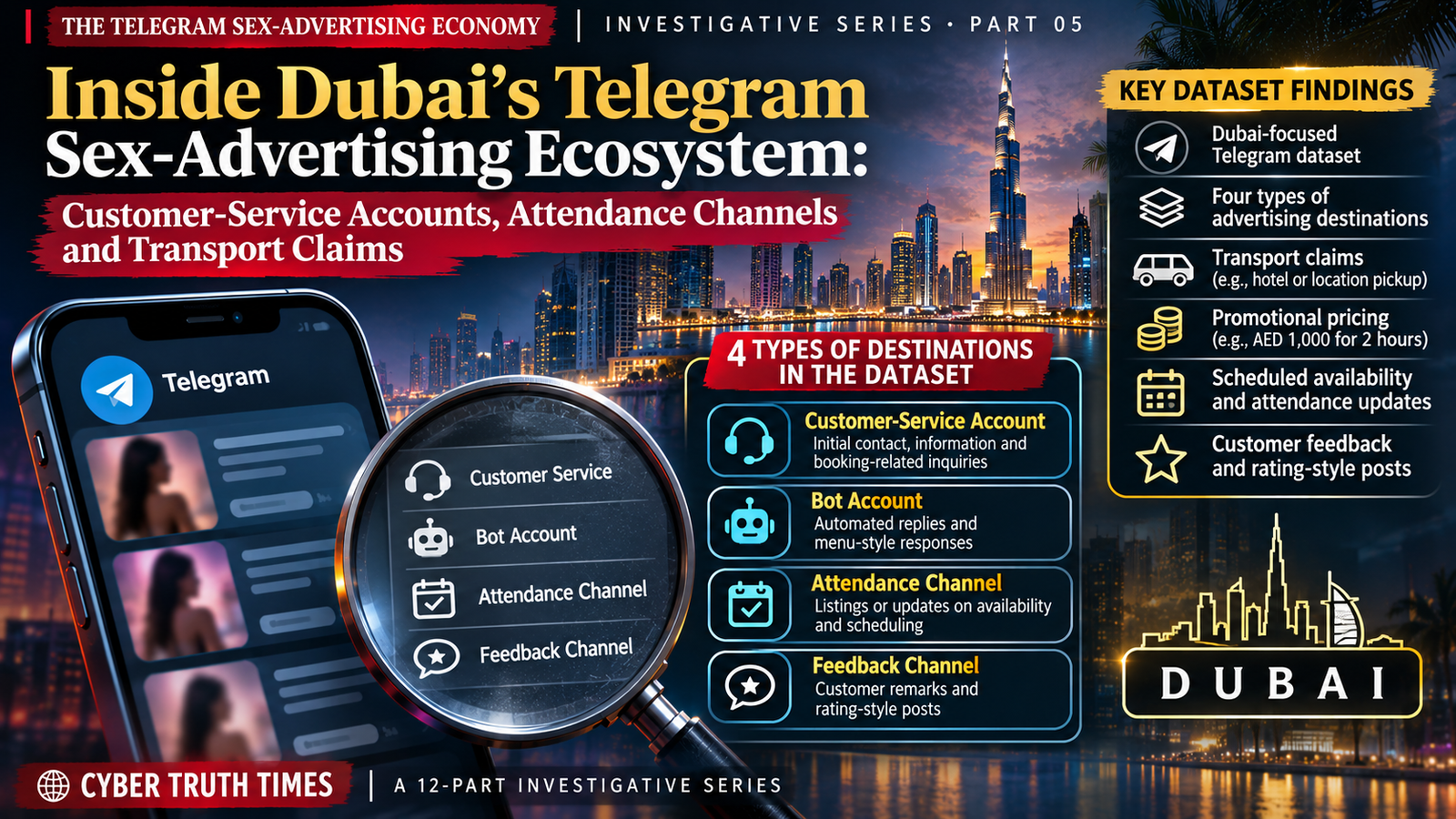
Cyber Truth Times dives into the Dubai Telegram Sex Advertising dataset containing customer-service accounts, bot links, attendance posts, transport claims and promotional references.
Introduction: Dubai Telegram Sex Advertising
Telegram channels, bots and messaging accounts can be used to distribute promotional material, facilitate communication and direct audiences toward other digital destinations. In advertising ecosystems built around messaging platforms, content may appear across several accounts, with different posts presenting advertisements, contact references, purported availability or customer-facing information.
Cyber Truth Times examined a Telegram dataset associated with Dubai, containing promotional material, customer-service account references, a bot, attendance-related posts, transport claims, feedback references and media attachments. The dataset offers a case study in how promotional content is presented through multiple Telegram destinations rather than a single channel.
The material includes references to a customer-service account, a contact bot, attendance-related posts, feedback destinations and claims about hotel arrangements, transport, operating hours and packages. These elements provide a basis for examining the visible structure of the promotional communication.
The records also raise questions about the segmentation of advertising content, the use of different digital destinations and the claims made by advertisers concerning arrangements and availability.
However, the dataset does not independently establish that the accounts are controlled by a single person or organisation, that advertised services were delivered, that any hotel or transport provider was involved, or that any individual was subjected to coercion or exploitation.
This report focuses on the observable digital records, the apparent structure of the advertising material and the evidentiary limitations of the dataset.
1. The Dataset: A Telegram Channel Associated with Dubai
The dataset examined by Cyber Truth Times is associated with a public Telegram channel recorded under the title 迪拜修车✨金澜汇 轻奢顶美俱乐部, with an original recorded title of 迪拜会所.
The dataset identifies the channel with the recorded identifier 4302377157.
According to the available metadata, the channel was created on 1 October 2026. The dataset contains a promotional burst recorded around 8:35 AM on 1 October 2026, alongside other references and associated promotional material.
The advertising content includes descriptions of purported services, package pricing, overnight packages, contact details, attendance-related material, transport claims and references to other Telegram destinations.
The dataset also contains media filenames and durations, alongside references to customer-facing accounts and a contact bot.
These elements make the dataset relevant to the examination of messaging-platform advertising infrastructure.
The records should not be interpreted as an independently verified directory of people, establishments, services or transactions. They constitute promotional content and associated digital references that require careful interpretation.
2. A Promotional Ecosystem Extending Beyond One Channel
One of the notable features of the Dubai dataset is the presence of multiple Telegram references associated with the promotional material.
The records contain references to:
- A customer-service account identified as @DBbaibai.
- A contact bot identified as @DBxc8bot.
- Attendance-related Telegram references.
- A feedback destination.
- Another account reference appearing once in the dataset.
These references suggest that the promotional material directs readers toward different digital destinations rather than relying exclusively on the original channel.
From an investigative perspective, this is an observable feature of the dataset.
The appearance of different account types and destination links may indicate a segmented communication format in which promotional posts, contact references and other content are presented separately.
However, the available records do not establish the operational roles of each account, whether the accounts share an administrator, whether they are part of one business or whether the referenced destinations are controlled by the original channel operator.
The existence of a link or account reference is not proof of common ownership.
The investigation therefore documents the digital destinations without attributing organisational control where it has not been independently established.
3. Customer-Service Account References
The dataset contains a customer-service account reference identified as @DBbaibai.
Its appearance in promotional material is relevant to understanding how the advertisements direct prospective audiences toward another Telegram destination.
Customer-service references are a common feature of online promotional communication, where advertisers may use separate contact points for enquiries or other interactions.
In this dataset, the account is an observable reference in the promotional material.
The records do not independently establish who operates the account, whether it responds to enquiries, whether it manages bookings or payments, whether it is connected to a physical establishment or whether it shares control with the original advertising channel.
The label or presentation of an account should not be treated as proof of its actual function.
A digital account may be presented as a customer-service contact while its operational role remains unknown.
Further independent evidence would be required before attributing the account to a specific person, business or organisational structure.
For this reason, the investigation treats the account as a digital reference rather than a verified operator.
4. The Contact Bot: A Separate Digital Destination
The dataset also contains a reference to a Telegram bot identified as @DBxc8bot.
The inclusion of a bot reference is noteworthy because bots represent a different type of digital destination from an ordinary channel or personal messaging account.
The dataset establishes that the promotional material references the bot. It does not establish how the bot operates, what data it collects, whether it processes enquiries, whether it facilitates transactions or whether it is controlled by the same individuals as the advertising channel.
The bot’s apparent promotional context is not sufficient to determine its actual technical or operational role.
A bot may have different functions depending on its configuration and the services associated with it. Without an independently documented examination of its behaviour, the investigative conclusions must remain limited.
The presence of a bot reference is therefore a potential avenue for further examination, but it is not evidence of a confirmed booking system, payment infrastructure or coordinated commercial operation.
5. Attendance-Related Posts and Promotional Claims
The dataset contains attendance-related references, including posts associated with the Telegram destinations https://t.me/BlueGXF/939 and https://t.me/DBnb555/139.
The records also contain attendance-related claims referring to numbers of people reportedly available, including claims of 15 and 18 individuals.
These figures are promotional claims contained in the dataset.
They are not independently verified counts of individuals, staffing levels, participants, available services or completed transactions.
Attendance-style posts may be relevant to the analysis of advertising formats because they present purported information about availability or participation in a promotional context.
However, the dataset does not establish that the figures were accurate, that the individuals described were physically present, that they consented to the advertising or that the posts corresponded to actual services.
The distinction between a promotional claim and a verified fact is essential.
The investigation records the attendance references as elements of the advertising material, not as confirmed information about individuals or a physical establishment.
6. Transport Claims and Hotel References
The promotional material contains claims relating to hotel arrangements, transport and other purported logistical arrangements.
Some advertisements describe a central Dubai five-star hotel, pickup and drop-off arrangements, a Chinese-speaking driver, refreshments, operating hours and claims that there are no hidden charges.
These statements are claims made within the promotional material.
The dataset does not independently verify the hotel, the transport arrangements, the driver, the advertised venue, the operating hours or the availability of the services described.
A hotel reference within an advertisement does not establish hotel involvement.
Similarly, a transport claim does not establish that a vehicle, driver or transport provider was actually used, that the arrangement occurred or that a third party participated.
The presence of a hotel-related promotional claim should not be used to associate a named hotel or hospitality business with the advertising without independent corroboration.
This distinction is particularly important when advertisements contain references to real-world locations or businesses. Publishing unverified claims as facts could create unjustified reputational harm.
The dataset provides a record of the advertiser’s language—not independent confirmation of the arrangements described.
7. Packages, Pricing and Promotional Presentation
The dataset contains references to package pricing and overnight packages.
These price-related claims are part of the promotional content and may help researchers describe how the advertisements present commercial arrangements.
The records do not independently establish whether prices were accurate, whether offers were available, whether transactions occurred, whether payments were collected or whether advertised terms were honoured.
The currency associated with some pricing references is not independently established by the dataset.
Price and package descriptions are therefore treated as advertiser claims.
From a digital-advertising perspective, the presence of packages and pricing information illustrates the way promotional material may be structured to communicate purported options to an audience.
The dataset does not establish the revenue generated by the channel, the number of customers, the number of completed transactions or the commercial relationship between the channel and any physical establishment.
8. Feedback References and the Appearance of Customer-Facing Communication
The dataset contains a feedback-related reference identified as https://t.me/DBnb222.
The appearance of a feedback destination is a notable feature of the promotional material because it indicates that the advertisements reference another digital location presented in a feedback-related context.
However, the dataset does not independently establish the authenticity of the feedback, the identities of people posting it, whether the comments reflect actual experiences or whether the destination is controlled by the original channel operator.
Feedback-related content can be copied, fabricated, selectively presented or posted by people whose identities and circumstances cannot be independently established.
Without corroboration, the presence of a feedback link does not establish customer satisfaction, service quality, completed transactions or a verified commercial reputation.
The investigation treats the reference as an observable digital feature, not as independently validated customer testimony.
9. Media Metadata and the Question of Provenance
The dataset contains media files associated with promotional posts.
Some filenames and media metadata may provide potential leads for further examination. However, filenames do not automatically establish the date of capture, the location of the recording or the identity of the individuals depicted.
One recorded filename, video_2023-05-28_20-57-38.mp4, contains a date-like string.
That string cannot independently establish when the video was captured, who recorded it, where it was recorded or whether the video depicts the circumstances described in the advertisement.
A filename may be generated, modified, copied or preserved from an earlier file.
The relationship between a filename and the date of publication or capture must therefore be established independently.
Further media analysis may involve preservation of original files where available, documenting cryptographic hashes, examining available metadata and assessing potential reuse through lawful image-similarity research.
Such work should be undertaken with attention to the privacy and safety of people depicted in the material.
10. What the Dataset Establishes
The Dubai Telegram dataset contains several observable findings that can be documented.
Multiple Telegram references
The promotional material contains references to customer-service, bot, attendance and feedback-related destinations.
Customer-service reference
The account @DBbaibai appears in the dataset.
Bot reference
The contact bot @DBxc8bot appears in the promotional material.
Attendance-related references
The dataset contains attendance-related posts and claims involving numbers of people reportedly available.
Transport and hotel claims
The advertisements contain descriptions involving purported hotel, pickup, drop-off and other arrangements.
Pricing and packages
The promotional material contains package and overnight pricing claims.
Feedback-related reference
The dataset contains a feedback-related Telegram destination.
Media records
The dataset contains media filenames and durations associated with promotional material.
These findings document the digital references and claims visible in the dataset.
They do not independently establish identities, common ownership, transactions, hotel involvement, transport-provider involvement, trafficking, coercion or the existence of a unified operation.
11. What the Dataset Cannot Establish
The available records do not independently establish:
- The identities of the individuals operating the accounts or bot.
- Whether the customer-service account and bot share an administrator.
- Whether the original channel controls all referenced destinations.
- Whether the attendance claims are accurate.
- Whether advertised individuals were physically present.
- Whether any advertised service was delivered.
- Whether transactions or payments occurred.
- Whether a hotel was involved.
- Whether transport providers participated.
- Whether the advertisements corresponded to a physical establishment.
- Whether individuals were coerced, deceived or exploited.
- Whether human trafficking occurred.
- Whether the channel was connected to other datasets or organisations.
The absence of such evidence in the dataset does not establish that exploitation is absent.
It means the available records do not independently demonstrate these allegations.
Commercial sex advertising is not, by itself, proof of human trafficking or coercion. Those conclusions require evidence specific to the relevant legal and factual elements.
12. Further Investigative Avenues
The dataset may support further examination, provided the research is conducted with appropriate safeguards and independent corroboration.
Preservation of the source dataset
Preserve the original export, document the extraction process, record the collection date and retain cryptographic hashes where appropriate.
Chronological analysis
Develop a timeline of promotional posts, account references, bot links, attendance claims and changes in advertising presentation.
Account-reference documentation
Document the occurrence of accounts, bots and referral destinations without assuming common ownership or publishing sensitive information unnecessarily.
Independent examination of digital destinations
Where lawful and safe, assess the publicly accessible content of referenced destinations and preserve relevant records with clear provenance.
Media analysis
Examine available metadata, document file hashes and assess potential reuse of media through lawful and ethical methods.
Corroboration of real-world claims
Seek independent evidence before making claims about hotels, transport providers, establishments, transactions or individuals.
Privacy and ethical review
Avoid exposing individuals through contact details, images, location information or links where publication could facilitate unwanted contact or harm.
The dataset is a documentary starting point, not a verified account of the people or organisations associated with the advertisements.
Conclusion: Examining a Digital Advertising Structure
The Dubai Telegram dataset provides a record of promotional material containing customer-service references, a bot, attendance-related posts, feedback links, pricing claims, transport descriptions and media attachments.
These features offer a basis for examining how promotional communication is presented through multiple digital destinations.
The records suggest a segmented presentation of advertising content, but they do not independently establish that the referenced accounts are operated by the same person or organisation, that advertised services were delivered, that hotels or transport providers were involved or that exploitation occurred.
The customer-service account, bot, attendance references and feedback destination are observable digital leads. Their operational roles and relationships remain unverified.
Cyber Truth Times’ objective is to document the digital advertising structure visible in the dataset, preserve the distinction between promotional claims and verified evidence, and identify questions that require further examination.
This report forms Part 05 of The Telegram Sex-Advertising Economy, a 12-part investigative series examining five Telegram datasets and the advertising patterns visible in the records.
The investigation seeks to document the underlying digital evidence while avoiding conclusions that the available material cannot support.
Explore the Full Investigation
This report is part of The Telegram Sex-Advertising Economy, a 12-part investigative series by Cyber Truth Times examining five Telegram datasets associated with commercial sex advertising across Malaysia, Cambodia, Myanmar, Dubai and a Russian-language advertising channel. The series investigates digital distribution patterns, intermediary and agent references, advertising infrastructure, media-related investigative leads, geographic claims and the evidentiary limits of the available records. Read our pillar investigation for the overarching findings, methodology, research objectives and complete roadmap of the series.
Access the Dossier & Evidence
The raw Telegram datasets examined in this investigation are available in our Dossier & Evidence section for readers seeking to inspect the underlying documentary material. These files provide the source records used in our dataset-level analysis and support transparency, scrutiny and further examination. The records should be interpreted cautiously: the presence of advertisements, forwarding metadata, contact references or geographic claims does not independently verify identities, transactions, ownership, recruitment or exploitation.
Investigative Disclaimer
This report analyses promotional material and records contained in a Telegram dataset supplied for journalistic examination. Advertisements, account references, bot links, attendance claims, feedback references, pricing, hotel and transport descriptions, media filenames and other claims have not necessarily been independently verified. The presence of commercial sex advertising does not, by itself, establish human trafficking, coercion, exploitation, criminal conduct, common ownership or the involvement of a hotel, transport provider or other business. Cyber Truth Times distinguishes documented observations, advertiser claims, investigative leads and unresolved questions throughout this report.
Bibliography and external references
These references provide contextual background on trafficking definitions, digital platforms and investigative considerations. They do not independently corroborate the findings of the Dubai dataset.
- UNODC — The Crime of Trafficking in Persons — Legal and conceptual framework for trafficking.
- United Nations — Understanding Human Trafficking — Background on trafficking and exploitation.
- U.S. Department of Justice — What Is Human Trafficking? — Overview of trafficking definitions and distinctions.
- UNODC — Human Trafficking Toolkit — Investigative and response guidance.
- Telegram — FAQ — General information about Telegram.
- Telegram — Channels FAQ — Background on Telegram channel functionality.
For deeper investigations on such topics, see our Cybercrime Investigations & Exposes.