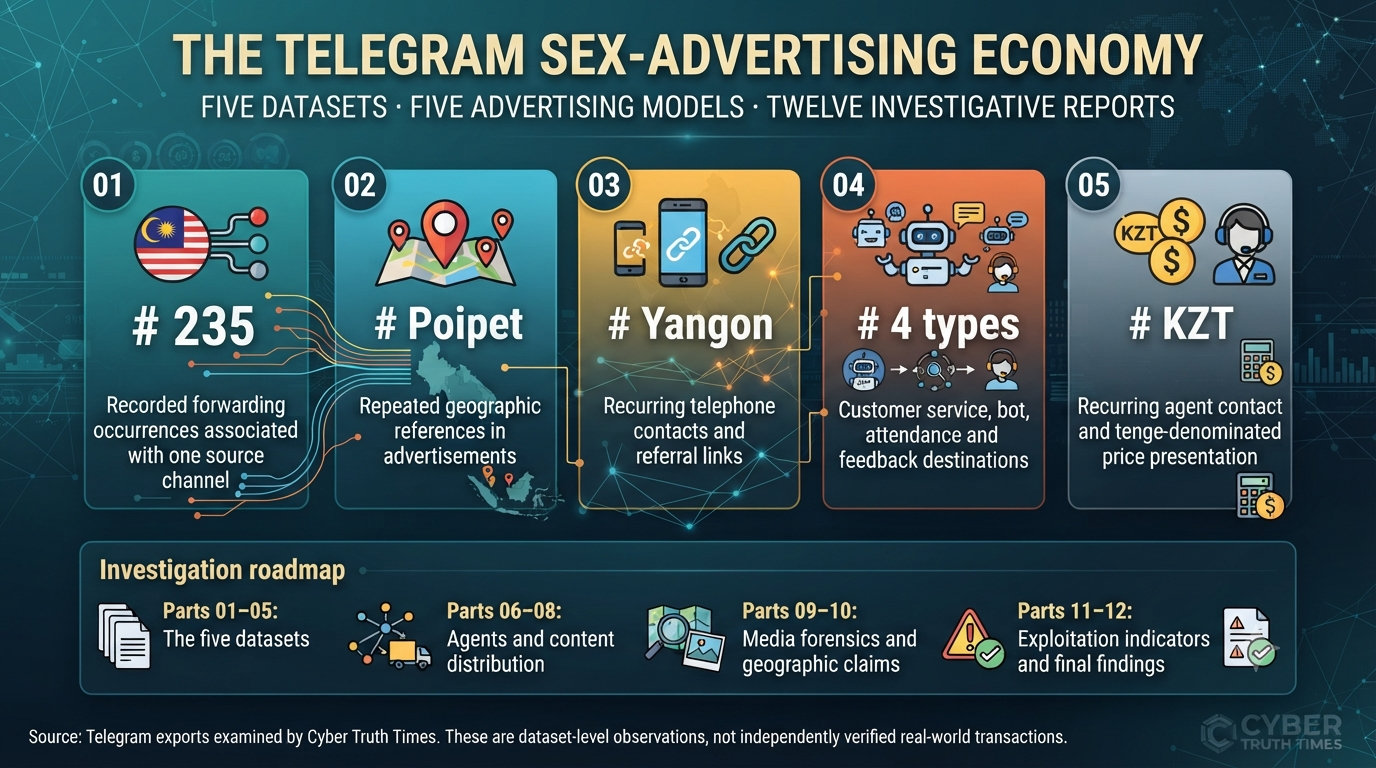
Cyber Truth Times investigates the Telegram Sex Advertising Economy by analysing five Telegram datasets linked to commercial sex advertising in Malaysia, Cambodia, Myanmar, Dubai and a Kazakhstani Tenge pricing market.
Introduction: Examining the digital infrastructure
Telegram has evolved into a widely used platform for broadcasting information, distributing multimedia content and connecting users through public channels, private groups, bots and individual accounts. Its communication infrastructure provides legitimate services to millions of users. However, the same features can also be used to distribute commercial advertisements, circulate promotional material and connect prospective customers with intermediaries.
Cyber Truth Times has examined five Telegram datasets containing commercial sex advertisements and associated promotional material. The datasets relate to five distinct market references: Kuala Lumpur in Malaysia, Poipet in Cambodia, Yangon in Myanmar, Dubai in the United Arab Emirates, and a Russian-language advertising channel displaying prices in Kazakhstani tenge.
Our examination identified different digital advertising models, including forwarded listings, location-specific promotions, recurring contact accounts, agent-linked profile advertisements and customer-facing Telegram infrastructure involving bots, attendance channels and feedback destinations.
These findings provide the foundation for a 12-part investigative series examining how commercial sex advertisements are organised and distributed through Telegram, how digital intermediaries appear in the available records, and whether further evidence can establish connections to exploitation or trafficking.
The investigation does not begin with the assumption that these five datasets belong to one organisation or represent a single criminal network. Instead, it asks what the available records actually establish, which relationships can be independently verified and what remains unknown.
The five datasets under investigation
1. Kuala Lumpur, Malaysia: The forwarding and distribution model
The first dataset concerns a public Telegram channel titled 在马来的妹子 吉隆坡妹子, approximately translated as “Girls in Malaysia – Kuala Lumpur Girls”. Its channel ID is 1830651823.
The export records channel activity from October 2023 to October 2024. Its advertisements contain profile descriptions, location references, promotional photographs and videos, and commercial pricing information.
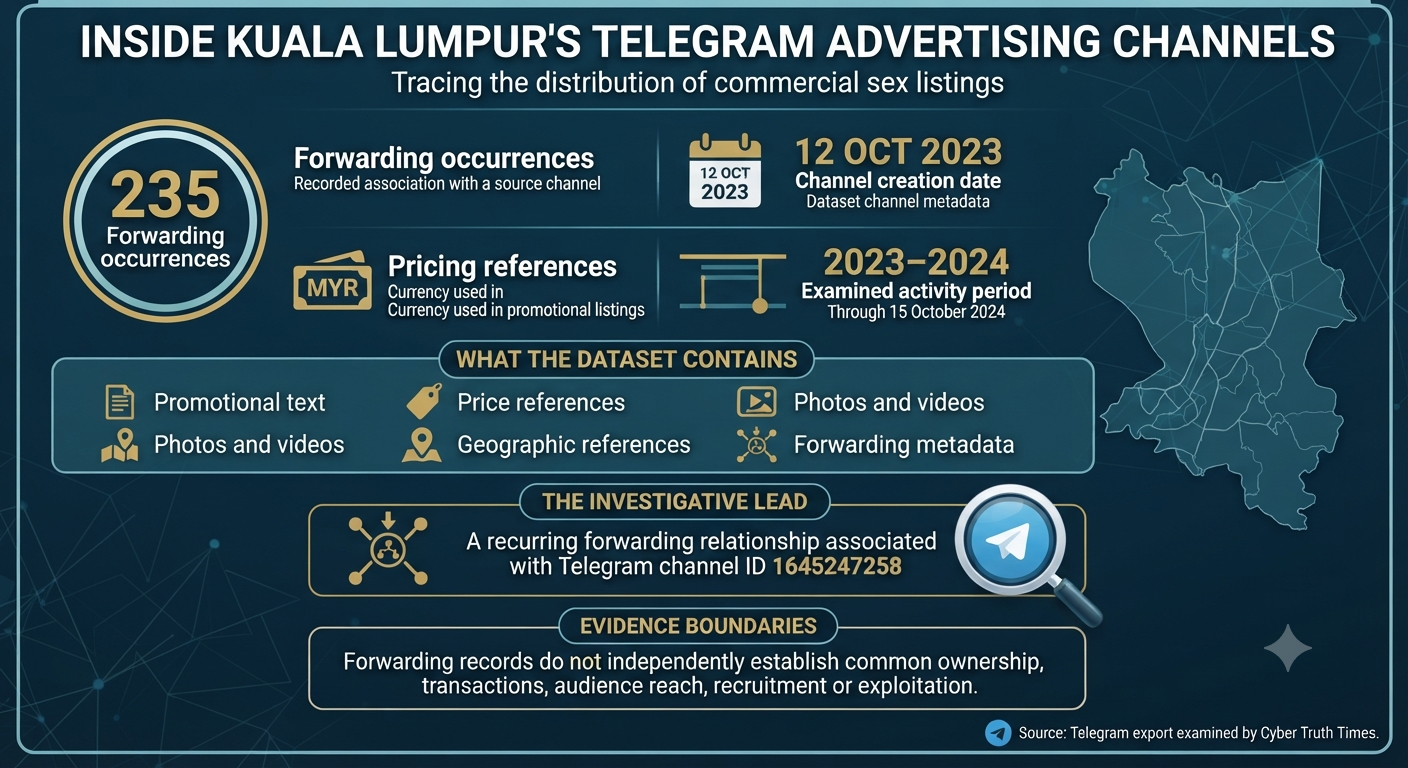
One notable feature is the repeated forwarding of material attributed to another Telegram channel, ID 1645247258. The export contains 235 occurrences of this forwarding relationship.
This creates a specific investigative lead: the relationship between the source channel and the channel carrying the forwarded advertisements. Further examination may establish whether similar promotional material was distributed through additional channels.
The forwarding records do not establish common ownership, shared administration or criminal coordination.
Primary investigative question: How does promotional content circulate between Telegram channels, and can the source and distribution relationships be independently established?
2. Poipet, Cambodia: Location-based advertising
The second dataset concerns a public Telegram channel titled 在水一坊会所选秀频道, channel ID 2695673688. Its export records creation in August 2025 and subsequent activity extending into 2026.
The advertisements repeatedly reference Poipet through the Chinese-language hashtag #波贝. The material includes promotional descriptions, service-related terminology, prices and multimedia attachments.
One advertisement dated September 2026 describes a 90-minute package with a starting price of $179. The currency is not established by the export, and the amount should not be presented as a verified transaction.
The repeated Poipet references provide a basis for examining how a particular location is marketed through Telegram. They do not independently establish the physical location of the advertised individuals or any cross-border movement.
Primary investigative question: What can the channel’s location references and promotional history establish about the digital marketing of commercial sex services in Poipet?
3. Yangon, Myanmar: Contact and referral infrastructure
The third dataset concerns a public channel titled (May) Date Girl Agency, channel ID 4387425524. Its original title references Yangon, and the export records its creation on 25 June 2026, with visible activity extending into November 2026.
The advertisements include profile descriptions, photographs, videos, prices, transport references and contact information. Two telephone numbers recur in the material: 09 779636254 and 09 664426946.
These numbers are unverified investigative leads. Their appearance in advertisements does not establish the identity of the account holders or the nature of their relationships with the individuals being advertised.
The dataset also contains a link to t.me/myannarmalays. This provides a potential avenue for examining relationships between Myanmar- and Malaysia-related Telegram advertising channels. It does not prove recruitment, travel or cross-border movement.
Primary investigative question: Can recurring contact details and referral links reveal a verifiable intermediary structure or connections between separate advertising channels?
4. Dubai, United Arab Emirates: A segmented customer-facing workflow
The fourth dataset concerns a public Telegram channel titled 迪拜修车✨金澜汇 轻奢顶美俱乐部, channel ID 4302377157. The export records its creation on 1 October 2026.
The channel references several customer-facing Telegram destinations, including a customer-service account, a two-way contact bot, attendance channels and a feedback or review destination.
The export references @DBbaibai as a customer-service contact and @DBxc8bot as a contact bot. Separate links are used for attendance information and feedback.
The advertisements also make claims about hotel settings, transport, operating hours and availability. These remain advertiser claims; the dataset does not independently verify the hotel, transport arrangements or involvement of any outside business.
The different Telegram destinations nevertheless provide an opportunity to examine how promotional, contact, availability and feedback functions are separated across a digital advertising workflow.
Primary investigative question: How are the linked customer-facing accounts organised, and can their relationships be independently verified?
5. Russian-language channel: Agent-linked profile advertisements
The fifth dataset concerns a private Telegram channel titled Лучшие модели (“Best Models”), channel ID 1946541366. Its earlier title is recorded as Интим Монолит. The supplied export includes advertisements from April 2026 onward.
The channel contains profile advertisements, promotional photographs and videos, duration-based pricing and a recurring contact described as an agent. Prices are displayed using the Kazakhstani tenge symbol.
The repeated appearance of the Telegram account @Lakomkaa221 across multiple advertisements is a significant lead. It provides a starting point for examining whether one contact account is repeatedly used to connect customers with multiple advertised profiles.
The use of tenge is a pricing signal, not proof that the channel or advertised individuals are physically located in Kazakhstan. Nor does the repeated agent contact establish the identity of the account holder or prove control over the advertised profiles.
Primary investigative question: Does the recurring agent contact form part of a centralised advertising or intermediary structure, and what evidence can establish its role?
What the five datasets reveal collectively
The five datasets demonstrate different ways in which commercial sex advertisements can be presented and distributed through Telegram.
The Kuala Lumpur material contains repeated forwarding relationships. The Poipet dataset repeatedly uses a specific geographic reference. The Yangon dataset contains recurring telephone contacts and a channel referral. The Dubai dataset references multiple customer-facing accounts and destinations. The Russian-language channel repeatedly directs users to an agent contact.
These are distinct patterns, not proof of a unified organisation.
The records also contain promotional photographs, videos, profile descriptions, prices and other metadata that may support further digital analysis. A systematic comparison of original media could help establish whether particular files or visual materials have been reused across channels.
The next stage is to test these leads through evidence preservation, network analysis, media forensics, translation, independent corroboration and requests for comment where appropriate.
The mission and objectives
The mission of this investigation is to document and examine the digital infrastructure behind commercial sex advertising on Telegram, with particular attention to intermediary accounts, promotional distribution, referral mechanisms and potential exploitation indicators.
The investigation has six principal objectives:
- Map the digital infrastructure: Document the five datasets, their channel identifiers, publication histories, linked destinations and visible contact references.
- Examine intermediary relationships: Investigate recurring agent accounts, telephone contacts, bots and forwarding sources without assuming common ownership.
- Trace promotional content: Examine whether advertisements, photographs and videos are reused or redistributed across channels.
- Assess geographic claims: Distinguish advertised locations and cross-border references from independently verified physical movement.
- Identify potential exploitation indicators: Examine whether additional evidence supports concerns involving coercion, deception, abuse of vulnerability, restriction of movement, debt bondage or other forms of exploitation.
- Maintain editorial accountability: Protect potentially vulnerable individuals, distinguish allegations from facts and provide relevant parties with an opportunity to respond.
Investigative methodology
Cyber Truth Times will use a structured OSINT and digital-evidence methodology.
- Evidence preservation: Retain original exports and associated media, create working copies and calculate SHA-256 hashes to identify changes.
- Telegram metadata analysis: Record channel IDs, message IDs, timestamps, edit histories, forwarding references and linked accounts.
- Translation and contextual analysis: Preserve original Chinese, Russian and Burmese text alongside translations, documenting uncertain or ambiguous terminology.
- Network mapping: Build relationship maps of publicly visible forwarding sources, recurring contact accounts, bots and linked channels.
- Media forensics: Compare original photographs and videos using cryptographic and perceptual hashes, metadata review, key-frame analysis and reverse-image searches.
- Contact verification: Treat telephone numbers and usernames as leads until identity and control can be independently established.
- Independent corroboration: Compare digital findings with reliable public records, specialist research, independent reporting and relevant responses.
- Editorial safeguards: Minimise unnecessary exposure of personal information and avoid identifying potentially exploited individuals without a compelling public-interest justification.
The investigation will also apply the definition and elements of trafficking under the UN Trafficking in Persons Protocol. The existence of a commercial sex advertisement alone is insufficient to establish trafficking. The relevant acts, means and exploitative purpose must be assessed against evidence.
The proposed outcome
The intended outcome is a documented account of the five datasets and the digital advertising models they display.
The series aims to produce a channel-by-channel evidence register, a map of verifiable public links and forwarding relationships, a comparative analysis of advertising structures, a review of recurring promotional media and a reasoned assessment of potential exploitation indicators.
It will also identify unanswered questions and evidence gaps. Where credible evidence warrants further action, the findings may be referred to appropriate authorities or specialist organisations, subject to legal and safety considerations.
The investigation does not promise to uncover a trafficking network. It will report what can be established, correct or qualify earlier interpretations when necessary, and distinguish verified findings from unresolved leads.
The 12-part investigative series
The pillar report introduces the full 12-part series. Each subsequent report will examine a specific part of the digital advertising ecosystem, building from the five datasets while keeping the evidentiary limits clear.
Part 01 — The Telegram Sex-Advertising Economy: Mapping Digital Intermediaries Across Five Telegram Datasets
The pillar investigation. Introduces the five datasets, explains the research questions and methodology, and establishes the evidentiary boundaries for the entire series.
Part 02 — Inside Kuala Lumpur’s Telegram Advertising Channels: Tracing the Distribution of Commercial Sex Listings
Examines the Kuala Lumpur dataset, its publication history and the 235 recorded forwarding occurrences associated with another channel. The report will investigate the distribution of listings and whether additional source or recipient channels can be identified.
Part 03 — Poipet on Telegram: Investigating the Digital Marketing of Commercial Sexual Services
Examines the Poipet-focused dataset, recurring location references, promotional language and advertising formats. It will distinguish the channel’s geographic marketing claims from independently verified physical locations.
Part 04 — Inside Yangon’s Telegram Advertising Infrastructure: Agents, Phone Numbers and Digital Referrals
Examines recurring contact numbers, referral links, promotional content and the Yangon channel’s publication structure. It will assess what can be established about the visible contact and referral infrastructure.
Part 05 — Inside Dubai’s Telegram Sex-Advertising Ecosystem: Customer-Service Accounts, Attendance Channels and Transport Claims
Maps the Dubai channel’s customer-service account, contact bot, attendance destinations and feedback links. It will assess the advertiser’s transport and venue claims without treating them as independently verified facts.
Part 06 — The Agent Behind the Profiles: Investigating Telegram’s Russian-Language Model Advertising Channels
Examines the Russian-language dataset, its recurring agent contact, pricing presentation and profile-advertising structure. The report will investigate the intermediary role suggested by repeated references to the same account.
Part 07 — The Telegram Agent Economy: How a Single Contact Account Can Connect Dozens of Advertisements
A comparative investigation into recurring contact accounts and the possible intermediary models visible across the datasets. It will examine how repeated references can be mapped without assuming that account appearance establishes identity or control.
Part 08 — From One Channel to Another: How Telegram’s Forwarding Infrastructure Spreads Commercial Advertisements
Examines forwarding relationships and content distribution, beginning with the Kuala Lumpur dataset. The report will investigate how source channels, recipient channels and repeated promotional material can be identified through Telegram records.
Part 09 — The Faces Behind the Advertisements: Using Image and Video Forensics to Trace Reused Promotional Media
Explains and applies digital-media analysis to the supplied photographs and videos. The report will examine file metadata, hashes, perceptual similarity and other methods that may identify reused media, while avoiding unsupported claims about the identities of people depicted.
Part 10 — From Kuala Lumpur to Poipet: Examining Cross-Border Claims in Southeast Asian Telegram Advertisements
Examines geographic and cross-border references appearing in the Southeast Asian material. It will distinguish promotional language from evidence of actual recruitment, travel, transfer or movement between countries.
Part 11 — Beyond the Advertisements: What Digital Evidence Can and Cannot Tell Us About Human Trafficking
Examines the legal and evidentiary distinction between commercial sex advertising and trafficking. It will explain relevant exploitation indicators, the limitations of Telegram exports and the additional corroboration required to substantiate trafficking allegations.
Part 12 — Five Telegram Channels, Multiple Markets: What We Know About the Digital Infrastructure of Commercial Sex Advertising
The concluding report will consolidate the findings from the series, identify verified relationships, assess unresolved questions and explain what the five datasets collectively establish—and what they do not.
Access the Dossier & Evidence
For readers seeking to examine the underlying material, Cyber Truth Times has made the raw Telegram datasets examined in this investigation available in the Dossier & Evidence section. These source files provide the documentary basis for the dataset-level observations discussed in this series, including advertising records, forwarding data, contact and referral references, channel-linked promotional material, and other metadata captured in the respective exports.
The dossier is provided to support transparency, independent scrutiny and reproducibility of the journalistic analysis. The raw records should be interpreted within their evidentiary limitations: Telegram export data alone does not independently authenticate identities, transactions, locations, media provenance or allegations of exploitation. The publication’s findings are based on the examination and interpretation of these records, with distinctions maintained between documented observations, promotional claims, investigative leads and independently corroborated facts.
Disclaimer
This investigation analyses Telegram exports and promotional material supplied for journalistic examination. Advertisements, prices, contact details, location references and claims made by channel operators have not necessarily been independently verified. The presence of commercial sex advertising does not, by itself, establish human trafficking, coercion, exploitation, criminal conduct or common ownership between channels. Individuals and organisations are not to be treated as responsible for wrongdoing without corroborating evidence. Cyber Truth Times will distinguish verified facts, advertiser claims, investigative leads and unresolved allegations throughout this series.
Conclusion: Following the evidence
The five datasets provide a starting point for examining the digital infrastructure behind commercial sex advertising on Telegram. They reveal different patterns of promotion, forwarding, contact management and agent-linked advertising.
What they do not yet establish is equally important. There is no verified basis in these records alone to conclude that all five channels share common ownership, form one coordinated regional network or are involved in human trafficking.
The purpose of this series is to test the connections, verify the claims and examine whether further evidence supports a more serious conclusion.
Cyber Truth Times will approach the investigation through documented evidence, transparent methodology and careful distinction between fact and inference.
Five datasets. Twelve investigative reports. One evidence-led examination of the digital advertising ecosystem.
Bibliography and external references
The following sources provide legal, platform and investigative context. They should not be represented as independent verification of the five Telegram datasets.
- UNODC — The Crime of Trafficking in Persons — Explains the act, means and purpose elements of trafficking.
- United Nations — Understanding Human Trafficking — Overview of trafficking and exploitation.
- Telegram — Channels FAQ — Official explanation of Telegram channels, administrators and broadcasting.
- Telegram — Frequently Asked Questions — Official documentation covering platform features and communication mechanisms.
- U.S. Department of Justice — What Is Human Trafficking? — Explains human trafficking and exploitation in commercial sex and labour contexts.
- UNODC — Toolkit to Combat Trafficking in Persons — Reference material on trafficking indicators and investigative approaches.
For deeper investigations on such topics, see our Cybercrime Investigations & Exposes.

2 thoughts on “The Telegram Sex-Advertising Economy: Mapping Digital Intermediaries Across Five Telegram Datasets”