Why Cyber Truth Times publishes raw datasets and investigative evidence to encourage transparency, independent research and collaborative OSINT analysis.
Introduction: Why I Created a Dossiers & Evidence Section on Cyber Truth Times
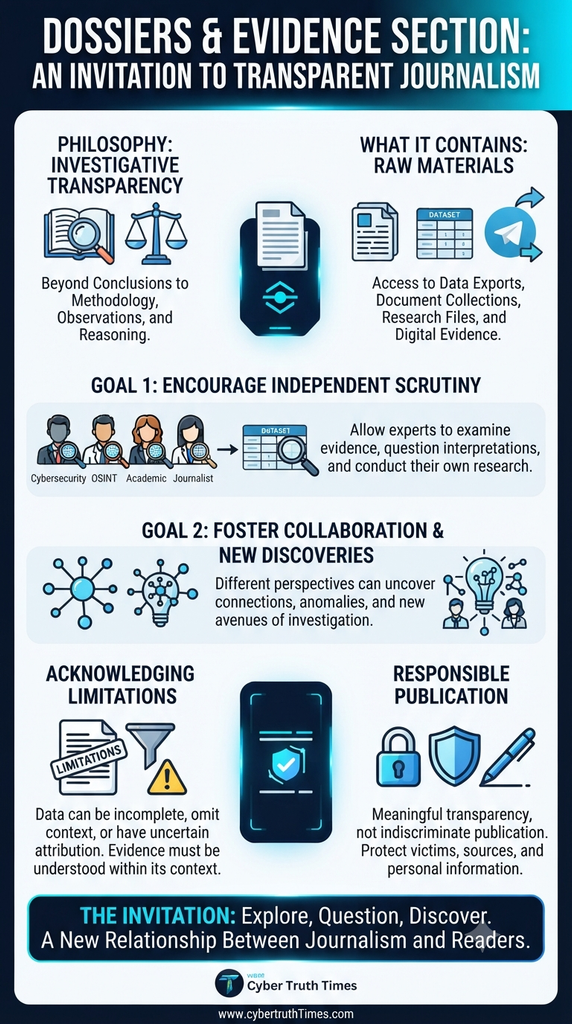
The foundation of investigative journalism should not simply be the conclusions a journalist reaches. It should also be the evidence, methodology, observations and reasoning that lead to those conclusions. I have increasingly come to believe that an investigation should not end with the publication of an article. Wherever possible and ethically permissible, it should also leave behind material that allows others to examine the evidence, question the interpretation, conduct their own research and perhaps discover something that I did not.
That philosophy is one of the primary reasons I created the Dossiers & Evidence section on Cyber Truth Times.
For me, this section represents something more than a repository of downloadable files, datasets, Telegram exports, documents, screenshots or other digital material. It represents a deliberate attempt to make investigative journalism more transparent, accessible and open to independent scrutiny.
Investigative journalism is often conducted behind closed doors. Researchers spend hours, days, weeks or even months collecting information, examining digital traces, comparing datasets, studying communication patterns, identifying connections and trying to make sense of information that may initially appear fragmented or chaotic. The final article, however, usually presents only a fraction of that work. Readers see the findings, the narrative and the conclusions, but they rarely see the entirety of the underlying material that informed the investigation.
There are understandable reasons for this. Some evidence cannot be published because it could expose victims, compromise sources, reveal sensitive personal information or create security risks. Nevertheless, I believe there is considerable room for investigative journalism to become more transparent about the evidence that can responsibly be shared.
The Dossiers & Evidence section is my attempt to move in that direction.
Journalism should invite scrutiny, not demand unquestioning trust
I do not want Cyber Truth Times to become a platform where readers are expected to accept my conclusions simply because I have written an article, presented an analysis or described something as an investigation.
I want the work to be examined.
If I analyse a Telegram conversation, publish an investigation involving a cybercrime network, examine a recruitment operation, investigate a website, study a digital ecosystem or analyse a dataset, I want other people with the relevant expertise to have an opportunity to examine the material themselves, where it is safe and lawful to do so.
An investigator may interpret a particular pattern one way. Another analyst, working with the same material, may notice a connection that was overlooked. A cybersecurity professional may recognise a technical detail that I did not fully understand. A data analyst may discover an anomaly. An OSINT researcher may identify a new avenue of investigation. A specialist familiar with a particular language, jurisdiction, platform or region may bring context that fundamentally changes how a piece of evidence should be understood.
That possibility matters to me.
I do not believe an investigation should become stronger merely because its author insists that its conclusions are correct. It becomes stronger when its evidence and reasoning withstand independent examination.
By making underlying material available when appropriate, I hope to make it easier for others to scrutinise the work rather than simply read the final result.
Making the underlying material accessible
The Dossiers & Evidence section is intended to provide access to some of the raw materials used during my investigations.
Depending on the investigation, this may include data exports, publicly available records, document collections, datasets, archived material, communication exports, research files or other digital evidence that formed part of the investigative process.
These materials can be valuable in their own right. A dataset that was initially collected to investigate one specific question may potentially support entirely different research. A document that appears insignificant within one investigation may become relevant when examined alongside another dataset. A collection of communications may contain patterns that different researchers can interpret using their own expertise, analytical methods or research questions.
I do not want these resources to remain unnecessarily confined to the analytical process through which they were originally examined.
The purpose is to make research materials available to other professionals, investigators, researchers, journalists, cybersecurity specialists and OSINT practitioners who may want to undertake their own examination.
This is not an invitation to simply reproduce my conclusions. It is an invitation to work with the underlying material independently.
Encouraging independent research and analysis
One of the most important objectives behind this initiative is to encourage independent research.
I recognise that no investigator possesses every skill, understands every technical discipline or has the capacity to examine every piece of information in sufficient depth. OSINT, digital forensics, cybersecurity research, data analysis, investigative journalism and other disciplines frequently intersect, but they also require different forms of expertise.
By making datasets and evidence available, I hope to encourage people with different backgrounds to approach the same material from different perspectives.
A researcher might use a dataset to examine trends. An OSINT analyst might investigate connections between publicly visible entities. A cybersecurity professional might examine technical indicators. An academic might explore the material from a sociological or organisational perspective. Another journalist might use it as a starting point for a completely different investigation.
The value of making evidence available is not limited to the conclusions I have already reached. It also lies in the conclusions that others may independently discover.
I would consider that a meaningful outcome of this initiative: when an investigation published by Cyber Truth Times becomes the starting point for additional research, a more comprehensive analysis, a correction, a new discovery or a better-informed investigation by someone else.
The objective is not to monopolise the findings of an investigation. The objective is to make the material available where doing so can contribute to a wider body of knowledge.
Transparency is also about showing the limitations
Making evidence available does not automatically make an investigation transparent.
A dataset can be incomplete. A digital export can omit deleted messages, attachments or contextual information. Metadata can be absent or altered. A collection may represent only a particular period, platform, account or geographical scope. A researcher may encounter technical limitations, inaccessible sources, uncertain attribution or information that cannot be independently corroborated.
These limitations deserve to be acknowledged.
I want the Dossiers & Evidence section to reflect the distinction between raw material, analytical interpretation and fact. The existence of a dataset does not necessarily establish the truth of every statement contained within it. A screenshot does not automatically authenticate the content it depicts. A message does not necessarily establish the identity of its author. A digital connection does not, by itself, establish culpability.
The evidence should be examined within its context.
Where possible, the accompanying material should help explain what the dataset contains, its provenance, its limitations, the circumstances under which it was collected, and the investigative article or analysis with which it is associated.
I also recognise that transparency must not become an excuse for exposing people unnecessarily. Protecting victims, sources, uninvolved individuals and sensitive personal information remains important. Not every file should be published in its original, unredacted form. Responsible disclosure, privacy protection, security considerations and legal restrictions must remain part of the process.
The objective is meaningful transparency, not indiscriminate publication.
A different relationship between journalists and their readers
I think journalism benefits when the relationship between a publication and its audience is not built entirely around authority.
A publication should not be the only entity capable of interpreting the information it presents. Readers, specialists, researchers and other professionals should, wherever practical, have the opportunity to question the underlying evidence and arrive at their own conclusions.
This does not mean every reader will agree with an investigation. Nor should agreement be the objective.
Independent scrutiny can reveal errors, strengthen arguments, expose missing context, identify alternative explanations and improve the quality of future reporting. It can also help distinguish between conclusions that are well supported and those that require further examination.
I would rather an investigation be challenged constructively on the basis of the evidence than accepted unquestioningly because of the publication that produced it.
That is why I see this initiative as part of the broader editorial philosophy of Cyber Truth Times. The publication should not only attempt to uncover information that deserves public attention; it should also, where possible, make the investigative process more accessible to those who want to examine it further.
An invitation to the investigative community
The Dossiers & Evidence section is ultimately an invitation.
It is an invitation to OSINT professionals, independent investigators, data analysts, cybersecurity researchers, journalists, academics and other specialists to explore the material we publish, conduct their own research, question our interpretations and pursue avenues of investigation that may not have been explored.
You may reach different conclusions. You may identify something we overlooked. You may discover a connection that deserves its own investigation. You may develop a methodology that produces a more comprehensive understanding of the material.
Those possibilities are precisely why I want the evidence to be accessible.
I do not expect this initiative to transform investigative journalism overnight, nor do I believe that publishing raw datasets is a substitute for rigorous reporting, verification, contextual analysis or responsible editorial judgement. But I believe it can contribute to a more open investigative ecosystem in which evidence is not unnecessarily hidden behind the final published narrative.
Cyber Truth Times is still evolving. I continue to explore ways to improve its investigations, research methodologies, documentation and transparency. The Dossiers & Evidence section is one step in that process.
The investigation does not have to end when the article is published. Sometimes, that is precisely where another investigation begins.
And if making the evidence accessible helps someone else uncover something important, correct an assumption, develop a better analysis or contribute to a deeper understanding of an issue, then this section will have accomplished something that I consider genuinely worthwhile.
Because investigative journalism, at its best, should not merely tell people what was discovered.
It should also help make further discovery possible.