Cyber Truth Times documents its 12-part Telegram sex advertising investigation, examining five datasets, digital advertising structures, preserved evidence and investigative findings.
Investigating Telegram Sex Advertising Investigation
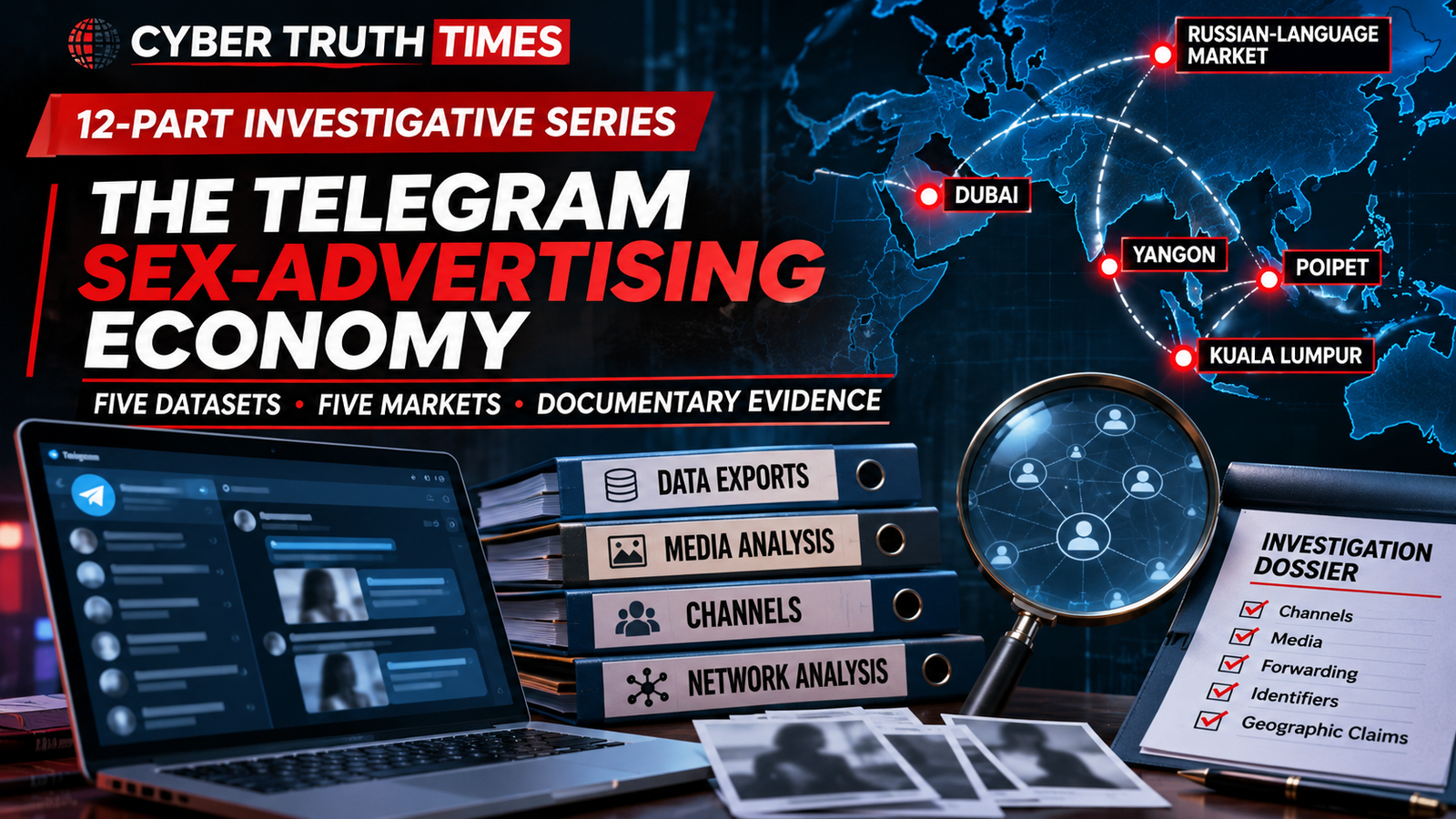
Investigating digital ecosystems that operate through fragmented Telegram channels, promotional accounts, forwarded messages, contact identifiers and multimedia content requires persistence, documentation and careful analysis. Over the course of a 12-part investigative series, Cyber Truth Times undertook a structured examination of five Telegram datasets associated with commercial sex advertising across Kuala Lumpur, Poipet, Yangon, Dubai and a Russian-language advertising channel.
The Telegram Sex-Advertising Economy was developed to examine how commercial sex advertisements are presented, distributed and interconnected within different Telegram-based environments, while investigating the digital mechanisms, recurring identifiers, forwarding relationships, promotional media and geographic claims visible in the available records.
The investigation involved accessing and documenting Telegram advertising environments, collecting text-based material and associated media, preserving exported records and examining patterns across multiple datasets. Rather than relying exclusively on individual screenshots or isolated advertisements, Cyber Truth Times organised its research around documentary datasets that could be revisited, compared and analysed throughout the investigation.
Accessing and Documenting Telegram Advertising Environments
One of the central components of this investigation was the research team’s ability to access and document multiple Telegram advertising environments that were not readily visible through conventional news reporting.
Through investigative access to relevant Telegram channels and groups, Cyber Truth Times gathered and preserved text-based advertisements, promotional descriptions, forwarding references, contact identifiers, links, pricing information, geographic claims and associated media available within the examined environments.
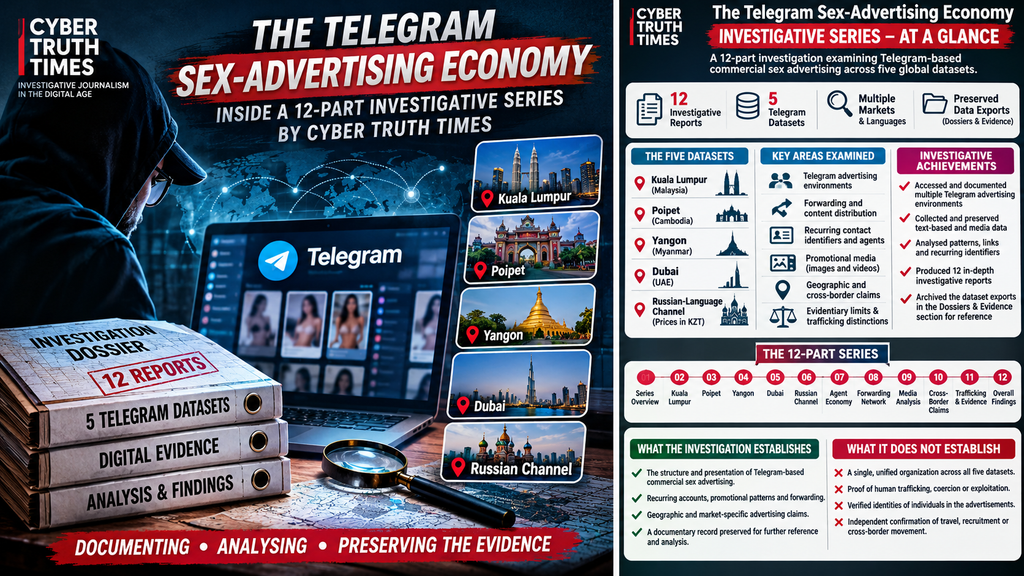
The research examined five datasets representing different advertising contexts:
- Kuala Lumpur and Malaysia.
- Poipet and Cambodia.
- Yangon and Myanmar.
- Dubai and the United Arab Emirates.
- A Russian-language advertising channel featuring prices denominated in Kazakhstani tenge.
The datasets were not treated as interchangeable. Each was examined according to its available content, identifiers, promotional structures, geographic references and distribution mechanisms.
The investigation also examined the presence of recurring accounts, forwarding relationships, referral links, intermediary-style contacts and media appearing alongside advertisements.
From Telegram Messages to Preserved Investigative Dossiers
A significant achievement of this project was the preservation and organisation of the documentary material gathered during the investigation.
The original data exports associated with the research have been preserved and made available through the Dossiers & Evidence section of Cyber Truth Times, subject to publication and redaction decisions.
This archival approach provides readers and researchers with access to the documentary foundation of selected investigations, rather than presenting conclusions without supporting material.
The preserved datasets serve as research records for future examination, reference and analysis. They also allow the investigation to be revisited as new information, verification opportunities or analytical questions emerge.
The archive is an important component of Cyber Truth Times’ investigative methodology: preserving the underlying material can help distinguish documentary observations from interpretations and conclusions.
The 12 Articles of the Investigation
The series was developed across twelve investigative reports, each addressing a distinct aspect of Telegram’s commercial sex-advertising ecosystem.
Part 01 — The Telegram Sex-Advertising Economy: Mapping Digital Intermediaries Across Five Telegram Datasets
The foundational report introduces the investigation, its five datasets, research methodology, objectives and evidentiary limitations. It establishes the framework for examining digital advertising structures without assuming that the datasets represent one unified organisation.
Part 02 — Inside Kuala Lumpur’s Telegram Advertising Channels: Tracing the Distribution of Commercial Sex Listings
This report examines the Kuala Lumpur dataset, including promotional content, geographic references, pricing and recorded forwarding occurrences. It explores how forwarding metadata can document content distribution while distinguishing these observations from proof of audience reach, ownership or transactions.
Part 03 — Poipet on Telegram: Investigating the Digital Marketing of Commercial Sexual Services
The Poipet report examines location-centred advertising, multilingual promotional content, service descriptions and marketing claims within the dataset associated with Poipet, Cambodia.
Part 04 — Inside Yangon’s Telegram Advertising Infrastructure: Agents, Phone Numbers and Digital Referrals
This article examines recurring contact identifiers, referral links, promotional media, communication references and distribution patterns in the Yangon dataset, identifying investigative leads without making unsupported attribution claims.
Part 05 — Inside Dubai’s Telegram Sex-Advertising Ecosystem: Customer-Service Accounts, Attendance Channels and Transport Claims
The Dubai report examines customer-facing promotional workflows, bot references, contact accounts, attendance-style listings, feedback references and advertiser claims concerning transport and other arrangements.
Part 06 — The Agent Behind the Profiles: Investigating Telegram’s Russian-Language Model Advertising Channels
This report examines profile-based advertising, recurring intermediary references, pricing structures and the promotional format of the Russian-language dataset, while distinguishing recurring identifiers from verified identities or ownership.
Part 07 — The Telegram Agent Economy: How a Single Contact Account Can Connect Dozens of Advertisements
The seventh report examines recurring contact accounts and intermediary-style references, exploring how a single identifier appearing across multiple advertisements can generate investigative leads and questions about distribution.
Part 08 — From One Channel to Another: How Telegram’s Forwarding Infrastructure Spreads Commercial Advertisements
This article investigates forwarding relationships, content distribution and the evidentiary significance of recorded forwarding occurrences, examining what Telegram’s distribution mechanisms reveal and what they cannot establish.
Part 09 — The Faces Behind the Advertisements: Image-Search Results, Digital Traces and the Limits of Visual Attribution
This report examines image-search and digital-media analysis in an investigative context, including the interpretation of image-search results, matching limitations, digital traces and the risks of assigning identities based on visual similarity.
Part 10 — From Kuala Lumpur to Poipet: Examining Cross-Border Claims in Southeast Asian Telegram Advertisements
The tenth report examines geographic and cross-border claims appearing within the Kuala Lumpur and Poipet datasets, distinguishing promotional references from independently verified travel, recruitment, transfer or movement.
Part 11 — Beyond the Advertisements: What Digital Evidence Can and Cannot Tell Us About Human Trafficking
This report examines the evidentiary and legal distinctions between commercial sex advertising and human trafficking, discussing indicators, digital evidence limitations, corroboration and responsible investigative reporting.
Part 12 — Five Telegram Channels, Multiple Markets: What We Know About the Digital Infrastructure of Commercial Sex Advertising
The concluding report consolidates the findings of the entire investigation, identifies documented relationships, examines unresolved questions and establishes what the five datasets collectively demonstrate and what they do not establish.
A Documentary Approach to Digital Investigations
The Telegram Sex-Advertising Economy series represents an effort to systematically document digital advertising environments through preserved datasets, comparative analysis and investigative reporting.
The five datasets demonstrate different promotional structures, recurring identifiers, forwarding occurrences, referral references, advertising formats and geographic claims within the examined Telegram environments.
However, the investigation does not establish a unified organisation connecting all five datasets, nor does the available material independently prove trafficking, coercion, exploitation, cross-border movement, common ownership or completed transactions.
These distinctions are integral to the investigation.
Cyber Truth Times has sought to document the available evidence, preserve the underlying records and identify questions requiring further corroboration rather than assigning conclusions beyond what the material supports.
The Investigation and Its Archive
The complete investigation is presented through twelve reports, supported by preserved datasets and documentary material in the Dossiers & Evidence section of Cyber Truth Times.
The archive provides a reference point for the material examined throughout the series and reflects the publication’s approach to investigative reporting: documenting evidence, examining digital patterns, preserving source material where publication is appropriate and clearly identifying the limits of what can be established.
The Telegram Sex-Advertising Economy is a 12-part investigative project documenting digital advertising infrastructure across five Telegram datasets. It is an investigation into digital patterns, distribution, promotional structures and evidence, not a declaration that the datasets establish trafficking or a unified criminal network.
Bibliography and External Sources
1. Telegram — FAQ
https://telegram.org/faq
Platform background, Telegram functionality, channels and messaging features relevant to understanding the digital environments examined in the series.
2. Telegram — Channels FAQ
https://telegram.org/faq_channels
Reference for Telegram channels and channel-related functionality.
3. UNODC — The Crime of Trafficking in Persons
https://www.unodc.org/e4j/en/tip-and-som/module-6/key-issues/crime-of-trafficking-in-persons.html
Legal and conceptual framework for distinguishing trafficking in persons from other forms of commercial activity.
4. United Nations — Understanding Human Trafficking
https://www.un.org/en/node/225155
Overview of the international framework and understanding of human trafficking.
5. UNODC — Indicators of Trafficking in Persons
https://www.unodc.org/e4j/en/tip-and-som/module-6/key-issues/indicators-of-trafficking-in-persons.html
Reference for indicators and the importance of contextual assessment when examining potential trafficking situations.
6. UNODC — Human Trafficking Indicators
https://unodc.org/documents/human-trafficking/HT_indicators_E_LOWRES.pdf
Additional reference material concerning indicators used in trafficking identification.
7. NIST — Digital Evidence Preservation: Considerations for Evidence Handlers
https://www.nist.gov/publications/digital-evidence-preservation-considerations-evidence-handlers
Digital evidence handling and preservation considerations relevant to documentary archives and investigative datasets.
8. U.S. Department of Justice — What Is Human Trafficking?
https://www.justice.gov/humantrafficking/what-is-human-trafficking
Background on trafficking-related concepts and legal distinctions.
9. UNODC — Human Trafficking and Migrant Smuggling
https://www.unodc.org/unodc/en/human-trafficking/index.html
Further resources on trafficking, related legal frameworks and investigative context.
Editorial methodology note: The bibliography contains independent research and reporting used to contextualise the series. The existence of a connection, advertisement or recruitment record should not be treated as proof of common ownership, criminal conduct or deception without case-specific evidence.
Disclaimer: Advertisements, contact identifiers, media, prices, location references, forwarding records and promotional claims examined in this series have not necessarily been independently verified. The datasets do not, by themselves, establish trafficking, exploitation, coercion, criminal conduct, common ownership or completed transactions. Publication and archival access are subject to appropriate redaction, privacy, safety and evidentiary considerations.