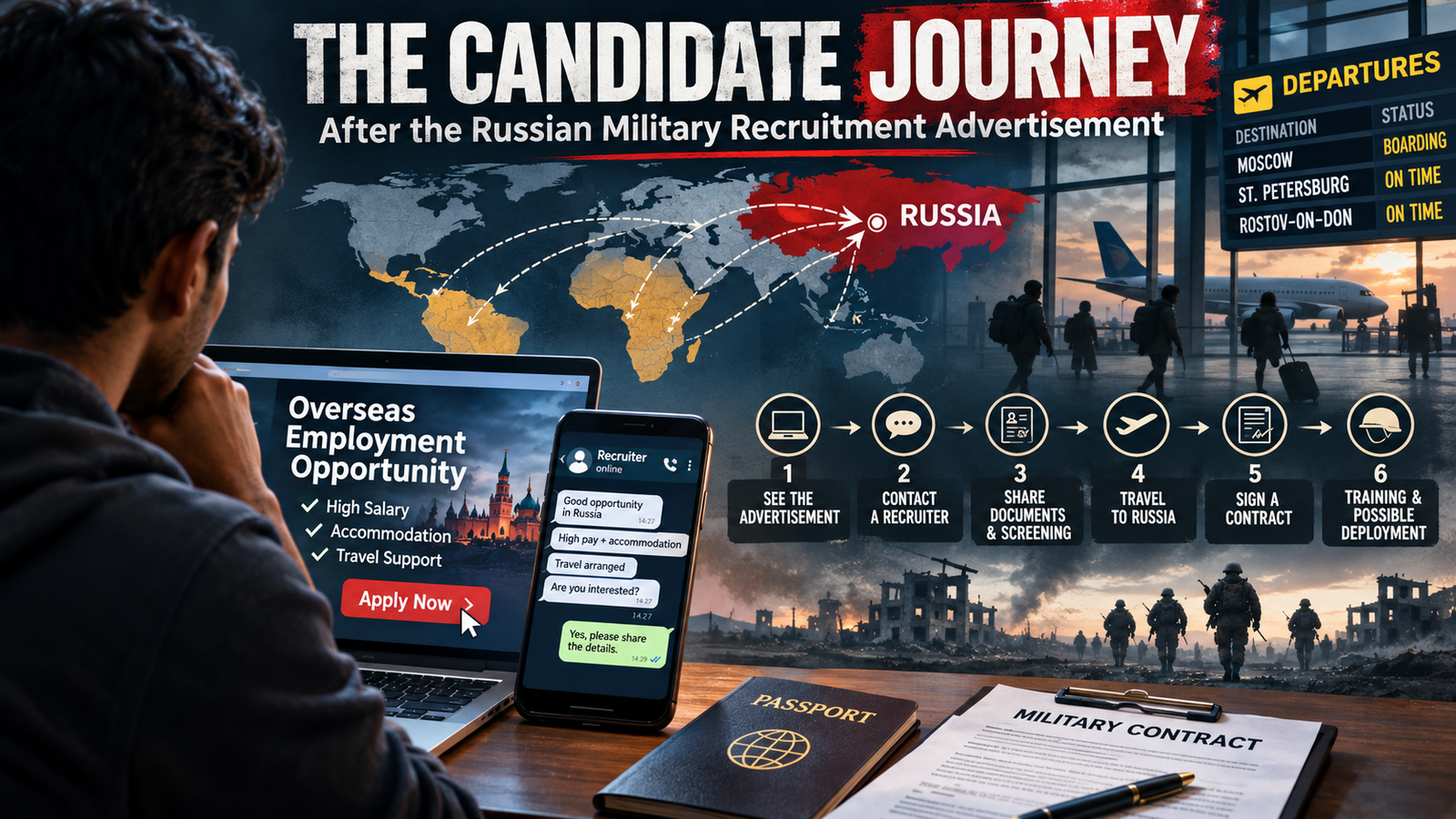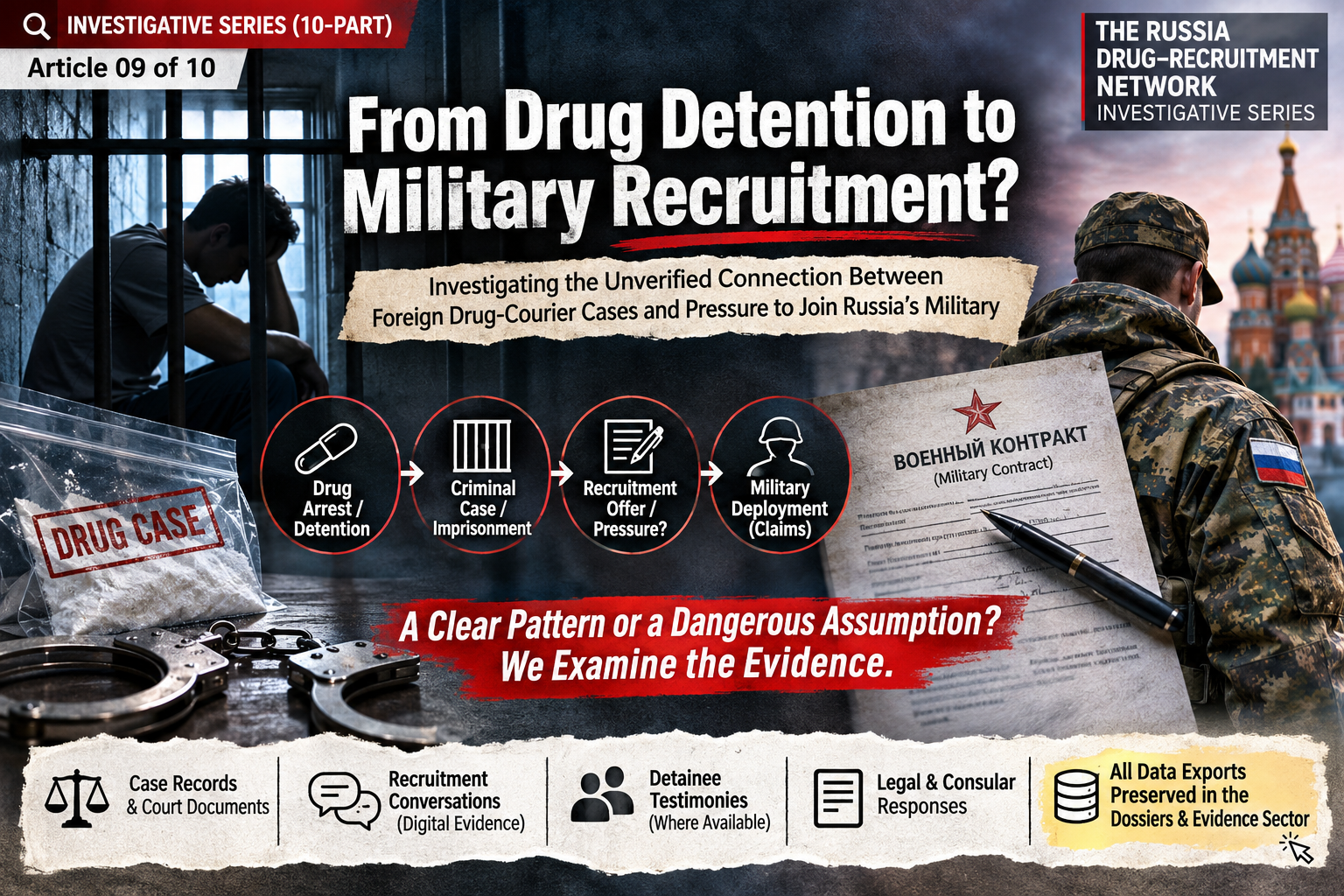
Cyber Truth Times investigates allegations connecting drug detention and military recruitment in Russia, pressure on foreign nationals to join Russia’s military, examining evidence and unresolved questions.
Introduction: Drug Detention and Military Recruitment in Russia
What happens when a foreign national travels to Russia after responding to an employment offer, subsequently becomes involved in a drug-related criminal case, and later alleges that they were pressured to join the Russian military?
This is one of the most consequential questions emerging from the broader investigation conducted by Cyber Truth Times into online recruitment for drug-related work in Russia.
Over the course of this investigation, Cyber Truth Times examined Telegram conversations in which purported recruiters initially presented employment propositions involving high earnings, relatively limited working hours, accommodation, travel arrangements and assistance with the process of entering Russia. In some conversations, the nature of the work eventually became explicit: distributing or concealing narcotics.
The recruitment conversations examined in this investigation raise questions about how prospective workers are approached, how the nature of the work is disclosed, and what safeguards or lack thereof exist for individuals who accept such offers.
Separately, public reporting from Russia and India has documented cases involving foreign nationals arrested in drug-related cases, alongside allegations in certain cases that detained individuals were pressured to join the Russian military.
But do these two phenomena share a demonstrable connection?
Are drug-related recruitment schemes and alleged pressure to enlist in the Russian military connected through a common intermediary, a particular recruitment operation, an institutional mechanism or an opportunistic practice occurring after detention?
Or are the similarities between reported cases circumstantial, reflecting distinct criminal, legal and military recruitment processes?
This article does not assume the answer.
Instead, it examines the hypothesis, the available evidence, the reported cases, the investigative limitations and the documentation required to establish a connection.
The distinction is critical. A hypothesis involving coercion, detention and military recruitment is serious. It must be examined rigorously rather than presented as fact.
1. The hypothesis under investigation
The hypothesis examined in this article is that some foreign nationals recruited through deceptive employment offers for drug-related work may subsequently face arrest, detention or prosecution, and that in particular cases individuals may then encounter pressure to join the Russian military.
This hypothesis contains several distinct propositions:
- Foreign nationals may be recruited through misleading or deceptive employment offers.
- Some recruitment offers may ultimately involve drug distribution or courier activities.
- Individuals undertaking such work may be arrested or prosecuted.
- Some individuals in detention may face pressure to enter military service.
- In specific cases, a relationship may exist between the recruitment operation, the circumstances of detention and subsequent military recruitment pressure.
These propositions must not be treated as a single established chain.
Evidence supporting one proposition does not automatically establish the others.
For example, a Telegram conversation explicitly offering drug-related work may demonstrate that a particular recruitment proposition exists. A publicly reported drug arrest may demonstrate that a foreign national was detained on a narcotics allegation. A family member’s account of pressure to enlist may document an allegation of coercion.
However, these three pieces of evidence do not automatically establish that the recruiter intentionally orchestrated the arrest, that the arrest was fabricated, or that the recruitment organisation was connected to military authorities.
The central task is therefore to determine whether documentary, testimonial, forensic or independently corroborated evidence can connect these stages in particular cases.
2. The recruitment environment: employment offers that change character
The first component of the investigation concerns the employment offers examined by Cyber Truth Times.
In the Telegram communications reviewed for this investigation, recruiters presented employment propositions that initially resembled informal overseas job opportunities.
The language included claims about:
- High weekly earnings.
- Limited working hours.
- Flexible schedules.
- Travel arrangements.
- Accommodation.
- Food and other basic necessities.
- Training and supervision.
- Assistance with visa-related arrangements.
- Support upon arrival.
In some conversations, these assurances were followed by disclosures that the actual work involved distributing narcotics or concealing packages.
The transition between the initial employment proposition and the eventual disclosure of the work is an important investigative feature.
The concern is not simply that the work involved illegal activity. It is that the initial communications may have presented a materially different employment proposition to prospective candidates, potentially limiting their ability to make an informed decision.
The investigation has documented recurring recruitment language across multiple accounts and conversations. Such similarities may indicate copied advertising material, common scripts, shared recruitment practices or a broader recruitment ecosystem.
But similar wording alone cannot establish common ownership, control or coordination.
The evidence must be examined at the level of individual accounts, communication records, media, dates, contact details and corroborating material.
3. Drug-related recruitment and the risks faced by foreign nationals
Drug-courier recruitment can expose individuals to serious criminal, physical and financial risks.
Foreign nationals who become involved in drug distribution may face arrest, prosecution, imprisonment, deportation or other legal consequences depending on the jurisdiction and circumstances of the case.
The risks may be particularly severe when individuals are unfamiliar with the local language, legal system, criminal procedures or available support services.
The recruitment conversations examined by Cyber Truth Times raise concerns about how prospective workers may be encouraged to accept arrangements without a transparent understanding of the legal consequences.
In the material examined, the recruitment proposition can include promises of financial rewards and logistical assistance while the nature of the work is presented only later in the communication.
The investigation is particularly interested in the circumstances under which prospective workers are asked to:
- Travel internationally.
- Submit identity documents.
- Communicate through private messaging platforms.
- Follow instructions from purported supervisors.
- Accept unfamiliar tasks.
- Receive training through informal online channels.
These elements are not individually proof of trafficking or coercion. They are investigative indicators that require examination in context.
The question is whether individuals are being recruited through materially misleading representations and what happens when they accept the proposed work.
4. What publicly reported cases reveal and what they do not
The investigation’s hypothesis is partly informed by public reporting concerning foreign nationals detained in Russia on drug-related allegations and by separate reporting concerning pressure to join the Russian military.
The most important cases for this article are those in which reporting identifies multiple elements within the same individual case.
The case of Tikeshwar Sahu
In November 2026, Indian media reported the case of Tikeshwar Sahu, a 38-year-old man from Raipur, Chhattisgarh, who had travelled to Russia after reportedly receiving a job offer.
According to reporting by India Today and other media outlets, Sahu’s family alleged that he was detained in Volgograd in a narcotics-related case and subsequently pressured to join the Russian military.
His family reportedly said he had travelled to Russia in September 2026, after receiving an employment proposition, and later lost regular contact with him.
The family alleged that he had been threatened with a lengthy prison sentence and pressured to enlist in the Russian military. They sought assistance from Indian authorities and engaged legal representation in Russia.
The allegations described in these reports are claims made by the family and are not independently established findings in this article.
The case is relevant to the investigation because the publicly reported sequence includes several elements that overlap with the hypothesis:
- An employment-related journey to Russia.
- Detention in a narcotics-related case.
- Family allegations concerning the circumstances of detention.
- Allegations of pressure to join the Russian military.
These elements warrant careful examination.
However, the case does not establish that the employment recruiter was involved in the alleged drug case, that the drug allegations were fabricated, or that the recruitment offer was deliberately designed to lead to military enlistment.
Those questions remain subject to independent verification.
The case of Vinit Kumar Dubey
Media reports in October and November 2026 also described allegations involving Vinit Kumar Dubey, a 21-year-old from Bilaspur district in Chhattisgarh.
According to reporting, his family sought assistance after alleging that he had been detained in Russia and subjected to pressure to join the Russian military.
Reporting concerning the case also described communications and representations made by family members seeking his return.
The case is relevant because it provides another publicly reported example of allegations concerning detention and military recruitment pressure involving an Indian national in Russia.
However, the circumstances of Dubey’s case must be examined independently. Unless documentary evidence establishes that he was recruited for drug-related work, his case cannot be presented as proof of the drug-courier hypothesis.
Why the distinction matters
The two cases raise serious questions about the treatment of foreign nationals in Russia and the circumstances under which allegations of military recruitment pressure emerge.
But they do not, by themselves, establish a connection between drug-courier recruitment and military enlistment.
The investigative value lies in identifying whether further evidence exists that connects specific recruitment communications, intermediaries, detention circumstances and military recruitment pressure.
5. The possible relationship between the stages
The hypothesis requires examination of several possible relationships.
Scenario A: Independent processes
Drug-related recruitment, arrest and military recruitment pressure may occur independently.
A foreign national may be recruited for illegal work by one individual or organisation, arrested through a separate law-enforcement process, and subsequently encounter a distinct military recruitment process.
In this scenario, the apparent sequence does not necessarily indicate coordination.
Scenario B: Opportunistic recruitment following detention
A detained foreign national may allegedly encounter military recruitment pressure during or after detention, without the original recruiter being connected to the military recruitment process.
This possibility would require evidence establishing the circumstances, timing, identity of the individuals involved and the nature of the pressure.
Scenario C: Recruitment intermediaries connected to multiple operations
An intermediary could theoretically be involved in more than one recruitment-related activity.
But establishing such a relationship would require evidence of the intermediary’s identity, communications, operational involvement and corroborated links between the relevant activities.
Scenario D: Deliberately orchestrated recruitment and exposure
The most serious hypothesis would involve a recruitment operation deliberately exposing recruits to arrest or detention and subsequently using the circumstances to pressure them into military service.
This scenario is the most consequential—and requires the strongest evidence.
It cannot be inferred from the existence of drug-related recruitment, an arrest or an allegation of military recruitment pressure alone.
Evidence would need to establish the relationship between the actors and the relevant stages of the process.
6. What documentary evidence would establish a connection?
The investigation must move beyond circumstantial resemblance.
A demonstrable connection between recruitment, drug-related detention and military recruitment pressure could require evidence from multiple independent sources.
Recruitment communications
The original Telegram exports, account identifiers, messages, media and communication timelines may help establish what prospective workers were promised, what tasks were disclosed and how recruiters communicated.
The investigation should distinguish between:
- Advertisements.
- Direct recruiter communications.
- Messages from purported supervisors.
- Messages from purported training personnel.
- Communications after travel.
- Communications following detention.
The chronology is critical.
Identity and attribution
The identity of recruiters and other individuals must be established where possible.
Account names, profile images and phone numbers can be useful investigative leads, but they do not independently prove the identity of account operators.
Attribution requires corroboration.
Travel and documentary records
Travel records, visa documents, employment communications and other records may help reconstruct the candidate’s journey.
Such material may establish timing and logistics but does not necessarily establish the purpose of a recruitment operation or the circumstances of detention.
Legal records
Court records, formal charges, detention records, legal correspondence and other official documentation may help establish the legal status and circumstances of a particular case.
The distinction between an allegation, a charge, a conviction and a family account must be maintained throughout the reporting.
Testimony and corroboration
Statements from detainees, families, lawyers, witnesses or other relevant parties may be important.
However, testimony should be evaluated carefully, with consideration of the circumstances in which it was obtained, possible translation issues, corroborating records and the risks faced by individuals providing information.
Evidence of an actual relationship
Ultimately, the investigation must establish whether evidence connects the relevant actors or processes.
Possible evidence could include corroborated communications, independently verified intermediary relationships, documented arrangements, reliable testimony supported by records or other material demonstrating a specific connection.
The investigation must not treat circumstantial similarities as sufficient proof.
7. The role of Telegram and digital evidence
Telegram is central to the recruitment conversations examined in this investigation because the platform was used in the communication material supplied to Cyber Truth Times.
The evidence reviewed includes recruitment messages, screenshots, media and exported conversations.
These records may help establish the language of the recruitment proposition and the sequence in which the nature of the work was disclosed.
However, Telegram exports and screenshots have limitations.
An export may not contain every message, account interaction or deleted communication. Screenshots may lack contextual information. Account names can change. A profile photograph may not identify the account operator. Translation may affect the interpretation of a message.
For these reasons, the investigation preserves original records and treats digital material as evidence requiring contextual analysis.
The investigation also compares recurring recruitment language and promotional material across communications.
The purpose is to document similarities, identify leads and establish whether independently corroborated relationships exist.
8. The Dossiers and Evidence archive
The underlying documentary material collected for this investigation is preserved in Cyber Truth Times’ Dossiers and Evidence section.
The archive provides readers with a documentary reference point for the materials associated with the investigation, subject to editorial, privacy and security considerations.
The materials preserved for personal reference include relevant Telegram data exports, screenshots, videos, recruitment communications and other supporting documentary records.
The preservation of original material is particularly important for an investigation examining allegations that may involve criminal proceedings, coercion or the treatment of foreign nationals.
The archive is intended to help readers understand the basis of the investigation and the documentary material examined.
The existence of a preserved document or screenshot does not automatically establish the truth of every claim contained within it. The evidence must be evaluated in context, with attention to provenance, corroboration and limitations.
Original data exports and supporting materials are preserved and available for personal reference through the Dossiers and Evidence section of Cyber Truth Times.
9. The questions that remain unanswered
The investigation has identified a series of questions that require further examination.
- Are the recruitment accounts examined by Cyber Truth Times connected to identifiable individuals or organisations?
- Are the recruiters offering drug-related work connected to any publicly reported cases involving foreign nationals in Russia?
- Are there independently corroborated examples in which a foreign national was recruited for drug-related work and subsequently faced military recruitment pressure?
- What are the circumstances in which alleged military recruitment pressure occurs?
- What documentation exists regarding the treatment of foreign nationals detained in drug-related cases?
- Are the recruitment communications and publicly reported cases connected through verified intermediaries?
- What role, if any, do employment advertisements, messaging platforms or informal recruitment networks play?
- Can the sequence of events in individual cases be reconstructed using independent documentary evidence?
These questions are not conclusions.
They are the investigative questions that determine whether the hypothesis can be substantiated, refined or rejected.
10. Why this investigation matters
The recruitment of foreign nationals through deceptive employment propositions can expose individuals to serious risks.
When recruitment involves drug-related work, the potential consequences can include arrest, imprisonment and long-term legal complications.
When allegations of pressure to join the military emerge in cases involving detention, the stakes become even higher.
The circumstances may be difficult to investigate because individuals may be detained abroad, may not speak the local language, may have limited access to legal assistance and may depend on family members in another country to obtain information.
The investigation must therefore avoid two equally serious mistakes.
The first is dismissing allegations simply because they are difficult to verify.
The second is presenting unverified allegations as fact.
Cyber Truth Times seeks to examine the evidence, document the recruitment communications, preserve supporting records and establish the extent to which the various stages of the hypothesis are connected.
The purpose is not to manufacture a conclusion.
It is to determine whether a conclusion is supported by evidence.
11. Conclusion: A hypothesis that demands evidence
The allegations examined in this article raise a serious investigative question: whether some foreign nationals recruited for drug-related work in Russia subsequently face detention and, in particular cases, pressure to join the Russian military.
Public reporting concerning Indian nationals has documented allegations involving employment-related travel, detention in narcotics-related cases and pressure to enlist.
Separately, Cyber Truth Times has examined Telegram recruitment conversations that explicitly describe drug-related work following employment-oriented recruitment language.
These two bodies of material raise questions worth investigating.
But the connection between them remains a hypothesis until evidence establishes it in specific cases.
The investigation must distinguish documented recruitment communications, public reporting, allegations, independently verified facts and unresolved questions.
The objective is to build a documentary record, identify corroborated relationships and determine what the evidence supports.
The question is not whether the pattern appears troubling. The question is whether the evidence can establish the connection.
About this investigation
This article is part of The Russian Drug Recruitment Pipeline, an investigative series by Cyber Truth Times examining deceptive employment recruitment, Telegram communications, drug-related work, public reporting, criminal cases and the risks faced by foreign nationals in Russia.
All relevant Telegram exports, screenshots, videos and supporting documentary material collected for the investigation are preserved and available for personal reference in the Dossiers and Evidence section of Cyber Truth Times, subject to editorial and privacy considerations.
Read the pillar investigation: The Russian Drug Recruitment Pipeline
Bibliography
Publicly reported cases
- India Today — Raipur man jailed in Russia on drug charge, pushed to join army: Family — Reporting on the family allegations concerning Tikeshwar Sahu’s detention and alleged pressure to join the Russian Army. India Today
- The Indian Express — Raipur man went to Russia for job and landed in jail. Now family writes to CM, police for help — Reporting on the employment journey, alleged detention and family’s account of military recruitment pressure. India News – The Indian Express
- The Times of India — Raipur man detained in Russia after job offer, wife alleges pressure to join army — Reporting on family allegations, purported recruitment circumstances and the alleged sequence of events. The Times of India
- Hindustan Times — Man detained in Russia, pressured to join war, alleges family; 2nd such case in Chhattisgarh — Reporting on the family allegations concerning Tikeshwar Sahu and a separate case involving Vinit Kumar Dubey. India News
- India Today — Andhra man lured to Russia for job, tricked into joining army; mother seeks Centre’s intervention — Reporting on separate allegations concerning employment-related travel and military recruitment. India Today
Broader contextual reporting
- RFE/RL — Promises of High-Paid Work Lure Kyrgyz Into Russian Drug Trade — Regional reporting on recruitment offers and drug-related work in Russia. This is contextual reporting and is not evidence of a connection to the Indian cases examined in this article.
- RFE/RL — Drug Mules Ads — Reporting concerning online advertisements associated with drug-courier recruitment.
- VestiVLG — Volgograd case involving an Indian national accused of attempted drug distribution — Russian local reporting on a drug-related criminal case involving an Indian national. The case is not treated as evidence of military recruitment pressure unless that connection is separately established.
Editorial note
This article forms Article 09 of The Russian Drug Recruitment Pipeline, an investigative series by Cyber Truth Times.
The article examines an unverified hypothesis concerning possible connections between drug-related recruitment, detention and alleged pressure on foreign nationals to join the Russian military.
The article distinguishes documented communications, publicly reported allegations, testimony, inference and unresolved questions. It does not presume that the cases discussed are connected to the recruitment accounts examined by Cyber Truth Times.
The article may be updated as further evidence, corroboration or official information becomes available.
Disclaimer
This article is published for journalistic, investigative and informational purposes.
It is not legal advice and does not establish criminal responsibility against any individual or organisation. Allegations reported by families, media outlets or other sources are attributed where appropriate and are not presented as proven findings.
The hypothesis examined in this article remains unverified unless and until evidence establishes the connection in specific cases. Similarities in recruitment language, geography, nationality or circumstances do not independently prove coordination, causation or common ownership.
For deeper investigations on such topics, see our Cybercrime Investigations & Exposes.