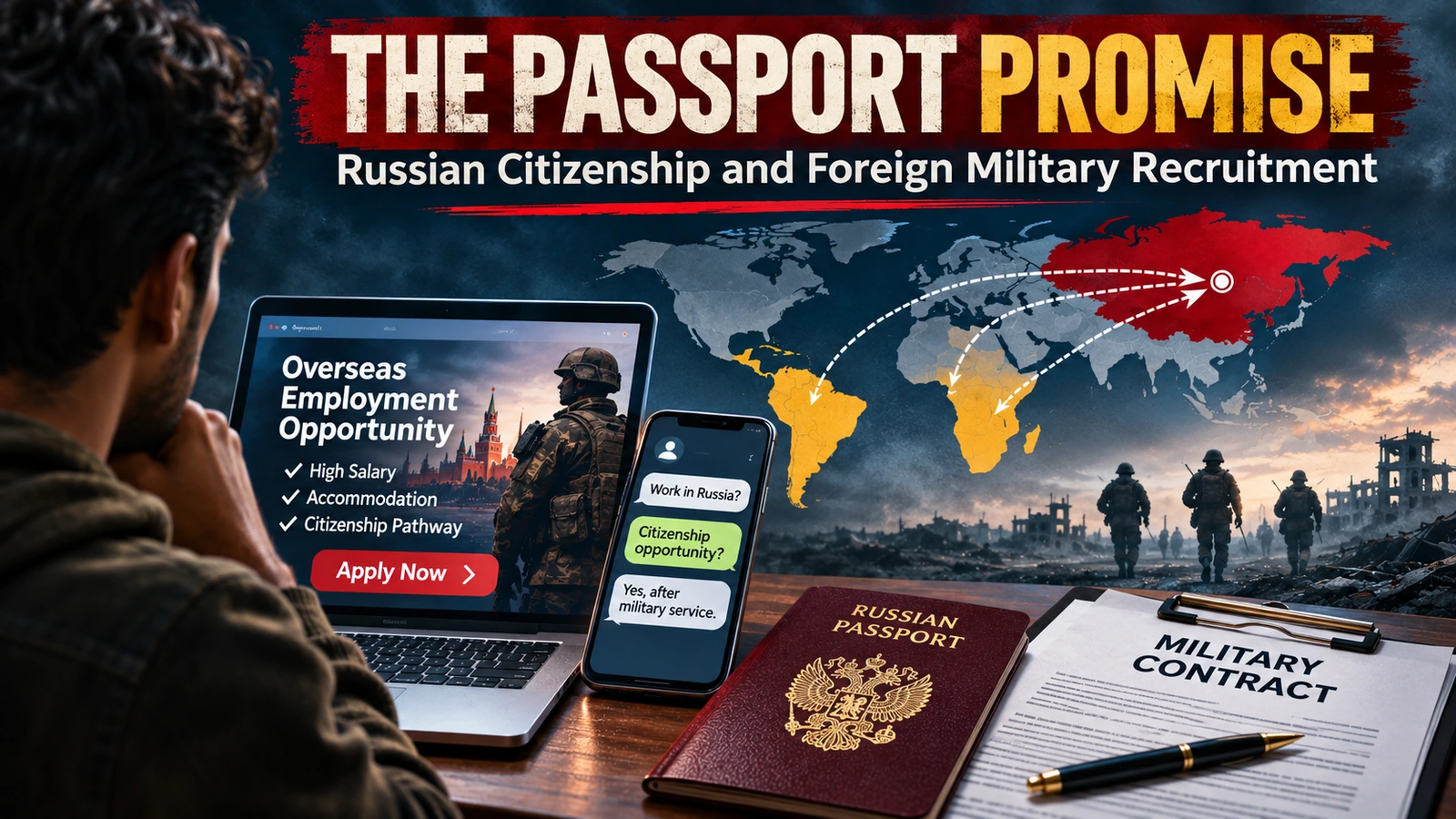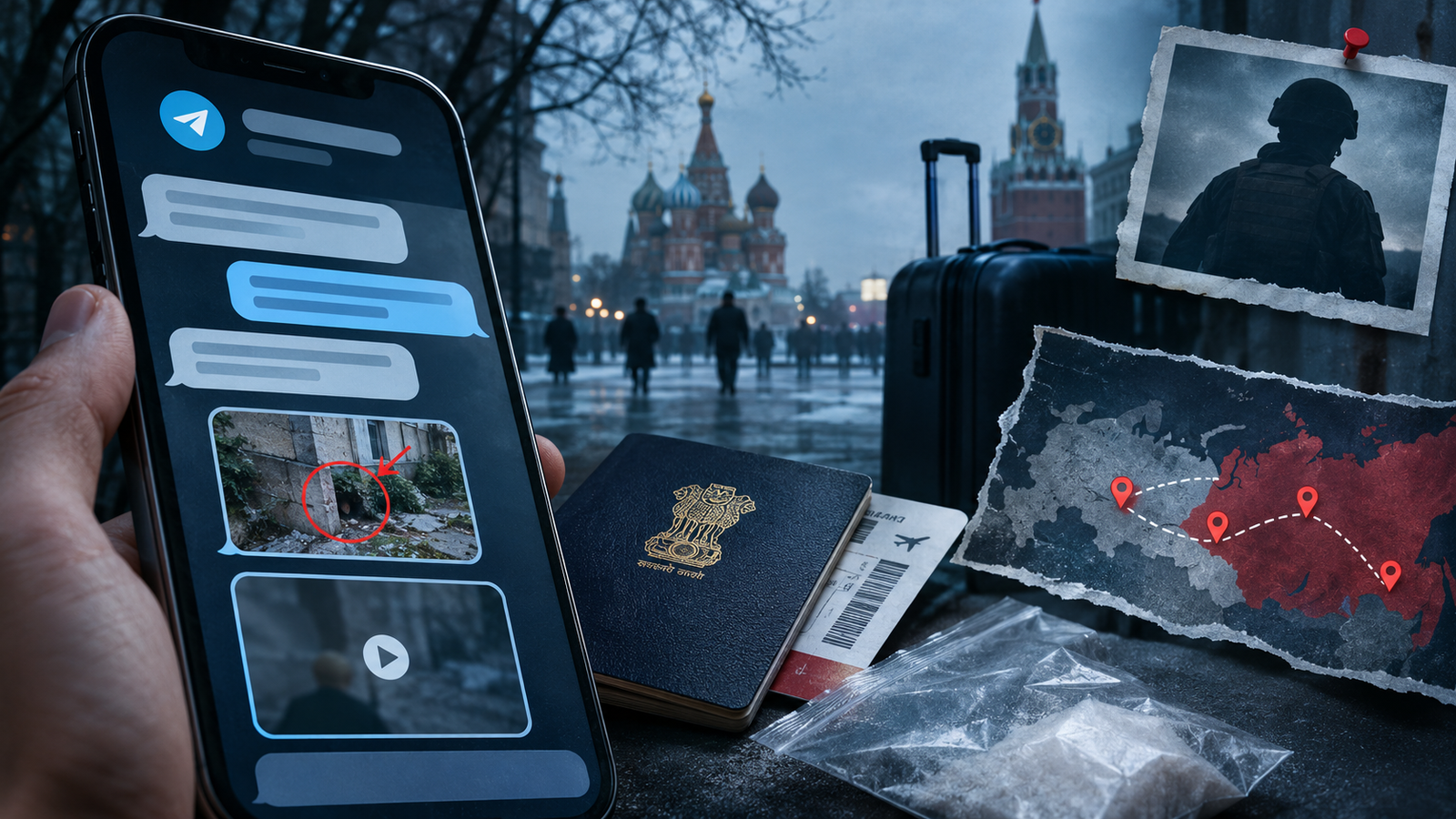
Cyber Truth Times launches a 10-part investigation into Russia’s Telegram Drug Recruitment of Indian citizens and other foreign nationals as drug couriers.
The Investigation: Russia’s Telegram Drug Recruitment
A seemingly ordinary online job offer can conceal a far more dangerous proposition.
Across Telegram conversations examined by Cyber Truth Times, accounts presenting employment opportunities in Russia have allegedly offered foreign applicants attractive salaries, flexible working schedules, accommodation, travel assistance and training. Yet, in conversations documented during this investigation, some of these offers transitioned into explicit descriptions of distributing and concealing narcotics across urban areas in Russia.
The advertisements presented the work as straightforward, financially rewarding and accessible to foreign nationals without Russian-language proficiency. Applicants were encouraged to communicate through Telegram, follow instructions from supervisors or so-called curators, and prepare for travel to Russia. In the conversations examined by Cyber Truth Times, the purported job duties were ultimately described as placing drug packages in locations around cities, photographing those locations and submitting descriptions of the completed deliveries.
These conversations raise serious questions about deceptive online employment recruitment, the targeting of foreign nationals, the risks of criminal exploitation and the possible consequences for individuals who accept such offers.
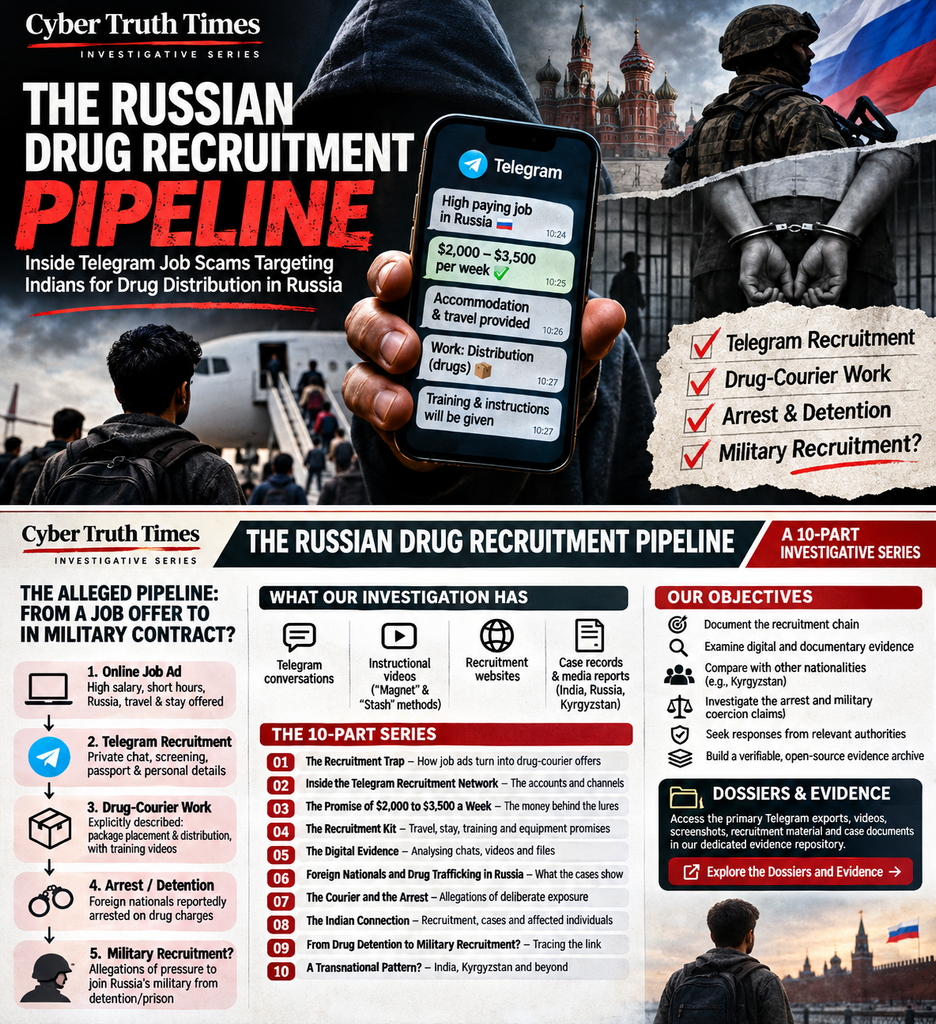
Cyber Truth Times is launching a ten-part investigative series to examine this recruitment pattern, document the evidence, compare it with publicly reported cases and investigate a more consequential question: whether there are verifiable links between drug-related recruitment, detention of foreign nationals in Russia and allegations of pressure to enlist in the Russian military.
The investigation will not assume that these events are connected merely because they occur in the same country or involve foreign nationals. Instead, it will examine the evidence, seek corroboration, identify gaps and test competing explanations.
The objective is to build a documentary, evidence-led investigation into a potentially dangerous recruitment ecosystem that warrants scrutiny.
1. Why this investigation matters
The promise of an ordinary job
The recruitment conversations examined by Cyber Truth Times share a recurring set of characteristics. Applicants are presented with an opportunity to earn substantial money in Russia, often with minimal daily working hours. The recruitment pitch may promise accommodation, assistance with travel arrangements, food, clothing and support from a supervisor. Some recruiters indicate that the applicant does not need to know Russian.
In one Telegram conversation documented by Cyber Truth Times, an account operating under the name Carlisle Rockwellford described a job involving the distribution of small medicine packets around a city, photographing the locations and writing short descriptions. The recruiter subsequently explicitly identified the product as cocaine and described payment arrangements based on the number of deliveries.
The conversation also contained references to accommodation, flight arrangements, a visa, a supervisor, training conducted through Telegram and a purportedly organised onboarding process. The recruitment pitch appeared to be designed to make the opportunity look structured and manageable.
The screenshots and videos supplied to the investigation show why the distinction between a job advertisement and the actual proposed work is important. What is initially presented as a conventional employment opportunity can turn into an offer to participate in criminal drug distribution.
The investigation is examining these recruitment conversations as evidence of potentially deceptive recruitment practices. The objective is to determine how these offers are structured, whether accounts or advertisements share identifiable characteristics and whether the pattern can be independently corroborated.
The recruitment language
An important aspect of this investigation is the repetition of language across different recruitment conversations and accounts.
The materials supplied to Cyber Truth Times contain similar descriptions of:
- High earnings for relatively few hours of work.
- Employment opportunities without Russian-language proficiency.
- Accommodation and travel assistance.
- Training through Telegram.
- Supervisors or curators providing instructions.
- Requests for photographs or descriptions of completed work.
- Promotional videos demonstrating or describing the proposed activity.
Similar wording is an investigative lead, not proof that accounts are controlled by the same person or organisation.
The investigation will therefore examine textual similarities alongside other evidence, including media files, account histories, contact information, timelines, domain infrastructure where legitimately available, recruitment documents and independently corroborated records.
The question is not simply whether recruiters use similar words. It is whether the similarities can be linked to a demonstrable recruitment infrastructure, common operators, shared intermediaries or a reproducible recruitment pattern.
2. What the public reporting already establishes
The investigation does not begin in an evidentiary vacuum. Reporting by Radio Free Europe/Radio Liberty in June 2025 documented recruitment advertisements in Kyrgyzstan promising unusually high earnings for work in Russia. The reporting described advertisements offering approximately $1,000 per week, short daily working hours and paid travel and housing.
When RFE/RL contacted the Telegram account associated with the advertisements, the response indicated that the work involved transporting illegal drugs. The reporting also examined the risks facing recruited couriers and cited an immigration lawyer’s account of the potentially short duration of such criminal activity before couriers face arrest. RFE/RL’s reporting
This reporting is particularly relevant because the recruitment characteristics described bear similarities to the materials independently collected by Cyber Truth Times: high financial promises, short working hours, travel and accommodation assistance, recruitment through digital communication channels and the explicit transition from employment language to narcotics-related duties.
The resemblance warrants comparative investigation. It does not, by itself, establish that the same operators, recruiters or criminal networks are involved.
The broader reporting also raises questions about how online advertisements for drug-courier work reach prospective recruits, the language used to attract applicants and the risks associated with accepting such offers. These questions form part of the investigation’s comparative framework.
The objective is to determine whether the evidence collected by Cyber Truth Times independently reflects a pattern described elsewhere, or whether important differences emerge when individual accounts, recruitment communications and reported cases are examined closely.
3. The central hypothesis and its evidentiary limits
The most consequential question emerging from this investigation concerns the possibility that some foreign nationals recruited into drug-distribution activity in Russia may subsequently face detention, criminal prosecution or pressure to join the Russian military.
This remains an investigative hypothesis. Cyber Truth Times is not presenting a unified trafficking-to-military-recruitment pipeline as a fact.
The hypothesis is being pursued because several strands of reporting and documentary evidence warrant examination together:
- Telegram accounts offering employment in Russia while describing drug-distribution activity.
- Publicly documented cases involving foreign nationals prosecuted for narcotics offences in Russia.
- Reporting by Indian media about foreign nationals who travelled to Russia following employment offers and whose families subsequently alleged detention, mistreatment or pressure to join the Russian military.
- Reporting concerning recruitment of foreign nationals into the Russian military.
- The possibility that recruitment, criminal exploitation, detention and military recruitment may intersect in individual cases.
These strands must be examined separately before any causal connection is established.
Why this distinction matters
A person recruited for drug distribution may be arrested without any deliberate involvement by a recruiter in arranging that arrest. A person detained in Russia may face pressure to enlist without having been recruited through a drug-courier advertisement. An employment advertisement may be fraudulent without being connected to military recruitment.
The investigation must avoid conflating these scenarios.
The central question is whether documentary evidence, witness testimony, independently corroborated communications, legal records or identifiable actors establish connections between these stages.
If evidence supports a connection, the investigation will report it with appropriate attribution and verification. If the evidence does not support a connection, that finding will also be published.
4. The Indian cases that warrant scrutiny
The investigation will examine publicly reported cases involving Indian nationals who travelled to Russia for purported employment and whose families subsequently raised concerns about detention, criminal charges or alleged pressure to join the Russian military.
In November 2026, India Today reported allegations by the family of Tikeshwar Sahu, a 38-year-old man from Raipur, who travelled to Russia in September after receiving an employment offer. His family alleged that he was detained in Volgograd in a narcotics-related case and pressured to join the Russian Army or face a lengthy prison term. The report described the family’s efforts to seek government intervention and assistance. India Today report, November 9, 2026
Another report concerning Vinit Kumar Dubey, a 21-year-old from Bilaspur, described allegations by his family that he had been detained and mistreated in Russia in connection with efforts to compel him to join the war. The allegations were reported by Indian media and prompted appeals for governmental intervention. India Today report, October 27, 2026
These cases are relevant to the investigation because they involve reported employment-related travel, detention and allegations of military recruitment pressure.
They do not establish that the individuals were recruited through the drug-distribution accounts examined by Cyber Truth Times, nor that their detention was arranged by recruitment operators.
The investigation will examine these reports alongside the digital evidence collected, while maintaining clear distinctions between allegations made by families, statements by authorities, court records and independently verified facts.
5. Our methodology
Cyber Truth Times intends to approach this investigation as a documentary and digital investigation rather than an exercise in speculation.
A. Telegram evidence collection and preservation
The investigation will examine Telegram exports, screenshots, videos and related materials supplied by the researcher.
Where possible, original files will be preserved separately from working copies. File hashes will be generated to help establish file integrity and identify duplicate materials. Relevant message timestamps, account identifiers and message context will be recorded, while acknowledging that exported data and screenshots may have limitations.
B. Comparative analysis of recruitment communications
The investigation will compare recruitment messages for recurring language, promises, communication patterns, recruitment claims and other observable characteristics.
The comparison will distinguish between:
- Identical or near-identical text.
- Generic recruitment language.
- Similar recruitment structures.
- Shared or independently corroborated identifiers.
- Evidence supporting or contradicting common control.
Textual similarities will not be treated as proof of common ownership.
C. Digital-media examination
Videos, photographs and promotional media supplied by recruiters will be examined for relevant properties and provenance.
Where appropriate, the analysis may include:
- File metadata.
- Hashes.
- Perceptual similarity comparisons.
- Image and video frame examination.
- Contextual consistency.
- Reverse-image-search findings where available.
- Evidence of reuse or duplication.
The investigation will not attempt to identify private individuals depicted in media solely through speculative facial recognition or unsupported identification.
D. Examination of publicly documented cases
The investigation will examine relevant Russian and Indian reporting, official statements and publicly accessible legal records.
Particular attention will be paid to the distinction between:
- Arrest.
- Accusation.
- Charge.
- Trial.
- Conviction.
- Reported allegations of coercion.
- Confirmed military enlistment.
These categories will not be treated as interchangeable.
E. Comparative international reporting
The investigation will compare its evidence with established reporting on drug-courier recruitment in Russia and neighbouring countries.
The objective is to examine similarities and differences in recruitment language, recruitment conditions, risks and reported outcomes, not to presume a single international network.
F. Hypothesis testing and contradictory evidence
The investigation will actively seek evidence that could contradict the central hypothesis.
This includes examining alternative explanations, inconsistent timelines, differences between recruitment accounts, missing records, independent criminal activity and whether a purported connection between two actors can actually be substantiated.
G. Ethical and legal safeguards
The investigation will protect unrelated personal information, avoid publishing sensitive identifiers unnecessarily and seek comment from relevant parties where practicable.
The publication will distinguish documented facts, allegations, analysis and unresolved questions.
6. The ten articles in this investigative series
The investigation will be published as a ten-part series under a central pillar article. Each article will examine a distinct aspect of the recruitment process, the evidence and the broader context.
Article 01 — The Recruitment Trap: How Online Job Advertisements in Russia Turn Into Drug-Courier Offers
Inside Telegram Job Offers Promising High-Paying Work in Russia
This opening article will document the recruitment offers, the financial promises, the advertised working conditions and the transition from apparently legitimate employment language to explicit narcotics-related duties.
Article 02 — Inside the Telegram Recruitment Network: How Recruiters, Supervisors and Curators Communicate With Prospective Workers
How Recruiters, Supervisors and Curators Communicate With Prospective Workers
This article will examine the Telegram communications, recruitment accounts, purported supervisors and onboarding language documented in the investigation, without assuming common ownership before verification.
Article 03 — The Promise of $2,000 to $3,500 a Week: Russia Drug Courier Recruitment
Examining the Financial Incentives Behind Drug-Courier Recruitment
This article will examine the remuneration claims, payment structures, advertised workloads and financial incentives used to attract applicants, comparing claims across collected conversations.
Article 04 — The Logistics of Recruitment: Travel, Accommodation and the Promise of Support
Travel, Accommodation, Training and the Promise of a New Life in Russia
This article will examine the assurances recruiters offer, including travel arrangements, housing, training, supervisors, visas and onboarding, and how these claims are presented to prospective recruits.
Article 05 — The Digital Evidence Behind the Recruitment Offers
Analysing Telegram Exports, Videos, Screenshots and Repeated Promotional Media
This article will explain the forensic and documentary methods used to examine the evidence, including preservation, file integrity, media comparison, timestamps and limitations.
Article 06 — Foreign Nationals and Drug Trafficking in Russia
What Publicly Documented Cases Reveal About Foreign Drug Couriers in Russia
This article will examine publicly documented cases involving foreign nationals, the legal consequences of drug trafficking and the recruitment circumstances where those circumstances are established.
Article 07 — The Courier and the Arrest
Investigating Allegations That Drug-Trafficking Organisers Expose Couriers to Law Enforcement
This article will examine the allegations and reporting concerning deliberate exposure of couriers to arrest, separating established evidence from testimony, speculation and unverified claims.
Article 08 — The Indian Connection
Indians Recruited for Drug-Related Work in Russia: Digital Evidence, Criminal Cases and the Recruitment Landscape
This article will focus on India-specific recruitment conversations, publicly reported cases, legal and consular concerns and the evidence connecting recruitment offers to the experiences of Indian nationals where demonstrable.
Article 09 — From Drug Detention to Military Recruitment?
Investigating the Unverified Connection Between Foreign Drug-Courier Cases and Pressure to Join Russia’s Military
This is the central hypothesis-focused article. It will examine whether verifiable documentary evidence connects drug-related recruitment, detention or imprisonment and military recruitment pressure in specific cases.
Article 10 — A Transnational Recruitment Pattern?
Kyrgyzstan, India and Russia: Are Foreign Job Seekers Being Targeted Through Similar Drug-Courier Recruitment Schemes?
The final article will compare the evidence gathered in India with relevant international reporting, examining whether the similarities establish a broader recruitment pattern, common infrastructure or merely comparable practices.
7. Dossiers and Evidence: The documentary archive
The investigation’s conclusions should not exist independently of the evidence from which they are derived.
Cyber Truth Times will maintain a dedicated Dossiers and Evidence section to provide readers with a structured overview of the materials and documentary sources underpinning the investigation, subject to appropriate privacy, legal and safety restrictions.
The archive will serve as the supporting documentary layer for the ten-part series.
What the Dossiers and Evidence section will contain
- Telegram communication records: Selected, appropriately redacted conversations illustrating recruitment claims and the transition to narcotics-related work.
- Recruitment media: Videos and photographs supplied by accounts offering employment, where publication is appropriate.
- Digital evidence summaries: Methodology, file-integrity records, media-comparison findings and relevant limitations.
- Public reporting: Hyperlinked news reports, public statements and accessible legal records.
- Case timelines: Chronologies based on verifiable dates and attributed information.
- Research notes: Selected explanations of the investigation’s methods and evidentiary standards.
- Corrections and updates: A record of significant changes, corrections and newly established findings.
The archive will not publish unredacted passports, private addresses, unnecessary phone numbers, sensitive personal data, operational instructions for drug distribution or material that could compromise individuals or ongoing investigations.
The purpose of the archive is to make the investigation more transparent and accountable, not to expose vulnerable individuals or provide a practical guide to criminal activity.
Dossiers and Evidence
Explore the documentary material, research notes, and evidence supporting Cyber Truth Times investigations.
The dedicated archive is already available in the Dossiers and Evidence section.
Proposed archive location: Cyber Truth Times → Dossiers and Evidence
Website: Cyber Truth Times
8. What this investigation seeks to establish
This investigation is not intended to sensationalise drug trafficking, criminal prosecutions or the circumstances of foreign nationals in Russia. It seeks to document a potentially deceptive recruitment practice and examine its consequences through evidence.
The desired outcomes are fivefold.
First, document the recruitment pattern. Establish what the recruiters advertise, how the offers are presented and what the prospective workers are subsequently told.
Second, identify the evidence of deception. Determine whether the employment claims, financial promises, travel arrangements or descriptions of work materially differ from the actual activity being proposed.
Third, examine the risks to foreign nationals. Document the criminal, personal, financial and legal risks associated with accepting these offers, using reliable reporting and records.
Fourth, investigate the potential connection to military coercion. Examine whether there is independently verifiable evidence linking drug-related recruitment, detention and military enlistment pressure in specific cases.
Fifth, improve public awareness. Provide readers, prospective migrant workers, families, journalists and policymakers with an evidence-based understanding of the recruitment practices under investigation.
The investigation will also seek responses from relevant authorities and identifiable organisations where appropriate. Any substantive response received will be incorporated into the reporting.
9. Why Cyber Truth Times is undertaking this investigation
Digital recruitment has made it possible for prospective workers to encounter employment offers through messaging applications, social media, online advertisements and intermediary accounts without ever meeting the purported employer.
For people seeking employment abroad, the promise of high earnings, travel assistance, accommodation and a relatively easy job can be persuasive. However, when those offers conceal criminal activity, the consequences may extend far beyond financial loss.
This investigation examines the intersection of online recruitment, digital evidence, transnational criminal activity and the vulnerability of foreign job seekers.
The reporting will prioritise evidence over assumption, attribution over speculation and transparency over sensationalism.
The series is also intended to contribute to a wider discussion about the risks associated with online employment advertisements and the protection of foreign nationals who may be recruited into criminal activity under misleading circumstances.
Conclusion: Following the evidence
The recruitment conversations examined by Cyber Truth Times raise questions that deserve a rigorous investigation.
The combination of high-paying employment claims, short working hours, travel assistance, accommodation promises, Telegram-based onboarding and explicit descriptions of narcotics distribution warrants examination. Public reporting on drug-courier recruitment in Russia provides an important comparative context, while recent reporting involving Indian nationals detained in Russia and allegations of pressure to join the military raises additional questions that require careful, independent verification.
The most consequential possibility explored in this series is whether these seemingly separate developments intersect in a demonstrable recruitment pathway.
That question remains open.
Over ten articles, Cyber Truth Times will examine the recruitment offers, analyse the digital evidence, investigate publicly documented cases, compare international reporting and test the central hypothesis against evidence that supports it, contradicts it or leaves it unresolved.
The objective is not to prove a predetermined theory. It is to establish what the evidence can prove, what it cannot and what remains unanswered.
Bibliography and sources
The following sources form the initial public-source reading list. They provide background, comparative reporting and case context. They do not independently establish every allegation or the central hypothesis of this investigation.
- Radio Free Europe/Radio Liberty (RFE/RL) — Promises Of High-Paid Work Lure Kyrgyz Into Russian Drug Trade. June 6, 2025. Reporting on recruitment advertisements, Telegram contact and drug-courier work targeting Kyrgyz job seekers.
- Radio Free Europe/Radio Liberty (RFE/RL) — Drug Mules Ads. Reporting concerning online recruitment advertisements for drug couriers.
- India Today — Indian man detained in Russia, pressured to join Russian army, family alleges. November 9, 2026. Reporting on allegations made by the family of Tikeshwar Sahu.
- India Today — Chhattisgarh man detained, tortured in Russia to join war, family seeks help. October 27, 2026. Reporting on allegations involving Vinit Kumar Dubey.
- The Hindu — Medico from Cuddalore arrested in Russia sends frantic message saying he was being forcibly sent to Ukraine war front; family seeks government help. Reporting on allegations of pressure to join the war.
- The Hindu — Man detained in Russia, pressured to join war, alleges family; second Chhattisgarh case. Reporting on a further case involving allegations by an Indian family.
- Vesti Volgograd — В Волгограде 29-летнего индийца обвинили в покушении на сбыт наркотиков. Russian-language reporting on a narcotics-related case involving an Indian national in Volgograd.
- Volgograd Bezformata — Гражданин Республики Индии. Regional reporting concerning an Indian national and a narcotics-related case.
- Vesti Volgograd Telegram — Telegram post 11101. A public post associated with reporting on an Indian national and a narcotics-related case.
- Cyber Truth Times research materials — Telegram exports, screenshots, videos, recruitment conversations and media supplied for this investigation. These are primary research materials and are not publicly accessible unless selectively published in the Dossiers and Evidence archive.
Editorial note: Bibliographic entries should be checked against the original pages, publication dates, article text and any subsequent corrections before publication. Some sources above describe allegations, not independently established findings.
For deeper investigations on such topics, see our Cybercrime Investigations & Exposes.