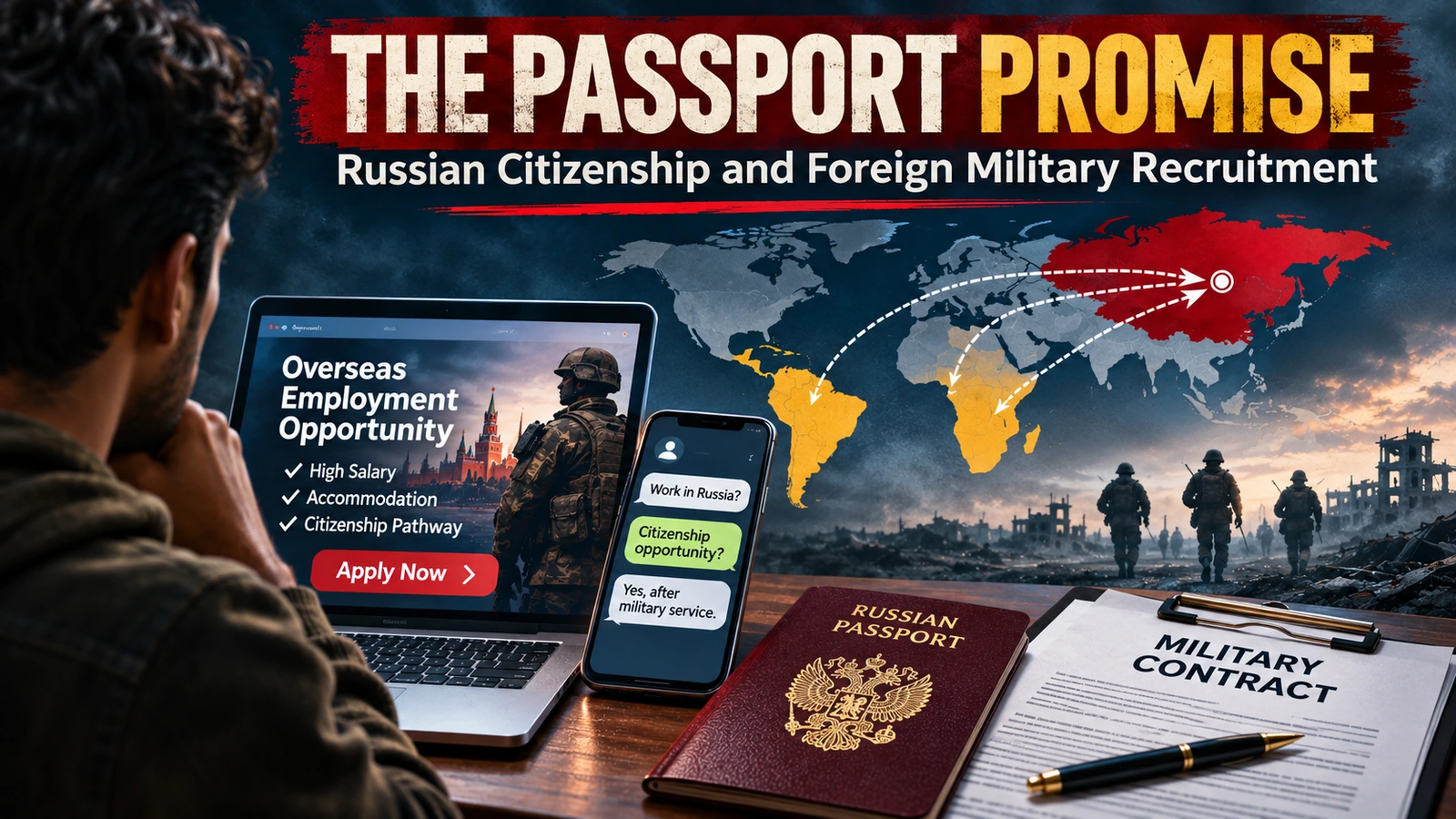
Russia offers Russian citizenship for foreign military recruits. Cyber Truth Times examines the laws, family eligibility, financial incentives and recruitment figures.
Introduction: Russian Citizenship for Foreign Military Recruits
For a foreign national considering military service in Russia, the offer may appear to extend beyond a salary or signing bonus. Recruitment materials and legal changes have presented Russian citizenship as a potential reward for signing a military contract. In some cases, the incentive has reportedly been promoted alongside accommodation, family eligibility, employment assistance and other benefits.
For people facing unemployment, insecure immigration status or limited opportunities at home, the possibility of obtaining a new nationality can be powerful. It can also obscure a fundamental distinction: eligibility to apply for citizenship is not the same as a guaranteed passport, and a citizenship incentive does not remove the risks or obligations attached to military service.
Russia has repeatedly amended its citizenship rules to create simplified routes for foreign military contract personnel and qualifying family members. The changes are part of a wider recruitment environment that offers foreign nationals financial compensation and faster access to legal status.
This investigation examines the legal framework, the incentives offered to foreign recruits, the role of family eligibility, evidence from Africa and Latin America, and the remaining questions about how citizenship promises are communicated and delivered.
Citizenship as a recruitment incentive
The promise of citizenship has appeared alongside salary and signing-bonus offers in recruitment material aimed at foreign nationals.
A 2025 academic study, Weaponising Naturalised Citizenship: Mitigating the Risks of War Mobilisation in Putin’s Russia, examined how changes to naturalisation rules were used to encourage foreign citizens to join the Russian military. The researchers described recruitment brochures offering citizenship to military personnel and eligible family members, alongside financial compensation and social benefits.
The study also documented promotional material advertising monthly payments, lump-sum compensation and access to Russian citizenship. These are recruitment claims and policy incentives; they should not be interpreted as proof that every recruit received the advertised sums or successfully obtained citizenship.
The incentive has two dimensions. The first is administrative: a foreign national who qualifies under the relevant rules may avoid some of the ordinary naturalisation requirements. The second is personal: citizenship may be presented as a route to long-term residence, family stability, employment and a future in Russia.
For a person with limited economic options, the promise can be as important as the salary.
What Russian law provides: the simplified citizenship route
The legal framework has developed through several presidential decrees.
Decree No. 690: the 2022 framework
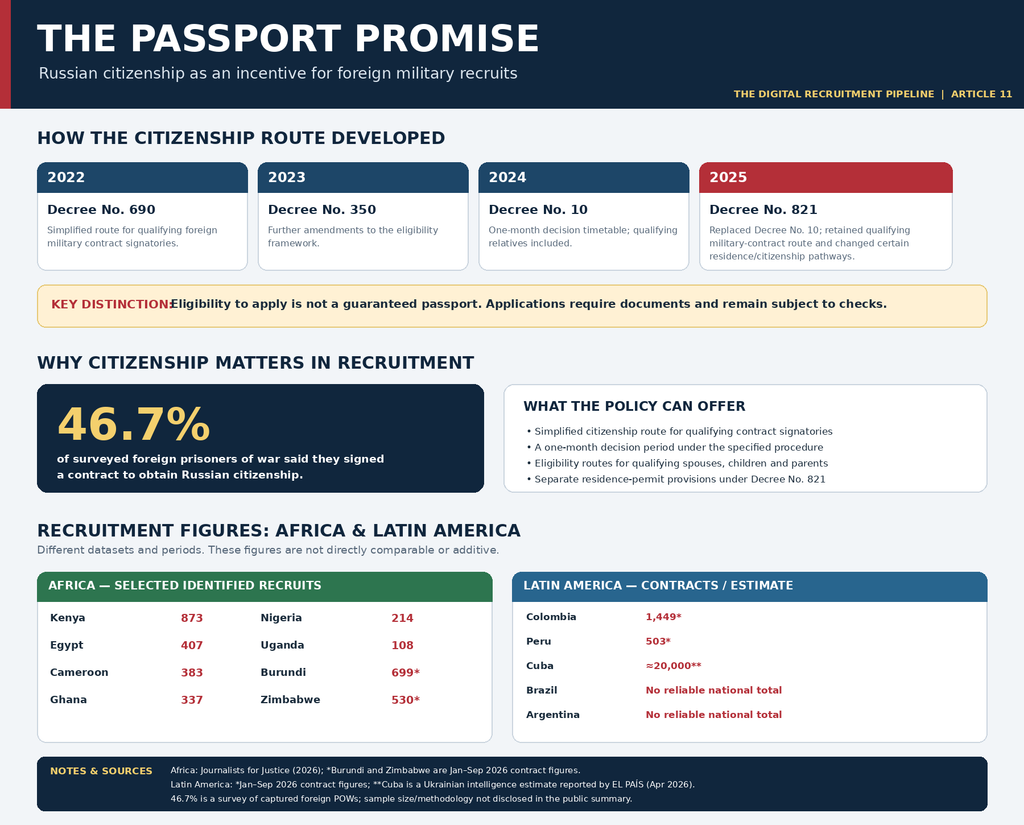
On 30 September 2022, President Vladimir Putin signed Decree No. 690, creating a simplified citizenship route for certain foreign nationals and stateless persons who entered into military-service contracts with the Russian armed forces.
The measure allowed qualifying contract personnel to apply for citizenship without meeting several ordinary naturalisation requirements, including the standard five-year residency requirement.
Decree No. 350: changes in 2023
On 15 May 2023, Decree No. 350 amended the earlier framework. Among other changes, it removed the requirement that certain applicants demonstrate a minimum period of participation in combat operations or qualify through a specified injury-related route.
Decree No. 10: family members and faster decisions in 2024
On 4 January 2024, Putin signed Decree No. 10, setting out a simplified citizenship procedure for foreign nationals who had entered into qualifying military contracts or were serving in the armed forces during the period of the war in Ukraine.
The decree also covered eligible relatives, including spouses, children and parents. It provided for decisions on qualifying applications within one month after the required documents were submitted, subject to possible extensions where additional checks were necessary.
The Law Library of Congress explained that qualifying foreign nationals who signed contracts for at least one year could apply through the simplified procedure. It also noted that eligible family members could use the associated route.
This was a significant incentive: the offer was no longer framed solely as a benefit for the individual signing a contract. It could extend to close relatives.
Decree No. 821: the November 2025 change
The legal picture changed again on 5 November 2025, when Russia adopted Presidential Decree No. 821.
The decree replaced Decree No. 10 and introduced temporary procedures governing citizenship and residence permits for specified categories of foreign nationals and stateless persons.
For qualifying foreign nationals who signed a military contract after 24 February 2022 for at least one year, the decree retained a route to apply for citizenship without meeting the ordinary requirements specified in the relevant provisions of the citizenship law. It also covers certain people discharged from military service and qualifying relatives, including spouses, children and parents.
The decree separately introduced conditions affecting certain common routes to residence and citizenship for able-bodied foreign men aged 18–65. Depending on the legal route used, applicants may need to provide evidence of prior military discharge or a finding that they are unfit for military service. Its residence-permit provisions also identify a military contract of at least one year, discharge on specified grounds or a finding of unfitness as qualifying conditions.
The distinction matters. Decree No. 821 does not mean that every foreign man in Russia must join the military to obtain citizenship. It does, however, make military-service status relevant to certain residence and naturalisation routes. The precise effect depends on the applicant’s circumstances and the legal basis of the application.
The decree is a primary legal document and should be read alongside the relevant Russian citizenship and immigration legislation. Recruitment advertisements that reduce it to a simple promise of a passport may omit important eligibility conditions.
A passport within one month? Understanding the promise
Recruitment material may describe citizenship as something a foreign recruit can obtain quickly. The legal provisions do provide for an expedited decision period for qualifying applications.
But several steps remain necessary.
The applicant must fall within an eligible category, submit the prescribed documentation and pass the relevant checks. The application can be rejected where statutory grounds for refusal apply. The one-month period is a decision timetable under the specified procedure; it is not a guarantee that every recruit will receive citizenship within one month of arriving in Russia or signing a contract.
A candidate should also distinguish between:
- being eligible to apply;
- submitting a complete application;
- receiving approval;
- completing the formalities required to acquire citizenship; and
- receiving a Russian passport.
These are different stages. A recruiter who says that a passport is automatic, immediate or guaranteed should be asked to identify the exact legal provision and explain every condition in writing.
The family dimension: citizenship beyond the individual recruit
One of the most consequential elements of the policy is the possibility of extending simplified citizenship procedures to qualifying family members.
Under the 2024 framework, and the subsequent 2025 replacement decree, eligible spouses, children, and parents of qualifying foreign military personnel may also apply through specified procedures. The provisions include certain relatives of people who have died.
For a recruit with a spouse or children, the prospect of securing a different legal status for the family may carry considerable weight. It can turn an individual employment decision into a family migration decision.
That incentive deserves scrutiny. A candidate may be considering not only personal earnings but also the possibility of bringing relatives to Russia, securing their residence rights or giving children access to education and other services.
However, family eligibility is not automatic. Applicants must establish the qualifying relationship and provide the documents required by the law. The rules also distinguish between citizenship and residence-permit procedures. A family member who qualifies for one route should not be assumed to qualify for every other benefit.
The financial package: salary, bonuses and the cost of recruitment
Citizenship is usually presented as part of a broader package.
Research by the Foreign Policy Research Institute in April 2026 described recruitment offers advertising monthly payments, signing bonuses and eligibility for citizenship. It reported that some campaigns promoted monthly salaries of around 204,000 rubles and signing bonuses of two to three million rubles. Other offers examined in the research promised lower amounts.
The same study estimated that nearly 2,000 African men had been promised a package of salary, signing bonus and citizenship in recruitment arrangements involving civilian-sounding roles such as drivers, cleaners, security guards and mechanics.
These figures are advertised or reported offers, not verified proof of payments to every recruit. The amounts may vary by region, contract, date, unit and eligibility. Recruiters may also deduct fees or impose other costs.
The Atlantic Council reported in November 2026 that some intermediaries demanded advance payments for visas and travel, while others allegedly deducted substantial portions of signing bonuses through powers of attorney. It cited recruitment fees ranging from US$1,500 to US$7,000 in cases described in the Journalists for Justice research.
This creates a significant contradiction. A candidate may be attracted by the promise of a large payment and citizenship, yet incur debt before departure or receive less money than advertised.
The financial terms should therefore be examined separately from the citizenship provisions. A legal route to naturalisation does not establish that the salary, bonus, insurance or other advertised benefits will be paid as promised.
What foreign recruits say about citizenship
One of the most revealing figures comes from the October 2026 report of Ukraine’s Coordination Headquarters for the Treatment of Prisoners of War.
A survey conducted by the Ukrainian project I Want to Live among foreign prisoners of war from 59 countries found that 46.7% said they had signed a Russian military contract to obtain citizenship. The same survey found that 28% said they had not known they would be fighting against Ukraine.
The announcement did not publish the survey’s sample size or full methodology. The findings therefore describe the surveyed prisoner-of-war population and cannot be treated as representative of all foreign recruits.
Nevertheless, the result is significant. It suggests that citizenship was not merely a secondary benefit in the recruitment process for a substantial share of the respondents. It was a stated motivation for signing.
The same survey reported that 41.4% of respondents had been recruited through military enlistment offices and selection points. This challenges the assumption that all recruitment takes place through private brokers or online advertisements. State recruitment structures also appear in the reported pathways.
The survey does not establish that every respondent received citizenship, nor does it show how many recruits applied successfully. It does, however, provide evidence that the prospect of naturalisation can influence the decision to enlist.
Africa: citizenship promises within a growing recruitment market
The recruitment of African nationals has become a major concern for governments and human-rights organisations.
Journalists for Justice’s 2026 investigation, The Death Contract, identified at least 3,066 African recruits from 40 countries. It documented 502 deaths by June 2026 and described recruitment through employment agencies, local brokers, universities, military networks and other intermediaries.
Its country-level figures included:
| Country | Identified recruits |
|---|---|
| Kenya | 873 |
| Egypt | 407 |
| Cameroon | 383 |
| Ghana | 337 |
| Nigeria | 214 |
| Uganda | 108 |
A separate Ukrainian dataset recorded 699 Burundian and 530 Zimbabwean nationals who signed contracts during the first nine months of 2026. These are contract figures for a defined period and should not be added to the Journalists for Justice dataset as if the sources measured the same population.
The incentives described in African recruitment campaigns include high monthly pay, signing bonuses and eligibility for Russian citizenship. The Foreign Policy Research Institute documented examples of these offers, while Amnesty International reported cases in which people said they had been promised civilian employment before being directed into military service.
The presence of citizenship in a recruitment advertisement does not by itself prove deception. The central question is whether the candidate was accurately informed that the contract involved military service and potential deployment to a war zone.
Latin America: the citizenship incentive and country-level figures
Latin America has also become a significant recruitment region.
According to Ukraine’s Coordination Headquarters, 1,449 Colombian nationals and 503 Peruvian nationals signed Russian military contracts during the first nine months of 2026.
Cuba is a separate case. In April 2026, EL PAÍS reported a Ukrainian military intelligence estimate of approximately 20,000 Cuban citizens contracted by the Russian army. This is an intelligence estimate, not a publicly audited list of named recruits, and it is not directly comparable with the Colombian and Peruvian contract figures.
| Country | Reported figure | Definition |
|---|---|---|
| Colombia | 1,449 | Contracts signed, Jan–Sep 2026 |
| Peru | 503 | Contracts signed, Jan–Sep 2026 |
| Cuba | Approximately 20,000 | Ukrainian intelligence estimate reported by EL PAÍS |
| Brazil | No reliable national total located | Individual cases documented |
| Argentina | No reliable national total located | Isolated cases reported |
The legal incentive is only one part of the recruitment picture. Financial hardship, existing military experience, migration aspirations and the promise of civilian work can all influence a candidate’s decision. Individual circumstances must be established rather than assumed from nationality.
The contradiction: a route to citizenship that may begin with a dangerous contract
The citizenship policy raises a broader question about the relationship between migration and military recruitment.
For some foreign nationals, the offer may be a deliberate choice: a one-year contract, financial compensation and a possible route to a new nationality. For others, the same promise may be presented through a civilian job advertisement that conceals the military obligation.
Amnesty International and other investigators have documented cases involving deception, coercion, confiscation of documents and restrictions on movement. Those allegations must be assessed individually. Not every foreign recruit is a trafficking victim, and not every person who signs a military contract has been deceived.
But the existence of a citizenship incentive does not make the recruitment process automatically lawful or voluntary. A contract signed after deception or coercion raises different legal questions from a contract signed with full understanding and free consent.
The distinction is particularly important where recruiters promise a passport but do not clearly explain the duration of service, the possibility of frontline deployment, the conditions for discharge or the risks to family members.
What remains unanswered
Several questions require further investigation:
- How many foreign recruits have actually received Russian citizenship through the military route?
- How many applications have been rejected, delayed or withdrawn?
- How many family members have successfully obtained citizenship?
- Are recruiters accurately explaining the difference between eligibility and guaranteed approval?
- Are advertised salary, bonus and insurance benefits being paid in full?
- What deductions are made by recruitment agencies or intermediaries?
- How many recruits were told they would perform civilian or non-combat work?
- What happens to citizenship applications when a recruit is killed, missing, captured or discharged?
- Are home-country authorities warning citizens about the legal consequences of joining a foreign military?
A transparent record of applications, approvals, refusals and family-member outcomes would help establish how the citizenship incentive operates in practice. Without such information, public claims about the number of foreign recruits who obtained passports remain difficult to verify.
Conclusion: the passport is part of the recruitment offer
Russian citizenship has become a documented element of the incentives offered to foreign military recruits. Presidential decrees have created simplified routes for qualifying contract personnel and eligible relatives, while recruitment campaigns have promoted citizenship alongside salaries and signing bonuses.
The October 2026 prisoner-of-war survey provides an important indication of the role this incentive may play: 46.7% of respondents said they had signed up to obtain Russian citizenship. That finding is not a representative survey of all recruits, but it demonstrates that the passport offer can be a central motivation.
For investigators, the task is to establish what candidates were promised, what the law actually provides, whether the contract was understood and whether the promised benefits were delivered.
A passport is not a substitute for informed consent. Nor does eligibility for citizenship erase the risks of military service.
The question for the next stage of this investigation is straightforward: when citizenship is offered as a reward for military service, who benefits from the arrangement and who bears the cost?
This is Article 11 of The Digital Recruitment Pipeline, Cyber Truth Times’ investigation into the websites, intermediaries and international networks involved in recruiting foreign nationals for Russian military service.
Bibliography
- Law Library of Congress — Russian Federation: Decree Grants Foreigners Serving in Armed Forces During the War in Ukraine the Right to Obtain Citizenship Under Simplified Procedure — 15 March 2024. Legal analysis of Decrees No. 690, No. 350 and No. 10, including family eligibility and application timelines.
- Presidential Decree No. 821 of 5 November 2025 — Russian legal text — Primary legal text establishing temporary citizenship and residence-permit procedures. Verify the Russian text and any subsequent amendments before publication.
- Andrii Latsyba, Atlantic Council — Not Quite Mercenaries: How Russia Lures Thousands of Foreigners to Fight in Its War on Ukraine — 6 November 2026. Analysis of recruitment methods, citizenship incentives, financial intermediaries and the 2025 legal changes.
- Journal of Ethnic and Migration Studies — Weaponising Naturalised Citizenship: Mitigating the Risks of War Mobilisation in Putin’s Russia — 2025. Academic analysis of citizenship policy, migration enforcement and military recruitment incentives.
- Coordination Headquarters for the Treatment of Prisoners of War — October 2026 Monthly Report — October 2026. Foreign contract signatory figures and survey findings on citizenship as a recruitment motivation.
- Hromadske — Nearly 46,000 Foreigners From 151 Countries Signed Contracts With Russian Military, Ukraine Says — 20 October 2026. Summary of contract figures and the prisoner-of-war survey.
- Foreign Policy Research Institute — False Promises: Russian Military Trafficking in Africa — April 2026. Analysis of recruitment offers, financial incentives and citizenship promises in African recruitment campaigns.
- The EastAfrican — Kenya Tops Africa in Russia Military Recruitment, New Report Reveals — 26 September 2026. Journalists for Justice country-level findings and reported recruitment methods.
- EL PAÍS — Cuba and Colombia, the Main Recruitment Hubs for the Russian Army in Latin America — 29 April 2026. Latin American recruitment reporting and the Cuban intelligence estimate.
- Amnesty International — Russia: Recruitment of Foreign Nationals to Fight in Ukraine Amounts to Human Trafficking — September 2026. Interviews and findings on deception, coercion and exploitation in recruitment.
Editorial note: Contract totals, identified recruits, intelligence estimates, prisoner-of-war survey findings and citizenship approvals are different measures. The 46.7% figure relates only to the surveyed foreign prisoners of war; the survey sample size and full methodology were not included in the public announcement. No claim is made that all foreign recruits were deceived or that all who signed contracts received citizenship.
For deeper investigations on such topics, see our Cybercrime Investigations & Exposes.


