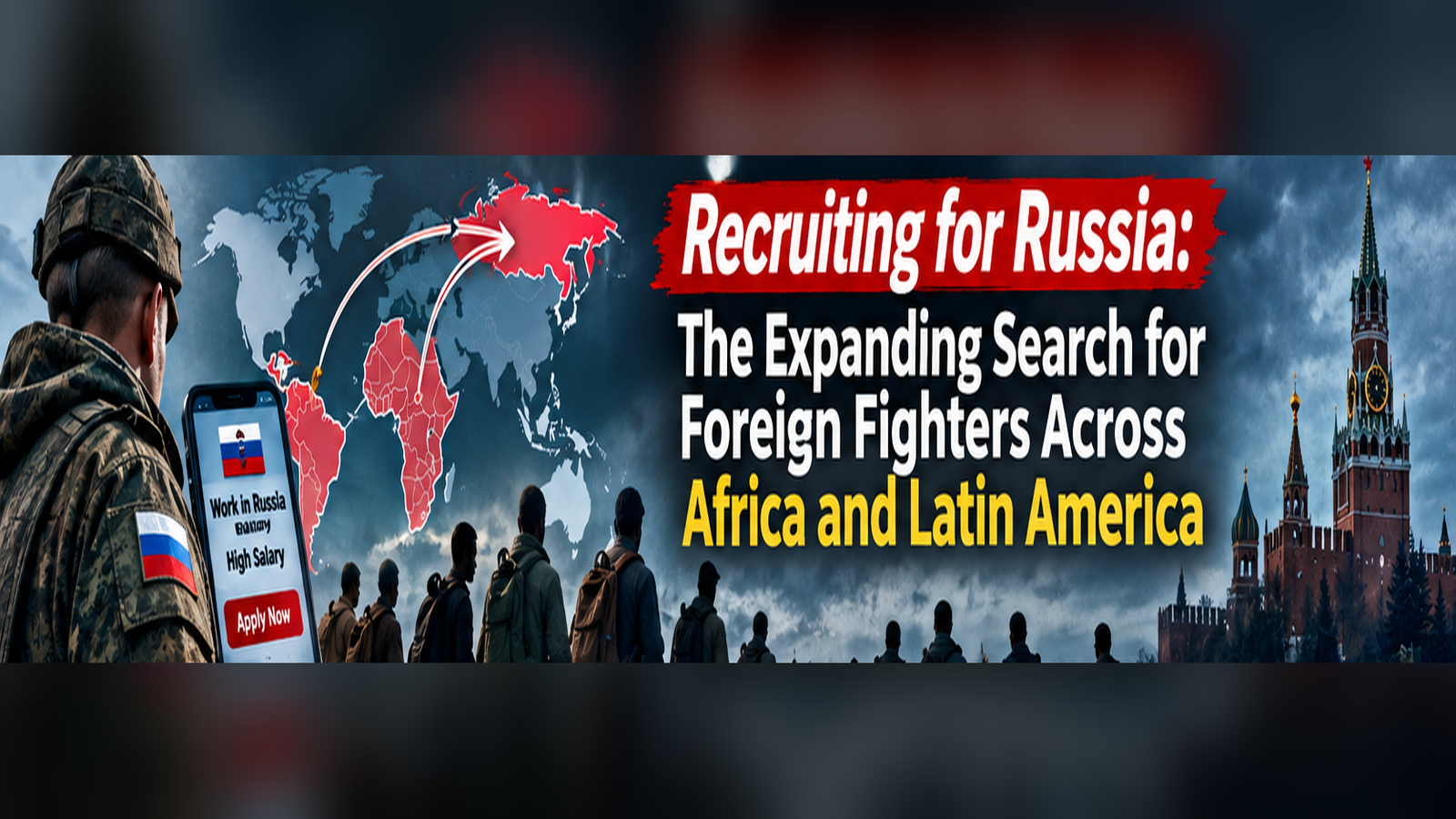
An OSINT investigation tracing into Russia’s Digital Recruitment Chain direct foreign candidates to WhatsApp, Telegram and private intermediaries.
Introduction: Russia’s Digital Recruitment Chain
A recruitment website can look like an ordinary employment portal. It may advertise attractive salaries, assistance with travel, help with documentation and access to opportunities in Russia. It may offer several language versions and invite visitors to submit a short application.
But the website is often only the first point of contact.
Once a visitor submits an enquiry or clicks a messaging link, the interaction can move into a private conversation with a recruiter or intermediary. WhatsApp, Telegram and other messaging services provide a direct channel through which questions can be answered, documents requested and travel or application arrangements discussed.
For investigators, this transition is significant. It connects the visible digital advertising infrastructure with the people and organisations handling prospective candidates.
In this sixth instalment of The Digital Recruitment Pipeline, Cyber Truth Times examines four recruitment websites, their publicly visible contact arrangements and the wider evidence connecting online recruitment portals to messaging-based candidate acquisition.
The investigation asks a central question: what happens between the moment a foreign job seeker visits a recruitment website and the moment a recruiter takes over the conversation?
1. The website is only the beginning
The first stage of digital recruitment is visibility.
A prospective candidate may encounter a sponsored social-media advertisement, a recruitment page shared in a messaging group, a recommendation from an online account or a search result. The visitor is then directed towards a website presenting information about opportunities in Russia.
The European External Action Service (EEAS), in research published in August 2026, identified at least 35 recruitment websites operating in up to 40 languages. Its investigation also documented paid advertisements and digital campaigns targeting audiences across Africa, Latin America and Southeast Asia.
The research described several methods used to bring prospective candidates into the recruitment process:
- Social-media advertisements presented as employment opportunities.
- Landing pages designed to collect contact information.
- Multilingual recruitment websites.
- Disposable domains redirecting visitors to recruitment portals.
- Messaging applications used to continue conversations with potential candidates.
The African Digital Democracy Observatory’s investigation, published in September 2026, subsequently mapped 289 digital assets associated with 33 recruitment-operation groups. Its inventory included websites, social-media accounts and messaging routes.
These figures describe different research datasets and scopes. The EEAS count of websites should not be compared directly with the ADDO count of all digital assets.
Together, however, the investigations show that the recruitment process extends beyond individual websites. It involves a wider digital infrastructure designed to attract, identify and communicate with potential candidates.
2. The four websites: What their contact arrangements reveal
Cyber Truth Times revisited four websites examined in earlier chapters of this series:
The purpose was to establish what each website publicly displays, how it directs visitors towards communication and whether the published contact details provide evidence of a wider recruitment structure.
A. JoinRussianArmy.com: A direct WhatsApp route
The English-language version of JoinRussianArmy.com presents itself as an independent application-support service for foreign citizens considering Russian military contract service. The website states that it is not a government website.
Its application process says that a coordinator may respond through WhatsApp or telephone. The page also provides a direct WhatsApp contact link.
On 16 November 2026, the link resolved to the following number:
Telephone: +33 7 81 10 02 50
The country code is French. That is a verifiable feature of the published contact route, but it does not establish that the account holder is French, physically located in France or operating from a French business.
The website also describes a local partner programme. It says prospective partners can identify and inform interested adults, help with an initial questionnaire and pass candidates to a central team. The site states that partners are paid only after a verified official contract is signed, with reward terms determined by country, route, volume and lead quality.
These are first-party statements made by the website. They are relevant evidence of how the operator describes its own recruitment model, but they do not independently establish that every advertised arrangement has been implemented or that payments have been made.
An important distinction must also be maintained: the domain JoinRussianArmy.com is not the same as Russian-Army-Join.com. Similar wording in their names does not establish common ownership or operational control.
B. Russian-Army-Join.com: The Military Staff Agency contact route
The second website, Russian-Army-Join.com, identifies itself as the Military Staff Agency (MSA).
It describes a process involving an online application, a manager, an interview, visa and document processing, travel arrangements, arrival in Russia and military contract signing.
The website publishes the following contact details:
Telephone: +7 964 513 58 02
It also provides a separate button inviting applicants to open a WhatsApp conversation with a personal manager after submitting an application.
However, the publicly accessible page extraction does not establish that the WhatsApp button resolves to the same number as the telephone contact. Cyber Truth Times therefore records the Russian number as a published telephone contact, not as a verified WhatsApp destination.
This distinction is important. A website can display a telephone number while using a different number for WhatsApp, a dedicated manager or a regional recruitment office.
The website also links to a separate Military Staff Agency portal. This is a stronger first-party indication of brand association between the two MSA-branded web properties than a similarity in domain names alone.
It still does not, by itself, establish the legal ownership of every associated website or identify the individuals operating each communication account.
C. WorkInRussia2025.ru: The contact form as the gateway
WorkInRussia2025.ru takes a different approach.
Its English-language page describes military contract service for foreign citizens and identifies the Central Headquarters of Volunteer Battalions in the Republic of Bashkortostan as the organisation recruiting foreign nationals.
The page presents a sequence involving initial contact, document processing, travel, accommodation, training, contract signing and departure for service.
Unlike the other two sites discussed above, the English page does not display a publicly readable recruiter WhatsApp number.
Instead, its candidate application form asks the applicant to provide contact details, including a WhatsApp number and a Telegram username or phone number.
That difference matters. The website is collecting the prospective candidate’s messaging details rather than publishing a recruiter number in the visible form.
The distinction is corroborated by an investigation published by The Insider in May 2026. The publication reported that WorkInRussia2025.ru directed prospective recruits towards messaging accounts, including a WhatsApp account using the display name “Work RF” and a Telegram account called workinrussia2025ru.
The Insider also reported that the telephone number displayed on the website differed from the number used to register the messaging accounts.
The public English page currently exposes an email address and a link to the application form. It does not provide enough information to identify the WhatsApp account’s underlying number from the page itself.
Cyber Truth Times therefore does not assign an unverified number to this website.
The account name reported by The Insider is a useful investigative lead. It is not a substitute for independently verifying the account’s number, ownership or current operator.
D. WorkCrewAgency.com: A clearly published WhatsApp number
WorkCrewAgency.com explicitly describes itself as a recruitment and information partner for Russian military contract service.
Its website says that it guides international candidates through the application process, checks documents, prepares applicants for interviews and remains in contact while their files are reviewed.
The website explicitly publishes:
WhatsApp: +1 539 664 0234
The same number is displayed in its contact section and linked through a WhatsApp button.
The country code is associated with the North American Numbering Plan. It does not establish the physical location of the person operating the account.
The website also claims that it has worked with candidates from more than 30 countries and reports its own placement and success figures. These are claims made by the website and should not be presented as independently verified statistics.
The contact number establishes a publicly advertised communication route. It does not, by itself, identify the account holder or establish a connection to the other three websites.
3. The contact matrix: What can actually be established?
The following table records the contact evidence observed during the website review on 16 November 2026.
| Website | Public contact evidence | Verification status |
|---|---|---|
| JoinRussianArmy.com | +33 7 81 10 02 50 | WhatsApp link resolves to this number |
| Russian-Army-Join.com | +7 964 513 58 02 | Published telephone number; separate WhatsApp manager link |
| WorkInRussia2025.ru | No recruiter WhatsApp number displayed on the English page | Application form requests the candidate’s WhatsApp details; The Insider reported a “Work RF” WhatsApp account |
| WorkCrewAgency.com | +1 539 664 0234 | Explicitly published as WhatsApp contact |
This matrix should be treated as a dated observation, not a permanent directory. Contact details can change, and a website may use different numbers for different countries, managers or recruitment campaigns.
It also demonstrates why an investigation should not simply collect every telephone number visible online and label it a WhatsApp contact.
A number displayed as a telephone contact, a number embedded in a WhatsApp link and a number supplied by an independent investigation are three different forms of evidence.
4. The EEAS finding: Shared WhatsApp contacts and the Bashkortostan connection
The wider significance of messaging contacts becomes clearer when placed alongside the EEAS investigation.
In August 2026, the EEAS reported that three recruitment brands—Military Staff Agency, Work in Russia and IRC Russian Bear—were linked through shared WhatsApp contact details to a Russia-registered organisation identified as Central Headquarters in Bashkortostan.
This is an important finding because it moves the investigation beyond visual similarities between websites.
A shared contact point can provide evidence of a common communication route. When supported by corporate records, archived pages, domain data and other independent material, it can help investigators identify relationships between apparently separate recruitment brands.
But the finding must be used precisely.
It does not establish that every website examined by Cyber Truth Times belongs to the same organisation. In particular:
- JoinRussianArmy.com must be treated as a separate domain unless further evidence establishes a connection.
- Russian-Army-Join.com identifies itself with Military Staff Agency, but the exact WhatsApp destination still requires verification.
- WorkInRussia2025.ru publicly identifies the Bashkortostan Central Headquarters as its recruitment organisation.
- WorkCrewAgency.com is one of the four brands identified by the EEAS, but the EEAS’s shared-WhatsApp finding concerned the first three brands, not Work Crew Agency.
The EEAS also reported a separate open-source link involving a Work Crew Agency domain and a Russian military blogger. That is a distinct attribution lead; it should not be confused with the shared WhatsApp evidence.
The wider lesson is that investigators must map relationships individually. A shared telephone number, a shared messaging account, a shared analytics identifier and a shared legal entity are different indicators. Each supports a different kind of conclusion.
5. Why recruiters move conversations into private messaging
A public website is designed to present information to a broad audience. A messaging application enables direct communication with an individual.
That transition can serve several practical purposes:
Candidate screening: Recruiters can ask about age, nationality, location, passport status, language and experience.
Document requests: A candidate may be asked to provide personal or travel-related information. The handling and security of such information becomes an important question.
Language support: Messaging services allow recruiters to communicate with people who may not speak Russian or English fluently.
Travel coordination: A private conversation can be used to discuss invitations, flights, accommodation, meeting points and arrival arrangements.
Referral tracking: Where a recruitment operation uses partner or scout programmes, referral identifiers and candidate updates may be communicated privately.
The EEAS and Code for Africa investigations describe a broader process in which advertisements and landing pages lead to direct messaging conversations with recruiters.
ADDO’s September investigation specifically described a sequence involving a social-media advertisement, a landing page, a web form and a human recruiter taking over through WhatsApp or Telegram.
This is a reported pattern across the wider recruitment ecosystem. It should not be assumed that every candidate contacting one of the four websites follows the same sequence.
6. The data trail: What investigators should preserve
The public number is only the beginning of an evidence record.
A responsible OSINT investigation should preserve the full context in which a contact detail appears.
For each website, the evidence file should include:
- Page capture: A dated screenshot showing the number, contact button or application form.
- Source URL: The exact page address, not just the website homepage.
- Link destination: The underlying WhatsApp link, where publicly exposed.
- Capture timestamp: Date and time, including time zone.
- Page version: An archived copy or web archive reference, where available.
- Attribution label: Whether the number is explicitly described as WhatsApp, displayed as a telephone contact or reported by another publication.
- Corroboration: Independent reporting, corporate records or other evidence supporting any claimed organisational connection.
A screenshot of a WhatsApp button is not equivalent to a verified account identity. A link destination is stronger evidence of the number used by the website, but it still does not establish who controls the account.
Likewise, a public display name is not proof of a person’s legal identity.
These distinctions should be preserved in the article, in the evidence archive and in any subsequent reporting.
7. The privacy and security implications
The movement from a public recruitment portal to private messaging also raises questions about personal data.
A prospective candidate may be asked to provide a telephone number, passport details, photographs, nationality, location and other information.
WorkInRussia2025.ru’s application form, for example, requests the candidate’s WhatsApp and Telegram contact details. JoinRussianArmy.com provides fields for contact information and optional document uploads. WorkCrewAgency.com says its application form opens WhatsApp with the candidate’s details filled in.
These are first-party descriptions of the websites’ forms and processes. They do not independently establish how every submitted record is stored, accessed, transferred or deleted.
The questions for further investigation are straightforward:
- Which legal entity is responsible for collecting the information?
- Where is the information stored?
- Is it shared with other recruiters or intermediaries?
- How long is it retained?
- Are candidates told who will receive their documents?
- What security measures protect passport copies and other sensitive information?
- Can applicants withdraw consent and request deletion?
The answers matter because passport and identity information can expose individuals to identity theft, fraud or other forms of exploitation if mishandled.
Cyber Truth Times has not submitted test applications or uploaded personal documents to these websites. This investigation relies on publicly accessible pages and independently published research.
8. What the contact numbers do and do not prove
The four-site review provides several useful leads, but it does not establish a single unified operation.
A French-format WhatsApp number on one website and a US-format number on another do not prove that the two services share an owner. A Russian telephone number on an MSA-branded site does not establish that its separate WhatsApp manager link uses the same number.
Similarly, the fact that WorkInRussia2025.ru requests a candidate’s WhatsApp number does not identify the recruiter who will eventually contact that candidate.
The EEAS finding about shared contact details is stronger because it comes from a separate investigation that examined the relationship between recruitment brands and a Bashkortostan organisation.
Even so, shared contact infrastructure is evidence of a relationship in communications. It is not automatically proof of common legal ownership, common management or the involvement of every website in the same recruitment operation.
The next stage of the investigation requires corroboration through archived website versions, domain registration records, company filings, advertising records, technical identifiers and other independently verifiable material.
Conclusion: The message is where the investigation gets closer to the operator
The journey from a recruitment website to a messaging application is one of the most important stages in the digital recruitment chain.
A website can present the opportunity, collect an enquiry and direct a visitor towards a private conversation. The messaging account can then become the point through which a candidate receives further information and communicates with an intermediary.
The four websites examined here demonstrate different approaches to that transition: direct WhatsApp links, a telephone contact alongside a separate manager link, an application form that collects the candidate’s own messaging details, and an explicitly published WhatsApp number.
Independent investigations by the EEAS, Code for Africa and The Insider provide a wider context for understanding how messaging applications fit into Russia’s foreign military recruitment infrastructure.
But the most important investigative principle remains the same: a contact detail is a lead, not a conclusion.
Cyber Truth Times will continue to distinguish what a website publishes, what an independent investigation establishes and what remains unverified.
The next question is no longer simply which websites attract prospective recruits. It is who operates the recruitment channels, who controls the candidate data, who receives referrals and who ultimately benefits when an enquiry becomes a signed military contract.
This article is part of The Digital Recruitment Pipeline, a Cyber Truth Times investigative series examining the digital infrastructure, intermediaries and international networks involved in recruiting foreign nationals for Russian military service.
Bibliography and Sources
- European External Action Service / EUvsDisinfo — From Social Media to the Front Line: Russia’s Foreign Recruitment Pipeline, 14 August 2026.
- African Digital Democracy Observatory — Death Benefits: Russia’s War Recruiters Have Gone Into Business, Justin Arenstein, 23 September 2026.
- The Insider — Kremlin-Style Colonialism: Russian Propaganda Is Actively Preparing Africans for Military Service in Ukraine, 15 May 2026.
- JoinRussianArmy.com — Contract Service for Foreign Citizens, first-party website reviewed 16 November 2026.
- Russian-Army-Join.com — Military Staff Agency, first-party website reviewed 16 November 2026.
- WorkInRussia2025.ru — Contract Service for Foreign Citizens, first-party website reviewed 16 November 2026.
- WorkCrewAgency.com — Contract Military Service for Foreigners, first-party website reviewed 16 November 2026.
Methodology and qualification: The four websites were reviewed on 16 November 2026. Contact details are reproduced as publicly displayed or linked by the respective websites. A published number or messaging link does not independently establish the identity, location or legal status of the account operator. Claims made by recruitment websites are identified as first-party statements, not independently verified facts. The article does not imply that all four websites share ownership or control.
For deeper investigations on such topics, see our Cybercrime Investigations & Exposes.