
An evidence-based examination of a preserved Telegram export documenting escort-related advertising, promotional patterns, media, communication behaviour and the limits of digital attribution.
Introduction
Telegram has increasingly become a space in which commercial advertising, informal marketplaces and service promotion can operate through group-based communication. In some groups, messages are not primarily conversational. Instead, they function as advertisements, repeated promotional posts, responses to enquiries and attempts to direct prospective customers towards private communication.
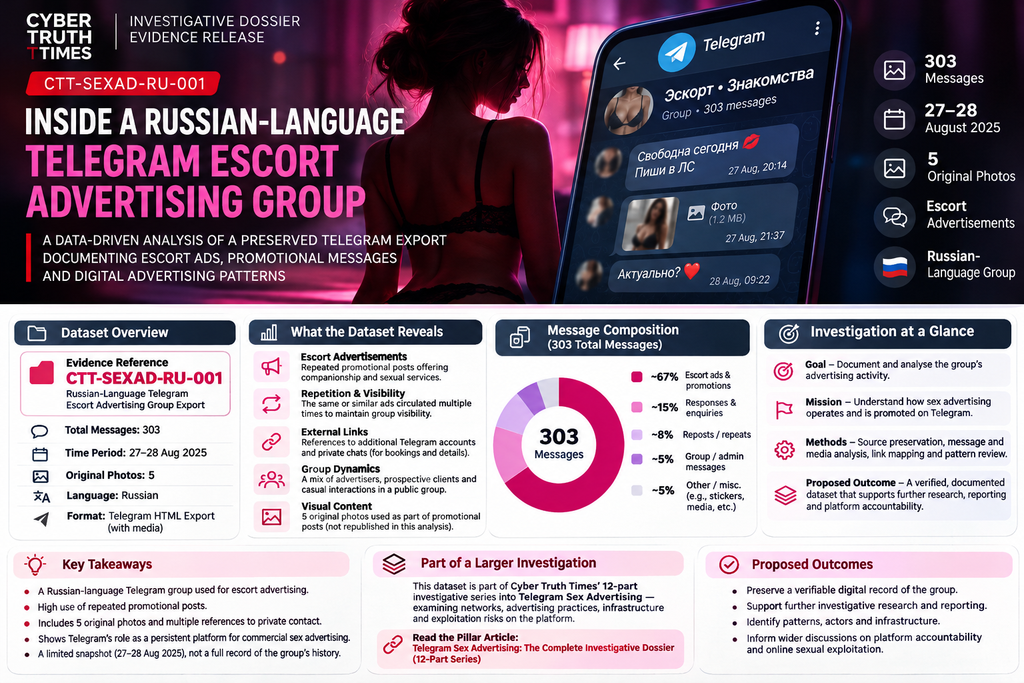
Cyber Truth Times has preserved a Telegram group export titled in Russian and associated with escort-related advertising. The archive contains message entries dated 27 and 28 August 2025, together with five original photographs and associated Telegram export material.
This evidence release examines the group as a digital advertising environment. It analyses the structure of its communications, the repeated nature of promotional content, the relationship between text and imagery, and the potential investigative value of preserving the material.
The dataset is a snapshot of activity within one group over a limited period. It is not a complete representation of the Telegram escort-advertising ecosystem, and the messages alone do not establish the identities, motivations, circumstances or legal status of the people referenced.
The purpose of this publication is to document the source material, analyse observable patterns and make the evidence available for further examination within the broader 12-part Cyber Truth Times investigative series into Telegram sex advertising.
1. The dataset: A snapshot of Telegram escort advertising
The preserved archive contains a Telegram HTML export with 303 message blocks and five original photographs. The visible chronology spans 27–28 August 2025.
The message material is dominated by advertising-related content. Messages include promotional descriptions, claims about availability, pricing, service offerings, geographic references, contact instructions, responses and repeated advertisements.
The export also contains Telegram reply-context elements, meaning some messages appear in relation to earlier posts rather than as entirely independent communications. This matters when reconstructing the conversation: a reply, repost or repeated advertisement should not automatically be counted as a separate commercial actor or transaction.
The dataset provides a documentary record of the material preserved from the group. Its significance lies in the ability to examine how advertising was communicated, how messages were repeated and how visual material was incorporated into promotional content.
The archive should be interpreted as a source snapshot not as a complete market census, verified customer ledger or independently confirmed record of transactions.
2. Repetition and the advertising rhythm
One of the most visible characteristics of the exported messages is the recurrence of promotional content.
The group contains repeated advertising messages, including content that appears to be reposted or circulated more than once. Repetition is a common characteristic of digital advertising environments: visibility can depend on keeping promotional content in circulation, particularly within fast-moving group conversations.
From an investigative perspective, repetition raises several questions:
- Is repeated content being circulated by the same account?
- Are advertisements being reposted to maintain visibility?
- Does repetition reflect a posting strategy, audience engagement or simply the structure of the group?
- Are similar advertisements associated with distinct accounts or repeated identities?
- Can the apparent repetition be reliably distinguished from Telegram reply or export artefacts?
The dataset supports examining repetition as an observable communication pattern. It does not, by itself, establish coordinated advertising, automation, a formal agency structure or a common operator behind similar messages.
A rigorous analysis would distinguish exact duplicates, near-duplicates and related advertisements, while preserving the original chronology and message context.
3. Advertising language and commercial presentation
The message export contains advertisements using persuasive and promotional language. The content presents services, availability, pricing and other claims in a format designed to attract attention and prompt contact.
This is significant because the group is not merely a discussion space. The communication style suggests that promotional messages are an important component of its activity.
The advertisements use short descriptions, emojis, claims about availability and calls to contact the advertiser. The combination of textual promotion and messaging-platform communication creates a format that can be examined as a digital advertising environment.
However, advertising language is not proof of the underlying claim. Statements about availability, identity, age, location, service conditions or the authenticity of a profile should not be treated as independently verified.
The investigation therefore treats promotional statements as claims made within the source material.
4. The role of images in the group
The archive contains five original photographs associated with the exported conversation.
The images form part of the evidentiary record because they accompany or contextualise the group’s advertising activity. Visual content can help investigators understand how advertisements are presented and whether the communication environment relies on text, photographs or a combination of both.
However, photographs are particularly sensitive in investigations involving sexual advertising. A photograph does not establish the identity of the person depicted, the consent of the person depicted to its circulation, whether it was originally created for the advertisement, or whether the advertiser has permission to distribute it.
The five photographs should therefore be treated as media preserved within the source export—not as verified representations of the people or circumstances described in accompanying messages.
Cyber Truth Times is not reproducing identifiable individuals or intimate visual content in this article. The evidence release should be handled with appropriate safeguards, particularly where the origin, consent or age of depicted individuals cannot be independently established.
5. Telegram as a communication and advertising environment
The dataset provides an opportunity to examine how Telegram group communication can be used for promotional activity.
The group format allows messages to be circulated within a shared digital environment, with replies and repeated posts creating an observable communication record. This structure may support advertising visibility, but it also complicates interpretation.
An exported message archive is not necessarily equivalent to a complete or uninterrupted record of the group’s activity. Messages may have been deleted before export, export settings may affect what is preserved, and the archive may not capture every participant’s interactions.
The investigation therefore focuses on the material available in the export and avoids claiming that the preserved dataset represents the group’s entire operational history.
6. Geographic references and the limits of attribution
The messages contain geographic references associated with the advertising claims.
Such references may be useful for understanding how advertisers describe the services they promote and the geographic context presented within the group. They may also provide leads for further investigation.
But geographic references in advertising do not independently establish where a person was physically located, where an advertisement was created, where a transaction occurred or whether the stated location was accurate.
Geographic attribution requires corroboration. Investigators should distinguish between:
- A location claimed in an advertisement.
- A location associated with a profile or account.
- A location inferred from other evidence.
- A location independently verified through additional sources.
This distinction is essential to avoid overstating what a Telegram export can establish.
7. Goals of the investigation
The objectives of this investigation are:
- Document: Preserve and describe the Telegram group export and associated media.
- Analyse: Examine the group’s advertising patterns, repeated messages and communication structure.
- Contextualise: Understand the source material as part of Telegram-based sex-advertising activity.
- Verify: Identify claims and patterns that require independent corroboration.
- Preserve: Maintain a documentary record for further investigative research.
- Inform: Contribute to a wider examination of digital advertising environments, platform accountability and potential exploitation.
The investigation does not assume that every advertisement is authentic or that every person referenced is involved in criminal activity.
8. Mission
The mission is to document and analyse the digital advertising activity preserved in this Telegram group export, while examining the wider structures through which sex-related commercial advertising may circulate online.
Cyber Truth Times seeks to preserve evidence, identify observable patterns, distinguish claims from verified facts and contribute to responsible investigative reporting.
The investigation prioritises evidentiary accuracy, contextual interpretation and responsible handling of sensitive material.
9. Investigative methodology
Source preservation
The Telegram export is treated as the primary documentary source for this release. The original message archive and associated media provide the basis for the analysis.
Message review
Messages are examined for promotional content, repetition, reply structure, advertising language and contextual references. Repeated messages are not automatically interpreted as separate actors or transactions.
Media review
The five photographs are considered as part of the dataset’s communication context. Visual material is not treated as proof of identity, consent, location or the authenticity of accompanying claims.
Chronological analysis
The apparent chronology of the export is preserved and interpreted cautiously. The limited date range means conclusions should not be extrapolated to longer-term activity without additional evidence.
Contextual investigation
The dataset is interpreted within the broader Telegram sex-advertising investigative series. It provides a source-level perspective that may complement the series’ wider examination of actors, infrastructure, advertising and digital networks.
Responsible publication
Sensitive personal information, contact details, intimate images and other information capable of exposing individuals to harm should be redacted or withheld where publication is not necessary to establish the public-interest findings.
Limitations
This export is a limited snapshot of one Telegram group. It does not independently establish the identity of advertisers, the authenticity of profiles, consent to the circulation of images, the occurrence of transactions, the presence of trafficking or coercion, or the complete history of the group.
10. Proposed outcome
The proposed outcome is a preserved and documented source record that can support further research and responsible investigative journalism.
The release is intended to:
- Preserve a record of the group’s advertising-related activity.
- Provide documentary evidence for further examination.
- Support contextual analysis of Telegram-based sex advertising.
- Identify patterns and claims requiring additional corroboration.
- Contribute to discussions about platform accountability and digital advertising.
- Support future investigative work while protecting individuals from unnecessary exposure.
The dataset should not be interpreted as a definitive account of the entire Telegram sex-advertising ecosystem.
11. Part of a wider 12-part investigation
This evidence release forms part of Cyber Truth Times’ 12-part investigative series examining Telegram’s sex-advertising ecosystem.
The wider series examines the digital environment surrounding sex-related advertising on Telegram, including the networks, advertising practices, actors, infrastructure and associated mechanisms through which such activity may be organised and circulated.
Read the pillar investigation:
Telegram Sex Advertising: The Complete Investigative Dossier — 12-Part Series
Link verification note: I could not independently verify the exact pillar-article URL during this review. The link above uses a proposed URL and should be replaced with the confirmed published URL if it differs.
This dataset contributes a specific documentary perspective to the wider series: a preserved record of advertising-related messages and media from one Russian-language Telegram group.
12. Access to the dataset
The preserved Telegram export is available through the Cyber Truth Times Dossiers and Evidence Archives.
The archive contains the Telegram HTML export and associated media. Readers and researchers accessing the material should interpret it cautiously, respect privacy and legal protections, and independently corroborate claims before concluding.
The release is intended to support investigative journalism, documentation and further research, not to facilitate the identification, contact or targeting of individuals depicted or referenced in the material.
Disclaimer
This dataset is published for investigative journalism, research, documentation and public-interest purposes. The preserved messages and media reflect content captured from the source Telegram export and do not independently establish the truth of every claim made within the group. The publication does not assert that every individual referenced is involved in unlawful activity. The dataset does not, by itself, establish trafficking, coercion, exploitation, criminal conduct, the authenticity of profiles or the consent of depicted individuals. All conclusions must be interpreted in context and independently corroborated where necessary. Sensitive material should be handled responsibly, with appropriate regard for privacy, victim protection and applicable law.
Bibliography and further reading
These links provide broader contextual reading and are not claims that they independently verify this particular dataset.
- Telegram — Privacy Policy
- Telegram — Transparency
- UNODC — Human Trafficking and Migrant Smuggling
- INTERPOL — Human Trafficking
- Cyber Truth Times — Telegram Sex Advertising: The 12-Part Investigative Series
- Reference
- CTT-SEXAD-RU-001
- Published
- Updated
- Category
- Telegram Investigations
- Tag
- Telegram Escort Group Export