Aung San Suu Kyi — “The Lady” — remains one of the most symbolically potent figures in Southeast Asia. Her transformation from an Oxford housewife into the face of Myanmar’s pro-democracy struggle is a saga of defiance, sacrifice, and political tragedy. Awarded the Nobel Peace Prize in 1991, she became the embodiment of non-violent resistance against one of the most entrenched military dictatorships in the modern world.
Myanmar’s armed forces, the Tatmadaw, have dominated the nation since independence in 1948. Their governance has oscillated between overt dictatorship and manipulated “democratic transitions,” but the underlying architecture of military supremacy has remained untouched. By 1989, Burma was effectively a sealed country — its constitution abolished, martial law imposed, and dissidents crushed.
Amid this suffocating ecosystem, the military junta enforced a total information blackout.
Publishing houses were forced to print only Tatmadaw propaganda. Newspapers were censored line-by-line. Radio and international media were banned. Myanmar was plunged into intellectual isolation.
Yet resistance found a way.
The One-Kyat Subversion
In the late 1980s, rumors began circulating about an unusual one-Kyat banknote. On the surface, it bore the portrait of General Aung San — the revolutionary father of modern Burma. But under light, the watermark revealed subtle changes: a softened jawline, narrower nose, gentler eyes. The hidden image resembled Aung San Suu Kyi, the leader of the democratic movement.
It was an act of silent rebellion — elegant, precise, and devastatingly symbolic.
More cryptic messages surfaced.
Around an eight-petalled flower were four concentric rings, representing “4×8,” an allusion to the historic 8888 Uprising of August 8, 1988 — a moment etched into Myanmar’s collective memory. The medium itself carried irony: the 1988 protests were triggered by bizarre currency reforms that wiped out the savings of Burmese citizens overnight.
The one-Kyat note, too, was swiftly declared worthless and withdrawn once the Tatmadaw detected the subversion.
The designer’s identity — and fate — remains unknown.
Myanmar’s New Descent: The Coup of 2021
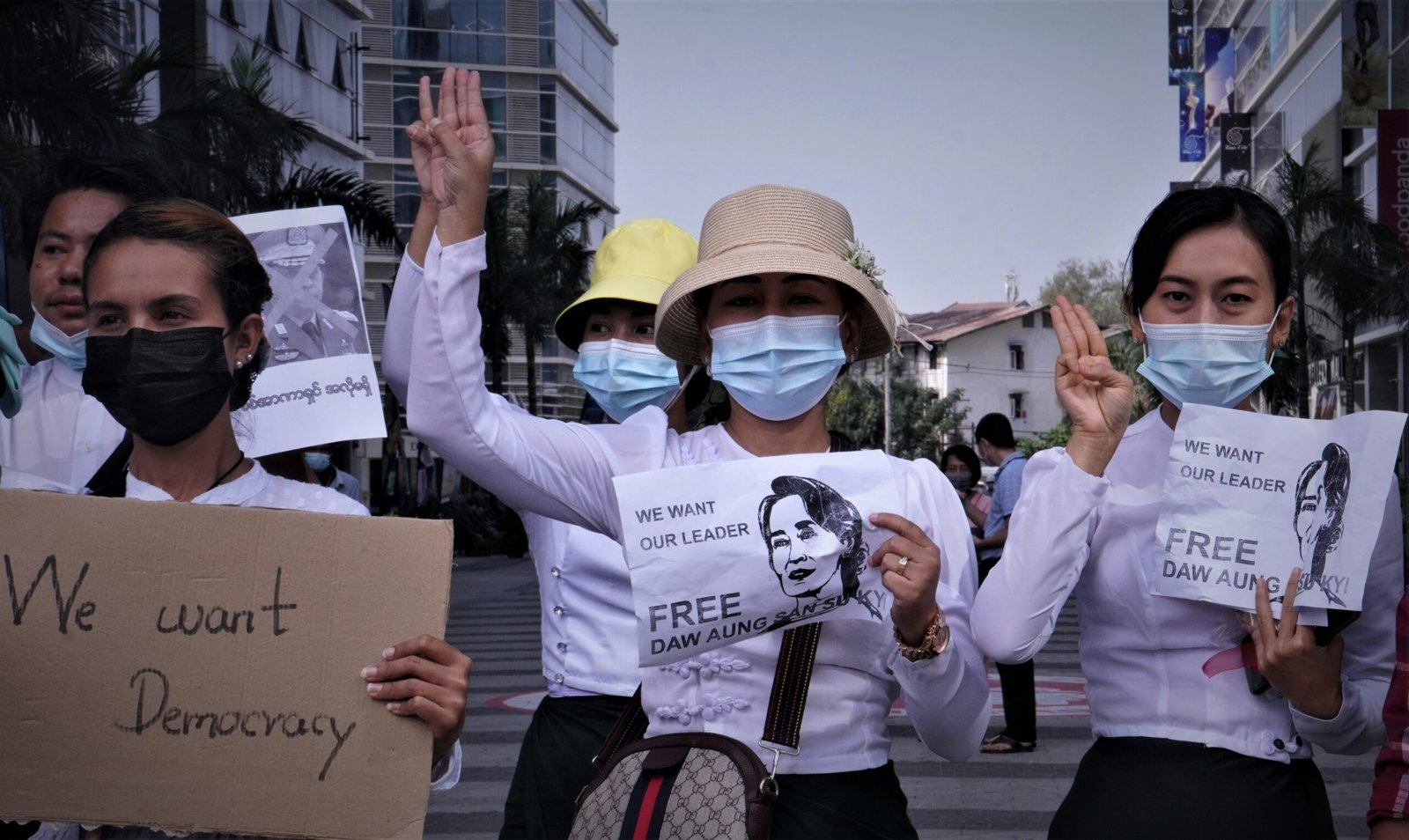
Decades later, on 1 February 2021, the Tatmadaw staged a coup, arresting Aung San Suu Kyi and dismantling the fragile semi-democracy it once pretended to tolerate. Her international reputation had already been damaged by the Rohingya crisis, but within Myanmar’s borders, she remained the singular symbol of civilian authority — a threat the generals could not allow.
The coup triggered:
- Nationwide mass protests
- Brutal crackdowns
- The birth of a full-scale civil war
- A fragmented resistance movement supported by ethnic armed groups
- Severe sanctions by the United States and Europe
- Renewed Chinese influence over Myanmar’s military
- India’s strategic dilemma along its volatile northeastern border
Myanmar today sits at the crossroads of an escalating geopolitical contest.
Russia and China back the Military Junta strategically; the US backs democratic resistance; India maintains cautious engagement to secure border states and counter Chinese influence. Meanwhile, ASEAN remains divided and ineffective.
A State on the Brink
Myanmar is now a collapse case study.
The economy has imploded.
Healthcare systems fractured.
The civil war has expanded into all regions.
With widespread poverty, conflict-driven displacement, and unchecked militia warfare, the country has become fertile ground for:
- human trafficking networks
- armed insurgencies
- transnational crime
- synthetic drug production
- foreign proxy influence
Amid this chaos, the fate of Aung San Suu Kyi — imprisoned, silenced, almost erased from public life — mirrors the fate of Myanmar itself: a nation whose democratic aspirations remain trapped beneath the weight of its Military Junta.
Whether “The Lady” resurfaces in Myanmar’s political narrative will depend not only on its domestic resistance, but on the evolving geopolitical rivalry surrounding the nation.
Bibliography & Sources
- Peter Popham, The Lady and the Peacock: The Life of Aung San Suu Kyi.
https://www.penguinrandomhouse.com/ - Human Rights Watch – Reports on Myanmar military abuses.
https://www.hrw.org/asia/myanmar - International Crisis Group – Myanmar conflict assessments.
https://www.crisisgroup.org/asia/south-east-asia/myanmar - United Nations OHCHR – Rohingya crisis documentation.
https://www.ohchr.org/en/countries/myanmar - The Economist & BBC Archives – Myanmar’s political timeline and the 2021 coup.
https://www.economist.com
https://www.bbc.com/news/world-asia-55902070 - Reuters Special Reports – Tatmadaw structure and China–Myanmar relations.
https://www.reuters.com/world/asia-pacific/