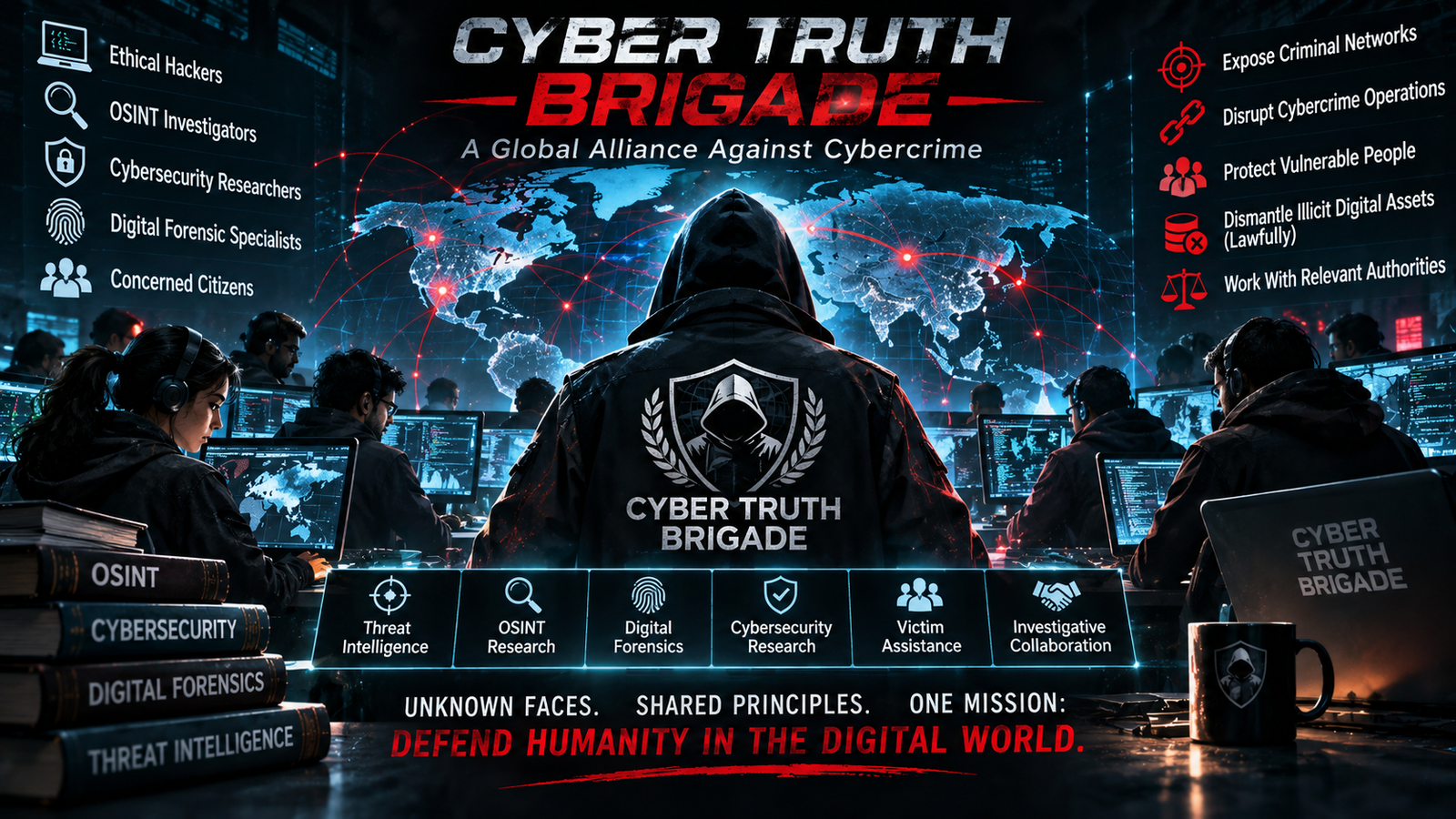
Cyber Truth Brigade: An army without uniforms, without borders, without a headquarters in the traditional sense. An alliance of people who believe that technology should protect humanity rather than become its greatest instrument of exploitation.
There is an idea that has occupied my mind for quite some time. It is ambitious, perhaps unconventional, and certainly born out of my complicated experiences with the darker corners of the digital world.
I call it the Cyber Truth Brigade.
I imagine a global community of individuals who remain largely unknown to one another, united not by nationality, religion, political ideology, or personal interests, but by a shared commitment to protecting people from cybercriminals.
I want to bring together ethical hackers, cybersecurity researchers, OSINT investigators, digital forensic specialists, journalists, programmers, and ordinary individuals who possess the knowledge and determination to make the internet a safer place.
Not an organisation built around personalities. Not a group pursuing fame or financial rewards. Not a collection of individuals seeking recognition for their technical abilities.
An alliance built around a principle: the internet should not belong to those who exploit the vulnerable.
The experiences that inspired the idea
My interest in this idea did not emerge from an abstract fascination with cybersecurity.
My experiences in Russia, Cambodia, and Myanmar exposed me to circumstances that profoundly influenced how I perceive technology, organised crime, and human exploitation.
I have encountered environments where technology was allegedly used as an instrument of coercion, manipulation, financial exploitation, and criminal enterprise.
In Myanmar, my experiences inside a cybercrime compound gave me a particularly disturbing perspective on the infrastructure supporting online criminal operations.
Behind every fraudulent website, phishing campaign, impersonation scheme, and online exploitation operation, there can be an infrastructure of people, systems, accounts, communication channels, and financial arrangements.
The internet has made it possible for criminal networks to operate across geographical boundaries while exploiting the limitations of traditional law enforcement.
And I began wondering something:
What if the people who understand technology best could work together to protect those who understand it least?
What if ethical hackers, investigators, researchers, and cybersecurity professionals could form an international network dedicated to confronting digital exploitation?
That question eventually became the foundation of Cyber Truth Brigade.
An army, but not an army of destruction
I deliberately use the word brigade because I imagine a coordinated collective rather than a conventional cybersecurity community.
However, there is an important distinction between what I envision and the methods employed by criminal hacking groups.
I initially imagined a collective that would actively dismantle the digital assets of cybercriminal organisations. The idea was to make criminal infrastructure unreliable, disrupt their operations, and prevent them from exploiting additional victims.
But I also recognise that unauthorised destruction of websites, servers, databases, or other digital assets can harm innocent people, compromise evidence, and undermine investigations.
That cannot become the foundation of an ethical organisation.
I want Cyber Truth Brigade to be formidable without becoming another criminal collective.
Its members should work through lawful threat intelligence, defensive cybersecurity, responsible vulnerability disclosure, digital forensics, evidence preservation, victim assistance, and coordinated reporting to appropriate authorities and service providers.
Where criminal infrastructure is identified, the objective should be to facilitate its lawful disruption through the organisations and institutions authorised to act.
The distinction matters.
If we claim to fight digital exploitation, we cannot justify becoming digital exploiters ourselves.
Unknown individuals, one common purpose
One of the most interesting aspects of my vision is the idea of anonymity.
I imagine capable individuals scattered across continents, often completely unknown to one another, contributing their expertise to a common purpose.
Some might be cybersecurity professionals working in established companies. Others might be independent researchers, ethical hackers, digital investigators, or individuals who simply refuse to watch vulnerable people being exploited.
They would not need to become public personalities.
Their contributions could be measured through the quality of their research, the accuracy of their findings, the victims they help, and the criminal operations they help authorities investigate.
I want the Brigade to value competence over popularity and evidence over assumptions.
Of course, anonymity cannot mean the absence of accountability. A serious organisation would need trusted leadership, verified membership, internal oversight, secure communication, and strict rules governing access to sensitive information.
Privacy should protect legitimate contributors, not shield misconduct.
What I want the Brigade to accomplish
I imagine several interconnected divisions operating under one common mission.
- Threat Intelligence: Identifying emerging cybercrime trends, criminal infrastructure, and indicators of compromise.
- OSINT Research: Investigating publicly available information to identify connections between criminal networks and document their activities.
- Digital Forensics: Preserving, analysing, and authenticating digital evidence.
- Victim Assistance: Helping victims understand incidents, secure compromised accounts, and report exploitation.
- Cybersecurity Research: Identifying vulnerabilities and responsibly reporting them to the relevant organisations.
- Investigative Collaboration: Sharing verified findings with journalists, cybersecurity organisations, and appropriate law enforcement agencies.
Each division would have clearly defined responsibilities, documented procedures, and safeguards against misuse.
I would particularly like the Brigade to help expose the digital infrastructure supporting human trafficking, online scam compounds, financial fraud, identity theft, and other forms of organised cybercrime.
These are not merely technological problems. They are human problems facilitated by technology.
The principles I refuse to compromise
I don’t want Cyber Truth Brigade to become an organisation driven by revenge.
I have experienced circumstances that have left me angry, distrustful, and deeply disappointed in humanity. But building an organisation around personal resentment would be a mistake.
Its purpose must be larger than the experiences of its founder.
I want five principles to define it:
- Legality: No unauthorised attacks, destruction, intrusion, or vigilantism.
- Evidence: Every serious allegation must be supported by verifiable material.
- Humanity: Victims must remain at the centre of every investigation.
- Accountability: Members must be answerable for their actions.
- Independence: No criminal organisation, political faction, or commercial interest should control its investigative priorities.
These principles are not restrictions on the mission. They are what would make the mission credible.
A dream larger than its founder
Sometimes I wonder whether I am being excessively ambitious.
Building a global network of capable cybersecurity professionals and investigators is not a small undertaking. It requires infrastructure, trust, resources, governance, legal expertise, and years of sustained effort.
There will be disagreements. There will be operational challenges. There will be questions about funding, jurisdiction, privacy, and accountability.
But I don’t think every ambitious idea needs to begin with an established institution.
Sometimes it begins with a person who believes something should exist, even when nobody has built it yet.
Cyber Truth Times is my attempt to build an independent investigative journalism platform.
Cyber Truth Brigade is a different but complementary ambition: a community of people who can translate technical expertise into meaningful protection against digital exploitation.
One documents the truth. The other helps defend the digital spaces in which that truth exists.
I don’t know how far either ambition will go.
But I know what I want them to represent.
I want a future in which cybercriminals cannot assume that their victims are helpless, that geographical boundaries guarantee protection, or that technical sophistication makes them untouchable.
I want researchers to have a place where their work matters, victims to have people willing to listen, and independent investigators to have a responsible network with which to collaborate.
And perhaps, somewhere across the world, there are already individuals who share this vision without knowing that others are thinking about the same thing.
I want to find those people.
I don’t want an army that makes people afraid of technology. I want a brigade that makes criminals think twice before using technology to destroy someone else’s life.
Perhaps the greatest achievement would be to build something that eventually operates independently of me, guided by principles rather than personalities.
Because the ultimate purpose was never to create an army for the sake of having an army.
It was to create a community that makes the digital world a little less dangerous for everyone.
Cyber Truth Brigade. Unknown faces. Shared principles. One mission: defend humanity in the digital world.
One distinction worth preserving: The Brigade should be conceived as a lawful, accountable cyber-defence and investigative coalition, not a vigilante hacking group. That distinction will determine whether it becomes a credible international initiative or creates legal and ethical liabilities.