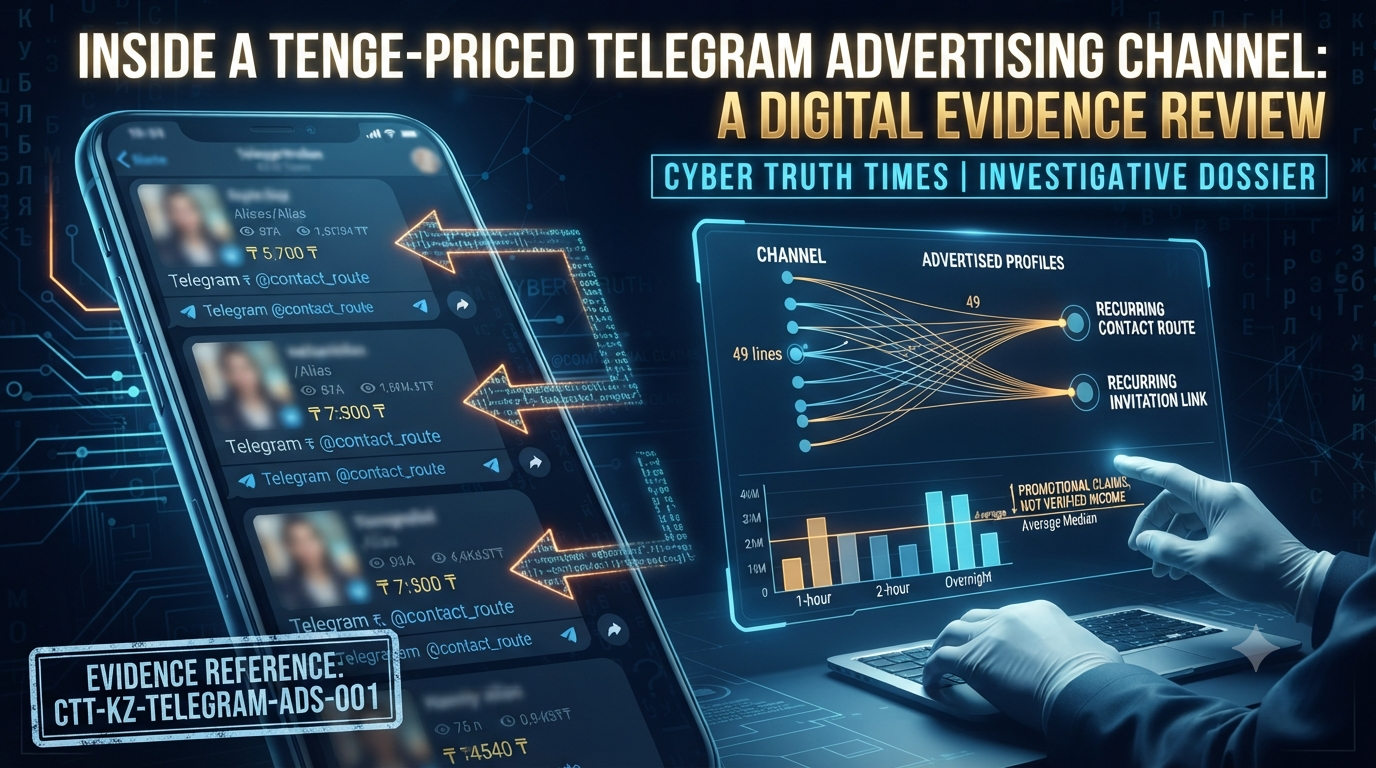
Cyber Truth Times examines Kazakhstan Telegram Escort Advertising Dataset that contains 199 Telegram messages, 49 advertising posts, repeated contact links, photographs and videos in a tenge-priced channel export.
Introduction: Kazakhstan Telegram Escort Advertising Dataset
Telegram has become an important platform for circulating commercial advertisements, private-channel promotions, and referral-based online communities. In some cases, channels use repeated promotional formats, visual catalogues, and direct-messaging links to connect prospective customers with advertised services. Understanding how these arrangements operate requires more than examining individual posts. It requires studying the message structure, media files, contact routes and patterns of repetition across the available digital evidence.
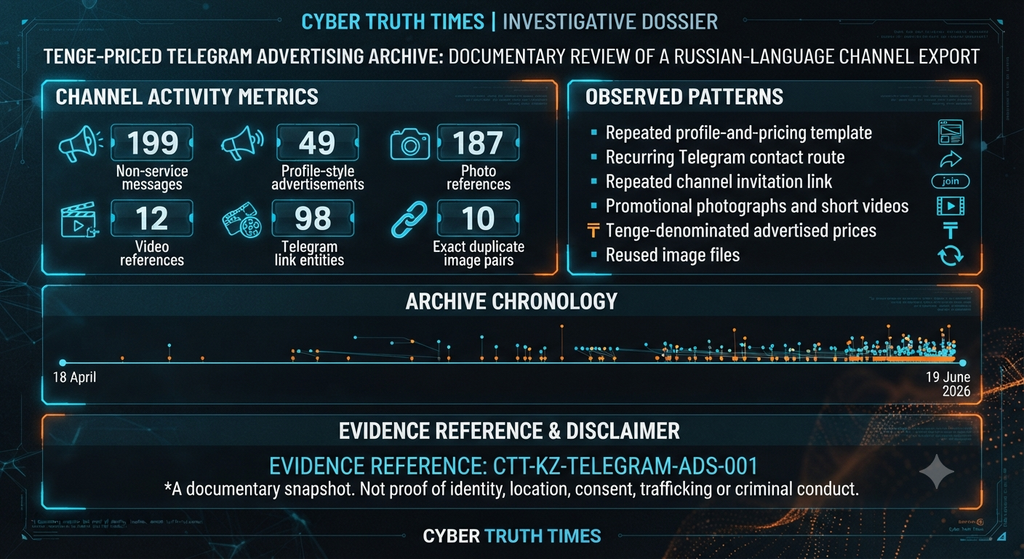
Cyber Truth Times examined a Telegram export supplied for this investigation and labelled Inside a Tenge-Priced Telegram Advertising Channel: A Digital Evidence Review of 199 Messages.zip. The archive contains 199 non-service message records, 49 structured profile-style advertising posts, 187 photo references, 12 video attachment references and 98 Telegram link entities.
The channel’s exported display name is Лучшие модели 💋, while its channel-creation service record contains the title Интим Монолит. The substantive advertising material reviewed dates from 18 April to 19 June 2026. The advertisements use Kazakhstani tenge (₸) when stating prices.
The dataset offers a documentary snapshot of a Telegram advertising channel’s promotional format, media catalogue and referral structure. It does not, on its own, establish the identities of the people depicted, the physical location of the operation, or whether any criminal activity took place.
What the dataset contains
The export contains 199 non-service messages and one channel-creation service record. Fifty of the messages contain text. Forty-nine are structured profile-style advertisements, while one contains only a short emoji message.
The profile advertisements follow a recurring template. They generally include a name or alias, physical measurements, prices for different durations, payment references, a Telegram contact route and a channel invitation link. This consistency is significant because it suggests that the posts are not simply independent text entries. They use a recognisable promotional format designed to present profiles in a standardised way.
The substantive message chronology runs from 18 April through 19 June 2026. The export also contains a channel-creation record dated 22 July 2023. That earlier record documents the creation event recorded in the export; it should not be interpreted as proof that the advertising activity visible in the 2026 messages existed continuously from that date.
A recurring advertising template
One of the clearest findings is the consistency of the 49 profile-style advertisements. Each uses a similar presentation: a short availability statement or profile introduction, a name or alias, measurements, three price categories and contact information.
The listed prices are denominated in tenge. Across the 49 profile advertisements, the stated one-hour prices range from 50,000 to 200,000 tenge, with a median of 120,000 tenge. Two-hour prices range from 80,000 to 400,000 tenge, with a median of 240,000 tenge. The stated overnight prices range from 150,000 to 750,000 tenge, with a median of 350,000 tenge.
These figures describe the prices displayed in the advertisements. They are not verified payments, completed transactions or evidence of actual income. The figures should therefore be treated as promotional claims contained in the source material.
The repeated format provides a useful basis for further investigation. Researchers can compare the advertisements over time, identify changes in listed prices, examine repeated profile aliases and test whether the same promotional material appears in other channels or platforms.
The Telegram contact and invitation structure
The link analysis identified 98 Telegram link entities across the 49 profile-style advertisements. The posts repeatedly direct readers towards the same contact route and the same channel invitation link.
The 98 entities comprise 49 references to a recurring invitation link and 49 references to a recurring contact route. The contact route appears in two formats: a Telegram username-style link and a full HTTPS Telegram URL.
This is one of the most important structural findings in the dataset. The advertising posts appear to use a common contact and referral mechanism rather than providing a different contact destination for every profile. That pattern may help investigators map the relationship between the channel’s promotional content and the account or accounts used to receive enquiries.
It does not, however, establish the identity of the person controlling the contact account, the ownership of the channel, or whether the same individual manages the advertising and the advertised profiles. Those questions require independent corroboration.
Photographs, videos and media reuse
The export contains 187 photo references and 12 video attachment references. The photo references resolve to 183 distinct accessible image paths, with three repeated references and one unavailable-file placeholder. The archive itself contains 191 full-size JPEG files and 183 thumbnail files. Eight JPEG-related files are not referenced by the message records.
A visual review of the accessible photographs and sampled video frames shows promotional glamour, fashion, lingerie and underwear-style imagery. The videos are short clips showing individuals posing or modelling. The media appears to function as a visual catalogue accompanying the text advertisements.
The image comparison also identified ten pairs of files with identical hashes. Exact hash matches indicate that the same digital file appears more than once in the examined media collection. This is a useful finding for media-catalogue analysis, but it does not prove that the same person was advertised under different names or that the material was copied from another website.
The archive does not provide a reliable basis for identifying the people depicted or determining their ages, consent, nationality or location. The examined JPEG files did not contain embedded EXIF metadata that could independently establish the camera, capture time or geographic location.
What the dataset may help investigators establish
The material provides several avenues for further examination.
First, the repeated advertising template can be used to identify related posts and compare the structure of other Telegram channels. Second, the recurring contact route and invitation link provide specific digital identifiers for a wider link-analysis exercise. Third, the repeated images and video material can be compared against other publicly available promotional archives using exact hashes and perceptual similarity methods.
The chronology may also support further work. The substantive advertisements span April, May and June 2026, with 79 message records in April, 75 in May and 45 in June. These figures describe the message records in the export, not necessarily the channel’s complete posting history.
A further investigation could examine whether the contact account appears in other advertising channels, whether the invitation destination connects to related communities, and whether the media files appear elsewhere online. Any such findings would need to be documented separately and independently verified.
Goals, mission and methodology
The goal of this investigation is to document the organisation and observable characteristics of a Telegram advertising channel, identify repeated promotional and referral patterns, and preserve a reproducible record of the source material.
The mission is not to identify the people depicted or to make allegations based on appearance or advertising language. It is to establish what the export actually contains, identify leads that can be independently tested, and make the underlying evidence available for scrutiny.
The examination involved parsing the Telegram export, reviewing all 199 non-service message records, extracting text and link entities, recording message dates and media references, inspecting accessible photographs and video frames, and comparing image files using cryptographic hashes. The results were then separated into direct observations, analytical findings and unresolved questions.
The approach follows established digital-evidence principles: preserve source material, document analytical steps, distinguish original records from interpretations, and avoid conclusions that the available evidence cannot support. Relevant guidance includes the National Institute of Standards and Technology’s Guide to Integrating Forensic Techniques into Incident Response and the Scientific Working Group on Digital Evidence’s guidance on acquiring online content.
Limitations and responsible interpretation
The archive’s filename refers to Kazakhstan, and the advertisements use tenge, but the message records examined do not establish a physical operating location. Currency denomination alone cannot prove that the channel, its administrators or the people depicted were located in Kazakhstan.
The export identifies a channel display name and records a different title in its creation event. It does not provide a complete administrative history or establish who controlled the channel. The repeated contact and invitation links are investigative leads, not proof of ownership.
The JSON export also lacks its final outer closing delimiters. The message records could be parsed after restoring the expected closing structure, without changing the individual entries. This technical limitation is disclosed to support transparency and reproducibility.
Nothing in this dataset independently establishes trafficking, coercion, exploitation, age, consent, identity or the completion of any advertised transaction. Those matters require additional evidence and appropriate corroboration.
Proposed outcome
Cyber Truth Times intends to use this dataset as a documentary starting point for a wider investigation into Telegram sex-advertising networks, their digital intermediaries, referral mechanisms and media-distribution practices.
The next stage should focus on corroborating the recurring contact route, identifying whether the same promotional media appears in other channels, and establishing whether the advertising structure connects to a broader network. Any conclusions about individuals, locations or criminal conduct will require evidence beyond this export.
Access the evidence
The original dataset is made available through the download facility on this page. Researchers should preserve the archive in its original form, document any transformations, and avoid treating promotional claims as independently verified facts.
Evidence reference: CTT-KZ-TELEGRAM-ADS-001
Dataset: Inside a Tenge-Priced Telegram Advertising Channel: A Digital Evidence Review of 199 Messages
Source Format: Telegram HTML and JSON export
CHRONOLOGY: 18 April – 19 June 2026
Editorial note: This report analyses the contents of a Telegram export. It does not verify the identities of individuals depicted or endorse the claims made in the advertisements.
Related Investigation
This dataset forms part of Cyber Truth Times’ 12-part investigative series examining Telegram-based sex advertising, digital promotional ecosystems, external communication infrastructure and the challenges of responsibly investigating online advertising environments.
Read the pillar investigation and explore the broader series: The Telegram Sex-Advertising Economy: Mapping Digital Intermediaries Across Five Telegram Datasets
Disclaimer
This dataset is a limited documentary snapshot of material contained in a Telegram export. The inclusion of a name, telephone number, advertisement, link, location reference or promotional message in the archive does not establish the identity, ownership, authenticity, consent, criminal conduct or legal status of any individual. Cyber Truth Times does not decide that the material establishes human trafficking, sexual exploitation, coercion or organised criminal activity. External links have not been independently verified as to their destination content. Original advertisement photographs were not included in the ZIP archive examined. This evidence release is intended for responsible research, investigative journalism, documentation and public-interest analysis. Readers should avoid using the material to identify, contact, harass, threaten, expose or target individuals.
Bibliography
These sources support the digital-evidence methodology and platform context. They do not independently verify the claims made in the Telegram advertisements.
- National Institute of Standards and Technology (NIST), Guide to Integrating Forensic Techniques into Incident Response — SP 800-86. A reference for methodical examination, preservation and reporting of digital evidence. NIST Computer Security Resource Centre
- Scientific Working Group on Digital Evidence (SWGDE), Best Practices for Acquiring Online Content. Guidance on the acquisition and preservation of online material.
- Scientific Working Group on Digital Evidence (SWGDE), Best Practices for Digital Evidence Collection. Guidance on evidence inventories, documentation and integrity.
- Telegram, Privacy Policy. Official information about Telegram accounts, public usernames, messages, media and public channels.
- Telegram, Terms of Service. Official platform rules concerning spam, scams and prohibited content.
- Reference
- CTT-KZ-TELEGRAM-ADS-001
- Published
- Updated
- Category
- Telegram Investigations
- Tag
- Telegram Escort Group Export