An investigation into the Russian Military Recruitment Network, digital assets, international intermediaries, online advertising campaigns and financial incentives being used to attract foreign nationals into Russian military contract service.
Introduction: What is the Russian Military Recruitment Network
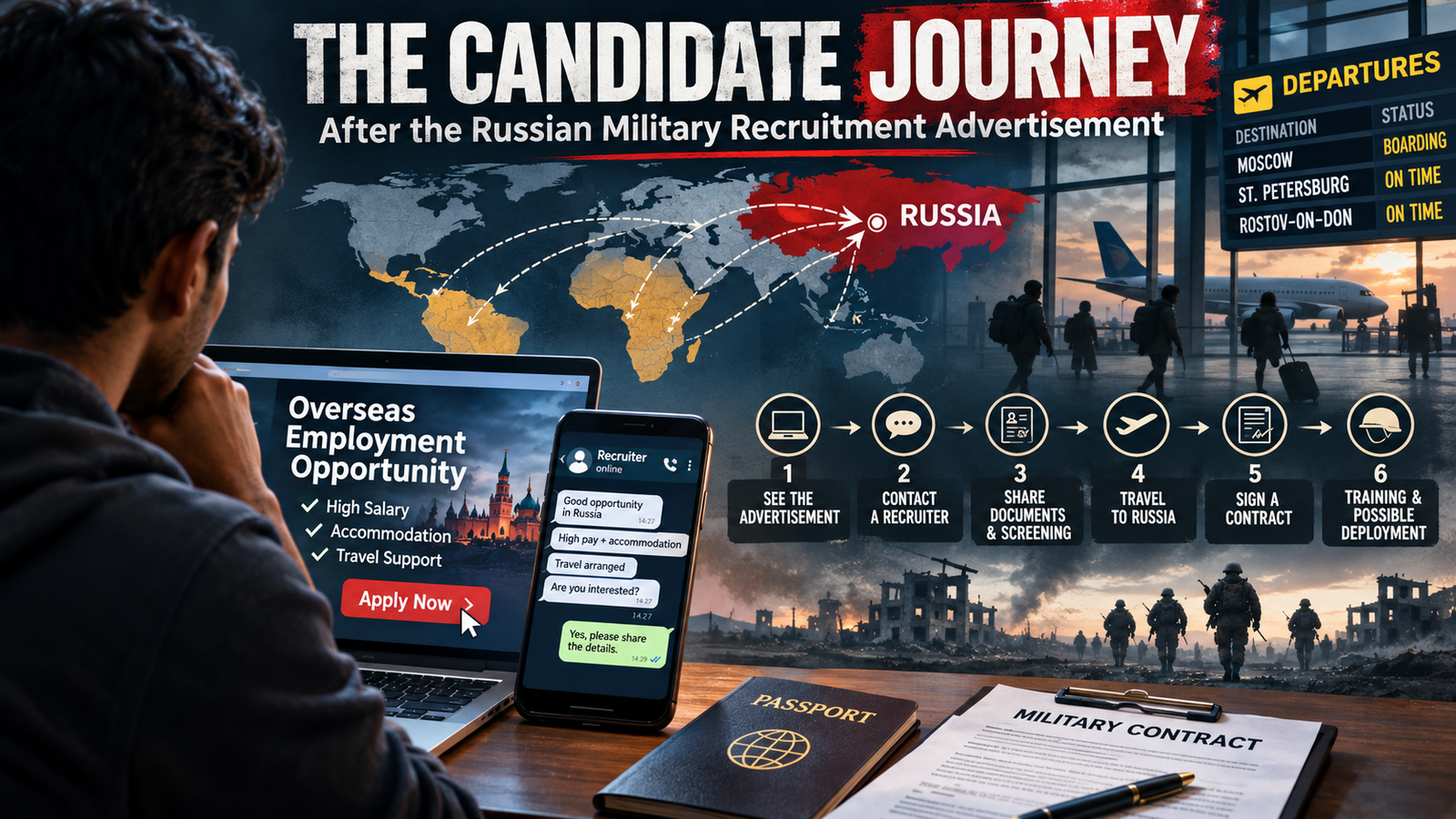
A recruitment advertisement appears on social media. It promises an attractive monthly salary, a substantial signing bonus, free accommodation, assistance with international travel and the possibility of obtaining Russian citizenship.
The advertisement directs interested individuals to a professional-looking website available in several languages. A preliminary application follows, requesting personal information and contact details. Within a short period, a prospective candidate may be communicating with a recruiter through WhatsApp or Telegram.
What initially resembles an international employment opportunity is, in reality, part of a wider Russian Military Recruitment Network.
This is the emerging digital dimension of the Russian Military Recruitment Network.
Cyber Truth Times examined four recruitment websites —
to understand how online recruitment portals present military service, attract foreign applicants and connect prospective candidates with recruitment intermediaries.
The investigation also examined independent research published by the European External Action Service (EEAS), Code for Africa and The Insider.
The findings indicate that the Russian Military Recruitment Network is no longer limited to traditional recruitment offices or government announcements. It increasingly involves multilingual websites, social media advertisements, messaging applications, referral arrangements and commercially available digital infrastructure.
The central question is not simply how the Russian Military Recruitment Network functions. It is how an international digital recruitment ecosystem makes military service accessible, marketable and, in some reported cases, difficult to distinguish from ordinary civilian employment.
1. Four websites, four recruitment identities
The first stage of this investigation involved examining four publicly accessible websites advertising or facilitating Russian military contract service for foreign nationals.
Although their presentation and organisational claims differ, all four illustrate how online platforms can function as entry points into international military recruitment.
JoinRussianArmy.com: An independent application-support service
JoinRussianArmy.com presents itself as an independent application-support service for foreign citizens interested in Russian military contract service.
The website explicitly states that it is not a government website. It describes a preliminary application process in which prospective candidates provide citizenship, current location, contact information and passport-related information.
Its published recruitment material advertises monthly payments starting at ₽210,000 and one-time contract payments of ₽900,000 or ₽2.6 million, depending on the candidate’s circumstances.
It also describes assistance with visa documentation, travel arrangements, temporary accommodation and the process of reaching official military selection authorities.
The website supports multiple languages, including English, French, Russian, Spanish, Portuguese, Arabic, Thai, Bengali, Indonesian, Malay, Japanese, Vietnamese, Hindi, Urdu, Nepali and Filipino.
Its multilingual presentation is significant because it demonstrates how a recruitment intermediary can make military contract information accessible to prospective candidates across geographically diverse markets.
The website also acknowledges that military service carries risks of serious injury, disability and death.
These are the operator’s published representations. Cyber Truth Times has not independently verified its legal authorisation, advertised payments or recruitment outcomes.
Russian-Army-Join.com: The Military Staff Agency connection
The second website, Russian-Army-Join.com, identifies itself as a recruitment channel associated with the Military Staff Agency (MSA).
It advertises a structured nine-stage recruitment process involving application submission, interviews, visa processing, medical examinations, travel arrangements, arrival in Russia and contract signing.
The website claims to have served more than 8,500 candidates across 46 countries and advertises a signing bonus exceeding $30,000.
It also publishes recruitment categories covering combat roles, technical support, logistics, medical services, intelligence analysis and drone operations.
An important feature is its connection to a separate partner platform, MSA Connect, which advertises recruitment partnerships and financial commissions.
These figures and organisational claims originate from the websites themselves. They should not be interpreted as verified recruitment statistics or proof of government authorisation.
WorkInRussia2025.ru: Recruitment associated with Bashkortostan
The third website, WorkInRussia2025.ru, is particularly significant because it has been examined by independent investigative journalists.
The website identifies the Central Headquarters for the Formation of Volunteer Battalions of the Republic of Bashkortostan as the organisation recruiting foreign citizens for military service under contract.
It advertises recruitment to nationals from several countries and regions, including Cambodia, Indonesia, Myanmar, Zimbabwe, Colombia, the Philippines and others.
Its English-language page advertises a one-time payment of up to $65,000, monthly payments of $3,500 and a contract payment of up to ₽2 million in its detailed recruitment process.
The difference between its headline financial promise and its detailed payment description warrants further examination.
The Insider’s May 2026 investigation independently examined this recruitment operation, its website and its connections to the Bashkortostan volunteer recruitment structure.
The publication also identified a related website, WorkInRussia2026.ru, illustrating how recruitment portals can be expanded or replaced while retaining similar recruitment messaging.
WorkCrewAgency.com: An international recruitment and information partner
The fourth website, WorkCrewAgency.com, describes itself as an international recruitment and information partner for Russian military contract service.
Its website advertises recruitment for assault and tactical units, drivers, construction workers, drone operators, medical personnel, engineers and communications specialists.
It claims to have facilitated more than 500 placements across 30 countries, with a reported success rate of 98%.
These figures are self-reported.
Its current website provides application access through WhatsApp and describes a process involving document review, interviews, medical assessment, military preparation and contract signing.
Work Crew Agency is especially relevant because its name appears in the EEAS investigation into Russia’s foreign military recruitment infrastructure. Code for Africa subsequently identified a technical relationship between its digital infrastructure and that of Military Staff Agency.
The four websites therefore provide a useful starting point for examining the wider recruitment ecosystem, although their individual ownership and organisational relationships must be established separately.
2. The EEAS investigation: A recruitment network spanning continents
An important development in understanding this phenomenon came on 14 August 2026, when EUvsDisinfo published the investigation From Social Media to the Front Line: Russia’s Foreign Recruitment Pipeline, based on research by the European External Action Service.
The investigation identified at least 35 recruitment websites operating in as many as 40 languages.
It also identified four recruitment brands:
- Military Staff Agency
- Work in Russia
- IRC Russian Bear
- Work Crew Agency
The report established that Military Staff Agency, Work in Russia and IRC Russian Bear shared WhatsApp contact details associated with an organisation called Central Headquarters, registered in Russia and located alongside a volunteer battalion training centre in Bashkortostan.
The report also discussed Work Crew Agency as part of the wider recruitment ecosystem.
Importantly, the EEAS findings did not establish that all four brands had identical ownership or operated as one organisation.
The geographical scope of the advertising activity is particularly noteworthy.
Investigators documented campaigns targeting audiences in Africa, Latin America and Southeast Asia. The advertising material appeared in languages including French, Spanish, Indonesian, Thai, Malay and Arabic.
The investigation also documented 85 paid recruitment advertisements on Meta platforms, of which 78 were no longer accessible when the report was published.
The findings demonstrate that online recruitment can operate across national boundaries without requiring a conventional recruitment office in every target country.
Source: EUvsDisinfo – From Social Media to the Front Line.
3. From social media advertisements to recruitment applications
One of the most important aspects of this recruitment ecosystem is its digital acquisition model.
Prospective candidates may encounter recruitment material through Facebook advertisements, social media pages, messaging applications or third-party websites.
The advertisement may direct users towards a dedicated recruitment portal or an intermediary landing page.
From there, the candidate can be encouraged to submit personal information or communicate directly with a recruitment representative.
The October 2026 investigation by Code for Africa, conducted through its iLAB and the African Digital Democracy Observatory, provides further evidence of this model.
Its report, Death Benefits: The Industry Selling Russia’s War as a Job, mapped 289 digital assets across 33 recruitment operations.
The asset count comprised:
- 197 web assets, including domains, subdomains and platform-hosted pages.
- 19 social media accounts or pages.
- 73 messaging accounts or channels across WhatsApp, Telegram, VK and Russia’s MAX platform.
The researchers reported that 17 of the 33 recruitment groups had been verified by name, while the remaining groups were still under investigation.
The investigation documented advertisements that presented military recruitment as civilian employment, including construction work, security positions and film-related opportunities.
In one example, advertisements targeting different African audiences promoted substantially similar opportunities but used different descriptions. One explicitly referred to joining the Russian armed forces, while another presented the opportunity as employment in Russia.
This difference matters.
A prospective candidate responding to an advertisement for military service is making a fundamentally different decision from someone responding to what appears to be an ordinary civilian employment opportunity.
The distinction between the advertised opportunity and the actual contractual obligation is therefore a central question for investigators.
Source: Code for Africa investigation – Inside the Covert Industry Selling Russia’s War as a Civilian Job.
4. The recruitment intermediary economy
The recruitment process does not necessarily end when an applicant submits an online form.
Intermediaries can play a role in document preparation, communication, travel coordination and referrals to official recruitment authorities.
The MSA Connect platform illustrates how recruitment partnerships can be monetised.
Its published materials invite individuals and organisations to become recruitment partners and advertise commissions for successful referrals.
This introduces an important economic dimension to the investigation: the possibility that international recruitment is supported by a network of intermediaries who have financial incentives to identify and refer candidates.
Code for Africa’s research also identified recruitment operations openly inviting agents and agencies to supply candidates in exchange for commissions.
However, the existence of commission-based recruitment does not establish that every intermediary is part of the same organisation or that every candidate has been recruited deceptively.
The questions requiring further investigation include:
- Who legally owns the recruitment companies?
- Who pays the intermediaries?
- What conditions trigger commission payments?
- Are payments made for applications, signed contracts or completed enlistments?
- How are recruitment agents identified and supervised?
- What happens when a candidate withdraws an application?
These questions are essential for understanding the commercial structure behind international military recruitment.
5. Digital infrastructure: The connections behind the websites
The websites are only the visible layer of the Russian Military Recruitment Network ecosystem.
Their technical infrastructure may reveal relationships that are not immediately apparent from their branding.
Code for Africa’s investigation identified a shared Google Tag Manager container connecting Military Staff Agency and Work Crew Agency.
The report also documented common advertising and measurement technologies across parts of the wider recruitment ecosystem.
A shared analytics or tracking identifier can provide evidence of a technical relationship, shared website development or common measurement infrastructure.
It does not, on its own, prove common ownership or operational control.
The researchers also documented the use of commercially available website-building platforms, hosting providers, domain services and digital advertising tools.
This is significant because it demonstrates that international recruitment operations can use ordinary commercial technology to establish multilingual websites, collect application information and manage advertising campaigns.
For investigative journalists, this creates several potential lines of inquiry:
- Historical domain registration records.
- Passive DNS and hosting changes.
- Shared analytics and advertising identifiers.
- Certificate history.
- Website source-code similarities.
- Contact information and messaging identifiers.
- Archived recruitment advertisements.
These indicators should be examined collectively rather than treated as independent proof of ownership.
6. The human consequences of Russian Military Recruitment Network
The digital infrastructure becomes more consequential when examined alongside the experiences of foreign nationals who travelled to Russia.
The Insider’s May 2026 investigation documented cases involving Kenyan nationals who reportedly travelled after being promised civilian employment.
One family described a relative who believed he was travelling to Russia for work as a security guard.
The publication also discussed recruitment advertisements promising signing payments, accommodation, food, medical care and travel assistance.
Its reporting drew on accounts from relatives, government statements and other investigative material.
Separately, the investigation published by EUvsDisinfo described cases involving foreign nationals who believed they were travelling for civilian employment before ending up in Russian military service.
These reports illustrate why the distinction between voluntary military enlistment and deceptive recruitment matters.
Foreign nationals may knowingly choose military service. Others may be attracted by financial incentives without fully understanding the consequences. Some reported cases involve allegations of deception, coercion or exploitation.
These categories must not be conflated.
A credible investigation must establish what each individual was told, what documents they signed, whether they understood the language of the contract and whether they could freely withdraw.
The ultimate consequences can include serious injury, death, disappearance and prolonged separation from families.
7. India’s warning: An important national security and public safety dimension
India has a direct interest in this issue.
The Ministry of External Affairs has repeatedly warned Indian nationals against joining the Russian armed forces.
In its latest reported advisory of 15 November 2026, the government urged Indians travelling to Russia to exercise extreme caution when pursuing employment opportunities.
It warned against unverified agents and non-public recruitment entities, including voluntary groups.
The advisory also addressed cases in which individuals knowingly pursued Russian military enlistment in anticipation of receiving financial benefits and later seeking assistance from the Indian government to secure their release.
The Ministry reiterated that this was a dangerous course of action and strongly discouraged it.
It also stated that the Indian government remained engaged with Russian authorities regarding the safety, well-being and early discharge of Indian nationals serving in the Russian armed forces.
This warning is especially relevant when examining websites that advertise international recruitment and provide application-support services.
The investigation must determine whether Indian nationals are being approached through these or similar digital channels, whether any intermediaries operate within India and whether candidates are being provided with accurate information about the nature of the service.
Source: DD News – MEA Advises Indians Against Joining Russian Armed Forces.
8. What remains unanswered?
Despite the growing body of independent research, several important questions remain unresolved.
First, the legal ownership and operational control of every recruitment website have not been established.
Second, the complete financial relationships between recruitment intermediaries remain unclear.
Third, the number of foreign nationals who actually enter military service through individual websites cannot be reliably inferred from website traffic, application claims or advertising figures.
Fourth, technical relationships between websites do not automatically establish a common command structure.
Finally, the precise handling of applicants’ passport information, contact details and personal documents requires further investigation.
These gaps are not reasons to dismiss the findings. They identify where additional reporting is required.
Cyber Truth Times will examine these issues through independent OSINT research, documentary analysis, public records and interviews with relevant sources.
Conclusion: An international recruitment ecosystem deserves closer scrutiny
The four websites examined in this investigation demonstrate how digital platforms are the digital offshoot of the Russian Military Recruitment Network.
Independent research by the EEAS, Code for Africa and The Insider provides a broader picture of an international recruitment ecosystem involving multilingual websites, social media advertising, intermediary organisations, messaging applications and financial incentives.
The evidence also demonstrates that the ecosystem is not necessarily one centrally owned recruitment company. It includes multiple brands and operations with differing levels of documented technical and organisational relationships.
That distinction is essential.
The central investigative challenge is to move beyond the websites themselves and establish who operates them, how candidates are sourced, how intermediaries are compensated and what happens to applicants after they enter the recruitment process.
For prospective recruits, the consequences may extend far beyond an online application or an overseas employment opportunity.
For governments, the issue involves consular protection, cross-border recruitment, possible exploitation and the safety of their citizens.
For investigative journalists, it presents an important opportunity to examine how digital advertising and international recruitment infrastructure intersect with a continuing armed conflict.
The Russian Military Recruitment Network pipeline begins online. Understanding who operates it, who benefits from it and what happens to the people who enter it requires evidence that goes beyond the advertisements.
About this investigation
This article is the opening instalment of The Digital Recruitment Pipeline, an investigative series by Cyber Truth Times examining the Russian Military Recruitment Network, online recruitment, international intermediaries, digital advertising and the sourcing of foreign manpower for Russian military service.
The investigation into the Russian Military Recruitment Network draws on publicly accessible recruitment websites, independent investigative reporting and official government statements.
The financial figures, candidate statistics and organisational descriptions attributed to recruitment websites are presented as claims made by those operators unless independently corroborated.
The article does not establish that all four websites share ownership or that every foreign recruit has been deceived or coerced.
Bibliography and primary sources
- European External Action Service / EUvsDisinfo – From Social Media to the Front Line: Russia’s Foreign Recruitment Pipeline (14 August 2026)
- Code for Africa / Stop Russian Recruiters – Inside the Covert Industry Selling Russia’s War as a Civilian Job (6 October 2026)
- The Insider – Kremlin-Style Colonialism: Russian Propaganda Is Actively Preparing Africans for Military Service in Ukraine (15 May 2026)
- DD News – MEA Advises Indians Against Joining Russian Armed Forces, Urges Caution Over Job Offers (November 2026)
- Politico / Hromadske – Russian Network Disguises Military Recruitment as Jobs to Lure Foreign Workers (22 September 2026)
Recruitment websites examined
- JoinRussianArmy.com
- Russian-Army-Join.com – Military Staff Agency
- WorkInRussia2025.ru – English
- WorkCrewAgency.com
- MSA Connect – Recruitment Partner Platform
Research note: Website content and external reporting were reviewed for this article as of 16 November 2026. Website claims and third-party investigative findings have been distinguished throughout.
For deeper investigations on such topics, see our Cybercrime Investigations & Exposes.