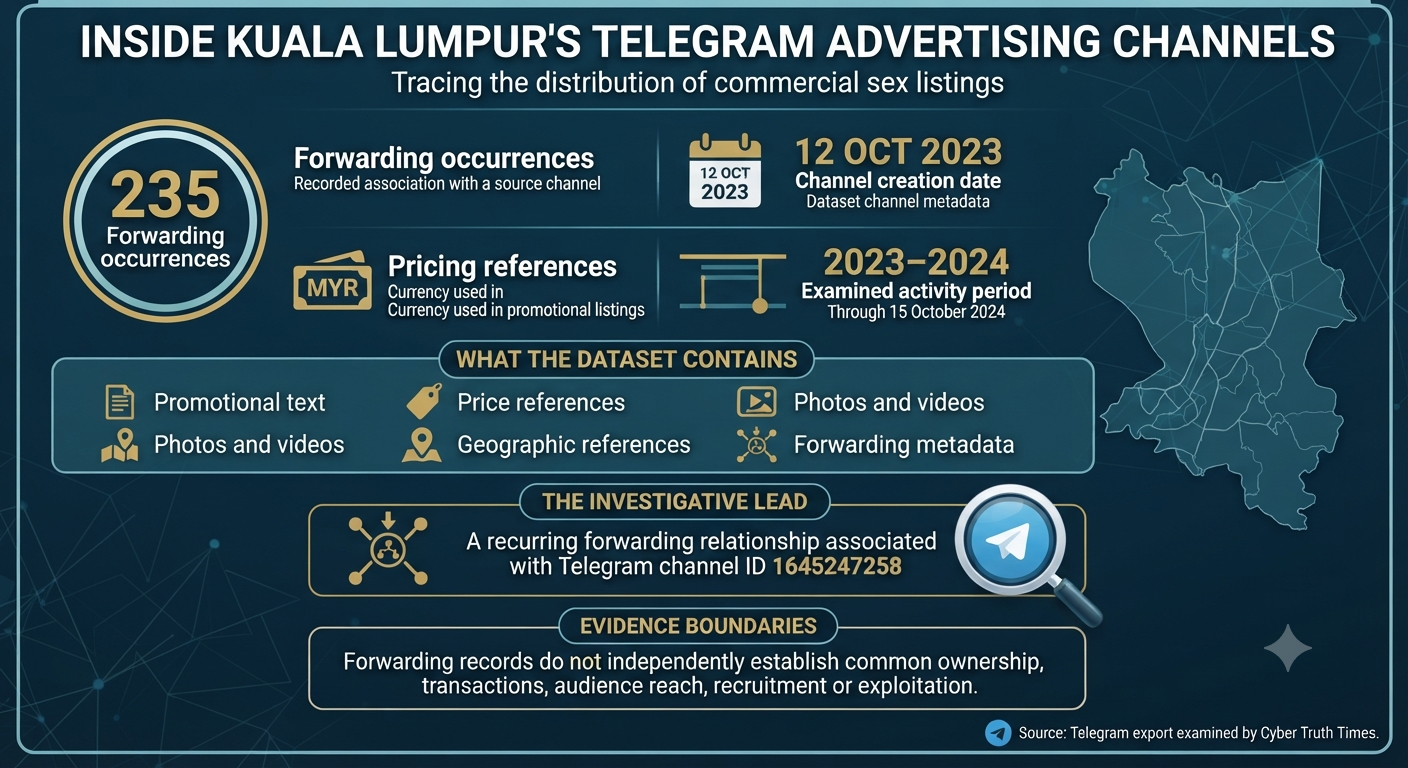
Cyber Truth Times investigates Inside Yangon’s Telegram Advertising Infrastructure, containing recurring phone numbers, digital referrals, advertisements and promotional payment claims.
Introduction: Yangon’s Telegram Advertising Infrastructure
Telegram has become a digital platform where advertising, referrals, messaging and media distribution can coexist within a single ecosystem. In markets where commercial services are promoted through messaging applications, public channels and contact accounts can provide researchers with a view into how promotional content is distributed and how prospective customers are directed toward advertisers.
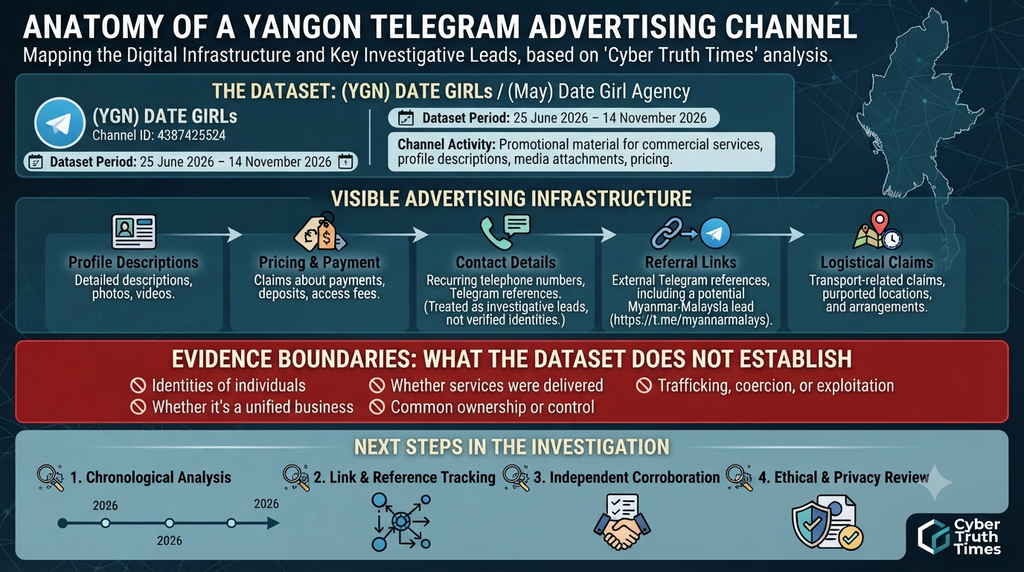
Cyber Truth Times examined a Telegram dataset associated with the channel (YGN) DATE GIRLs, also identified in the records as (May) Date Girl Agency. The dataset contains advertising material, profile-style listings, recurring contact references, telephone numbers, promotional links and descriptions of arrangements involving payments, deposits and transport.
The material provides a basis for examining the visible advertising infrastructure within the dataset: how listings are presented, how contact details recur, how external Telegram references appear and how advertisements communicate purported arrangements to potential customers.
The records also raise questions about the relationship between advertising channels, contact accounts and referral mechanisms. However, the available dataset does not independently establish the identity of the individuals behind these accounts, whether advertised services were delivered, whether the advertisements represent a unified business or whether any individuals were subjected to coercion or exploitation.
This report therefore focuses on observable digital records, recurring advertising features and investigative leads while distinguishing documentation from inference.
1. The Dataset: A Yangon-Focused Telegram Advertising Channel
The dataset examined by Cyber Truth Times originates from a public Telegram channel identified as (YGN) DATE GIRLs, with the alternative recorded title (May) Date Girl Agency.
The channel’s recorded identifier is 4387425524.
According to the dataset metadata, the channel was created on 25 June 2026, and the records contain visible activity extending through 14 November 2026.
The dataset includes promotional material associated with advertisements for commercial sexual services. The posts contain profile-style descriptions, photographs and videos, pricing references, contact information and other promotional details.
The material also includes references to transport, payment arrangements, deposits, access to photographs and instructions relating to purported locations or arrangements.
These features make the dataset relevant to an examination of digital advertising infrastructure and the use of Telegram as a channel for distributing promotional content.
The records are not an independently verified catalogue of services, people, establishments or transactions. They are a collection of promotional material and associated metadata that must be evaluated within their evidentiary context.
2. The Channel’s Advertising Format
The channel’s promotional material appears to follow recurring advertising formats.
Posts contain descriptive text, media attachments, price references and contact information. Some listings include additional details about purported arrangements or the process of engaging with the advertiser.
This format is relevant because it illustrates how advertisements can be presented through a messaging platform rather than through a conventional website or publicly accessible commercial directory.
The channel’s posts provide a record of the content being circulated. They do not independently verify the accuracy of the information presented.
The advertising structure can nevertheless be documented through several observable elements:
- Profile-style descriptions.
- Photographs and video attachments.
- Pricing and payment references.
- Contact details.
- Telephone numbers.
- Referral links and Telegram account references.
- Transport-related claims.
- Promotional instructions.
- Deposit and access-fee references.
Together, these features form the visible advertising structure represented in the dataset.
3. Recurring Telephone Numbers: An Investigative Lead
One of the notable features of the dataset is the recurrence of telephone numbers within promotional material.
Two telephone numbers appear repeatedly in the records examined by Cyber Truth Times. For publication purposes, the numbers are withheld from this article because their appearance in promotional content does not establish the identity, role or circumstances of the individuals associated with them.
The recurrence of contact details is nevertheless an important investigative observation.
Repeated telephone numbers can help researchers identify patterns in the distribution of advertisements, locate recurring references within a dataset and establish a chronology of how contact details appear across different posts.
However, a recurring number alone does not establish that the same individual authored every advertisement, controlled the channel, managed a business or operated a network.
Telephone numbers may be shared, reassigned, used by intermediaries, connected to multiple accounts or appear in copied promotional content. The records available in this dataset do not independently resolve these possibilities.
The recurring numbers are therefore treated as investigative leads rather than verified identities or evidence of ownership.
A responsible investigation would require corroboration before attributing the numbers to specific individuals, organisations or establishments.
4. Contact Details and the Role of Digital Intermediaries
The dataset contains contact references that appear within advertisements and promotional material.
These references may represent points through which prospective customers are encouraged to communicate with advertisers. In digital advertising environments, contact details can serve as a transition between a public promotional post and a private interaction.
This is an observable feature of the advertising format.
The dataset, however, does not establish the precise role played by each contact reference. An account or telephone number may belong to an advertiser, intermediary, administrator, service provider or another person. The available records do not independently verify these roles.
The appearance of contact details in advertisements is therefore relevant to mapping the digital structure, but it should not be used to make unsupported claims about the individuals associated with them.
Cyber Truth Times treats these contact references as leads that require independent verification.
5. Referral Links and Connections Beyond the Main Channel
The dataset contains Telegram-related links and references to other channels or accounts.
One link recorded in a post dated 25 June 2026 points to the Telegram channel https://t.me/myannarmalays. Its appearance in the dataset is a potential investigative lead involving a Myanmar–Malaysia reference.
The presence of the link establishes that the promotional material included a reference to that Telegram destination. It does not establish that individuals travelled between Myanmar and Malaysia, that recruitment occurred, that a cross-border commercial operation existed or that the linked channel was controlled by the same person or organisation.
The dataset also contains another Telegram invitation link associated with promotional material.
Such links can be relevant to documenting how advertisements reference other digital destinations. Researchers may examine the chronology of their appearance, whether they are repeatedly included in posts and whether the destination’s publicly available content can be independently preserved and evaluated.
However, referral links do not automatically demonstrate a relationship between channel administrators.
A link may be copied, shared, reused, distributed by an intermediary or included in promotional material without the source channel having control over the destination.
The distinction between a referral and an organisational relationship is critical.
The records provide digital references that may merit further investigation, but any claim of a wider network would require additional evidence.
6. Advertising Claims About Payments, Deposits and Access
The dataset includes promotional material referring to payment arrangements, deposits, access to photographs and other financial instructions.
These references are important because they document the language used in advertisements to describe purported commercial arrangements.
Some promotional posts refer to payments or deposits, while others include instructions associated with accessing promotional material or purported services.
Such claims may help researchers understand the format of the advertisements and the types of arrangements advertisers describe.
However, promotional instructions are not evidence that payments were completed.
The dataset does not independently establish whether a deposit was collected, whether a payment was transferred, whether the advertised service was delivered, whether the terms were honoured or whether the person involved had control over the arrangement.
The presence of payment-related language also does not independently establish fraud, coercion or exploitation.
These distinctions matter because digital advertisements can contain inaccurate, misleading, copied or unverifiable statements.
The investigation records payment-related claims as elements of the promotional content, not as verified financial transactions.
7. Transport and Location Instructions
The dataset contains advertisements with transport-related claims, location instructions and references to purported arrangements involving rooms or addresses.
These elements form part of the promotional material and may be relevant to understanding how advertisers communicate logistical details.
However, the records do not independently establish that the locations mentioned were real, that the addresses were accurate, that transport arrangements occurred or that individuals travelled to the locations described.
Location and transport references require corroboration.
A Telegram post containing an address or instruction should not be treated as proof of a physical establishment, a completed visit or the involvement of a third party.
For this reason, Cyber Truth Times avoids publishing sensitive addresses or location details that could expose individuals or facilitate unwanted contact.
8. Media Attachments and the Problem of Authentication
The dataset contains photographs and video attachments associated with promotional posts.
Media files may provide useful material for digital analysis, particularly when examining the chronology of posts, file properties, repeated use of images or similarities between promotional content.
However, the presence of a photograph or video does not independently establish the identity of the person depicted, their age, their nationality, their location or their involvement in the advertised service.
Media metadata may also be incomplete, altered, stripped or inconsistent with the date of publication.
A filename or Telegram post date cannot automatically be treated as the date a photograph or video was captured.
Further examination may involve preserving the original media files where legally and ethically appropriate, documenting file hashes, examining available metadata and conducting lawful image-similarity research.
Any such analysis must consider privacy, consent, the possibility of vulnerable individuals being depicted and the risk of exposing people to harm.
The dataset’s media attachments remain material for further examination, not independently authenticated evidence of the claims made in the advertisements.
9. A Potential Myanmar–Malaysia Digital Referral Lead
The Telegram link recorded in the 25 June 2026 post, which references the destination myannarmalays, is a potentially relevant lead for further examination.
The reference raises a research question concerning the use of Telegram destinations that contain Myanmar–Malaysia references within advertising material.
The dataset, however, does not establish that the link represents a recruitment pipeline, a migration arrangement, a trafficking route or a relationship between operators in the two countries.
The presence of a reference to Malaysia cannot be used to establish cross-border movement.
Further research would need to establish the nature of the destination’s content, its chronology, whether the reference was copied or shared elsewhere and whether any independently verifiable relationship exists between the channels or accounts involved.
The link should be understood as a digital reference within the dataset—not evidence of a confirmed cross-border operation.
10. What the Dataset Establishes
The Yangon dataset contains several findings that can be documented from the available records.
A public Telegram channel
The records identify a public channel with the recorded title (YGN) DATE GIRLs, also referenced as (May) Date Girl Agency.
Recorded channel activity
The dataset’s metadata indicates creation on 25 June 2026 and visible activity extending through 14 November 2026.
Promotional advertisements
The records contain profile-style advertisements, promotional descriptions and media attachments.
Recurring telephone numbers
Two telephone numbers appear repeatedly in the dataset. Their identities and roles remain unverified.
Telegram referral references
The dataset contains links and references to other Telegram destinations, including a link recorded on 25 June 2026 containing a Myanmar–Malaysia reference.
Payment-related and logistical claims
The advertisements contain claims involving pricing, deposits, access to photographs, transport and purported location arrangements.
These findings describe the observable records. They do not independently establish the identities of advertisers, the control of accounts, completed transactions, trafficking, coercion or the existence of a unified commercial network.
11. What the Dataset Cannot Establish
The available records do not independently establish:
- The identities of individuals associated with the channel or contact details.
- Whether the telephone numbers belong to the people described in the advertisements.
- Whether advertisers and channel administrators are the same individuals.
- Whether the channel is part of a wider organised operation.
- Whether the advertisements accurately describe real services.
- Whether transactions or payments occurred.
- Whether advertised locations or transport arrangements were real.
- Whether the linked channels are controlled by the same people.
- Whether individuals travelled between Myanmar and Malaysia.
- Whether any person depicted was coerced, deceived or exploited.
- Whether human trafficking occurred.
- Whether the channel is connected to scam compounds or other criminal organisations.
The absence of these findings in the dataset does not establish that exploitation is absent. It means the available records do not independently demonstrate these allegations.
Human trafficking, forced labour, sexual exploitation and other forms of criminal conduct require evidence specific to the relevant legal and factual elements.
Digital advertising material alone is insufficient to establish those conclusions.
12. Next Steps in the Investigation
Further examination of the dataset may involve several evidence-led avenues.
Preservation of source records
Preserve the original export, document the extraction methodology, record the collection date and retain cryptographic hashes where appropriate.
Chronological analysis
Build a timeline of recurring contact details, advertisements, Telegram references and changes in promotional content.
Contact-reference analysis
Document the occurrence of recurring numbers and account references without publicly exposing sensitive contact information or attributing identities without corroboration.
Referral-link examination
Document the appearance and chronology of referral links, preserve accessible records where appropriate and independently assess whether a relationship between destinations can be established.
Media analysis
Examine available metadata, document hashes and investigate potential media reuse through lawful, ethical methods.
Independent corroboration
Seek independent evidence before attributing ownership, identity, physical locations, transactions or cross-border relationships.
Ethical and privacy review
Assess whether publishing contact details, photographs, links or location information could expose vulnerable individuals or facilitate unwanted contact.
The dataset is a starting point for further investigation. It should not be treated as a definitive account of the people, services or organisations associated with the advertisements.
Conclusion: Mapping Digital References Without Overstating the Evidence
The Yangon Telegram dataset provides a documented view of advertising material containing recurring contact references, telephone numbers, referral links, payment-related claims, transport instructions and media attachments.
These features make the dataset relevant to an examination of how advertising content is presented and how digital contact references appear within promotional material.
The recurring telephone numbers and Telegram links are investigative leads. They may warrant further examination, but the available records do not independently establish identities, ownership, common control, cross-border movement, trafficking or coercion.
The link containing a Myanmar–Malaysia reference is similarly a lead, not proof of a cross-border operation.
Cyber Truth Times’ objective in this report is to document the advertising infrastructure visible in the records while maintaining a clear distinction between observation, inference and independently corroborated evidence.
This investigation forms Part 04 of The Telegram Sex-Advertising Economy, a 12-part series examining five Telegram datasets and the digital advertising patterns they contain.
The series seeks to make the underlying records more transparent, document observable digital structures and identify unanswered questions without drawing conclusions the available evidence cannot support.
Explore the Full Investigation
This report is part of The Telegram Sex-Advertising Economy, a 12-part investigative series by Cyber Truth Times examining five Telegram datasets associated with commercial sex advertising across Malaysia, Cambodia, Myanmar, Dubai and a Russian-language advertising channel. The series examines digital distribution patterns, contact and referral references, advertising infrastructure, promotional claims and the limitations of online evidence. Read our pillar investigation for the overarching findings, methodology, research objectives and complete roadmap of the series.
Access the Dossier & Evidence
The raw Telegram dataset examined in this investigation is available in our Dossier & Evidence section for readers seeking to inspect the underlying records. These files form the documentary basis of our analysis and support transparency, scrutiny and further research. The records should be interpreted cautiously: recurring telephone numbers, referral links, promotional claims and geographic references do not independently verify identities, transactions, ownership, cross-border movement or exploitation.
Investigative Disclaimer
This report analyses promotional material and records contained in a Telegram dataset supplied for journalistic examination. Advertisements, contact details, telephone numbers, referral links, pricing references, media attachments and location claims have not necessarily been independently verified. The presence of commercial sex advertising does not, by itself, establish human trafficking, coercion, exploitation, criminal conduct, common ownership or the identity of individuals associated with the material. Contact details and referral links are treated as investigative leads rather than proof of identity or control. Cyber Truth Times distinguishes documented observations, advertiser claims, investigative leads and unresolved questions throughout this report.
Bibliography and external references
These references provide contextual background on digital platforms, trafficking terminology and investigative considerations. They do not independently corroborate the specific findings of the Yangon dataset.
- UNODC — The Crime of Trafficking in Persons — Legal and conceptual framework for trafficking.
- United Nations — Understanding Human Trafficking — Background on trafficking and exploitation.
- U.S. Department of Justice — What Is Human Trafficking? — Overview of trafficking definitions and distinctions.
- UNODC — Human Trafficking Toolkit — Investigative and response guidance.
- Telegram — FAQ — General information about Telegram.
- Telegram — Channels FAQ — Background on Telegram channels and their functionality.
For deeper investigations on such topics, see our Cybercrime Investigations & Exposes.