Cyber Truth Times investigates a Kuala Lumpur Telegram sex advertising dataset, documenting 235 forwarding occurrences and examining digital content distribution patterns.
Introduction: Kuala Lumpur Telegram Sex Advertising Channels
Telegram has become an important platform for the distribution of information, promotional material, community content and commercial messaging. Its channel-based architecture allows publishers to distribute content to audiences without relying on conventional website infrastructure. Public channels, forwarding functionality, usernames and links can also make it possible for content to circulate beyond its original point of publication.
Within this wider digital environment, Telegram channels are also used to publish advertisements promoting commercial sexual services. These advertisements can contain descriptions, photographs, videos, pricing references, contact details and geographic identifiers. While the existence of such material does not itself establish criminal activity or exploitation, the digital infrastructure surrounding it presents a legitimate subject for investigative journalism and digital evidence analysis.
This investigation examines a Telegram dataset associated with Kuala Lumpur and Malaysia. The dataset contains advertisements promoting commercial sexual services and records a recurring forwarding relationship involving another Telegram channel.
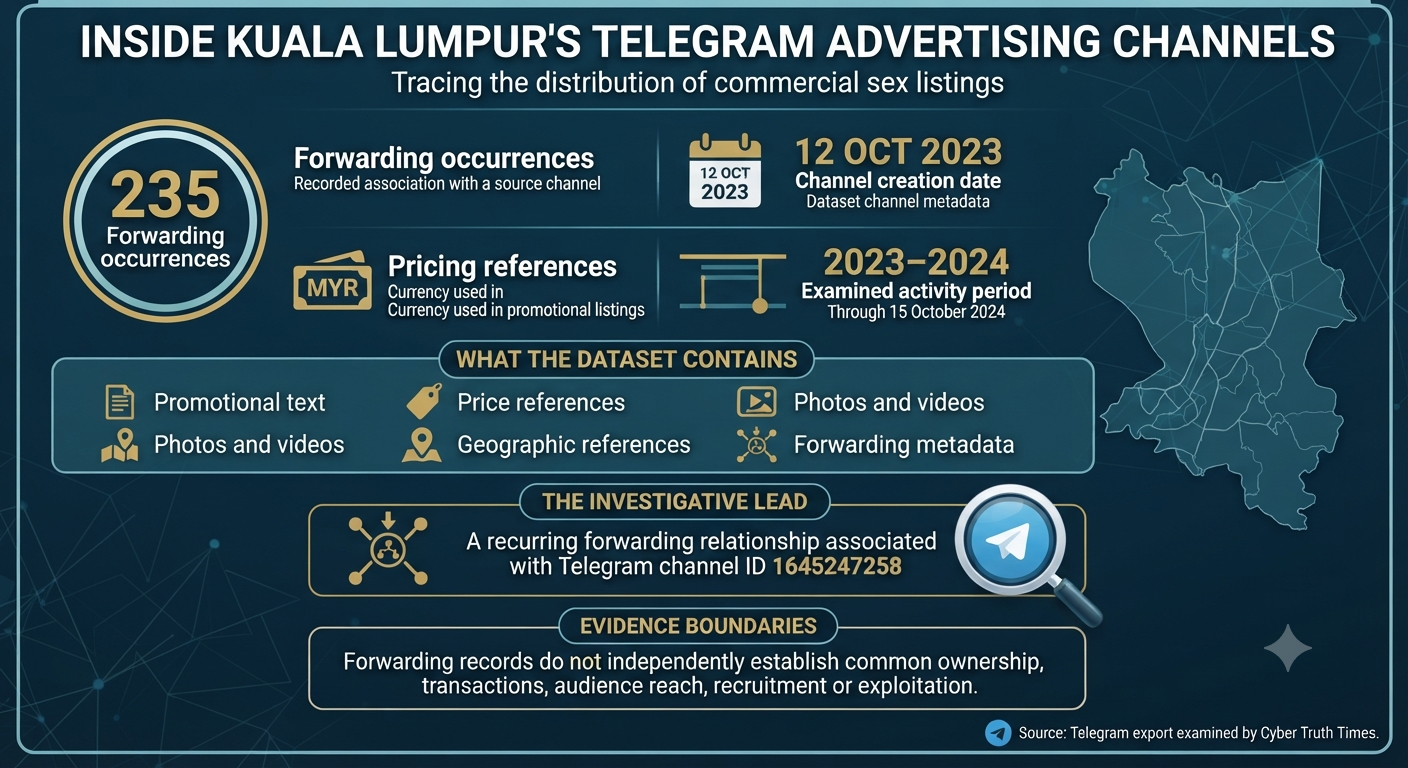
The most notable quantitative observation in the dataset is 235 recorded forwarding occurrences associated with one source channel. This figure provides a starting point for examining content distribution patterns, but it must be interpreted carefully. It represents occurrences recorded in the dataset not 235 individuals, transactions, customers, advertisements viewed or confirmed instances of recruitment.
The objective of this report is to document the observable digital characteristics of the dataset, examine the forwarding pattern, identify the investigative questions it raises and establish the limits of what the available records can support.
1. The Dataset: A Kuala Lumpur-Focused Advertising Channel
The dataset examined in this report is associated with a Telegram channel titled 在马来的妹子 吉隆坡妹子, approximately translated as “Girls in Malaysia – Kuala Lumpur Girls.”
The dataset identifies the channel as a public Telegram channel with the numerical channel identifier 1830651823. The records indicate that the channel was created on 12 October 2023, with the examined activity extending through 15 October 2024.
The channel’s advertising material includes promotional descriptions, geographic references, price information denominated in Malaysian ringgit (MYR), and photographs or videos associated with individual listings.
These records offer a snapshot of the channel’s advertising practices during the period represented in the export. They should not be interpreted as a complete record of the channel’s history, its audience, the identity of its operators or the real-world activities of individuals represented in its posts.
The export provides a digital record that can be examined for patterns of publication, content structure, recurring references and distribution relationships.
What the dataset records
The examined material contains several observable categories of information:
- Advertisements promoting commercial sexual services.
- Descriptive promotional text associated with listings.
- Geographic references associated with Malaysia and Kuala Lumpur.
- Price references expressed in Malaysian ringgit.
- Photographic and video material attached to promotional posts.
- Forwarding metadata associated with another Telegram channel.
These categories provide a foundation for examining the digital presentation and circulation of promotional material.
However, the existence of an advertisement does not independently establish that a service was available, that a transaction occurred, that a person depicted was accurately represented or that the channel operator had any particular relationship with the individuals featured.
2. The 235 Forwarding Occurrences: A Distribution Signal
The most distinctive observation in this dataset is the recording of 235 forwarding occurrences associated with Telegram channel ID 1645247258, displayed in the dataset as 生活助理 💋 包养 💕 ➗女, approximately translated as “Lifestyle assistant / kept-companion arrangements/women.”
The recurring forwarding relationship represents an observable distribution pattern within the dataset.
Forwarding is an important feature of Telegram’s content ecosystem. Messages can be redistributed between channels, allowing material to appear outside its original publication environment. Depending on the configuration of the channels and the circumstances of the forwarding, content can reach additional audiences and be reproduced without the recipient having to visit the original publisher.
In this dataset, the recorded forwarding occurrences provide evidence of a recurring relationship in the distribution of content associated with the Kuala Lumpur advertising channel and the identified source channel.
The number 235 should not be treated as a measure of audience size or reach. Nor does it establish that 235 separate advertisements were independently authored, that 235 people participated in a commercial arrangement or that the two channels were operated by the same individuals.
Instead, it is a dataset-level indicator that warrants closer examination of how promotional content was redistributed.
Why recurring forwarding relationships matter
In digital investigations, recurring forwarding metadata can help researchers identify content-distribution relationships that may otherwise be difficult to observe through isolated posts.
A forwarding relationship can help investigators formulate questions such as:
- Was content repeatedly redistributed from a particular source?
- Did forwarding occur over an extended period or within concentrated activity windows?
- Were similar advertisements or media files distributed through more than one channel?
- Did the relationship involve recurring content formats or promotional language?
- Were other channels involved in the redistribution process?
- Did the forwarding relationship change over time?
These questions are investigative hypotheses. Answering them requires additional examination of timestamps, message identifiers, content similarities, channel histories and corroborating records.
The 235 occurrences alone cannot establish the answers.
What forwarding does not establish
Forwarding metadata is not equivalent to proof of common ownership, control, collaboration or financial relationships.
Two channels may redistribute material for a variety of reasons. The available dataset does not independently establish why the forwarding relationship occurred, who initiated it, whether it was reciprocal or whether the operators of the channels knew one another.
Cyber Truth Times therefore treats the recorded relationship as a distribution lead, rather than evidence that both channels formed a single organisation.
3. Promotional Content and the Commercial Presentation of Listings
The examined advertisements contain elements characteristic of promotional content: descriptions of individuals, pricing references, geographic context and accompanying visual media.
The combination of textual and visual material creates a digital presentation designed to communicate information to prospective audiences. From an investigative perspective, the format of these posts can be studied without accepting their claims as factual.
Price references denominated in MYR are particularly relevant to the dataset’s geographic framing. They indicate that the promotional material presents pricing in Malaysian currency. However, currency denomination alone cannot establish where a transaction occurred, whether the price was actually charged or whether the advertiser was physically located in Malaysia.
The same evidentiary distinction applies to location references, descriptions and photographs.
Promotional claims versus verified information
Advertisements are authored or distributed for promotional purposes. They may contain accurate, inaccurate, exaggerated, incomplete or misleading information.
Consequently, a description appearing in a Telegram post should not automatically be treated as a verified fact about the individual represented.
The dataset allows researchers to document what was advertised. Establishing whether those representations were accurate would require independent corroboration.
This distinction is especially important when investigating potentially vulnerable individuals. Promotional material may not have been authored by the people depicted, and the dataset does not establish the circumstances under which photographs, videos or personal descriptions were obtained or published.
4. The Digital Infrastructure Behind Distribution
The dataset’s forwarding pattern raises broader questions about the infrastructure supporting Telegram-based advertising.
Channels provide a publication mechanism. Forwarding provides a redistribution mechanism. Photographs and videos provide promotional media. Text provides descriptions and pricing references. Geographic terms provide contextual framing.
Together, these elements create a digital environment in which advertisements can be published and circulated.
Yet the presence of these components should not be mistaken for proof of a centralised organisation. The available dataset documents a particular channel and an observed forwarding relationship. It does not establish the complete structure of the advertising ecosystem.
Distribution is not the same as ownership
A channel that forwards another channel’s material may function as a distribution point, but forwarding alone cannot determine whether it is:
- Operated by the same administrator.
- Controlled by a separate publisher.
- An independent distributor.
- A channel that selectively republishes promotional content.
- Part of a larger commercial arrangement.
These possibilities remain unresolved without corroborating evidence.
Investigators would need to examine additional records, potentially including historical channel metadata, publication chronology, content duplication, administrator-linked information where lawfully available and other independently verifiable digital traces.
The distinction between a distribution relationship and a control relationship is fundamental to responsible network analysis.
5. The Investigative Value of Digital Metadata
The dataset is valuable not merely because it contains promotional advertisements, but because it preserves metadata that can be examined alongside the content.
Metadata may assist in reconstructing publication sequences, identifying recurring patterns and organising investigative leads.
For example, researchers can compare message timestamps, forwarding references, message identifiers and the presence of similar content across records.
Such comparisons may help establish whether a pattern is isolated or recurring within the dataset.
However, the reliability of conclusions depends on the integrity and completeness of the underlying export.
A Telegram export is not automatically a complete representation of a channel’s history. Posts may be deleted, content may be inaccessible, records may be omitted, and the export may reflect a particular collection period or method.
The importance of preservation
For investigative work, the preservation of original records is critical.
Where available, researchers should retain the original export files, document the collection method, preserve timestamps and identifiers, maintain working copies separately from original material and record any transformations made during analysis.
Media files should be preserved in their original form where possible. File hashes can help document whether files have changed between collection and subsequent analysis.
A reproducible workflow allows readers and other researchers to better understand how observations were derived.
Cyber Truth Times’ analysis should therefore be understood as an examination of records available in the dataset, rather than a claim that every element of the underlying Telegram activity has been independently authenticated.
6. A Potentially Wider Distribution Ecosystem but What Can Be Established?
The recurring forwarding occurrences provide a basis for examining whether content distribution extends beyond a single Telegram channel.
The observed relationship is relevant because it demonstrates a recurring forwarding association in the exported records. It raises questions about content circulation and the role of secondary channels in reproducing promotional material.
Nevertheless, the evidence currently available does not establish a unified advertising network spanning multiple operators.
A network hypothesis would require additional evidence, potentially including repeated and independently documented relationships, corroborating account or administrator information, consistent operational patterns and evidence demonstrating the nature of the relationships between participants.
The investigation does not presently establish that the identified channels shared ownership, financial arrangements, recruitment activities or operational control.
The Cambodia promotional reference
One advertisement dated 12 October 2023 in the examined dataset contains promotional language referencing Cambodia and an advertised figure of USD 30,000 per month. The message also references Singapore, Malaysia and Dubai alongside figures expressed in Chinese yuan, reportedly between RMB 220,000 and RMB 250,000.
The language and commercial meaning of these references are not sufficiently established in the dataset to interpret them as verified employment, recruitment, travel arrangements or financial transactions.
The post is nevertheless a potentially relevant documentary lead because it contains cross-border geographic references and unusually prominent financial claims within promotional material.
Its evidentiary value should be assessed through contextual examination, translation, comparison with surrounding messages and independent corroboration.
It does not, on its own, establish that anyone travelled to Cambodia, Singapore, Malaysia or Dubai, that any payment occurred or that a recruitment operation existed.
Cyber Truth Times will treat this reference as a documented claim contained in the advertisement, rather than as proof of an actual cross-border arrangement.
7. What This Dataset Does Not Prove
The dataset documents commercial sex advertisements and a recurring forwarding relationship. It does not establish human trafficking, forced prostitution, coercion, debt bondage, recruitment through deception, restriction of movement or the exploitation of any person.
These are distinct factual and legal questions.
Human trafficking investigations require evidence relevant to the applicable legal framework and the circumstances of the individuals involved. The existence of commercial sex advertisements alone does not satisfy those evidentiary requirements.
The dataset also does not establish the identities, nationality, ages, consent, employment status or circumstances of the people represented in the promotional material.
Likewise, it does not independently authenticate the channel operators or determine whether any particular advertisement corresponds to an actual transaction.
The absence of such evidence in this export should not be interpreted as proof that exploitation does not occur. It simply means that these questions cannot be answered from the examined dataset alone.
8. The Next Stage of Investigation
The Kuala Lumpur dataset provides a starting point for a more systematic examination of Telegram content distribution.
The next stage of analysis should focus on the forwarding relationship, the chronology of recorded messages, the similarity of promotional content and whether additional independently documented distribution relationships emerge.
Media analysis may also provide useful leads. Identical or similar photographs and videos appearing in different records could help establish content-reuse patterns, although such findings would not automatically establish identity, ownership or the circumstances of the individuals depicted.
Any further analysis must maintain the distinction between content similarity and attribution.
The investigation will also examine the limitations of the dataset, including missing records, inaccessible content, potential export limitations and the possibility that observed patterns reflect only a fraction of the underlying activity.
The objective is to build a transparent record of what the available digital evidence supports, rather than to construct a network narrative from incomplete data.
Conclusion: 235 Occurrences, One Distribution Lead, More Questions
The Kuala Lumpur Telegram dataset offers a documented view of commercial sex advertising within a public channel and records a recurring forwarding relationship involving another channel.
The 235 forwarding occurrences represent the most notable quantitative observation in this dataset. They provide a concrete starting point for examining content distribution, channel relationships and the circulation of promotional material.
But the number is not proof of audience reach, transactions, recruitment, ownership or criminal activity.
The investigation’s value lies in documenting the evidence, preserving its context and identifying questions that can be pursued through further verification.
Cyber Truth Times will continue examining the digital infrastructure surrounding commercial sex advertising across the datasets included in this investigative series. Each report will distinguish documented observations from advertiser claims, investigative leads and conclusions that require independent corroboration.
The objective is not to make allegations unsupported by evidence. It is to make the digital record more transparent, examine its patterns rigorously and identify where further investigation is warranted.
Explore the Full Investigation
This report is part of The Telegram Sex-Advertising Economy, a 12-part investigative series by Cyber Truth Times examining five Telegram datasets associated with commercial sex advertising across Malaysia, Cambodia, Myanmar, Dubai and a Russian-language advertising channel. The series investigates digital distribution patterns, intermediary and agent references, advertising infrastructure, media-related investigative leads, geographic claims and the evidentiary limits of the available records. Read our pillar investigation for the overarching findings, methodology, research objectives and complete roadmap of the series.
Access the Dossier & Evidence
The raw Telegram datasets examined in this investigation are available in our Dossier & Evidence section for readers seeking to inspect the underlying documentary material. These files provide the source records used in our dataset-level analysis and support transparency, scrutiny and further examination. The records should be interpreted cautiously: the presence of advertisements, forwarding metadata, contact references or geographic claims does not independently verify identities, transactions, ownership, recruitment or exploitation.
Bibliography & References
These references provide methodological and contextual grounding. They are not presented as independent verification of the dataset’s specific findings.
- Telegram FAQ – Channels — Background on Telegram channels and their publication functionality.
- Telegram FAQ — Platform features, messaging and forwarding context.
- UNODC – The Crime of Trafficking in Persons — Legal and conceptual context for distinguishing trafficking from other conduct.
- United Nations – Understanding Human Trafficking — Overview of trafficking and exploitation.
- U.S. Department of Justice – What Is Human Trafficking? — General reference on trafficking definitions and related concepts.
- UNODC – Human Trafficking Toolkit — Reference material for trafficking investigations and responses.
For deeper investigations on such topics, see our Cybercrime Investigations & Exposes.