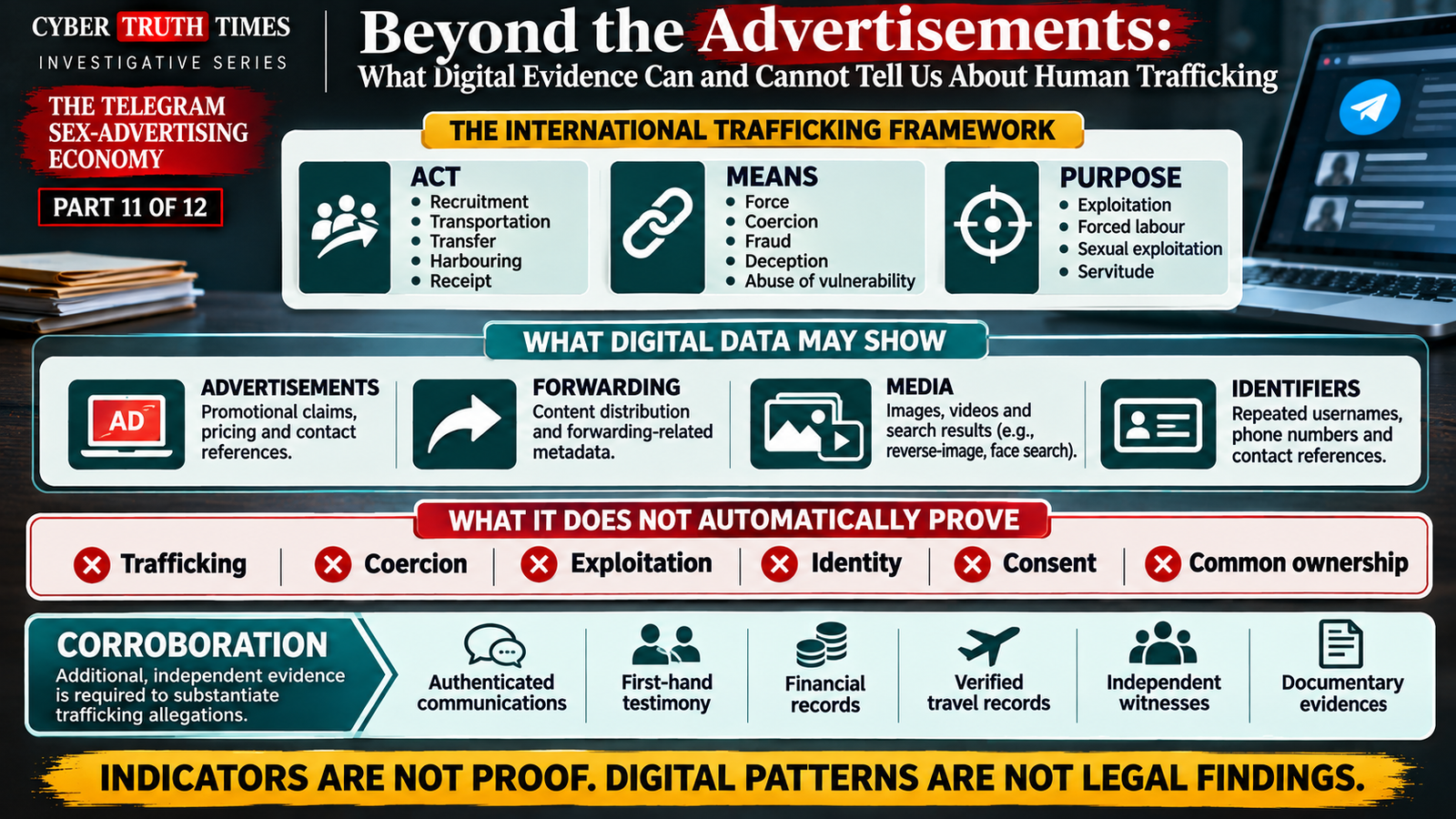
Cyber Truth Times examines the digital evidence and human trafficking, compares the legal distinction between commercial sex advertising and trafficking, and discusses the limitations of Telegram evidence and the corroboration trafficking allegations require.
Introduction: The Digital Evidence and Human Trafficking
Human trafficking is one of the most serious forms of exploitation, yet it remains one of the most difficult crimes to investigate and substantiate. Recruitment, deception, coercion, exploitation, financial control, intimidation and abuse can occur across physical and digital environments. Social media, messaging applications, classified advertisements and online platforms can be used to advertise services, recruit individuals, communicate with customers, coordinate activity or conceal exploitation.
The digital dimension of trafficking investigations is therefore significant.
But the existence of online advertisements does not automatically establish human trafficking.
An advertisement promoting commercial sexual services may contain photographs, prices, contact details, geographic references, descriptions of availability, customer instructions or references to intermediaries. These elements can provide valuable investigative leads. They can help researchers document digital distribution patterns, identify recurring advertising structures, examine potential relationships between accounts and preserve records for further investigation.
What they cannot independently do is establish that the person depicted or advertised is a trafficking victim.
This distinction is central to the investigation conducted by Cyber Truth Times under The Telegram Sex-Advertising Economy. Across five Telegram datasets associated with Malaysia, Cambodia, Myanmar, Dubai and a Russian-language advertising channel, the series has examined advertising patterns, forwarding relationships, recurring identifiers, promotional claims, geographic references and image-search results.
The investigation has documented digital patterns. It has not established trafficking or exploitation within those datasets.
This article examines why that distinction matters, what the international legal framework requires, what trafficking indicators may legitimately contribute to an investigation, the limitations of Telegram exports and the additional corroboration necessary before trafficking allegations can be substantiated.
The objective is not to dismiss online evidence. It is to examine what online evidence can legitimately establish.
What legally constitutes human trafficking?
The internationally recognised definition of trafficking in persons is set out in Article 3 of the Protocol to Prevent, Suppress and Punish Trafficking in Persons, Especially Women and Children, supplementing the United Nations Convention against Transnational Organised Crime.
The definition is generally examined through three elements:
- Act: recruitment, transportation, transfer, harbouring or receipt of persons.
- Means: specified forms of force, coercion, abduction, fraud, deception, abuse of power or vulnerability, or other means identified in the Protocol.
- Purpose: exploitation.
Exploitation includes, at a minimum, exploitation of the prostitution of others or other forms of sexual exploitation, forced labour or services, slavery or practices similar to slavery, servitude and the removal of organs.
The definition is available in the UNODC explanation of the crime of trafficking in persons.
The trafficking framework
1. ACT
What was done?
Recruitment, transportation, transfer, harbouring or receipt.
2. MEANS
How was it done?
Force, coercion, deception, fraud, abuse of vulnerability or other specified means.
3. PURPOSE
Why was it done?
Exploitation, including sexual exploitation, forced labour or other forms defined by the Protocol.
The framework is simplified for illustration. The applicable legal elements, including the treatment of means in cases involving children, depend on the relevant legal framework.
For adult victims, the framework generally requires the act, means and exploitative purpose. Where a child is trafficked, the means element is not required under the Protocol’s definition.
The consent of a victim is not legally decisive when the specified means have been used. In cases involving children, the means element is not required for trafficking under the Protocol.
This framework matters because investigators frequently encounter online content that contains only fragments of the information necessary to assess a trafficking allegation.
An advertisement may document a commercial offer. A message may document a communication. A photograph may document an image. A phone number may document an identifier.
None of these, by itself, necessarily establishes the act, means and purpose required for trafficking.
Commercial sex advertising is not automatically human trafficking
The distinction between commercial sex advertising and human trafficking is essential to responsible investigative journalism.
Commercial sex advertising may involve individuals advertising independently, intermediaries, agencies, businesses, organised arrangements or other forms of activity. The circumstances differ substantially across cases, countries, legal systems and individuals.
The presence of an advertisement does not establish whether the person involved:
- Is acting independently.
- Is acting with another person’s assistance.
- Is being coerced.
- Is being deceived.
- Is being exploited.
- Is underage.
- Has control over their earnings.
- Can freely refuse customers or services.
- Can leave their circumstances without threats or punishment.
These are separate investigative questions.
An advertisement containing a price, telephone number, photographs, service descriptions or contact instructions may be relevant to understanding the commercial activity being promoted. However, those elements cannot independently establish the conditions under which the advertised person operates.
A recurring agent account may warrant further examination. A payment arrangement may warrant scrutiny. A repeated location reference may provide a lead. A forwarded advertisement may document distribution.
But suspicion generated by these observations must not be confused with a substantiated trafficking allegation.
This problem is not merely theoretical.
In a 2024 academic article, Why We Cannot Identify Human Trafficking from Online Advertisements, Luca Giommoni critically examined research attempting to identify trafficking through online sex advertisements. The paper highlights problems including insufficient empirical validation of trafficking indicators, subjective interpretation, assumptions about the accuracy of advertisements and the conflation of sex work with trafficking.
The article argues that the evidentiary limitations of online advertisements make it unlikely that trafficking victims can be reliably identified from advertisements alone. FBI
This criticism is directly relevant to the datasets examined by Cyber Truth Times.
The purpose of analysing Telegram advertising records should not be to automatically classify the individuals depicted as trafficking victims. It should be to document patterns, preserve evidence, examine potential indicators, identify unanswered questions and seek independent corroboration where appropriate.
Understanding trafficking indicators and their limitations
Trafficking indicators are commonly used by investigators, social workers, healthcare professionals, immigration officials, journalists and organisations working with vulnerable populations.
Indicators can help identify circumstances that warrant further examination. They are not a substitute for an investigation.
The UNODC guidance on trafficking indicators explicitly recognises that indicators have limitations, that their relevance depends on context and that no single indicator conclusively establishes trafficking. unodc.org
A. Indicators of coercion and control
Potential indicators may include:
- Threats of physical violence or psychological harm.
- Threats directed at family members.
- Intimidation or punishment.
- Surveillance or monitoring.
- Restrictions on movement.
- Restrictions on communication.
- Inability to leave an employment or living environment.
- Control over identity or travel documents.
- Unexplained or imposed debt.
- Withholding of earnings.
- Restrictions on access to healthcare.
- Forced or coerced activity.
The relevance of these indicators depends on the specific circumstances.
For example, an advertisement describing a booking process or customer arrangement does not establish that the advertised individual is subject to restrictions on movement or communication.
Similarly, a reference to a deposit, commission, fee or financial arrangement does not automatically establish debt bondage.
Investigators must establish whether such circumstances exist and, where they exist, whether they are connected to coercion or exploitation under the relevant legal framework.
B. Indicators of deceptive recruitment
Trafficking investigations may involve deception concerning employment, travel, income, accommodation, immigration status or the nature of the work being offered.
Potential indicators include:
- Recruitment through false employment promises.
- Misrepresentation of the nature of work.
- Deceptive travel arrangements.
- Misleading financial promises.
- Recruitment under false pretences.
- Concealment of working conditions.
- Recruitment followed by coercion or exploitation.
The presence of a recruitment advertisement does not establish that recruitment occurred.
A message promising a particular income may be a misleading advertisement, an exaggerated commercial claim or an actual recruitment offer. Whether it forms part of a trafficking scheme requires evidence concerning the subsequent conduct and circumstances.
C. Indicators of exploitation
Potential indicators of exploitation can include:
- Compelled labour or commercial sexual activity.
- Inability to refuse work or services.
- Punishment for refusing work.
- Forced or involuntary activity.
- Control of earnings.
- Debt manipulation.
- Threats or intimidation.
- Restrictions on movement.
- Exploitation of a child.
The UNODC and other organisations provide indicator frameworks for identifying potentially trafficked persons. These frameworks should be used as contextual tools rather than rigid scoring systems.
An indicator may justify further inquiry or protective intervention without establishing that a trafficking offence has occurred.
This distinction is important for journalists who may encounter apparently concerning advertisements without access to the people involved or the circumstances underlying those advertisements.
Why trafficking cannot be reduced to a checklist
One of the recurring problems in online trafficking research is the temptation to develop a checklist of suspicious features and treat the accumulation of those features as proof of trafficking.
A dataset might contain:
- Repeated contact accounts.
- Identical advertisements.
- Multiple photographs.
- Frequent posting.
- Pricing structures.
- Location references.
- Forwarding patterns.
- Referral links.
- Multiple languages.
- Advertisements associated with a particular city.
These characteristics may be relevant to the examination of digital advertising infrastructure.
They do not necessarily establish coercion, exploitation or trafficking.
A pattern is not a legal finding
Pattern observed
Repeated contact identifiers, forwarding relationships, pricing structures, geographic references and reused content.
Investigative hypothesis
The advertising may involve intermediaries, coordinated distribution, shared infrastructure or commercial relationships.
Unsubstantiated conclusion
The pattern alone proves trafficking, coercion, exploitation or the identity of an operator.
A responsible investigation should separate these three levels.
The first level concerns observable data.
The second concerns interpretations that can be tested.
The third concerns conclusions that require sufficient evidence.
This separation helps prevent false positives and reduces the risk of exposing vulnerable people, wrongly accusing individuals or publishing conclusions that cannot be supported.
It also protects the credibility of the investigative process.
What Telegram exports can actually establish
Telegram datasets can contain a variety of useful documentary records.
Depending on the export method and completeness of the material, researchers may be able to examine:
- Message text.
- Message timestamps.
- Channel identifiers.
- Message identifiers.
- Forwarding-related metadata.
- Media references.
- Photographs.
- Videos.
- Contact references.
- Links.
- Repeated phrases.
- Edited content.
- Channel descriptions.
- Promotional patterns.
- Posting chronology.
These records can support digital investigations into content distribution, advertising patterns and relationships between records.
However, a Telegram export is not necessarily a complete representation of the underlying activity.
A. Completeness
A dataset may contain only a portion of a channel’s activity.
Messages may have been deleted before export. Private content may be unavailable. Media may be missing. Export tools may omit certain data fields. Channels may have changed names or descriptions.
The researcher should therefore avoid treating an export as a complete historical record unless completeness has been independently established.
B. Authenticity
The presence of a message in an export does not automatically establish that the message is authentic in the evidentiary sense required for a particular investigation or legal proceeding.
Researchers should document the collection method, preserve the original export, retain relevant metadata, record collection dates and avoid unnecessarily modifying the source material.
C. Attribution
Channel names, usernames and contact references do not necessarily establish the identity of the person operating an account.
A channel may be renamed. A username may be reassigned. An account may be impersonated. Multiple people may have access to an account.
An investigator should not attribute an account to a named person solely because a name, username or profile image appears in the export.
D. Forwarding relationships
Forwarding metadata can provide evidence that content was forwarded or associated with a particular source identifier, depending on the export and the underlying Telegram data.
It does not necessarily establish common ownership, coordination, a commercial relationship or a unified operation.
A forwarding relationship is a digital distribution observation not automatically an organisational relationship.
E. Geographic attribution
A message mentioning Kuala Lumpur, Poipet, Yangon, Dubai or another location does not establish that the publisher, advertised individual or customer was physically located there.
Geographic claims require independent corroboration.
F. Transaction verification
Advertisements, prices, booking instructions and contact details do not establish that a transaction was completed.
A promotional post may remain online despite changes in availability, location, pricing or the underlying arrangement.
Digital evidence requires preservation, provenance and integrity
Digital evidence can be altered, copied, edited, deleted, misrepresented or taken out of context. This makes preservation and documentation essential.
The National Institute of Standards and Technology (NIST) addresses these challenges in Digital Evidence Preservation: Considerations for Evidence Handlers, NISTIR 8387.
The publication discusses considerations for preserving digital evidence and the challenges associated with digital objects, storage, acquisition and evidence management. nist.gov+1
For investigative journalism, an evidence-preservation workflow should ideally include:
- Source preservation: retain the original export or downloaded file.
- Collection documentation: record how, when and from where the material was collected.
- File integrity: use cryptographic hashes where appropriate to document file integrity.
- Metadata preservation: retain relevant metadata rather than stripping it from original evidence.
- Chain-of-custody documentation: record who handled the material and when, particularly where the evidence may be used in legal proceedings.
- Analytical copies: conduct analysis using copies rather than unnecessarily altering originals.
- Version tracking: record transformations, redactions, translations and modifications.
- Secure storage: protect potentially sensitive evidence and restrict access.
These practices do not automatically make an item admissible in court. Admissibility and evidentiary standards depend on jurisdiction and the circumstances of the case.
Nevertheless, documentation and preservation materially improve the transparency and reproducibility of a journalistic investigation.
Why hashes matter
A cryptographic hash can be used to produce a digital fingerprint of a file.
If the same file is hashed using the same algorithm and its contents have not changed, the hash value should remain consistent.
This can help researchers document whether a file has changed between preservation and subsequent handling.
A hash does not prove that the file was authentic when first collected, that it came from the claimed source or that its contents are true.
File integrity is not the same as source authenticity.
Both matter, but they answer different questions.
Photographs and videos: Evidence of an image, not necessarily evidence of exploitation
Photographs and videos can be particularly influential in investigations involving commercial-sex advertising.
A photograph may appear repeatedly across channels. A reverse-image search may identify multiple matches. A face-search tool may return numerous results. A video may contain metadata or visual details suggesting a particular location.
These findings can help investigators examine media distribution and provenance.
However, visual evidence presents several limitations.
A. Reuse does not establish identity
A photograph appearing in multiple advertisements does not necessarily establish that the same person published those advertisements.
The image may have been copied, reposted, stolen, edited, redistributed or used without the depicted person’s knowledge.
B. Similarity scores are not identity probabilities
Face-search or similarity tools may return matches based on their own algorithms and scoring systems.
A high similarity score is not automatically a probability that two images depict the same individual.
The performance of such tools depends on the model, image quality, conditions, training data, thresholds and other factors.
C. Reverse-image search is not provenance verification
Reverse-image search can identify related images, webpages or visually similar content.
It cannot automatically establish the original publisher, date of capture, consent, authenticity or the circumstances in which the image was created.
D. AI detection is not authentication
AI-generated-image detectors and deepfake-detection tools may produce probabilistic or categorical outputs.
Those outputs should not be treated as definitive proof that an image is authentic or manipulated.
E. Images cannot establish consent or coercion
A photograph showing an adult in a commercial-sex advertisement does not establish whether the individual consented to the advertisement, the underlying activity, the use of the image or the circumstances in which the content was created.
A photograph cannot, by itself, establish trafficking.
The visual-forensics analysis in Part 09 of this series illustrates the distinction between search results and verified conclusions. That report recorded multiple face-search and reverse-image-search results, but the numerical outputs did not establish the identity, provenance, authenticity, consent or exploitation of the depicted individual.
The same evidentiary principle applies to the other datasets in this series.
What additional corroboration is required?
A trafficking investigation requires evidence capable of establishing the relevant circumstances, rather than simply identifying suspicious digital content.
The nature of the evidence will vary depending on the allegations, jurisdiction and circumstances.
The following categories may be relevant.
A. First-hand testimony
First-hand testimony may help establish:
- How a person was recruited.
- Whether promises were made.
- Whether those promises were deceptive.
- Whether threats were made.
- Whether movement was restricted.
- Whether the individual could refuse work or services.
- Whether earnings were withheld.
- Whether debt was manipulated.
- Whether exploitation occurred.
- Who was involved in the relevant conduct.
Testimony should be obtained ethically and without coercion.
Journalists must not pressure potential victims to recount traumatic experiences or expose them to additional risk for publication.
B. Communications evidence
Authenticated communications may provide evidence of recruitment, deception, threats, coercion, financial arrangements or other relevant conduct.
However, communications must be examined in context.
A message may be incomplete, edited, forwarded, impersonated or misunderstood. Authorship and chronology may require corroboration.
C. Financial records
Financial records may help establish:
- Payments.
- Earnings.
- Financial control.
- Debt arrangements.
- Transfers.
- Payments to intermediaries.
- Relevant financial relationships.
However, the existence of a payment does not automatically establish exploitation.
The nature, context and purpose of the payment must be examined.
D. Travel and movement records
Travel records may help establish movement, but movement alone does not establish trafficking.
Relevant records may include authenticated travel documents, verified itineraries, accommodation records, relevant immigration records obtained lawfully and other documentary evidence.
The investigative question is not simply whether a person moved.
It is whether the movement or other relevant conduct formed part of the legally applicable trafficking framework.
E. Independent witness accounts
Independent witnesses may corroborate recruitment, control, coercion, transportation, exploitation or other relevant circumstances.
The reliability, independence and context of witness accounts should be assessed.
F. Documentary and physical evidence
Depending on the circumstances, investigators may examine records documenting living conditions, work arrangements, control, injuries, restrictions, financial arrangements or other circumstances.
Such evidence must be authenticated and interpreted carefully.
G. Independent corroboration
The strongest conclusions are often supported by multiple forms of evidence that corroborate one another.
An advertisement containing a recruitment claim is materially different from an advertisement corroborated by authenticated communications, first-hand testimony, verified financial records and independently documented circumstances.
Corroboration is not simply the accumulation of more data. It is the establishment of a reliable evidentiary relationship between the records and the allegation being examined.
The distinction between trafficking, migrant smuggling and commercial sex
These concepts are frequently conflated in online discussions and investigations, but they are not interchangeable.
Human trafficking
Trafficking involves the relevant acts, means and exploitative purpose under the applicable legal framework. International trafficking law does not require an international border crossing.
Migrant smuggling
Migrant smuggling generally involves facilitating irregular entry into another country for a financial or material benefit under the relevant legal framework. It is conceptually distinct from trafficking, although the circumstances may overlap and a smuggling situation can develop into trafficking or other exploitation.
Commercial sex
Commercial sex is not synonymous with trafficking. The legal treatment of commercial sex varies across jurisdictions, and the circumstances of the individuals involved matter.
The presence of an advertisement, intermediary or commercial arrangement does not automatically establish trafficking.
Child sexual exploitation and trafficking
The exploitation of children in commercial sexual activity is treated differently from adult trafficking under international frameworks. Under the Trafficking in Persons Protocol, where a child is involved, the means element is not required for trafficking.
Age must therefore be established carefully and not inferred from appearance, promotional descriptions or profile claims.
These distinctions are essential for investigations that rely on digital advertisements.
The United Nations explanation of human trafficking provides a useful overview of trafficking and its different forms. United Nations
Why false positives matter
Incorrectly identifying someone as a trafficking victim, trafficker, recruiter or exploiter can have serious consequences.
A false allegation can:
- Expose an individual to harassment.
- Damage their reputation.
- Threaten their safety.
- Lead to discriminatory treatment.
- Expose vulnerable individuals to retaliation.
- Misrepresent the circumstances of commercial sex.
- Undermine legitimate trafficking investigations.
- Damage the credibility of a publication.
- Create legal risks for journalists and publishers.
The risks are particularly serious when investigations involve photographs, names, telephone numbers, contact accounts, geographic references or other identifying material.
The individuals depicted in advertisements may not be the publishers of the advertisements. They may not know that their images have been reused. They may be vulnerable to harassment, stigma or retaliation.
Researchers should therefore avoid publishing unnecessary identifying information.
The fact that information is publicly accessible does not automatically mean that publishing it is ethically justified.
Responsible publication practices
A responsible investigation should:
- Avoid identifying individuals unnecessarily.
- Avoid treating commercial sex as proof of trafficking.
- Avoid treating nationality, ethnicity or language as evidence of exploitation.
- Avoid publishing unverified allegations.
- Avoid unnecessarily exposing contact details.
- Avoid reproducing sensitive photographs when they do not materially advance the investigation.
- Distinguish promotional claims from verified facts.
- Seek corroboration before attributing criminal conduct.
- Consider the potential consequences of publication for the individuals involved.
- Give subjects an appropriate opportunity to respond where allegations are being made.
- Clearly state limitations and unresolved questions.
These safeguards are not obstacles to investigative journalism.
They are part of the process that makes investigative journalism credible.
What the five Telegram datasets examined by Cyber Truth Times actually demonstrate
The five datasets examined in The Telegram Sex-Advertising Economy provide a documentary basis for analysing different forms of digital advertising and distribution.
They reveal several patterns that warrant analytical examination.
Malaysia
The Kuala Lumpur dataset documents geographically framed advertising, promotional content, pricing and forwarding-related metadata.
The recorded forwarding occurrences provide a distribution-related lead, but they do not establish a trafficking network or common ownership.
Cambodia
The Poipet dataset documents repeated geographic references, multilingual promotional material and advertising descriptions.
It does not establish the physical location, nationality, exploitation status or movement of the individuals depicted.
Myanmar
The Yangon dataset documents advertising content, recurring contact references, transport-related claims, payment instructions and promotional arrangements.
These records may provide investigative leads, but they do not independently establish coercion, trafficking or cross-border movement.
Dubai
The Dubai dataset documents promotional content, customer-service references, a contact bot, attendance-related content and feedback references.
The apparent workflow may be relevant to analysing advertising infrastructure, but it does not independently establish common ownership, trafficking or exploitation.
Russian-language advertising channel
The Russian-language dataset documents profile-style advertising, recurring agent references, prices and promotional content.
The recurring agent identifier is a lead for further examination, not proof of identity, control or trafficking.
Across all five datasets, the documented evidence concerns digital advertising, content distribution, identifiers, promotional claims and related media. It does not currently establish trafficking or exploitation.
That conclusion does not mean trafficking is absent from the broader environment.
It means that the evidence examined in this series has not substantiated trafficking within these particular datasets.
This distinction is important.
A responsible investigator should neither dismiss potential trafficking concerns nor convert unverified concerns into allegations.
What further investigation should look like
The next stage of research should focus on testing specific hypotheses rather than attempting to assign trafficking labels to advertisements.
Potential areas of further examination include:
- Source authentication: establish the provenance and integrity of original records.
- Content verification: examine whether promotional claims are corroborated.
- Media provenance: investigate whether images or videos have identifiable origins and whether their reuse can be documented.
- Account attribution: distinguish account identifiers from verified human identities.
- Distribution analysis: examine content forwarding and redistribution without assuming organisational relationships.
- Independent corroboration: seek evidence outside the advertising datasets.
- Legal analysis: assess the evidence against the applicable legal framework.
- Ethical review: consider the potential impact of publication on the individuals involved.
The purpose of further investigation should be to establish facts, not to force the data into a predetermined narrative.
Conclusion: Digital evidence can expose patterns, but patterns are not proof of trafficking
Telegram advertisements, photographs, videos, forwarding metadata, recurring contact references, pricing structures and geographic claims can provide valuable material for digital investigations.
They can help journalists examine advertising ecosystems, distribution patterns, commercial claims, digital relationships and potentially relevant leads.
But digital evidence must be interpreted within its limitations.
An advertisement does not establish coercion. A repeated contact identifier does not establish ownership. A forwarded message does not establish coordination. A photograph does not establish identity, consent or exploitation. A geographic reference does not establish travel. A commercial-sex advertisement does not automatically establish trafficking.
Human trafficking is a serious crime, and its investigation requires evidence capable of establishing the relevant circumstances under the applicable legal framework.
The existence of online advertisements may justify further examination. Indicators may justify further inquiry. Patterns may generate hypotheses. Digital records may corroborate an investigation.
But none of these should be treated as a substitute for corroboration.
The responsibility of an investigative journalist is not merely to identify suspicious patterns. It is to establish what those patterns demonstrate, test what they suggest, and clearly report what remains unknown.
This is the evidentiary standard Cyber Truth Times seeks to apply throughout The Telegram Sex-Advertising Economy.
The series documents digital advertising patterns across five datasets. It does not currently establish trafficking or exploitation within those datasets. Further conclusions would require additional, independently corroborated evidence.
Explore the Full Investigation
This report is part of The Telegram Sex-Advertising Economy, a 12-part investigative series by Cyber Truth Times examining five Telegram datasets associated with commercial sex advertising across Malaysia, Cambodia, Myanmar, Dubai and a Russian-language advertising channel. The series examines digital distribution patterns, advertising infrastructure, contact and referral references, promotional claims and the limitations of online evidence. Read our pillar investigation for the overarching findings, methodology, research objectives and complete roadmap of the series.
Access the Dossier & Evidence
The raw Telegram dataset examined in this investigation is available in our Dossier & Evidence section for readers seeking to inspect the underlying records. These files form the documentary basis of our analysis and support transparency, scrutiny and further research. The records should be interpreted cautiously: profile descriptions, recurring usernames, price references, payment-related symbols and invitation links do not independently verify identities, transactions, ownership, physical locations or exploitation.
Bibliography
- UNODC — The Crime of Trafficking in Persons — International trafficking definition and legal framework.
- UNODC — Indicators of Trafficking in Persons — Trafficking indicators and their limitations.
- United Nations — Understanding Human Trafficking — Background on trafficking and forms of exploitation.
- UNODC — Human Trafficking Indicators — General trafficking indicators.
- NIST — Digital Evidence Preservation: Considerations for Evidence Handlers — Digital evidence preservation and evidence handling.
- Giommoni, Luca — Why We Cannot Identify Human Trafficking from Online Advertisements — Academic critique of trafficking identification from online sex advertisements.
- U.S. Department of Justice — What Is Human Trafficking? — Overview of human trafficking and victim-survivor principles.
- U.S. Department of State — Understanding Human Trafficking — Trafficking definitions, movement and debt bondage.
- United Nations — Protocol to Prevent, Suppress and Punish Trafficking in Persons, Especially Women and Children — International legal framework.
- UNODC — Trafficking in Persons and Smuggling of Migrants — Additional international legal and investigative resources.
Disclaimer
This article is an investigative and analytical examination of digital evidence and the legal and evidentiary distinctions surrounding human trafficking. It does not allege that the individuals depicted in the datasets examined by Cyber Truth Times are trafficking victims, traffickers, exploiters or participants in criminal activity. Advertisements, contact references, photographs, videos, forwarding metadata, pricing, geographic references and promotional claims do not independently establish trafficking, exploitation, coercion, consent, identity, ownership or transaction completion. Legal definitions and evidentiary standards may vary by jurisdiction.