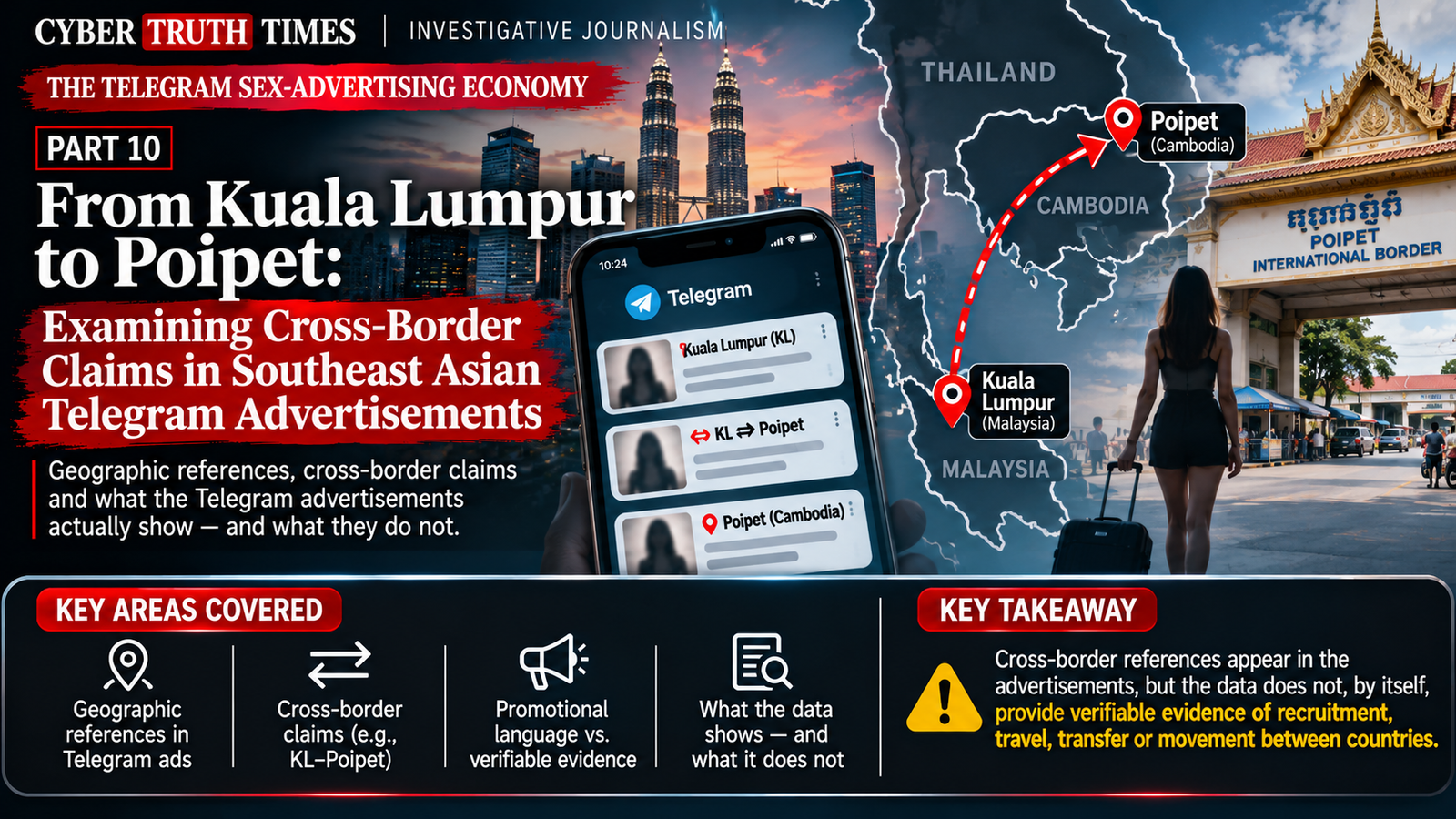
Cyber Truth Times examines geographic and cross-border claims in Telegram Advertisements in Kuala Lumpur and Poipet Telegram datasets, separating promotional language from verified movement.
Introduction: Cross-border Claims in Telegram Advertisments
This investigation examines geographic references, cross-border language and regional promotional claims appearing in the Malaysia and Poipet Telegram datasets examined by Cyber Truth Times. It focuses on the evidentiary distinction between advertising that mentions countries, cities, travel, relocation or regional markets and documentary evidence that an individual actually travelled, was recruited, transferred, transported or moved across a border.
The central finding is a methodological one: geographic references in digital advertising can establish what an advertiser claims or promotes, but they cannot independently establish that cross-border movement occurred.
1. Introduction: Geography in an advertisement is not geography in evidence
Digital advertisements increasingly use geographic language to construct a market. Cities, countries, border regions, transport references and claims about availability can be used to attract customers, describe services, establish perceived credibility or signal the geographic reach of an advertiser.
In the Southeast Asian material examined by Cyber Truth Times, Kuala Lumpur and Poipet appear in different advertising contexts. The Malaysia dataset contains geographically oriented advertising associated with Kuala Lumpur, while the Cambodia dataset repeatedly references Poipet. Both collections contain promotional material, but the presence of geographic references does not independently establish that people, services or advertising operators moved between the two locations.
This distinction is particularly important when investigating online commercial-sex advertising. An advertisement mentioning another country can be interpreted in several ways. It may describe a market, refer to a location where an advertiser claims to operate, promote a service, repeat promotional language, or invoke a geographic association intended to attract an audience.
Without corroborating evidence, an investigator cannot determine which interpretation is correct.
This article examines geographic and cross-border references in the two datasets, the significance of those references as investigative leads, and the evidence required to establish a genuine movement or transfer between countries.
2. Two datasets, two geographic contexts
The Kuala Lumpur dataset
The first dataset examined in this series concerns a public Telegram channel titled 在马来的妹子 吉隆坡妹子, approximately translated as “Girls in Malaysia – Kuala Lumpur Girls.”
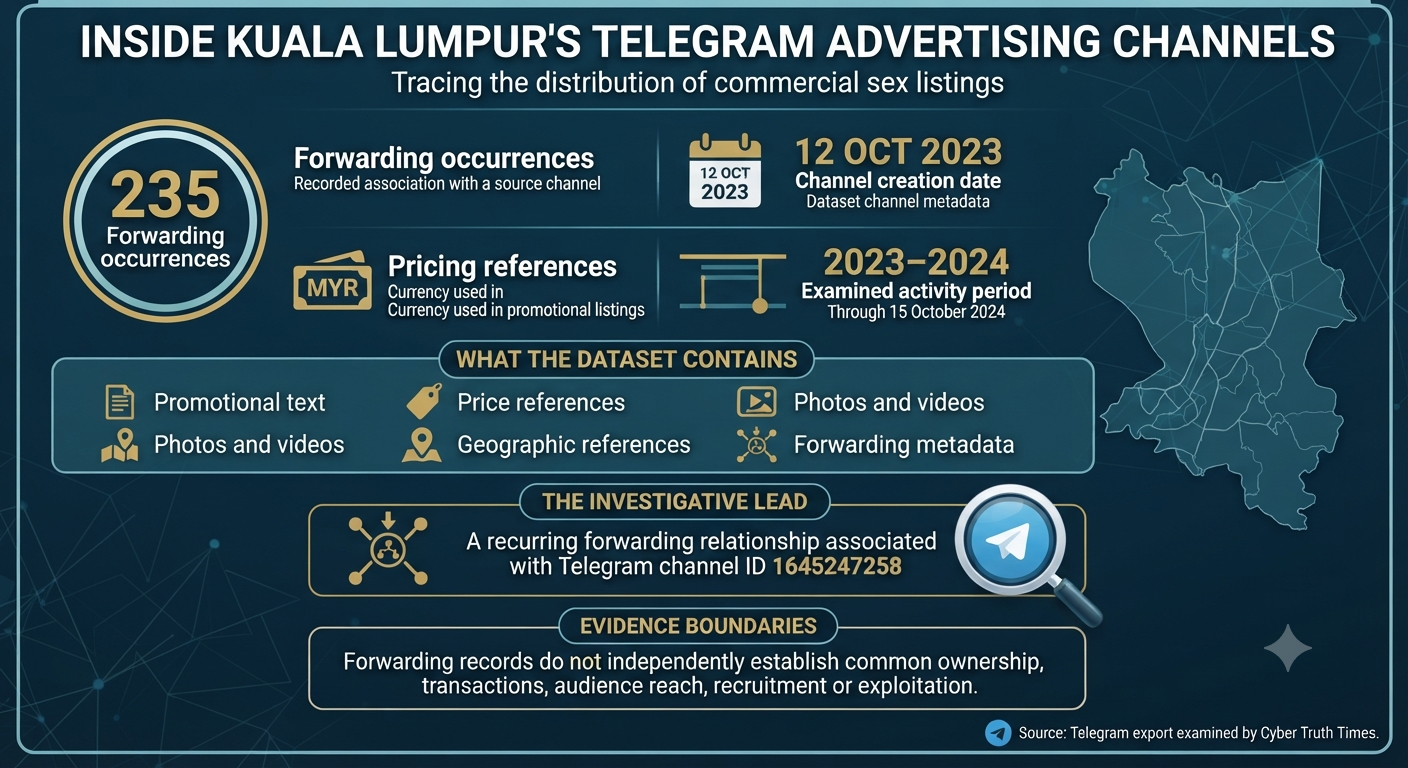
The channel, identified by ID-1830651823, was created on 12 October 2023. The dataset contains recorded activity through 15 October 2024.
Its promotional material includes profile-style advertisements, photographs, videos, geographic references and pricing expressed in Malaysian ringgit (MYR). The use of Kuala Lumpur in the channel’s title and promotional content establishes the geographic framing adopted by the channel’s publisher.
It does not independently establish that every advertised individual was physically located in Kuala Lumpur when an advertisement was published.
The dataset also contains 235 recorded occurrences of forwarding metadata associated with channel ID 1645247258, whose displayed name was 生活助理 💋 包养 💕 ➗女.
These forwarding occurrences provide a documented distribution-related lead. They may help researchers examine the circulation of advertising material between Telegram channels, but they do not establish that the channels were operated by the same person, that the forwarded content represented actual services, or that individuals were transferred between locations.
The Poipet dataset
The second dataset concerns a public Telegram channel titled 在水一坊会所选秀频道, identified by channel ID 2695673688.
The available dataset records channel creation on 9 August 2025, with activity represented from 2025 into July–October 2026.
The material repeatedly references Poipet, a Cambodian border city. The advertisements also contain Vietnamese-, Lao- and Chinese-language content.
The repeated geographic reference to Poipet establishes a pattern of location-oriented advertising. However, it does not establish the physical location, nationality or migration history of the people depicted or advertised.
Similarly, language selection and the use of national flags are marketing signals. They cannot independently establish nationality, immigration status or cross-border movement.
The dataset includes promotional terminology such as 服务大纲 (service outline), 配合指数 (cooperation rating), 服务指数 (service rating), 更多隐藏服务 (additional or hidden services) and 刚下海 (a colloquial expression commonly used in some Chinese-language commercial-sex advertising to indicate someone newly entering the trade).
These expressions provide contextual information about the advertising language. They are not independently verified descriptions of individuals or actual services.
The geographic and linguistic observations in this section are derived from the Telegram datasets previously examined by Cyber Truth Times.
3. What the datasets establish and what they do not
The two datasets provide documentary material that can be examined for geographic references, advertising language, promotional claims, distribution patterns and recurring identifiers.
They support the following observations:
- The Kuala Lumpur dataset uses Kuala Lumpur and Malaysian geographic references in advertising.
- The Poipet dataset repeatedly uses Poipet as a geographic reference.
- The datasets contain advertising material in multiple languages.
- The material contains promotional descriptions, pricing and location-oriented claims.
- Telegram records can be examined for forwarding relationships, timestamps, identifiers and recurring content.
However, the datasets do not establish that the same people travelled between Kuala Lumpur and Poipet.
They do not establish that a recruiter arranged cross-border movement, that an advertised individual was transported between countries, or that an advertisement represented a completed transaction.
The distinction between geographic association and geographic movement is the central evidentiary issue in this investigation.
A location reference is a record of language or metadata. A movement claim requires evidence of movement.
4. How geographic references function in digital advertising
Geographic references in online advertising can perform multiple functions.
A. Market identification
A city or country name may be used to identify an intended audience or market.
An advertisement that explicitly names Kuala Lumpur may be designed to reach users searching for or interested in services associated with the city. Similarly, repeated references to Poipet may signal a particular geographic market.
This is a reasonable analytical interpretation of the advertising structure. It is not proof that the advertised services were physically available at the referenced location.
B. Promotional credibility
Geographic references can create an impression of familiarity or legitimacy.
A city name, hotel reference, neighbourhood description, landmark or transport claim can make an advertisement appear geographically specific. Specificity, however, is not verification.
An advertiser can mention a location without being physically present there. An advertisement can also remain online after the location, availability or service description changes.
Investigators should therefore avoid treating geographic specificity as proof of physical presence.
C. Audience segmentation
Different language and geographic references may indicate audience segmentation.
The Poipet dataset includes content in several languages. This may reflect an attempt to reach different audiences, but the language of an advertisement cannot establish the nationality of the publisher, the nationality of the advertised person, or the country from which the audience accessed the content.
The same principle applies to references to Malaysia, Cambodia, Singapore, Dubai or other markets in promotional material.
D. Geographic association as a lead
Geographic references can still be valuable investigative leads.
Repeated references to a location may warrant further examination of:
- Whether the same advertisements appear in other datasets.
- Whether the same media files are reused.
- Whether the same contact identifiers recur.
- Whether posts refer to specific locations consistently over time.
- Whether independent documentary evidence corroborates the geographic claims.
The purpose of such examination is to establish whether a geographic pattern exists beyond promotional language.
5. The Cambodia-related promotional claims in the Malaysia dataset
One of the more notable records in the Kuala Lumpur dataset is a promotional post dated 12 October 2023.
The post contains claims relating to Cambodia, a monthly income figure of USD 30,000, references to Singapore, Malaysia and Dubai, and figures expressed in renminbi (RMB), including RMB 220,000–250,000.
These figures and geographic references are noteworthy because they appear within promotional material that spans multiple geographic contexts.
However, the meaning of the figures and the nature of the promotional claim remain unclear.
The dataset does not independently establish:
- What the USD 30,000 figure represents.
- Whether the figure is an income claim, business claim, promotional exaggeration or something else.
- Whether the RMB figures refer to prices, commissions, revenue, financial targets or another category.
- Whether the reference to Cambodia describes an actual service location.
- Whether any individual travelled to Cambodia.
- Whether any person was recruited or transferred between countries.
- Whether the post describes an actual arrangement or merely promotional language.
The post therefore represents a potentially relevant geographic and commercial lead, not proof of a cross-border operation.
An investigator should not convert an ambiguous financial or geographic statement into a factual account of a movement or recruitment process.
The appropriate next step would be corroboration through independent records, verified communications, authenticated travel or transaction evidence, or reliable testimony.
Without such corroboration, the claim should remain attributed to the advertisement itself.
6. Poipet as a geographic reference, not proof of a movement corridor
Poipet is repeatedly referenced in the Cambodia dataset. The repetition makes the location relevant to the analysis of the channel’s advertising environment.
Nevertheless, a repeated location tag, hashtag, or place name is not equivalent to a documented movement corridor.
A genuine cross-border movement corridor would require evidence that people or groups actually travelled along a particular route, whether voluntarily, under deception, coercion or other circumstances.
In an investigation, a corridor hypothesis might emerge from several independent records:
- Repeated and independently corroborated accounts of movement.
- Verified departure and arrival information.
- Authenticated communications arranging travel or transfers.
- Records of transport arrangements.
- Evidence identifying intermediaries who facilitated movement.
- Reliable testimony supported by other documentary evidence.
A Telegram advertisement alone is unlikely to establish all of these elements.
The Poipet dataset establishes that the location is repeatedly used in the channel’s promotional content. It does not establish a route between Poipet and Kuala Lumpur.
That distinction should remain explicit throughout the investigation.
7. Kuala Lumpur and Poipet: Why comparing two datasets does not establish a route
The juxtaposition of Kuala Lumpur and Poipet is analytically useful because it allows researchers to examine two geographic advertising contexts within the broader Southeast Asian material.
But the comparison must not create an unsupported narrative of movement.
What the comparison documents
Kuala Lumpur
Documented geographic framing
A Telegram channel title and promotional material reference Kuala Lumpur and Malaysia. The dataset records advertising and forwarding-related metadata.
Poipet
Documented geographic framing
A separate Telegram dataset repeatedly references Poipet and contains multilingual promotional content.
What is not established
A route connecting the datasets, shared operators, individual travel, recruitment, transfer arrangements or a unified cross-border network.
The two datasets should not be treated as interconnected merely because they contain geographic references to locations within Southeast Asia.
A relationship between them would require evidence demonstrating that relationship.
For example, investigators would need to examine whether an identical media file appears in both datasets, whether the same verified account or intermediary appears in both, whether communications explicitly refer to movement between the locations, and whether independent records corroborate those references.
Even if a shared account or identical image were identified, that would establish a further investigative lead—not automatically prove that the same person, organisation or operator controlled both advertising environments.
The evidence chain must be built step by step.
8. Cross-border movement, trafficking and migrant smuggling: Three different evidentiary questions
The geographic focus of this article intersects with the broader investigation of human trafficking, exploitation and migration. These subjects require careful distinctions.
The international legal framework for trafficking in persons, particularly the UN Trafficking in Persons Protocol, describes trafficking through three elements:
- Act: recruitment, transportation, transfer, harbouring or receipt of persons.
- Means: specified forms of coercion, deception, abuse, or other means applicable to adults.
- Purpose: exploitation.
The legal framework is not simply a test of whether a person crossed a border.
The United Nations Office on Drugs and Crime explains the definition in its educational materials on trafficking in persons. UNODC’s explanation of the international legal framework is an important reference for investigators examining the distinction between trafficking and other forms of movement. sherloc.unodc.org+1
Trafficking can occur without international movement.
A person may be trafficked within their own country. Crossing an international border is not a necessary element of trafficking.
Migrant smuggling, by contrast, involves the facilitation of irregular entry into another country for a material benefit, although smuggling and trafficking may overlap in circumstances involving abuse, exploitation or other criminal conduct.
The distinctions are important because geographic references in advertising cannot independently establish either trafficking or migrant smuggling.
An advertisement mentioning Cambodia and Malaysia, for example, does not establish the act, means and purpose required to demonstrate trafficking under the relevant legal framework.
Nor does a geographic reference alone establish the facilitation of irregular border crossing.
Investigators must assess the actual conduct and available evidence rather than infer a crime from the geography of a promotional post. cambodia.ohchr.org+2
9. Regional trafficking concerns provide context but not corroboration of these datasets
There is substantial documented concern about trafficking and exploitation across Southeast Asia, including deceptive recruitment, forced labour, forced criminality and exploitation within scam compounds.
The United Nations has reported on trafficking for forced criminality linked to online scam operations in Southeast Asia, including deceptive online recruitment, confinement and exploitation. UNODC’s Global Report on Trafficking in Persons provides broader regional context. un.org
The UN human rights experts have also raised concerns about trafficking and forced criminality in scam centres across the region. Their May 2025 statement describes the broader human-rights concerns associated with such operations. OHCHR
These broader findings are relevant to understanding the regional risk environment. They do not, however, corroborate trafficking or exploitation within the five Telegram datasets examined by Cyber Truth Times.
Context cannot substitute for dataset-specific evidence.
The existence of trafficking in Cambodia, Myanmar, Malaysia or other parts of Southeast Asia does not establish that an individual depicted in an advertisement was trafficked, exploited, coerced or transported.
A responsible investigation should avoid conflating distinct markets, crimes, populations or digital environments.
This investigation therefore treats regional trafficking literature as background context—not as evidence that the advertisements examined here are connected to trafficking operations.
10. What evidence would actually establish cross-border movement?
The next stage of an investigation would require evidence capable of corroborating movement, rather than merely suggesting it.
The following categories could be relevant if lawfully obtained, authenticated and handled responsibly.
A. Communications evidence
Authenticated communications could establish whether an individual, intermediary or advertiser explicitly discussed a journey, destination, border crossing, transfer or travel arrangement.
However, communications would need to be examined in context.
A message stating that someone is “in Cambodia” could be a claim, an impersonation, a hypothetical statement or a genuine location report.
Investigators should establish authorship, context, timestamps and corroboration.
B. Travel and transport documentation
Relevant records might include:
- Verified travel itineraries.
- Authenticated tickets or boarding records.
- Relevant immigration records obtained through lawful channels.
- Verified accommodation or transport records.
- Documented accounts of arrival and departure.
The presence of a document does not automatically authenticate it. Investigators must assess provenance, reliability, completeness and whether the record actually relates to the person or event being examined.
C. Financial evidence
Payments may sometimes provide corroborating evidence of arrangements involving travel, intermediaries or services.
But payment evidence is not self-interpreting.
A payment may relate to a booking, deposit, transport, accommodation, advertising, an unrelated transaction or a fraudulent claim.
Financial records should be examined alongside communications and other documentary evidence rather than treated as standalone proof.
D. Independent testimony
First-hand accounts can be important, particularly when people describe recruitment, travel, transfers or exploitation.
Testimony should be obtained ethically, without coercion, and with appropriate safeguards.
Investigators should avoid exposing individuals to retaliation or unnecessary public scrutiny. A person’s willingness to describe a journey does not automatically establish every detail of that journey.
E. Digital-media corroboration
Photographs, videos, geolocation evidence and metadata can potentially corroborate location or movement.
However, media must be authenticated.
An image can be reposted, edited, staged or taken at a different time or place from the one claimed in an advertisement. A photograph of a landmark may establish that the image depicts a location, but not necessarily when the image was captured or who was present.
The visual-forensics methodology explored in Part 09 of this series is particularly relevant to this problem.
F. Independent corroboration
The strongest investigative conclusions generally emerge from the convergence of independent evidence.
A travel claim supported by authenticated communications, verified travel records and credible first-hand testimony is materially different from a travel claim contained in an advertisement.
The investigator’s task is to establish what the evidence demonstrates and to identify what remains unresolved.
11. A reproducible OSINT methodology for examining geographic claims
A geographic investigation based on Telegram exports should be reproducible and should separate data extraction from interpretation.
The following methodology is appropriate for examining location references in the two datasets without assuming cross-border movement.
Investigative workflow
From geographic reference to corroborated finding
01 · Extract
Identify location names, hashtags, city references, country references and relevant timestamps.
02 · Contextualise
Examine the full post, language, surrounding messages, media and relevant metadata.
03 · Compare
Compare relevant records across datasets, checking for exact duplicates, recurring references and chronology.
04 · Corroborate
Seek independent evidence supporting the claimed location, journey, transfer or relationship.
05 · Report
Distinguish documented observations, attributed claims, analytical interpretations and unresolved questions.
Investigative Workflow Explained In Depth
Step 1: Extract geographic references
Researchers should identify geographic terms appearing in the dataset, including city names, country names, regional references and location-related hashtags.
The extraction process should preserve the original text wherever possible, particularly when multilingual advertising is involved.
Translation should be identified as translation rather than silently substituted for the original language.
Step 2: Preserve contextual information
A location reference should not be extracted and analysed in isolation.
The original message, timestamp, channel identifier, available media and surrounding context should be preserved.
A post referencing a city as a marketing destination may have a different meaning from one describing a journey or transfer.
Step 3: Examine chronology
Chronology can help researchers distinguish recurring promotional language from potentially meaningful changes in geographic claims.
The publication date of a post is not necessarily the date a journey occurred or a photograph was taken.
Edited posts, reposts and forwarded content should be considered separately.
Step 4: Compare records without assuming relationships
Researchers can compare datasets for identical or near-identical content, repeated language and recurring identifiers.
A similarity between records may indicate content reuse, redistribution or a shared source. It may also arise from copying, reposting or independent use of similar promotional material.
The conclusion should reflect the strength of the evidence.
Step 5: Record uncertainty
Every geographic finding should be classified according to what the source actually establishes.
| Evidence category | Example |
|---|---|
| Documented observation | A Telegram post contains the word Poipet. |
| Attributed claim | An advertiser claims a service is available in Cambodia. |
| Analytical hypothesis | The content may target multiple geographic markets. |
| Unverified inference | The advertisement may suggest a cross-border arrangement. |
| Unsupported conclusion | The advertisement proves that a person was transported from Kuala Lumpur to Poipet. |
This classification helps prevent investigative language from overstating what the source can support.
12. The risks of constructing a cross-border narrative prematurely
The relationship between geographic references and actual movement is one of the most consequential methodological challenges in digital investigations.
A researcher examining advertisements across two locations may encounter recurring language, similar photographs, identical pricing structures or overlapping contact references.
It can be tempting to interpret these similarities as evidence of an interconnected cross-border network.
That interpretation may eventually prove correct, but it must be demonstrated.
There are several alternative explanations:
- Advertisers may copy promotional content from unrelated channels.
- Images may be redistributed without the knowledge of the depicted person.
- Geographic references may be used to attract customers in different markets.
- Contact identifiers may be reused, impersonated or shared.
- Similar promotional terminology may reflect common advertising conventions.
- A channel may publish content from several locations without operating in those locations.
- A post may remain available after the underlying advertisement becomes obsolete.
These alternatives do not invalidate the investigation. They demonstrate why corroboration is necessary.
The responsible approach is to formulate hypotheses, identify evidence capable of testing those hypotheses and report findings according to the evidentiary threshold actually achieved.
13. The unanswered questions
The Kuala Lumpur and Poipet datasets raise questions that remain unresolved.
- Are any geographic claims independently corroborated by documentary evidence?
- Are there identical media files in both datasets or in other datasets examined by Cyber Truth Times?
- Are there independently verified identifiers linking advertising material across locations?
- Does any authenticated communication explicitly document movement between the geographic contexts examined?
- Are the references to Cambodia in the Kuala Lumpur material describing a destination, an audience, a promotional claim or something else?
- Can any of the claims about availability, location or commercial arrangements be independently verified?
- Are the geographic references primarily promotional, or do some correspond to documented activity?
These questions should not be treated as findings.
They define the scope of further research.
14. Conclusion: A location is a lead, not a journey
The Kuala Lumpur and Poipet datasets demonstrate how geographic references can appear prominently within Telegram-based commercial-sex advertising.
The Kuala Lumpur material includes geographic framing, promotional content, pricing and forwarding-related metadata. The Poipet dataset repeatedly references a Cambodian location and contains multilingual promotional material.
Together, these records provide material for examining geographic advertising patterns in Southeast Asia.
They do not establish a cross-border route connecting Kuala Lumpur and Poipet. They do not demonstrate recruitment, transportation, transfer, trafficking, exploitation or common ownership between the two datasets.
The Cambodia-related promotional claims contained in the Kuala Lumpur dataset remain ambiguous. The geographic references in the Poipet material establish the channel’s promotional framing, but not the physical location or movement of the individuals depicted or advertised.
The distinction between an advertised location and a verified journey is not a technicality. It is the difference between a documented observation and an unsupported allegation.
Cyber Truth Times will continue to examine the digital advertising material, distribution patterns and documentary records across the series while distinguishing verified evidence from promotional claims and unresolved hypotheses.
This investigation does not establish trafficking or exploitation within the two datasets discussed. Those conclusions would require additional, independently corroborated evidence.
Bibliography and External Sources
- UNODC — International Legal Frameworks and Definitions of Trafficking in Persons and Smuggling of Migrants — Legal framework and trafficking definition.
- United Nations — Understanding Human Trafficking — Background on trafficking and its elements.
- UNODC — Global Report on Trafficking in Persons, 2024 — Regional trafficking context, including forced criminality in Southeast Asia.
- OHCHR — Trafficking in Persons: The UN Human Rights Approach — Trafficking, movement, internal trafficking and migrant smuggling distinctions.
- UN — Consular Guidelines to Support Vulnerable Migrants, Especially Potential Victims of Trafficking in Thailand — Legal and practical distinctions between trafficking and migrant smuggling.
- UN Human Rights Experts — Action to Tackle Forced Criminality in Southeast Asia Scam Centres, 21 May 2025 — Regional human rights context.
- UNODC — Trafficking in Persons and Smuggling of Migrants — Additional background and resources.
Explore the Full Investigation
This report is part of The Telegram Sex-Advertising Economy, a 12-part investigative series by Cyber Truth Times examining five Telegram datasets associated with commercial sex advertising across Malaysia, Cambodia, Myanmar, Dubai and a Russian-language advertising channel. The series investigates digital distribution patterns, intermediary and agent references, advertising infrastructure, media-related investigative leads, geographic claims and the evidentiary limits of the available records. Read our pillar investigation for the overarching findings, methodology, research objectives and complete roadmap of the series.
Access the Dossier & Evidence
The raw Telegram datasets examined in this investigation are available in our Dossier & Evidence section for readers seeking to inspect the underlying documentary material. These files provide the source records used in our dataset-level analysis and support transparency, scrutiny and further examination. The records should be interpreted cautiously: the presence of advertisements, forwarding metadata, contact references or geographic claims does not independently verify identities, transactions, ownership, recruitment or exploitation.
Disclaimer
This article analyses publicly available Telegram content and previously examined datasets for investigative and research purposes. Advertisements, geographic references, photographs, videos, prices, contact references and promotional claims have not necessarily been independently verified. The publication of geographic references does not establish physical presence, travel, recruitment, transportation, transfer, trafficking, exploitation, consent, transaction completion or common ownership. No individual depicted in the datasets is identified or accused of wrongdoing in this article.