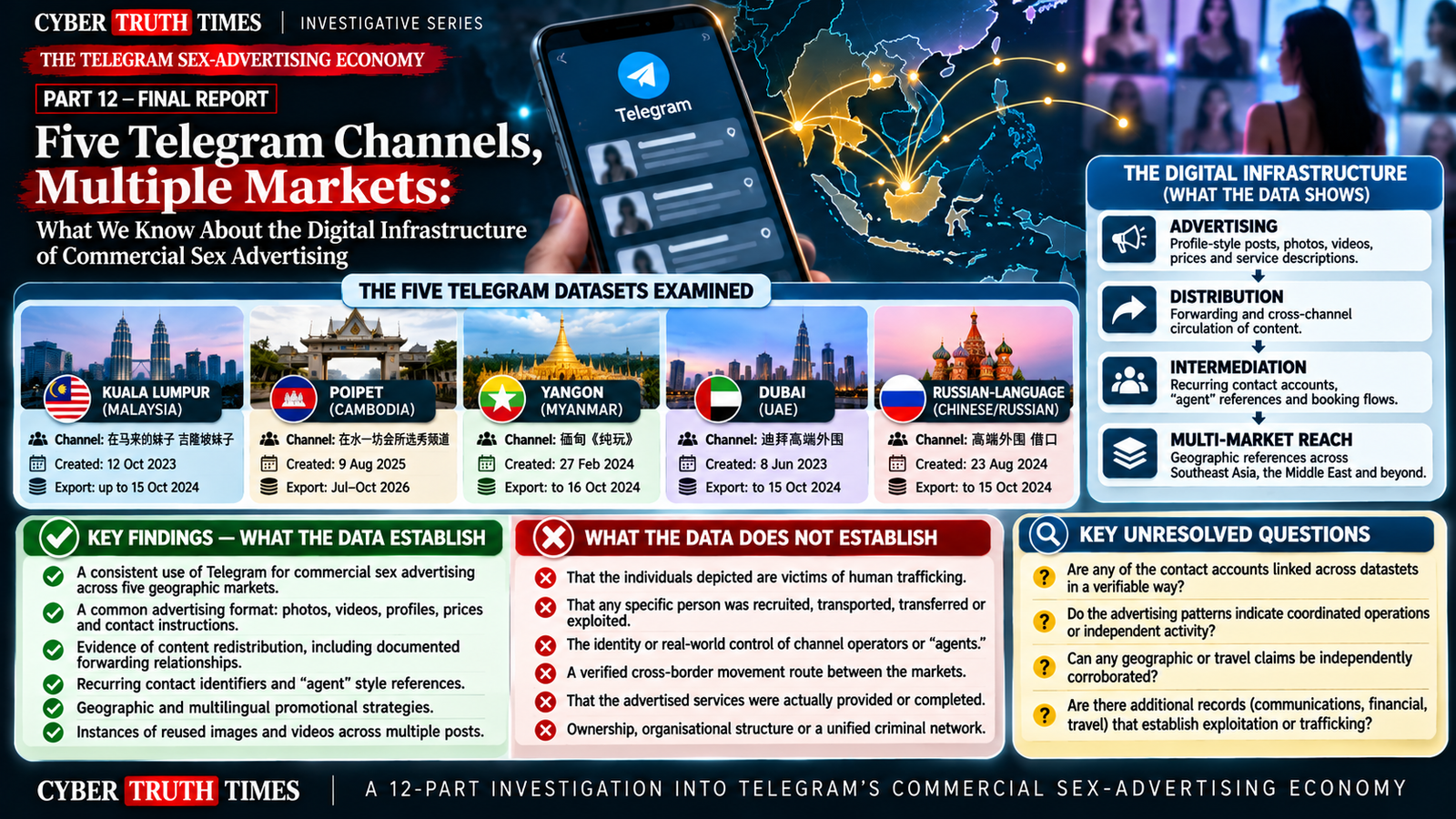
Cyber Truth Times embarks on a Telegram Sex Advertising investigation, mapping advertising infrastructure, verified relationships, investigative leads and evidentiary limitations.
Introduction: Telegram Sex Advertising Investigation
Telegram has become a platform where a variety of commercial activities are promoted, coordinated and distributed through channels, forwarded messages, usernames, bots and other digital mechanisms. Among these activities is the advertising of commercial sexual services, which can appear in location-specific channels, profile-based promotional formats, agent-led listings and customer-facing communication systems.
Over the course of this investigative series, Cyber Truth Times examined five Telegram datasets associated with commercial sex advertising across different geographic and linguistic contexts: Kuala Lumpur and Malaysia, Poipet in Cambodia, Yangon in Myanmar, Dubai in the United Arab Emirates, and a Russian-language advertising channel featuring prices denominated in Kazakhstani tenge.
The investigation examined advertisements, recurring identifiers, forwarding relationships, contact accounts, promotional language, links, media references, pricing structures and the digital workflows presented within these datasets.
The findings reveal several distinct forms of digital advertising infrastructure. Some channels appear to distribute advertisements through forwarding relationships. Others organise promotional content around geographic locations, individual profiles, intermediary accounts, customer-service contacts or attendance-style listings.
Yet the investigation also encountered a fundamental limitation: digital advertising patterns cannot, by themselves, establish the existence of a unified organisation, prove the identity of those operating accounts or determine whether the people appearing in advertisements are acting voluntarily.
This concluding report consolidates the findings from all five datasets, identifies the relationships documented within the available records, examines unanswered questions and establishes what the investigation collectively demonstrates and what remains unverified.
1. Five Datasets and Their Distinct Advertising Models
The five datasets did not present identical structures. Instead, they offered examples of different digital approaches to advertising and distribution.
Kuala Lumpur, Malaysia: Advertising Distribution Through Forwarding Relationships
The Kuala Lumpur dataset, associated with the Telegram channel 在马来的妹子 吉隆坡妹子, contained promotional content referencing individuals, services, locations, prices and photographs or videos.
The dataset covered activity beginning in October 2023, with recorded activity extending into October 2024.
One of the most notable observations was the presence of 235 recorded forwarding occurrences associated with the channel identifier 1645247258, displayed under the name 生活助理 💋 包养 💕 ➗女.
These occurrences provide a documented example of content distribution through Telegram’s forwarding functionality. They establish that the exported dataset contains repeated forwarding references associated with the identified source channel.
However, these occurrences cannot be equated with 235 customers, individual transactions, unique recipients, verified advertisements or independently confirmed relationships.
The dataset also contained a promotional post dated 12 October 2023 that referenced Cambodia, Singapore, Malaysia and Dubai, alongside financial figures expressed in USD and RMB.
The context and commercial meaning of those claims remain unresolved.
The Kuala Lumpur dataset therefore provides a useful case study of promotional content and forwarding-based distribution, but it does not establish a verified cross-border recruitment or trafficking network.
Poipet, Cambodia: Location-Centred and Multilingual Advertising
The Poipet dataset, associated with the channel 在水一坊会所选秀频道, contained promotional material repeatedly referencing Poipet.
The dataset includes multilingual content, including Vietnamese, Lao and Chinese language material. These linguistic characteristics indicate the presence of multilingual promotional content, but they do not independently establish the nationality, residence or movement of the people represented.
Advertisements included terms associated with service descriptions, promotional ratings, additional offerings and other marketing language.
A post dated 21 September 2026, identified as post 2374 in the dataset, advertised a 90-minute service starting at $179, alongside promotional claims involving group discounts and in-person or outcall arrangements.
The currency and authenticity of these claims were not independently verified.
The Poipet dataset demonstrates how a location-specific advertising channel can use recurring geographic references and promotional language to present commercial listings.
It does not establish the identities of advertisers, the authenticity of the offers, the movement of individuals or the existence of a trafficking operation.
Yangon, Myanmar: Contact-Based Advertising and Referral Infrastructure
The Yangon dataset, associated with the channel (YGN) DATE GIRLs, contained profile-based advertisements, photographs, videos, price references, transport charges, contact information and instructions relating to accommodation or settlement.
The dataset included recurring telephone numbers, including:
- 09 779636254
- 09 664426946
These identifiers represent investigative leads within the dataset. Their recurrence does not independently establish who owns, controls or operates them.
The records also included a Telegram link to myannarmalays, as well as another channel or referral link and forwarded content associated with a channel identified as (YGN) DATE GIRNS.
These observations suggest that the dataset contains multiple forms of digital contact and content redistribution.
Nevertheless, the records do not establish that the channels, telephone numbers or accounts are operated by one person or organisation.
Nor do they establish that the people appearing in advertisements were transported across borders, coerced, deceived, exploited or connected to scam compounds.
The Yangon dataset offers a documented starting point for examining contact-based advertising and digital referrals, while leaving questions about ownership, operational relationships and actual transactions unanswered.
Dubai, UAE: Segmented Customer-Facing Advertising
The Dubai dataset, associated with the channel 迪拜修车✨金澜汇 轻奢顶美俱乐部, contained advertisements promoting commercial sexual services, package pricing, overnight offerings, transport arrangements and customer-facing communication.
The dataset included references to accounts such as:
@DBbaibai@DBxc8bot@DUbaibai
It also contained links associated with attendance-style promotional content and feedback.
The advertising material claimed the availability of services, pickup and drop-off arrangements, refreshments, operating hours and other customer-facing features.
Some promotional posts claimed that services were associated with central Dubai hotels. These statements were advertisements, not independently verified hotel relationships.
The presence of customer-service accounts, bots, attendance-style listings and feedback references suggests a segmented digital promotional workflow within the material examined.
However, the available records do not establish common ownership or control of these accounts, actual bookings, completed transactions or involvement by hotels, transport providers or other businesses.
The Dubai dataset therefore illustrates a particular advertising presentation and communication structure, rather than a verified organisational chart.
Russian-Language Advertising: Profile Listings and Agent-Based Promotion
The fifth dataset, associated with the channel Лучшие модели and its earlier title Интим Монолит, contained profile-oriented advertising, pseudonyms, measurements, price listings and agent-related contact references.
The dataset included prices denominated in Kazakhstani tenge, including an advertisement dated 18 April 2026 that listed 80,000 KZT per hour, 160,000 KZT for two hours and 240,000 KZT for an overnight arrangement.
A recurring contact identifier @Lakomkaa221appeared within the promotional material, alongside a recurring invitation link.
The presence of repeated contact identifiers and profile advertisements provides a basis for examining the role of intermediary-style accounts in digital advertising.
However, recurring contact information does not establish identity, ownership, management, the existence of an agency or whether transactions took place.
The use of KZT also does not independently establish the physical location of the channel operators or the people advertised.
This dataset illustrates an agent-associated advertising format within the records, but the operational relationship between the contact account and individual advertisements remains unverified.
2. What the Five Datasets Collectively Reveal
Although the datasets differ considerably in their content and apparent advertising formats, several recurring characteristics can be identified.
A. Channels function as advertising and distribution environments
Across the datasets, Telegram channels were used to publish promotional material, descriptions, images, videos, price references and contact information.
The channels provided an identifiable digital environment in which promotional content could be repeatedly presented.
The available exports document content published within these environments. They do not establish the actual number of people viewing the content, the effectiveness of the advertisements or the number of resulting transactions.
B. Contact identifiers are recurring investigative leads
Telephone numbers, usernames, bots and other identifiers appeared within several datasets.
Their recurrence may be useful when investigating advertising continuity, communication infrastructure and possible relationships between posts.
However, an identifier is not equivalent to a verified identity.
A recurring username may be controlled by one individual, several individuals, an intermediary or an account whose control has changed over time. Without independent corroboration, attribution remains unresolved.
C. Forwarding and referral mechanisms contribute to distribution
The Kuala Lumpur dataset provides a particularly documented example of repeated forwarding occurrences.
Other datasets contained references to referral links, additional channels and contact accounts.
Together, these records illustrate several digital distribution mechanisms, including forwarding, links and account-based communication.
They do not establish that these mechanisms form one interconnected network or that all participants share an organisational structure.
D. Promotional content is adapted to different contexts
The datasets contain different geographic references, linguistic presentations, pricing formats and promotional styles.
These differences may reflect distinct advertising environments, audiences, operators or marketing practices.
However, the datasets alone cannot reliably determine why these differences exist.
It would be premature to infer a common business model, standardised operational system or unified organisation from similarities in promotional presentation.
E. The datasets contain claims that require independent verification
Advertisements frequently contain claims concerning prices, availability, locations, services, transport, accommodation, customer experience or other commercial arrangements.
These claims remain claims unless corroborated.
A listing does not establish that a service was available, that a booking occurred, that payment was made or that the advertised person was present at the stated location.
This distinction is central to the investigation.
3. Verified Relationships: What Can Actually Be Established?
The investigation identified several relationships that can be described at the level of the available digital records.
| Dataset | Documented relationship or observation | Evidentiary limitation |
|---|---|---|
| Kuala Lumpur | 235 recorded forwarding occurrences associated with a source channel identifier | Does not establish audience size, transactions, ownership or coordination |
| Poipet | Repeated geographic references and multilingual promotional content | Does not establish nationality, movement or organisational relationships |
| Yangon | Recurring telephone identifiers, referral links and forwarded content | Does not establish identity, ownership, trafficking or cross-border movement |
| Dubai | Customer-service accounts, bot references, attendance-style content and feedback references | Does not establish common ownership, completed bookings or third-party involvement |
| Russian-language dataset | Recurring agent identifier, invitation link and profile advertisements | Does not establish agent identity, ownership, transactions or physical location |
These relationships are verified only to the extent that they are documented in the examined dataset exports.
The investigation has not established that the five channels are connected to one another through a common owner, operator, administrator, financial structure or coordinated organisation.
The distinction between a documented digital relationship and a verified organisational relationship must remain explicit.
4. What the Investigation Has Not Established
The five datasets contain evidence of commercial sex advertising and digital promotional activity. They do not currently establish several allegations that would require considerably stronger corroboration.
Human trafficking
The investigation has not established that the individuals represented in the advertisements were trafficked.
Human trafficking requires legally relevant elements that differ from the mere presence of advertisements, pricing, contact information or commercial sexual services.
Evidence of recruitment, transportation, transfer, harbouring or receipt of persons must be assessed alongside applicable means and exploitation-related elements under the relevant legal framework.
The dataset material examined here does not independently establish those elements.
Coercion or forced prostitution
The available records do not establish that individuals were forced, threatened, controlled or compelled to provide sexual services.
Advertisements and pricing structures cannot independently establish consent, coercion or the circumstances under which the people represented were participating.
Common ownership or a unified network
The five datasets were examined independently.
Recurring identifiers, similar promotional formats, forwarding relationships and geographic references may generate further investigative leads, but they do not establish a unified network.
No verified common ownership or control relationship linking all five datasets has been established.
Cross-border movement or recruitment
Geographic references to Malaysia, Cambodia, Myanmar, Dubai and other locations do not establish that individuals travelled between those locations.
The datasets contain promotional claims and geographic references, but the investigation has not independently verified the movement, recruitment, transportation or transfer of individuals across borders.
Transactions, payments or customer identities
Price listings and contact information do not establish that payments occurred or that advertised services were completed.
The investigation has not independently verified customers, payment records, bookings or transactions across the five datasets.
Criminal activity by named individuals or businesses
The recurring identifiers examined in the investigation should not be treated as proof of criminal conduct.
The investigation has not established criminal responsibility by any individual, business, hotel, transport provider or other third party based solely on the advertising material examined.
5. The Unresolved Questions
The five datasets provide several directions for further investigation, but these require additional evidence and careful corroboration.
Who controls the recurring accounts?
The recurring usernames, telephone numbers, bots and forwarding identifiers represent potential leads.
Further investigation would require evidence capable of establishing account ownership, control, continuity and the relationship between individual accounts.
Are the channels connected beyond content distribution?
The records contain forwarding, referral and contact relationships.
The next evidentiary step would be to determine whether these relationships represent independent advertising, shared administration, commercial partnerships or other forms of coordination.
The presence of a link or repeated identifier is insufficient to establish any of these possibilities.
Are advertised locations independently verifiable?
Geographic references within advertisements could be investigated through independently authenticated records, where ethically and legally available.
However, a location mentioned in promotional material cannot automatically be treated as the physical location of an individual, an operator or a service.
What happens after a potential customer contacts an advertiser?
The datasets contain contact information and communication references, but they do not provide a complete, independently authenticated account of the interactions that follow.
Further evidence would be required to establish how communications proceed, whether transactions occur, who controls the communication channels and whether any coercive or exploitative practices are involved.
Are the promotional media reused?
Photographs and videos represent a potential avenue for media-forensics research.
Metadata analysis, file hashing, perceptual similarity, reverse-image searches and video-frame comparisons may identify media reuse or distribution patterns.
However, matching promotional media does not establish the identity of the people depicted, consent, exploitation, trafficking or common ownership of the advertising channels.
6. Why Digital Evidence Requires Corroboration
The investigation demonstrates the value of Telegram exports as sources of digital evidence.
They can preserve information about messages, channel identifiers, forwarding references, timestamps, links, media and contact details.
But digital evidence must be assessed in context.
The integrity of an export, the provenance of media, the completeness of records, the reliability of timestamps and the attribution of accounts all affect the strength of conclusions.
A screenshot may omit contextual information. A forwarded post may not preserve the complete original context. An account may change ownership. A telephone number may be recycled. An advertisement may be misleading or fabricated.
Consequently, further investigative work would require careful evidence preservation and independent corroboration, potentially through authenticated communications, financial records, testimony, verified travel records, documentary evidence and other lawful sources.
The purpose of this approach is not to weaken an investigation. It is to make its conclusions defensible.
7. The Methodological Importance of Separating Leads from Findings
The Telegram Sex-Advertising Economy investigation was designed to examine digital advertising infrastructure rather than to presume a particular criminal explanation.
This distinction affects how the findings are interpreted.
A recurring username is a lead.
A repeated forwarding relationship is a documented distribution observation.
A geographic reference is a claim or contextual signal.
A price listing is promotional information.
A reverse-image match is a potentially useful media-search result.
None of these, in isolation, is a legal finding of trafficking or exploitation.
Maintaining this distinction prevents an investigation from turning a collection of digital observations into a narrative that the evidence cannot support.
It also allows future research to build upon the dataset without inheriting unsupported conclusions.
8. What Five Datasets Collectively Establish
The five datasets collectively document several forms of digital advertising infrastructure associated with the promotion of commercial sexual services on Telegram.
They demonstrate the presence, within the examined exports, of:
- Channel-based promotional content.
- Location-oriented advertisements.
- Profile-based advertising formats.
- Repeated forwarding occurrences.
- Recurring contact identifiers.
- Referral and invitation links.
- Customer-facing accounts and bot references.
- Attendance-style promotional content.
- Pricing information and service-related claims.
- Media accompanying advertisements.
- Multilingual promotional material.
These findings provide a foundation for further OSINT research into the digital distribution and presentation of commercial sex advertisements.
The investigation also establishes the importance of evidentiary restraint.
The five datasets do not independently establish trafficking, coercion, exploitation, forced prostitution, common ownership, a unified organisation, cross-border movement, verified transactions or criminal responsibility.
Those questions remain unresolved.
Conclusion: Documenting the Infrastructure Without Outrunning the Evidence
The Telegram Sex-Advertising Economy investigation examined five datasets representing distinct advertising environments across Malaysia, Cambodia, Myanmar, Dubai and a Russian-language advertising channel featuring KZT-denominated pricing.
The records reveal digital promotional activity, repeated identifiers, forwarding occurrences, contact structures, referral references, media and advertising claims.
They offer a window into how commercial sex advertising can be presented and distributed within Telegram-based environments.
But the investigation’s most important conclusion is not that the five datasets reveal a single organisation or trafficking network.
It is that digital advertising infrastructure can be documented, mapped and examined without prematurely assigning identities, ownership, criminal responsibility or exploitative relationships.
The findings provide investigative leads and an evidentiary foundation for further research. They also identify the limits of what can be concluded from the records currently available.
Cyber Truth Times will continue to distinguish documented observations from hypotheses, promotional claims from independently verified facts, and investigative leads from substantiated conclusions.
The evidence should determine the narrative, not the other way around.
Explore the Full Investigation
This report is part of The Telegram Sex-Advertising Economy, a 12-part investigative series by Cyber Truth Times examining five Telegram datasets associated with commercial sex advertising across Malaysia, Cambodia, Myanmar, Dubai and a Russian-language advertising channel. The series investigates digital distribution patterns, intermediary and agent references, advertising infrastructure, media-related investigative leads, geographic claims and the evidentiary limits of the available records. Read our pillar investigation for the overarching findings, methodology, research objectives and complete roadmap of the series.
Access the Dossier & Evidence
The raw Telegram datasets examined in this investigation are available in our Dossier & Evidence section for readers seeking to inspect the underlying documentary material. These files provide the source records used in our dataset-level analysis and support transparency, scrutiny and further examination. The records should be interpreted cautiously: the presence of advertisements, forwarding metadata, contact references or geographic claims does not independently verify identities, transactions, ownership, recruitment or exploitation.
Bibliography
The bibliography below supports the legal framework, digital-evidence methodology and platform-related context of the concluding report.
- United Nations Office on Drugs and Crime (UNODC) — The Crime of Trafficking in Persons — Legal elements and conceptual framework for trafficking in persons.
- United Nations — Understanding Human Trafficking — Background on the international framework for trafficking in persons.
- UNODC — Indicators of Trafficking in Persons — Indicators and contextual factors relevant to identifying potential trafficking situations.
- UNODC — Human Trafficking Indicators — Reference material concerning indicators used in trafficking identification.
- UNODC — Human Trafficking and Migrant Smuggling — Resources on trafficking and related international legal frameworks.
- National Institute of Standards and Technology (NIST) — Digital Evidence Preservation: Considerations for Evidence Handlers — Digital evidence handling and preservation considerations.
- U.S. Department of Justice — What Is Human Trafficking? — Overview of trafficking-related concepts and legal context.
- Telegram — FAQ — Platform overview and information concerning Telegram’s functionality.
Disclaimer: This report examines digital records associated with commercial sex advertising. Advertisements, prices, contact identifiers, location references, forwarding records, media and claims contained in the datasets have not necessarily been independently verified. The material does not, by itself, establish human trafficking, coercion, exploitation, forced prostitution, criminal conduct, common ownership or completed transactions. The identities and circumstances of individuals represented in promotional media remain unverified unless independently established through appropriate evidence.
For deeper investigations on such topics, see our Cybercrime Investigations & Exposes.