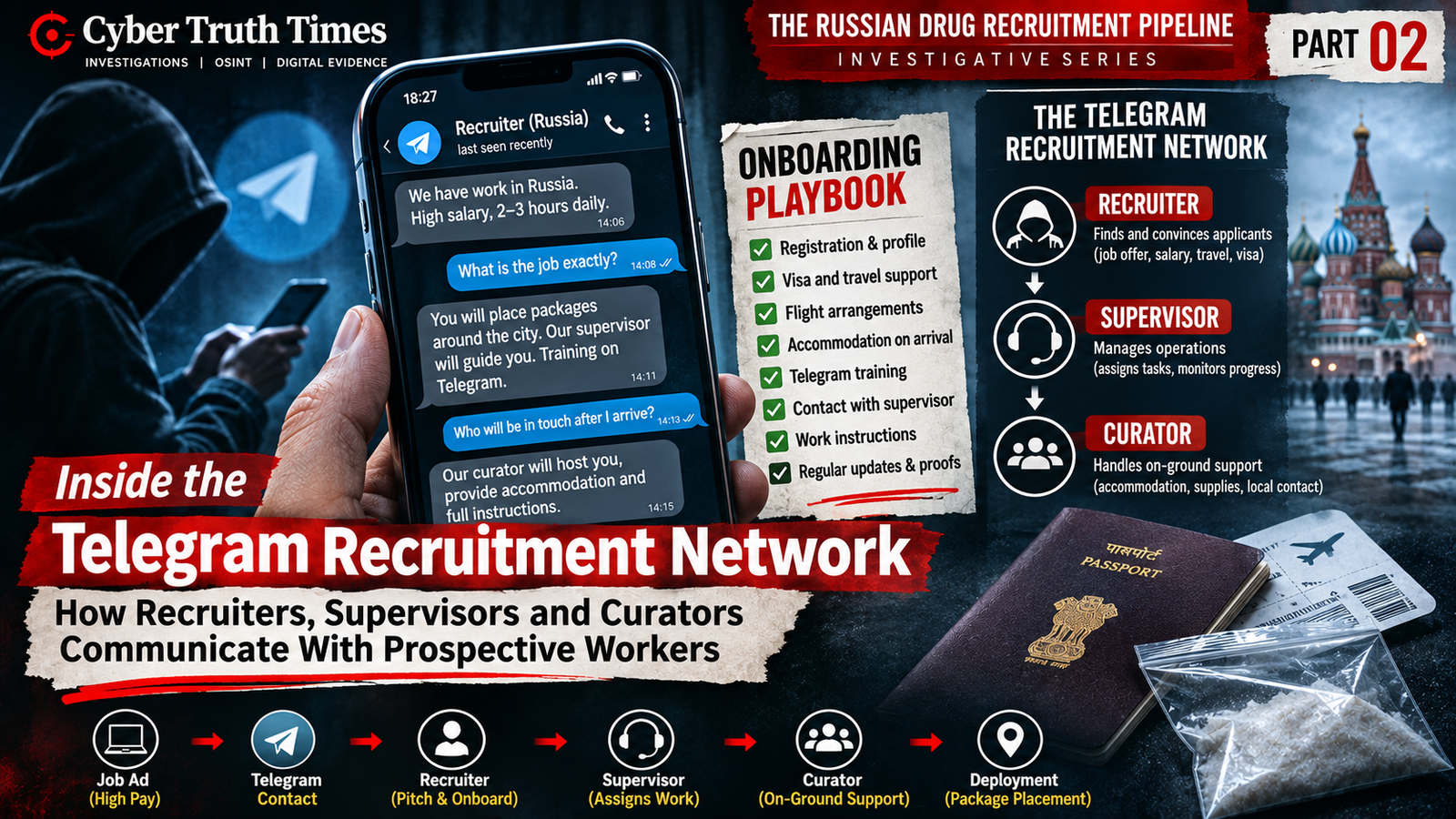
Cyber Truth Times investigates a Telegram recruitment network, purported supervisors, onboarding messages and communication patterns linked to drug-related job offers in Russia.
Introduction: Telegram Recruitment Network
Online recruitment advertisements rarely tell the entire story of a prospective job. In some cases, the advertisement is merely the first point of contact in a longer digital conversation that unfolds through messaging platforms, private chats, media files and individual intermediaries.
In our investigation into suspicious employment advertisements targeting prospective workers for Russia, Telegram conversations have revealed a recurring pattern worth examining beyond the content of the original job offer. Several recruitment accounts approached prospective candidates using employment-oriented language, promising attractive earnings, flexible schedules and assistance with travel or accommodation. However, in the conversations examined, the proposed work subsequently changed character, with recruiters explicitly describing activities involving the distribution of illegal drugs.
This second article in the Cyber Truth Times investigative series examines the communications surrounding these recruitment propositions. It looks at the roles claimed by recruiters, the language used during onboarding, the references to supervisors and curators, the movement of conversations between recruitment and training stages, and the similarities observed across different Telegram interactions.
The objective is not to assume that every account belongs to the same organisation. Instead, it is to establish what the messages themselves reveal, identify recurring communication patterns, and develop a framework for investigating whether apparently separate recruitment accounts are connected.
1. Telegram as the Recruitment Contact Point
Telegram appears repeatedly in the recruitment conversations examined in this investigation.
The platform’s messaging environment allows individuals to communicate directly, exchange media, forward messages, create group conversations and move prospective workers into private chats. These capabilities can facilitate legitimate recruitment. They can also make it difficult for an applicant to establish who is actually operating an account, whether the purported employer exists, or whether the person offering employment has any verifiable relationship with an organisation.
In the material reviewed for this investigation, recruitment conversations begin with relatively straightforward employment-oriented messages. Prospective candidates are told that work is available in Russia, sometimes without requiring knowledge of the Russian language.
The initial proposition may emphasise:
- Attractive compensation.
- Limited daily working hours.
- Flexible schedules.
- Assistance with travel.
- Accommodation arrangements.
- Food and other necessities.
- Training before the work begins.
These elements create the appearance of a conventional international employment arrangement. However, the communications examined subsequently reveal a significant divergence between the initial framing and the actual proposed activities.
The distinction between the initial advertisement and the later conversation is central to this investigation.
2. The Recruiter: Introducing the Employment Proposition
The recruiter appears to occupy the first identifiable communication role in the conversations.
This individual or account initiates, responds to or manages communication with prospective workers. The recruiter presents the opportunity, responds to questions about compensation and logistics, and attempts to establish whether the prospective candidate is willing to proceed.
In one conversation supplied for this investigation, the account identified in the chat as Carlisle Rockwellford described employment in Russia without requiring Russian-language proficiency. The conversation subsequently introduced compensation claims, a description of the work involving drug distribution, and logistical promises relating to travel and accommodation.
The messages included a proposed activity involving the distribution of small medicine packets, followed by an explicit clarification identifying the substance as cocaine.
What this establishes: The supplied conversation contains an employment proposition that transitions into an explicit drug-related job description. It does not, on its own, establish the recruiter’s real identity, location, employer, or relationship with other accounts.
This distinction matters. Telegram display names and profile photographs are not independently verified identities. They can be changed, impersonated or reused. The investigative value lies initially in preserving the communication record and documenting the account’s observable behaviour.
3. The Promise of Earnings and Logistical Assistance
The financial proposition appears to be a significant component of the recruitment conversation.
The messages supplied for this investigation included compensation claims ranging from an initial description of earnings to more detailed payment calculations tied to the number of purported deliveries. Recruiters also discussed the possibility of travel to Russia and accommodation after arrival.
These claims were presented alongside statements suggesting that the work could be completed in a relatively short period each day.
Such messaging creates a recruitment proposition built around several apparent advantages: substantial earnings, limited working hours and the removal of logistical obstacles to international travel.
The conversation also included references to arrangements for obtaining a visa, purchasing flight tickets and providing accommodation, food and necessities.
These promises are important to document because they can make an otherwise suspicious offer appear more credible to someone considering employment abroad.
Yet the presence of logistical promises does not demonstrate that the recruiter is a legitimate employer. Nor does a promise of payment establish that the prospective worker will actually receive it.
The investigation therefore treats compensation figures, travel commitments and accommodation claims as statements made by the recruiting accounts not independently verified employment conditions.
4. The Disclosure of Drug-Related Work
The most significant transition in the communications examined occurs when the recruiter explains what the prospective worker is expected to do.
In the conversation supplied for this investigation, the recruitment proposition shifts from general employment language to an explicit description of distributing packages containing illegal substances. The recruiter identifies the substance as cocaine and asks whether the prospective candidate understands the proposed work and is willing to proceed.
This is a material change in the nature of the offer.
The recruitment conversation is no longer simply about an unspecified job in Russia. It becomes a proposition involving illegal drug distribution, with compensation linked to the activity described.
The transition raises several investigative questions:
- Was the nature of the work disclosed in the original advertisement?
- Was the disclosure made only after a candidate expressed interest?
- Did multiple recruitment accounts use similar language?
- Were the same videos, images or explanatory messages circulated?
- Were the same purported supervisors or training arrangements mentioned?
- Can the accounts be linked through independently corroborated evidence?
These questions form the basis of the wider investigation.
5. The Supervisor and the Curator: What the Messages Describe
The conversations examined also refer to a subsequent stage involving a purported supervisor or curator.
Recruiters described a process in which a prospective worker would receive additional instructions after the initial recruitment stage. In the material supplied, training was said to take place through Telegram, with another person providing instructions, rules and explanations about the work.
The communications suggest a claimed division between the person initially recruiting the candidate and the person who would later provide operational instructions.
This is a claimed role structure within the conversations not a verified organisational chart.
The distinction between recruiter, supervisor and curator should be investigated rather than assumed.
A person described as a curator may be:
- A separate individual operating another account.
- The same individual using a different account or role.
- A label used within a scripted recruitment conversation.
- A genuine intermediary within a larger network.
- An impersonator copying recruitment language or instructions from another source.
Without independent evidence, these possibilities remain open.
The investigation will therefore examine the communication records for observable relationships between accounts, including direct references, introductions, forwarded messages, shared media, group membership and documented transitions between chats.
6. The Onboarding Language: Training, Instructions and Reassurance
The recruitment conversations contain repeated references to training and detailed instructions.
In the supplied material, prospective workers were told that they would receive a briefing from a supervisor or curator, who would explain the work and relevant instructions. The communication also presented the work as straightforward, with the recruiter suggesting that following the instructions would make the activity easy or safe.
This language is notable because it attempts to reduce uncertainty about an activity that the recruiter has already described as involving illegal drug distribution.
The use of reassurance, structured training and claims of safety should be documented in their original context.
The investigation is not treating the recruiters’ descriptions of safety as evidence that the activity is safe. Rather, these statements are part of the communication itself and may be relevant to understanding how prospective candidates are encouraged to proceed.
Where similar reassurance language appears across multiple conversations, investigators can compare the original text, timestamps, media attachments and account details to determine whether the similarity is meaningful.
7. Comparing Recruitment Accounts: Similarity Is a Lead, Not a Conclusion
One of the central questions in this investigation is whether multiple recruitment accounts are communicating independently or are connected through a common recruitment structure.
The material supplied includes conversations in which recruitment language, compensation claims, descriptions of work and references to training appear similar.
Such similarities can be investigative leads.
However, identical or near-identical language can arise for several reasons:
- A common recruiter or organisation uses standardised scripts.
- Multiple accounts copy messages from an existing advertisement.
- Accounts imitate an established recruitment model.
- Individuals share templates without belonging to the same organisation.
- Similar recruitment practices emerge independently.
The investigation will therefore distinguish textual similarity from attribution.
A comparison of messages can establish whether particular phrases, sentence structures, compensation descriptions or instructions recur. It cannot independently establish who wrote the original text or whether the accounts are operated by the same person.
The stronger investigative approach is to compare multiple independent indicators.
These may include:
- The original message text and timestamps.
- Telegram account identifiers, where lawfully and reliably preserved.
- Profile changes documented over time.
- Shared photographs, videos or attachments.
- Repeated links or external contact points.
- Direct introductions between accounts.
- References to the same purported supervisor.
- Group membership or invitation records.
- Independently corroborated information about the accounts.
A meaningful connection should be based on a combination of evidence, not merely a similar username or repeated sentence.
8. The Role of Shared Videos and Recruitment Media
Media files can provide an additional dimension to the investigation.
The recruitment conversations supplied for this project included videos described as instructional material concerning package placement and concealment methods. Their captions reportedly described methods associated with hiding packages.
These videos are relevant because they may demonstrate how the recruiters explain the proposed activity and what type of material they provide to prospective candidates.
The investigation can compare the videos’ visible content, captions, file properties where available, perceptual similarities and contextual references.
A shared video across multiple conversations may indicate that the same material is being circulated. However, it does not necessarily establish a common operator: a video can be downloaded, forwarded or reused by unrelated accounts.
For publication, the videos should be contextualised carefully. The investigation should avoid reproducing operational instructions that could facilitate drug distribution, while retaining enough evidence to demonstrate the nature of the recruitment proposition.
The focus should remain on recruitment, deception, communication patterns and accountability, not on explaining how drug-distribution activities are carried out.
9. The Wider Context: Foreign Nationals and Drug-Related Cases in Russia
Public reporting provides another avenue for examining the consequences of drug-related activity involving foreign nationals in Russia.
The material previously supplied for this investigation included Russian-language reporting concerning Indian nationals arrested or accused in drug-related cases in Volgograd. The reports described allegations involving drug distribution, concealed packages and evidence reportedly recovered during police investigations.
These cases are relevant contextual material, but they should not be treated as direct confirmation that the individuals were recruited through the Telegram accounts examined in this investigation.
A documented arrest and an online recruitment conversation are separate pieces of evidence.
Connecting them requires corroboration, such as a verified recruitment history, authenticated messages, account attribution, testimony or other independently documented evidence.
The wider context is nevertheless important. Prospective workers who enter a foreign country and become involved in illegal drug distribution may face serious criminal consequences, including detention, prosecution and imprisonment. The consequences can be particularly severe where the individual has limited knowledge of the local language, legal system or support networks.
This investigation seeks to document the recruitment proposition before concluding any individual case.
10. What the Communications Reveal and What They Do Not
The Telegram conversations examined in this investigation reveal a recruitment proposition that deserves scrutiny.
The supplied messages include employment-oriented framing, compensation claims, assurances regarding working hours, logistical promises and explicit descriptions of drug-related work. They also refer to subsequent training or briefing arrangements involving purported supervisors or curators.
Taken together, these elements provide a basis for examining how the recruitment proposition is communicated.
However, the available conversations do not automatically establish:
- The real identities of all participants.
- The existence of a single central organisation.
- The nationality or location of account operators.
- The precise number of prospective recruits.
- Whether every recruitment account is connected.
- Whether travel arrangements were actually completed.
- Whether the promised compensation was paid.
- Whether a particular criminal case originated through these accounts.
These are questions that require further investigation and corroboration.
The purpose of this series is to develop the evidence systematically, preserve the original records and avoid treating investigative hypotheses as facts.
11. Dossiers and Evidence: Preserving the Original Communications
The original Telegram data exports, supporting screenshots, videos and other evidence collected for this investigation are being preserved and organised in the Dossiers and Evidence section of Cyber Truth Times.
The evidence repository is intended to provide a reference point for the material underpinning the investigation.
Where available and appropriate, the dossiers may include:
- Original Telegram data exports.
- Screenshots of recruitment conversations.
- Relevant photographs and video files.
- Recruitment advertisements and supporting material.
- Supporting public reporting.
- Investigative notes and comparisons.
The original records are preserved separately from the published narrative wherever possible, allowing the article to present findings without replacing the underlying source material with editorial summaries.
Dossiers and Evidence: The section serves as a supporting evidence archive for readers seeking to review the preserved materials associated with this investigation.
The availability of material in an archive does not itself establish authenticity, attribution or the accuracy of every claim contained within it. Sensitive personal information and material that could expose sources or facilitate criminal activity should be redacted before public release.
12. What Comes Next in the Investigation
Article 02 focuses on the communication structure surrounding the recruitment proposition.
Subsequent articles will examine other aspects of the investigation, including the recruitment advertisements themselves, the role of shared media, the alleged recruitment process, the risks facing foreign job seekers and the possibility that seemingly separate accounts may be linked.
The central investigative objective remains to establish the facts through preserved records, corroboration and transparent methodology.
The similarities observed across the communications warrant further scrutiny. But the investigation will not treat similarity as proof of a common organisation.
Conclusion: Mapping the Communications, Establishing the Evidence
The Telegram conversations examined in this investigation reveal more than isolated employment messages. They document a communication process in which recruiters present an employment opportunity, describe compensation and logistical arrangements, disclose drug-related work and refer prospective candidates to further instructions or purported supervisors.
These communications provide the starting point for investigating the digital recruitment process.
Whether the accounts form part of a coordinated network, share common operators or simply reproduce similar recruitment scripts remains a question to be answered through further evidence.
By preserving the original data exports, comparing communication patterns and documenting the limits of what the evidence establishes, Cyber Truth Times seeks to examine this recruitment proposition without overstating the conclusions.
The messages are the evidence. The network, if one exists, must be established through corroboration.
Bibliography and Further Reading
Suggested bibliography for the article. These links provide contextual background and methodological reference; they should not be presented as direct corroboration of specific Telegram accounts unless the underlying source explicitly supports that connection.
- Radio Free Europe/Radio Liberty — Reporting on drug-mule recruitment and Russia-related trafficking — Context for online recruitment advertisements and drug-mule recruitment practices.
- Radio Free Europe/Radio Liberty — Kyrgyzstan, Russia and drug-trafficking recruitment — Regional context concerning drug trafficking and recruitment-related risks.
- The Hindu — Medico from Cuddalore arrested in Russia, allegedly pressured toward the Ukraine war front — Context concerning reported experiences of Indian nationals in Russia.
- The Hindu — Man detained in Russia, pressured to join war, alleges family — Additional reporting concerning allegations involving Indian nationals detained in Russia.
- Vesti Volgograd — Indian national accused in a drug-related case in Volgograd — Local reporting on a drug-related criminal investigation involving an Indian national.
- Volgograd Bezformata — Reporting concerning an Indian national and a drug-related case — Additional local reporting and contextual material.
- Telegram — Vesti Volgograd post — Publicly available Telegram post referenced in the investigation.
- Cyber Truth Times — Dossiers and Evidence — Link to your website’s Dossiers and Evidence section. Replace this generic destination with the direct archive URL once the relevant archive page is live.
Before publication, verify each bibliography entry, its publication date and the precise claims supported by the article. A source that provides background is not necessarily evidence that the accounts examined in this investigation are connected.



One thought on “Inside the Telegram Recruitment Network: How Recruiters, Supervisors and Curators Communicate With Prospective Workers”