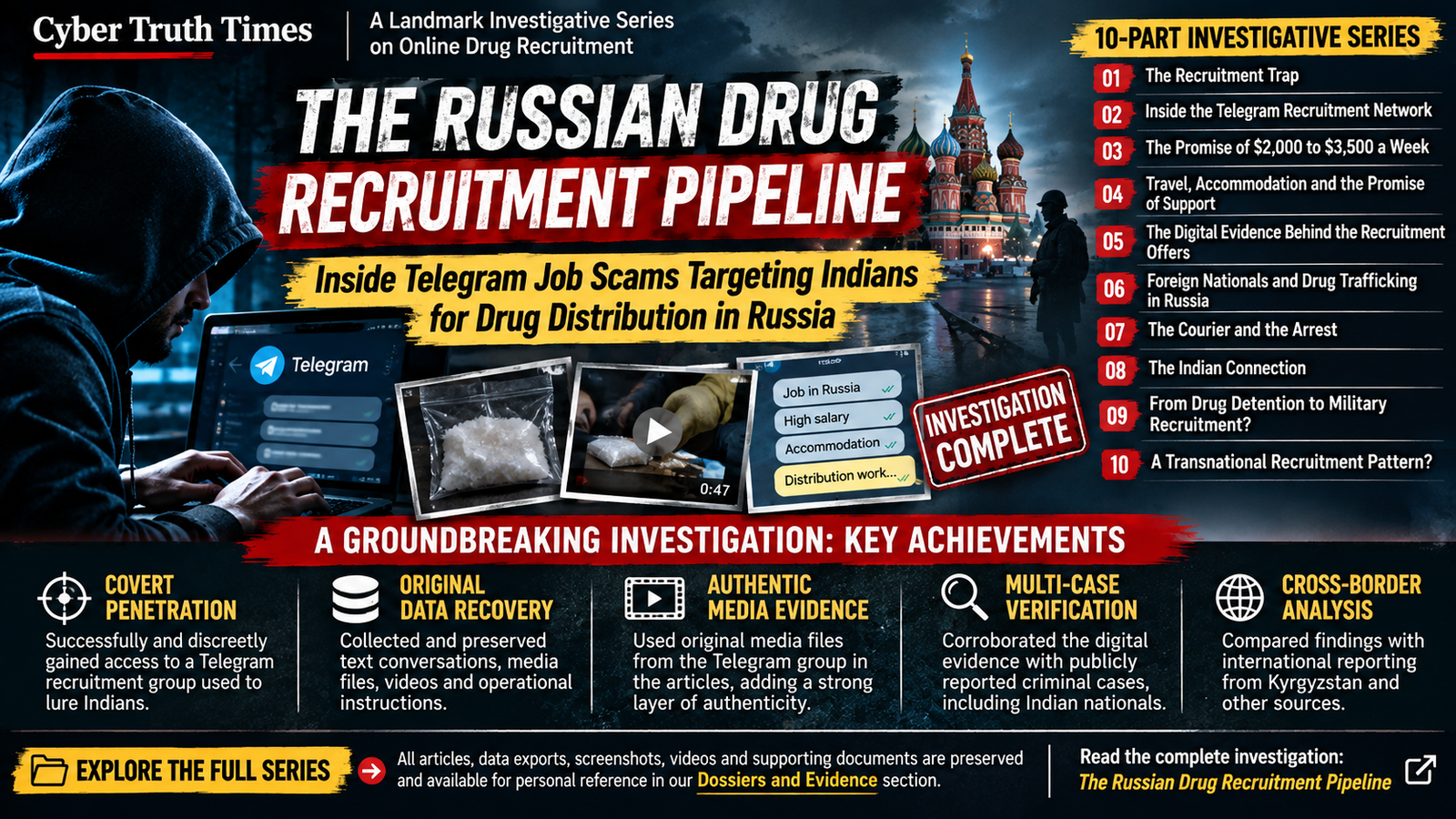
Cyber Truth Times investigates Telegram job scams targeting Indians for drug distribution in Russia through covert recruitment engagement, original media, preserved chat exports and a ten-part investigative series.
Cyber Truth Times Investigates: Inside Telegram Job Scams Targeting Indians for Drug Distribution in Russia
Cyber Truth Times has completed a multi-part investigative project examining a disturbing pattern of online employment advertisements that appear to offer foreign job seekers lucrative work in Russia but, in conversations documented during the investigation, lead to explicit proposals involving drug distribution.
The Russian Drug Recruitment Pipeline: Inside Telegram Job Scams Targeting Indians for Drug Distribution in Russia is an investigation built around digital communications, Telegram data exports, screenshots, videos, recruitment advertisements, publicly documented criminal cases and comparative reporting. Its central objective has been to document how apparently ordinary employment propositions can transition into offers to undertake drug-related activities, and to examine the wider risks facing prospective workers.
Investigating the recruitment proposition from the inside
Rather than relying exclusively on publicly visible advertisements, Cyber Truth Times engaged directly with recruitment accounts on Telegram in the course of its investigation, approaching the accounts through the recruitment-facing communications available to prospective applicants.
This investigative engagement allowed the newsroom to observe the progression of recruitment communications firsthand.
The conversations examined included offers describing work in Russia, unusually high compensation, relatively short working hours, travel arrangements, accommodation, training and assurances of support. In some of the communications documented by the investigation, the nature of the proposed work subsequently became explicit: distributing or concealing illegal drugs.
The newsroom collected and preserved relevant text-based communications, screenshots, videos and other media shared during these exchanges. These materials enabled a comparative examination of the recruitment language, the promises made to prospective applicants and the manner in which the proposition was disclosed.
The investigative approach was designed to document what the recruitment accounts actually communicated, rather than infer the nature of their activities from advertisements alone.
Original Telegram media and documentary evidence
One of the significant achievements of this investigation has been the preservation and examination of original media shared through the recruitment conversations.
The materials include recruitment messages, photographs, promotional videos and other media relevant to the advertised work and the subsequent disclosure of drug-related activities. The investigation also examined similarities in language and promotional material across different recruitment conversations.
Where relevant and editorially appropriate, original media obtained through the Telegram communications have been incorporated into published articles.
This provides readers with a documentary layer beyond the investigator’s narrative. Rather than merely describing what recruiters allegedly said, the published investigation can demonstrate selected portions of the underlying material.
The use of original media, accompanied by contextual explanation, redaction where necessary and careful attribution, strengthens the transparency of the reporting. It also allows readers to better understand the evidence underpinning the investigation.
The original Telegram exports and supporting documentary material have been preserved and made available for personal reference in Cyber Truth Times’ Dossiers and Evidence section, subject to appropriate privacy, security and editorial safeguards.
A ten-part investigative series
The investigation was developed into ten interconnected articles, each examining a different aspect of the recruitment proposition, its documentary evidence, its potential consequences and the questions that remain unresolved.
The Ten Investigative Articles
01 — The Recruitment Trap
How Online Job Advertisements in Russia Turn Into Drug-Courier Offers
Examines how seemingly conventional employment offers evolve into explicit proposals involving drug distribution, focusing on the recruitment language, financial promises and disclosures documented in the conversations.
02 — Inside the Telegram Recruitment Network
How Recruiters, Supervisors and Curators Communicate With Prospective Workers
Examines recruitment accounts, purported supervisors, onboarding communications and the language used to guide prospective workers through the recruitment process.
03 — The Promise of $2,000 to $3,500 a Week
Examining the Financial Incentives Behind Drug-Courier Recruitment
Investigates the compensation claims, payment structures, advertised workloads and financial incentives used to attract applicants.
04 — The Logistics of Recruitment
Travel, Accommodation, Training and the Promise of a New Life in Russia
Examines promises involving travel, accommodation, visas, training, supervisors and onboarding arrangements presented to prospective recruits.
05 — The Digital Evidence Behind the Recruitment Offers
Analysing Telegram Exports, Videos, Screenshots and Repeated Promotional Media
Documents the investigative methods used to examine, preserve and compare digital evidence, including media, timestamps, file integrity and limitations.
06 — The Courier and the Arrest
Investigating Allegations That Drug-Trafficking Organisers Expose Couriers to Law Enforcement
Examines allegations concerning couriers being exposed to arrest, distinguishing documented evidence from testimony, speculation and unverified claims.
07 — Foreign Nationals and Drug Trafficking in Russia
What Publicly Documented Cases Reveal About Foreign Drug Couriers in Russia
Examines publicly documented cases involving foreign nationals, the legal consequences and recruitment circumstances where established.
Indians Recruited for Drug-Related Work in Russia: Digital Evidence, Criminal Cases and the Recruitment Landscape
Focuses on India-specific recruitment communications, reported cases, legal and consular concerns and the evidence connecting recruitment offers to individual experiences.
09 — From Drug Detention to Military Recruitment?
Investigating the Unverified Connection Between Foreign Drug-Courier Cases and Pressure to Join Russia’s Military
Investigates the hypothesis of a connection between drug-related recruitment, detention or imprisonment and military recruitment pressure, without treating unverified links as facts.
10 — A Transnational Recruitment Pattern?
Kyrgyzstan, India and Russia: Are Foreign Job Seekers Being Targeted Through Similar Drug-Courier Recruitment Schemes?
Compares evidence examined in India with international reporting from Kyrgyzstan, testing whether similarities establish a broader pattern, common infrastructure or comparable practices.
Building a documentary record
The investigation is not limited to the publication of ten articles. Cyber Truth Times has also sought to maintain a documentary record of the materials examined throughout the project.
The Dossiers and Evidence section serves as a reference repository for relevant Telegram data exports, screenshots, original media files and supporting materials collected during the investigation. The purpose is to provide readers and interested researchers with a reference point for the documentary material underlying the reporting, subject to appropriate editorial safeguards.
The inclusion of original Telegram media in relevant articles is particularly important because it helps distinguish evidence-based reporting from narrative claims. Media presented in context can demonstrate the contents of specific communications, although it does not independently establish the identities, affiliations or intentions of every account involved.
The investigation’s conclusions remain bounded by what the materials can demonstrate.
Why this investigation matters
Online employment advertisements can exploit the financial pressures and aspirations of individuals seeking opportunities abroad. When recruitment offers transition into criminal activities, prospective workers may face consequences that extend far beyond the loss of money or a failed employment opportunity.
Drug trafficking charges in Russia can carry severe penalties. Reporting by Radio Free Europe/Radio Liberty in June 2025 documented employment advertisements in Bishkek offering lucrative work in Russia, with recruiters contacted by journalists confirming that the work involved transporting illegal drugs. The reporting also examined the risks faced by couriers and allegations concerning the exposure of recruited individuals to law enforcement.
Cyber Truth Times’ investigation adds its own documentary examination of recruitment conversations directed at prospective Indian applicants. It seeks to establish what was offered, how the nature of the work was disclosed, what evidence was preserved and which broader connections remain unverified.
The objective is to document a recruitment proposition, examine its evidence and identify questions that warrant further investigation.
The project does not presume that every recruitment account belongs to the same organisation, that all prospective recruits have the same experience or that the alleged relationship between drug detention and military recruitment has been established in every case.
Instead, the ten-part series attempts to assemble a verifiable documentary foundation for further reporting.
An investigative milestone for Cyber Truth Times
The Russian Drug Recruitment Pipeline represents a significant investigative project for Cyber Truth Times, combining direct engagement with recruitment-facing Telegram accounts, digital evidence preservation, media examination, comparative analysis and public-source research.
By publishing the investigation in ten interconnected articles, the newsroom has sought to make a complex subject accessible while retaining a record of the evidence and methods underpinning its reporting.
The series demonstrates the value of digital investigative journalism in examining recruitment practices that may operate through messaging platforms and informal online channels.
The work is ongoing. Additional evidence, corroboration, official records and responses from relevant parties may alter or expand the conclusions presented.
For Cyber Truth Times, the achievement is not simply the publication of ten articles. It is the development of a structured investigative record examining a potentially dangerous recruitment proposition, the preservation of supporting material and the identification of questions that remain unanswered.
Bibliography and supporting references
For this achievement article, I would include a short external reference section rather than a lengthy bibliography.
– Radio Free Europe/Radio Liberty — Promises Of High-Paid Work Lure Kyrgyz Into Russian Drug Trade — Comparative reporting on recruitment advertisements offering lucrative work in Russia and the confirmation that the work involved transporting illegal drugs. RadioFreeEurope/RadioLiberty
– Radio Free Europe/Radio Liberty — How Kyrgyz Citizens Are Recruited As Drug Couriers In Russia — Video reporting examining recruitment advertisements and the disclosure of drug-courier work. RadioFreeEurope/RadioLiberty
– Cyber Truth Times — The Russian Drug Recruitment Pipeline — Pillar article
– Cyber Truth Times — Dossiers and Evidence — Evidence archive
Editorial note
This article documents the investigative work undertaken by Cyber Truth Times in examining Telegram recruitment offers connected to drug distribution in Russia. The investigation involved engagement with recruitment-facing Telegram accounts, collection and preservation of relevant communications and media, examination of recruitment claims and comparison with publicly documented reporting.
The article summarises the methods, publication structure and documentary materials associated with the ten-part investigation. It does not establish that all recruitment accounts are operated by the same individuals or organisation, nor does it independently establish every hypothesis examined in the series.
The investigation’s findings are limited to the evidence examined and may be updated as additional corroborating information becomes available.
Disclaimer
This article is published for journalistic and informational purposes. Allegations, hypotheses and investigative interpretations are distinguished from independently verified facts wherever appropriate.
The use of original media and communications in the investigation does not independently establish the identity, affiliation or criminal responsibility of every person depicted or involved. The investigation does not claim to have conclusively established a single coordinated transnational organisation.