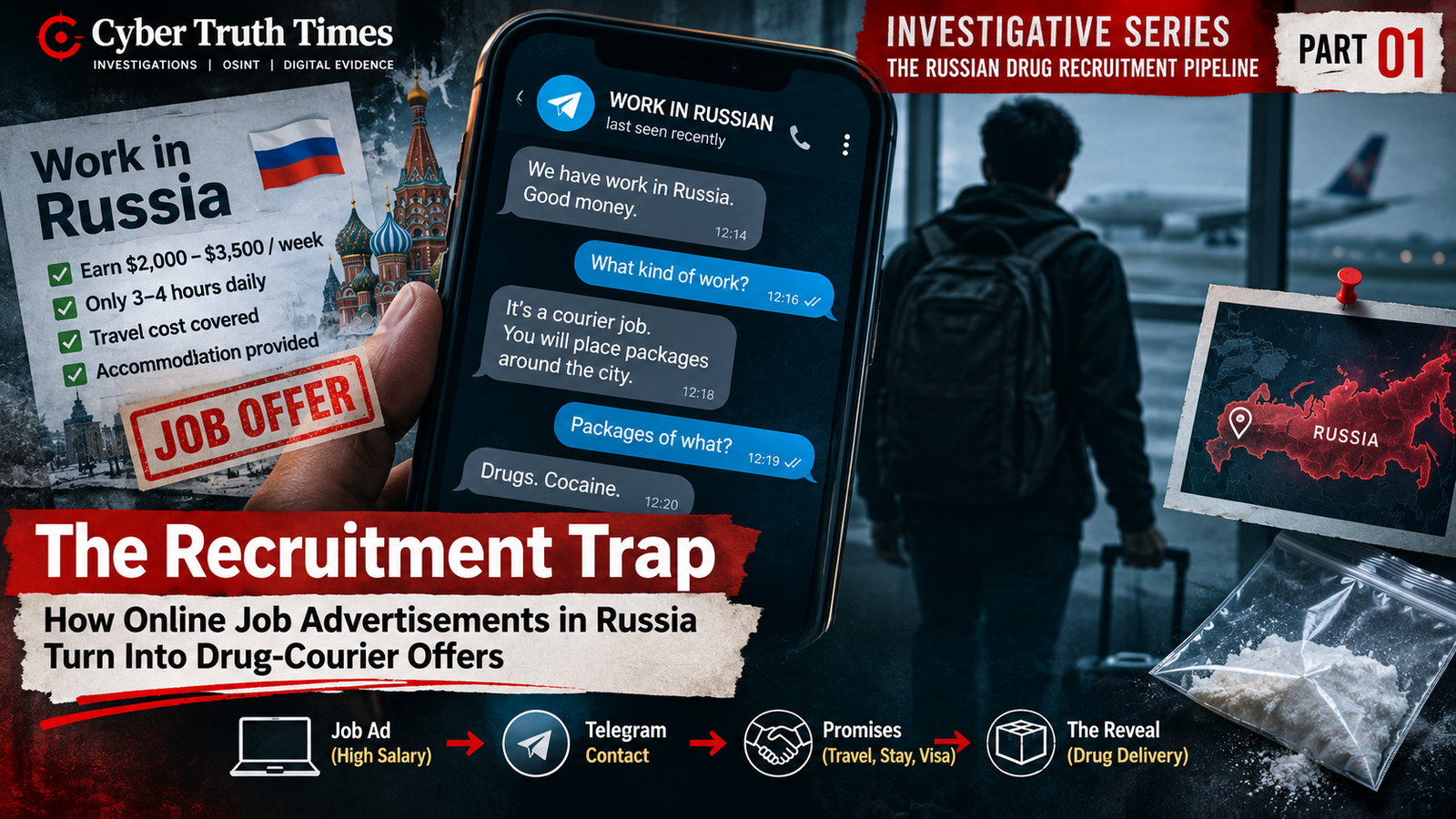
An investigation into Telegram drug recruitment Russia conversations, misleading job promises, digital ads, and the moment prospective workers learn what the job actually entails.
Introduction: Drug Recruitment Russia
An online job advertisement promising thousands of dollars a week, only a few hours of work a day, accommodation, travel assistance and no language requirements can appear attractive to someone searching for employment abroad. Such offers often frame international relocation as straightforward: contact a recruiter, complete registration, receive instructions and travel to the destination.
But what happens when the job advertised is not the job eventually offered?
Cyber Truth Times has examined a collection of Telegram recruitment conversations, message exports, screenshots and video materials in which ostensibly employment-oriented recruitment approaches develop into explicit offers involving the distribution of narcotics in Russia. The conversations examined for this investigation contain a recurring combination of financial incentives, promises of logistical assistance, informal onboarding procedures and the eventual disclosure of drug-related work.
The pattern raises questions about the way online recruitment advertisements can be used to attract foreign nationals into criminal activity under the appearance of conventional employment.
This article, the first in a ten-part investigative series, examines the recruitment proposition itself: how prospective workers are approached, how employment claims are framed, what incentives are offered and how the recruiters eventually disclose the nature of the work.
The objective is to document the recruitment transition, not to assume that every advertisement, recruiter or person involved belongs to the same criminal network.
1. The promise of employment abroad
The recruitment conversations examined by Cyber Truth Times contain a familiar set of inducements associated with international employment opportunities.
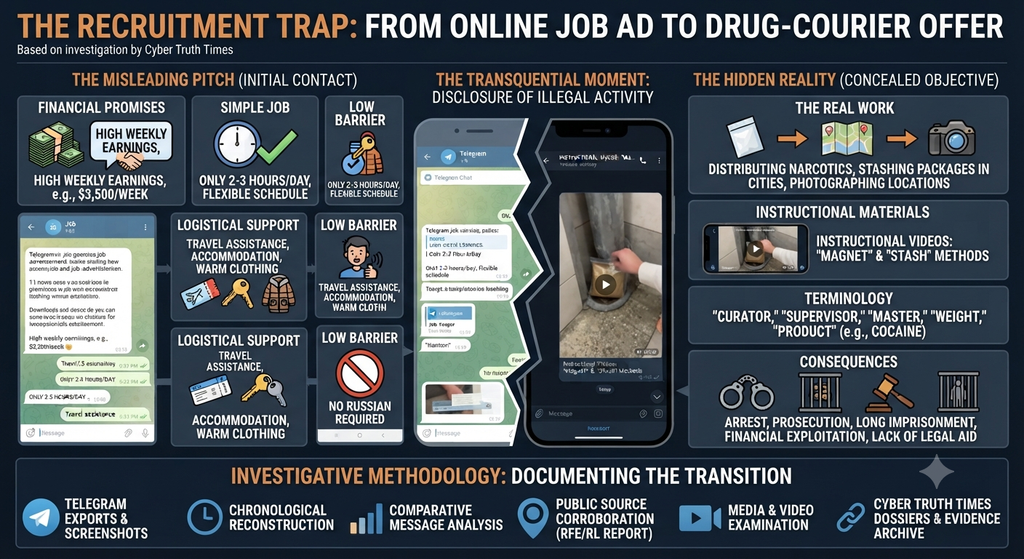
Among the promises communicated in the supplied Telegram material are:
- High weekly earnings.
- Short daily working hours.
- Work without knowledge of Russian.
- Travel assistance or employer-funded tickets.
- Accommodation upon arrival.
- Food and warm clothing.
- Training and instructions before commencing work.
- A recruiter or supervisor who would explain the procedures.
These claims are important because they collectively construct a proposition that appears to resemble a legitimate international employment opportunity.
The prospective worker is not initially presented with a complex description of a criminal operation. Instead, the recruitment pitch is framed around earnings, convenience, travel, accommodation and support.
In one conversation examined by Cyber Truth Times, the recruiter initially described an opportunity to work in Russia without knowledge of the language. The discussion subsequently moved to earnings, working hours and the proposed duties. The recruiter eventually explicitly described the activity as distributing narcotics and hiding packages around locations in a city.
The transition from the initial employment framing to the explicit description of the activity is one of the most significant elements of the material examined.
It provides a documentary basis for investigating how the recruitment proposition develops within the conversation.
2. The financial lure
Financial promises form a prominent part of the recruitment pitch.
The supplied conversations contain claims of substantial earnings, including a stated starting salary of $3,500 per week in one recruitment exchange. The recruiter also presented alternative compensation figures based on the number of daily placements or drop-offs.
These figures were presented as part of the recruiter’s proposed remuneration arrangement. Cyber Truth Times has not independently verified whether the payments were actually made to recruited workers, whether the figures reflect typical earnings or whether the recruiter had the capacity to honour the promises.
The distinction is essential.
A promised salary is not evidence of an actual salary.
High compensation can be an effective recruitment inducement, particularly when accompanied by claims that the work requires only a few hours a day. The apparent imbalance between the proposed workload and the promised income may encourage prospective applicants to proceed without sufficiently scrutinising the employment arrangement.
The investigation therefore treats financial claims as evidence of what recruiters represented to applicants, rather than evidence of what workers ultimately earned.
The remuneration figures also deserve comparison across the different recruitment conversations. If multiple accounts use substantially similar earnings claims, payment structures or descriptions of working hours, those similarities may help identify recurring recruitment scripts or shared advertising practices.
However, similarities alone do not establish common ownership, coordination or a single criminal organisation. Such conclusions would require additional evidence.
3. The promise of a simple job
The recruitment pitch also minimises the apparent complexity of the proposed work.
In the conversations examined, recruiters describe the work as straightforward, relatively quick and accompanied by training or safety instructions. The prospective worker is told that a supervisor or curator will provide detailed instructions and that the activity can be performed according to an adaptable schedule.
The language is significant because it presents the prospective activity as manageable.
The supplied conversations include references to:
- Working approximately two to three hours a day.
- Receiving detailed instructions.
- Training through Telegram.
- Having a supervisor or curator.
- Learning the rules and procedures before beginning.
- Receiving assistance during the process.
This framing may reduce the perceived barrier to participation. Applicants are not necessarily expected to possess professional qualifications, specialist experience or knowledge of the local language.
Instead, the recruiter presents the work as something that can be learned through remote instruction.
The investigation will compare these descriptions across the available Telegram exports to determine whether the same language, structure, claims and onboarding terminology recur.
4. Travel, accommodation and the appearance of logistical support
Another recurring element of the recruitment proposition is the promise of assistance with international travel and accommodation.
In one supplied conversation, the recruiter described a sequence in which the applicant would complete an initial setup process, receive instructions from a supervisor, arrange a visa, wait for processing and subsequently travel to Russia.
The conversation also contained assurances concerning:
- Airline tickets.
- Accommodation.
- Food.
- Warm clothing.
- Necessities upon arrival.
- Assistance with the initial relocation process.
These assurances were presented as part of the overall employment offer.
The combination of financial inducements and logistical promises is particularly relevant to this investigation because it creates a more complete recruitment proposition. The recruiter is not merely offering an activity and compensation. The conversation is presented as a pathway into a new country and a new working arrangement.
Yet the supplied conversations also raise questions about the degree of control prospective workers would retain over their travel, accommodation, financial arrangements and subsequent activities.
Cyber Truth Times will examine these promises against the available documentary evidence and public reporting.
The investigation does not assume that accommodation or travel assistance is inherently suspicious. These are common features of legitimate international employment arrangements. Their significance depends on the context in which they are offered, the nature of the work subsequently disclosed and whether the representations made to prospective workers are truthful.
5. The moment the recruiter discloses the work
The most consequential moment in the supplied recruitment conversations occurs when the recruiter explicitly identifies the activity being offered.
In one Telegram exchange examined by Cyber Truth Times, the recruiter moves from general employment-related messaging to a direct description of distributing small packets of narcotics around a city, photographing the placements and writing descriptions.
The conversation subsequently identifies the product as narcotics and explicitly names cocaine in the exchange.
This is no longer an ambiguous employment description.
The messages provide direct documentary evidence of what that particular recruiter communicated to the prospective applicant at that point in the conversation.
The supplied video material adds another dimension. The videos were accompanied by descriptions referring to methods for concealing packages, including references to the magnet method and the stash method. The existence of these instructional materials, their accompanying captions and the context in which they were transmitted form part of the documentary record being examined.
Cyber Truth Times will analyse the videos and associated communications as evidence of the recruitment proposition and the instructions being communicated. The analysis will not reproduce operational instructions that could facilitate narcotics distribution.
The significance of this transition lies in the contrast between the initial employment framing and the subsequent disclosure of the activity.
The applicant is approached through a proposition involving earnings, working hours, travel and accommodation. The conversation subsequently develops into an explicit description of drug distribution.
That transition is central to the investigation’s first article.
6. Comparing the recruitment language across Telegram conversations
The investigation is not based on a single conversation.
Cyber Truth Times has collected multiple recruitment conversations and exports, including materials identified within the investigation as the WORK IN RUSSIAN and Adel exports, alongside other recruitment communications and screenshots supplied during the research process.
The material will be compared across several dimensions.
| Recruitment element | What the investigation examines |
|---|---|
| Employment framing | How the initial opportunity is described |
| Earnings | Salary claims, payment structures and compensation language |
| Working hours | Claims about daily workload and flexibility |
| Language requirements | Whether recruiters claim applicants need no Russian-language knowledge |
| Travel | Promises or arrangements involving international travel |
| Accommodation | Housing and logistical assurances |
| Onboarding | Registration, supervisors, curators and training |
| Disclosure | The point at which narcotics-related work is explicitly described |
| Media | Videos, images and other instructional material supplied |
| Account similarities | Recurring wording, formatting, claims and communication patterns |
The comparison is intended to identify recurring features of the recruitment proposition.
Where multiple accounts employ similar language, the investigation will document those similarities and examine whether they can be corroborated by other evidence.
The research will distinguish between identical or near-identical language, general similarities in recruitment practices and evidence that could establish a relationship between particular accounts.
This distinction matters.
Recruiters operating independently may use similar advertising language because they are targeting the same audience or copying existing advertisements. Shared scripts, repeated media, common infrastructure or identifiable relationships between accounts may provide stronger indicators of coordination, but these too require corroboration.
The investigation will avoid attributing accounts to a particular organisation solely because their messages resemble one another.
7. What public reporting already tells us
The recruitment conversations examined by Cyber Truth Times are not occurring in an informational vacuum.
In June 2025, Radio Free Europe/Radio Liberty published an investigation titled Promises Of High-Paid Work Lure Kyrgyz Into Russian Drug Trade.
The report documented advertisements in Bishkek promising substantial earnings for work in Russia, with limited daily working hours and travel and accommodation reportedly covered. When journalists contacted the Telegram account associated with the advertisements, the response indicated that the work involved transporting illegal drugs. RadioFreeEurope/RadioLiberty
The reporting provides an important comparative example of a recruitment pattern involving:
- High-paying employment advertisements.
- Limited working hours.
- Travel and housing promises.
- Telegram-based contact.
- Disclosure of drug-related work.
The report also discusses the severe consequences associated with drug-trafficking prosecutions in Russia and the vulnerability of foreign nationals recruited into such activity. RadioFreeEurope/RadioLiberty
This reporting is particularly relevant because several recruitment characteristics described in the article resemble features present in the Telegram conversations examined by Cyber Truth Times.
These similarities establish a comparative basis for investigation; they do not establish that the accounts in our dataset are connected to the individuals or organisations described by RFE/RL.
That distinction will remain central throughout this series.
8. The risks concealed by the recruitment proposition
The apparent simplicity of the recruitment pitch contrasts sharply with the potential consequences of participating in narcotics distribution.
A prospective worker who accepts an offer involving the placement, transport or distribution of illegal drugs may face arrest, criminal prosecution, imprisonment, financial exploitation and other serious consequences.
For foreign nationals, the consequences may also involve:
- Limited access to legal assistance.
- Language barriers.
- Difficulty contacting family.
- Loss of financial independence.
- Immigration consequences.
- Restricted ability to navigate the criminal justice system.
- Vulnerability to exploitation by recruiters or intermediaries.
These are risks associated with the nature of the proposed activity and the circumstances of foreign workers. Their precise occurrence in any individual case must be established through evidence.
The investigation will also examine whether recruiters make assurances that could minimise these risks or create misleading perceptions about the legality or safety of the activity.
The supplied communications will be analysed to establish what assurances were made, what risks were disclosed and whether the recruitment messaging presented the activity as ordinary employment.
9. Our methodology: examining the recruitment proposition
Cyber Truth Times is approaching this investigation as a documentary and digital-evidence project.
The first article focuses on the recruitment proposition and its development within the communications. The wider investigation will examine the materials through a combination of comparative analysis, document review, digital-media examination and public-source research.
The methodology includes:
Primary-source review: examining Telegram exports, screenshots, videos and recruitment messages supplied for the investigation.
Comparative message analysis: identifying recurring wording, compensation claims, working-hour descriptions, onboarding language and explicit disclosures of the proposed activity.
Chronological reconstruction: documenting the sequence in which recruitment claims and subsequent disclosures appear within each conversation.
Media analysis: examining supplied photographs and videos for contextual and documentary relevance, while avoiding unsupported identification of individuals.
Public-source corroboration: comparing the material with published reporting, publicly documented cases and other verifiable sources.
Evidence preservation: maintaining copies of the original data exports and associated materials for reference, verification and future examination.
Editorial verification: separating direct evidence, reported allegations, contextual information, analytical observations and unresolved questions.
The investigation will not treat a similarity between two accounts as proof of common ownership or coordination. Nor will it treat a reported arrest as proof that an individual was recruited through the same process documented in the Telegram material.
Each claim will be assessed according to the evidence available to support it.
10. Dossiers and Evidence: preserving the original record
The documentary record associated with this investigation is preserved in the Cyber Truth Times Dossiers and Evidence section.
The archive contains the research materials underpinning the investigation, including Telegram data exports, recruitment conversations, screenshots, videos and other documentary materials collected during the research process.
The purpose of the archive is to provide a dedicated repository for primary-source material associated with the investigation, enabling readers and researchers to refer to the underlying documents where publication, access and privacy considerations permit.
The data exports are particularly important because they preserve the context of the recruitment conversations beyond individual screenshots.
Screenshots can illustrate specific messages, but exported conversations can provide a broader chronological record of communication, including surrounding messages and the progression of the recruitment exchange.
The preservation of these materials supports the investigation’s documentary approach and allows the research record to be maintained separately from the narrative articles.
The archive is intended for personal reference, research transparency and documentary continuity.
The original data exports and associated materials are preserved and available for personal reference through the Cyber Truth Times Dossiers and Evidence section.
Where necessary, materials may be redacted or access restricted to protect personal information, potential victims, uninvolved individuals and the integrity of ongoing investigations. The availability of a document in the archive should not be interpreted as an endorsement of every claim contained within it.
11. What This establishes and what remains unanswered
The materials examined for this article document recruitment conversations in which employment-oriented messaging develops into explicit descriptions of narcotics distribution.
The conversations contain claims concerning compensation, working hours, language requirements, travel, accommodation and training. In at least one supplied exchange, the recruiter explicitly describes narcotics-related distribution activity.
The accompanying videos and communications form part of the documentary record.
Comparative public reporting from RFE/RL demonstrates that similar employment-oriented recruitment approaches involving drug-courier work in Russia have been reported elsewhere. RadioFreeEurope/RadioLiberty
However, this article does not establish the identity of a single organisation responsible for all the recruitment accounts examined, nor does it establish that all accounts are connected to one network.
The central questions remain:
- Who operates the recruitment accounts?
- Are the advertisements coordinated or independently operated?
- How are prospective workers identified and contacted?
- What happens after applicants accept the proposed activity?
- What evidence exists concerning the actual payment of promised salaries?
- What is the relationship between recruiters, supervisors and the individuals who organise the proposed work?
- Are the recruitment accounts connected to any documented cases involving detention or allegations of military recruitment pressure?
These questions will be addressed progressively throughout the ten-part series.
Conclusion: documenting the transition
The recruitment conversations examined by Cyber Truth Times raise a fundamental question about online employment advertisements: how can a proposition presented as ordinary work develop into an explicit offer of criminal activity?
The supplied Telegram material documents a transition from employment-oriented claims to narcotics-related work. The financial promises, logistical assurances, onboarding messages and eventual disclosure of the proposed activity provide the basis for further investigation.
The purpose of this article is to document that transition.
The wider investigation will examine the accounts, digital evidence, recruitment language, publicly documented cases and unresolved questions surrounding the recruitment of foreign nationals for drug-related work in Russia.
The recruitment pitch is the starting point. The evidence will determine where the investigation leads.
Dossiers and Evidence
Explore the documentary record supporting this investigation.
The Cyber Truth Times Dossiers and Evidence archive contains preserved research materials associated with the investigation, including Telegram exports, screenshots, recruitment conversations and video materials.
The original data exports are preserved for personal reference and documentary examination, subject to redaction and privacy considerations.
Explore the Dossiers and Evidence archive
Bibliography & External Sources
- Radio Free Europe/Radio Liberty (RFE/RL). Promises Of High-Paid Work Lure Kyrgyz Into Russian Drug Trade. June 6, 2025.
- Cyber Truth Times. Primary research materials, including Telegram exports, screenshots, recruitment communications and videos collected and preserved as part of this investigation. Available for reference in the Dossiers and Evidence archive, subject to applicable access and redaction considerations.
The bibliography will be expanded as the investigation progresses and additional public-source material is independently verified.
For deeper investigations on such topics, see our Cybercrime Investigations & Exposes.



One thought on “The Recruitment Trap: How Online Job Advertisements in Russia Turn Into Drug-Courier Offers”