Cyber Truth Times investigates Telegram forwarding infrastructure records and advertising-related digital references, examining what metadata can and cannot prove.
Introduction: Telegram Forwarding Infrastructure
Digital advertising does not necessarily remain confined to the channel in which it first appears. Messaging platforms provide mechanisms through which content can be shared, redistributed, referenced or presented in different contexts. On Telegram, forwarding-related metadata can provide investigators with a record of certain content-sharing relationships.
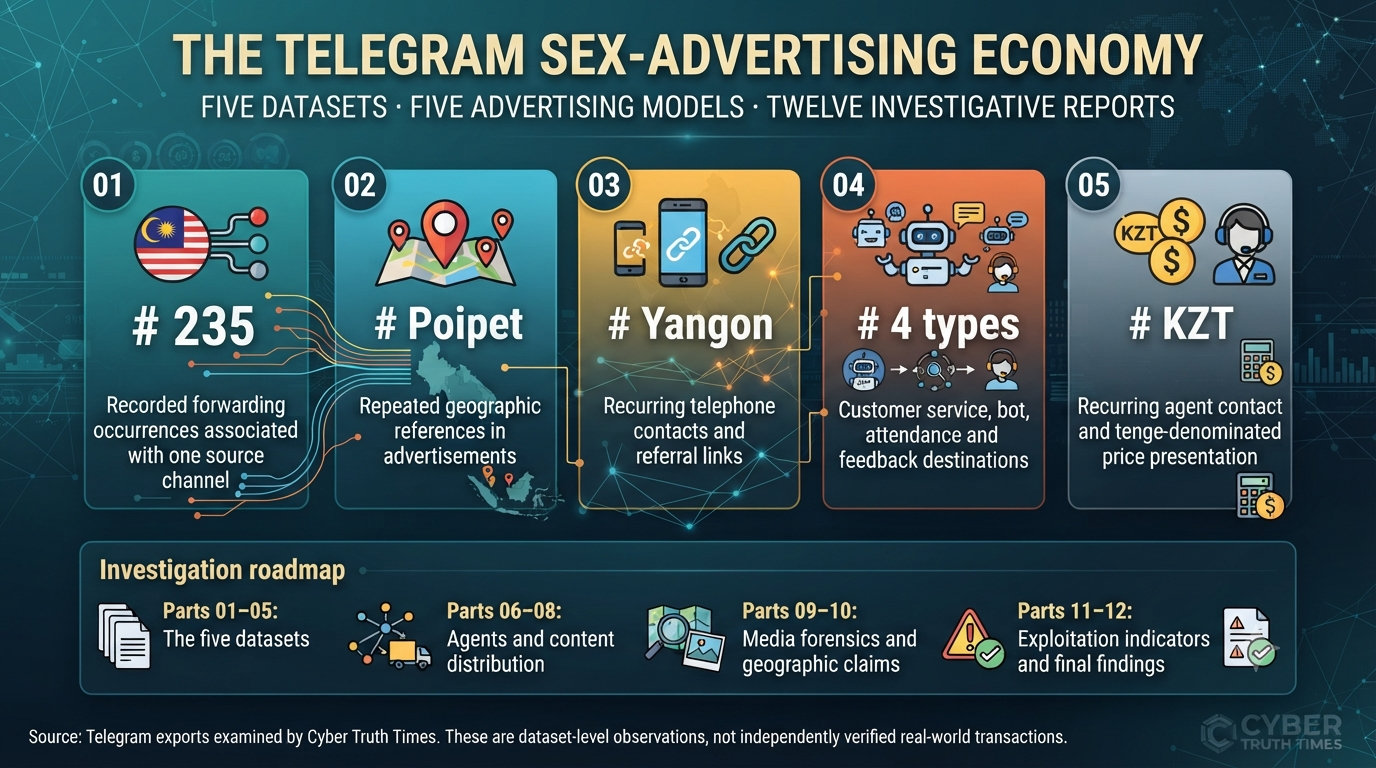
Cyber Truth Times’ investigation into The Telegram Sex-Advertising Economy examined five Telegram datasets associated with commercial sex advertising across Malaysia, Cambodia, Myanmar, Dubai and a Russian-language advertising channel. Among the observable patterns in these datasets are forwarding-related records, repeated contact references, promotional links and advertising content appearing alongside references to other digital destinations.
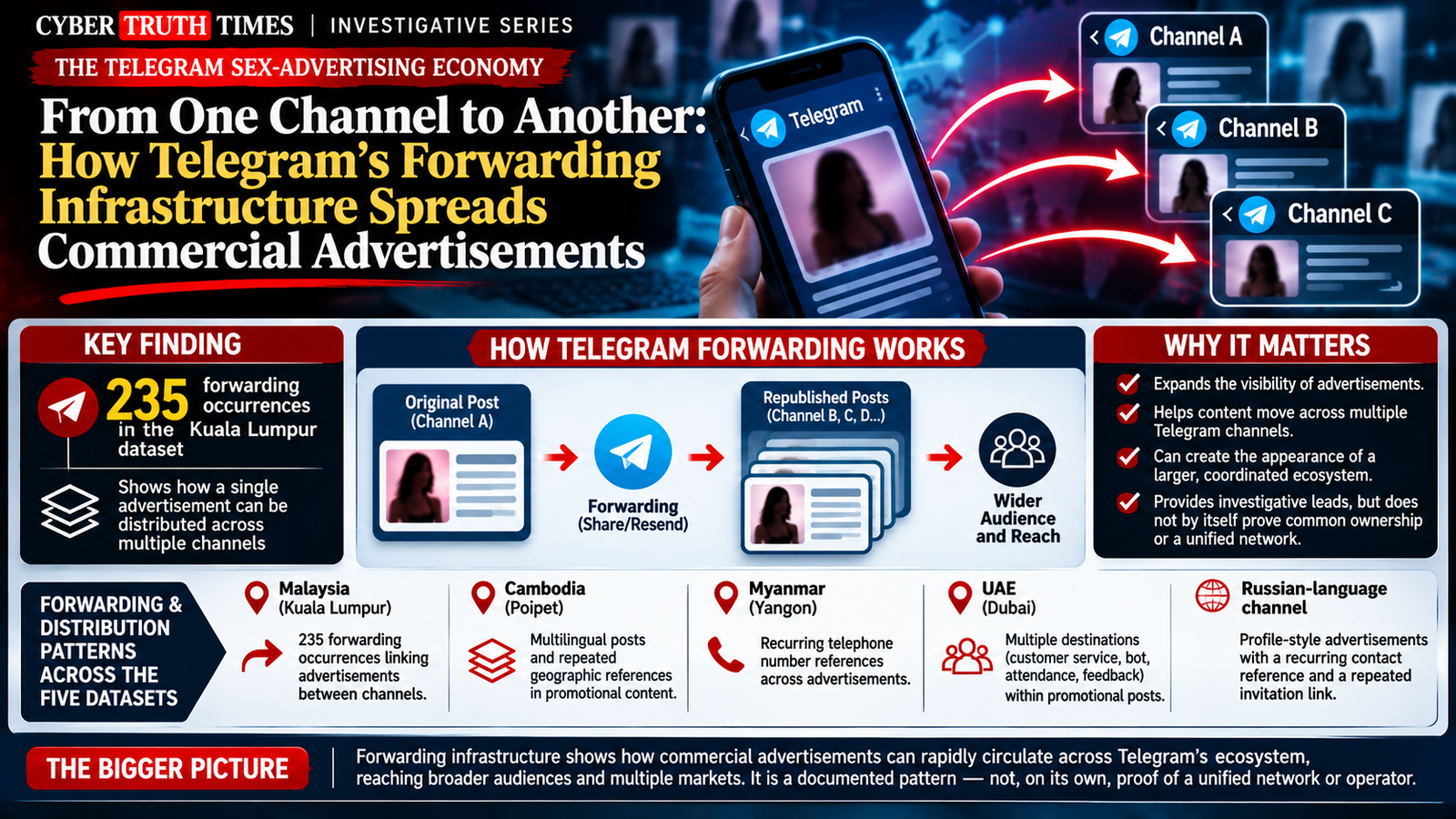
The Kuala Lumpur dataset provides a particularly relevant example. It contains 235 recorded forwarding occurrences associated with a channel identifier linked to a channel displayed as 生活助理 💋 包养 💕 ➗女. These records provide a distribution-related investigative lead, but they do not establish that 235 individual users forwarded content, that 235 transactions occurred or that the channels involved share ownership or control.
The distinction matters.
Forwarding metadata can help document recorded relationships between content sources and the records in which that content appears. It cannot independently establish the identity of channel administrators, the scale of an audience, the existence of a commercial relationship or a coordinated advertising operation.
This report examines forwarding infrastructure as a digital-investigation subject. It documents the significance of recorded forwarding relationships, explores their evidentiary limitations and explains why the movement of content should not be confused with proof of ownership, coordination or exploitation.
1. Understanding Telegram Forwarding as a Digital Record
Forwarding is a content-sharing mechanism associated with Telegram messages. Depending on the message, platform configuration and export method, a researcher may encounter records that indicate a message was forwarded or that identify a source associated with a forwarded message.
These records can be relevant to digital investigations because they may preserve information about content relationships.
For example, a researcher examining an export might encounter promotional content alongside forwarding metadata that references another channel or source.
That relationship can be documented.
However, the interpretation of the record must remain limited to what the metadata actually supports.
Forwarding metadata does not necessarily establish:
- Who initiated the forwarding.
- The real-world identity of the person responsible.
- Whether the receiving channel is affiliated with the source.
- Whether a channel administrator deliberately coordinated distribution.
- Whether the forwarded content reached a particular audience.
- Whether users interacted with the advertisement.
- Whether a transaction occurred.
- Whether the source and destination share ownership.
A forwarding record is evidence of a recorded digital relationship within the available material. It is not a complete account of how the content circulated across Telegram.
2. The Kuala Lumpur Dataset: 235 Recorded Forwarding Occurrences
The Kuala Lumpur dataset examined by Cyber Truth Times contains a channel titled 在马来的妹子 吉隆坡妹子, approximately translated as “Girls in Malaysia – Kuala Lumpur Girls.”
The dataset records 235 forwarding occurrences associated with another recorded channel identifier, displayed in the source material as 生活助理 💋 包养 💕 ➗女.
These occurrences are relevant because they provide a documented pattern of forwarding-related references within the export.
The records offer a starting point for examining the relationship between the promotional content in the Kuala Lumpur dataset and the channel reference appearing in the forwarding metadata.
But the number 235 must be interpreted carefully.
It represents recorded occurrences in the dataset. It should not be described as 235 unique people, 235 independent forwarding actions by different users, 235 customers, 235 transactions or 235 instances of commercial activity.
The dataset does not independently establish those interpretations.
Nor does the recurring channel reference establish that the source channel and the referenced channel are owned, administered or operated by the same person.
The finding is therefore narrower but still relevant: the export contains a repeated forwarding-related relationship associated with a recorded channel identifier.
This is a distribution-related lead that warrants contextual examination.
3. Why Forwarding Relationships Matter to Investigative Journalism
Forwarding-related records can be useful to journalists because they provide an additional layer of information beyond the text of individual advertisements.
An advertisement viewed in isolation may contain a description, a price, a location reference or a contact point.
A record containing forwarding metadata may also preserve a relationship between that content and another recorded source.
This additional context can help investigators document the digital environment in which promotional material appears.
Forwarding-related records may be relevant to several investigative questions:
- Does a dataset contain repeated forwarding references?
- Are the same recorded source identifiers associated with multiple posts?
- Does the forwarding metadata appear consistently across the export?
- What is the chronology of the recorded occurrences?
- Are the forwarded advertisements similar in content?
- What other identifiers or links appear alongside the forwarding references?
- What limitations affect the completeness of the records?
These questions can support documentary analysis.
However, forwarding metadata should not be used to make unsupported claims about the motives, identities or relationships of individuals associated with the channels.
A recorded relationship is not automatically an organisational relationship.
4. Forwarding, Copying and Redistribution Are Not the Same Evidentiary Claim
Digital content can be redistributed in different ways. A message may be forwarded, copied into a new post, reproduced as a screenshot, rewritten or accompanied by a different link.
These forms of redistribution can create similar-looking promotional material across digital destinations, but they do not necessarily preserve the same metadata or establish the same relationships.
A forwarded message may contain a recorded source reference. A copied advertisement may reproduce the text without retaining the original message’s metadata. A screenshot may preserve visual content while losing contextual information.
These differences matter when investigators compare records.
Similar advertisements appearing in multiple datasets may be relevant to an investigation, but similarity alone does not establish that one channel distributed content to another.
Content can be copied by third parties, independently recreated, redistributed without permission or reproduced in a context that cannot be determined from the available records.
The investigator must distinguish between:
Recorded forwarding relationships: Information preserved in the export that identifies a forwarding-related reference.
Content similarity: Advertisements or media that appear similar across records.
Documented redistribution: A supported description of content movement based on the available records.
Organisational attribution: A claim that particular people or entities control, coordinate or operate the destinations involved.
The final category requires substantially more evidence than the first three.
5. Five Datasets, Different Distribution-Related Patterns
The five datasets examined in The Telegram Sex-Advertising Economy contain different types of digital references. They should not be treated as a single network simply because they share a platform or advertising subject.
Malaysia: Forwarding-related occurrences
The Kuala Lumpur dataset contains 235 recorded forwarding occurrences associated with a channel identifier.
This is the most direct forwarding-related example in the five datasets discussed in the series.
The records provide a distribution-related lead, but they do not establish common ownership, coordinated activity, unique users, transactions or audience reach.
Poipet: Promotional content and location references
The Poipet dataset contains multilingual promotional content, geographic references and advertising claims.
The records provide material for examining location-oriented advertising.
However, the available dataset summary does not establish a comparable forwarding relationship that would justify treating it as equivalent to the Kuala Lumpur forwarding pattern.
Yangon: Contact and referral references
The Yangon dataset contains recurring telephone-number references and a Telegram link associated with promotional material.
These are contact and referral-related leads.
They are not, by themselves, evidence of forwarding relationships, channel ownership or cross-border movement.
Dubai: Multiple Telegram destinations
The Dubai dataset contains references to a customer-service account, a bot, attendance-related posts and feedback destinations.
These records provide examples of promotional content referring to multiple Telegram destinations.
The presence of those destinations does not independently establish that content was forwarded between them, that they share ownership or that a unified operation exists.
Russian-language dataset: Recurring contact and invitation references
The Russian-language dataset contains profile-style advertisements, pricing references, a recurring contact reference and a repeated invitation link.
The recurring contact and invitation references are relevant to examining the structure of promotional material.
However, these references do not independently establish forwarding relationships, common ownership or a coordinated distribution network.
The datasets contain different observable digital patterns. Their relationships remain unverified unless independent evidence establishes them.
6. The Difference Between Content Distribution and Network Attribution
The term “network” can be used in digital investigations to describe a collection of recorded relationships. But it can also imply a coordinated group of people or organisations.
These meanings should not be conflated.
A diagram showing a channel, a forwarding reference, a username and a link may illustrate relationships visible in a dataset.
It does not necessarily establish that those relationships represent common ownership, administrative control or coordinated commercial activity.
For example, a diagram that connects two channels because forwarding metadata references one channel from another record may accurately illustrate a recorded relationship.
But describing the same diagram as a confirmed advertising network could imply an organisational structure that the evidence does not establish.
A responsible investigative graphic should therefore distinguish:
- Recorded metadata relationships.
- Observed content similarities.
- Investigative hypotheses.
- Independently corroborated relationships.
- Unverified ownership or control.
Where the underlying records support only a recorded reference, the diagram should label it accordingly.
7. Audience Reach: What Forwarding Metadata Does Not Measure
Forwarding-related records can be misinterpreted as a measure of audience reach.
The number of forwarding occurrences recorded in an export does not necessarily represent the number of people who received, viewed or engaged with the content.
The records may not capture all forwarding activity. The export may be incomplete. A recorded occurrence may not correspond to a unique person. The dataset may not preserve the full distribution history of the content.
Audience reach, engagement and transaction activity are different measurements.
Without independently corroborated audience or engagement data, forwarding-related occurrences should not be used to estimate the number of people exposed to an advertisement.
The Kuala Lumpur dataset’s 235 occurrences are therefore a documentary count of recorded occurrences, not a verified audience measurement.
8. The Role of Metadata Preservation
Forwarding-related records can be useful only when their provenance and context are appropriately preserved.
Investigators should document how a dataset was collected, what information was included in the export, when the records were collected and whether any transformations were applied.
Where appropriate, source preservation may include:
- Retaining the original export.
- Recording the collection date.
- Documenting the export method.
- Maintaining original filenames.
- Recording cryptographic hashes for preserved files.
- Keeping the source records separate from analytical annotations.
- Documenting the limitations of the export.
- Preserving screenshots or other corroborating records when appropriate.
- Maintaining a chronology of investigative findings.
The objective is to preserve the distinction between the original records and the investigator’s interpretation.
A forwarding-related reference should not be silently transformed into a claim about a verified person, organisation or commercial relationship.
9. Privacy and Publication Risks
Forwarding records and channel references may contain information that could identify or expose individuals.
The public availability of a Telegram channel or username does not automatically justify republishing every identifier contained in a dataset.
Researchers should consider whether publication of a contact reference, invitation link, photograph or other identifier is necessary to demonstrate a finding.
The publication of such information may facilitate unwanted contact, harassment, stalking, exposure or other harm.
Where the investigative point can be demonstrated without publishing sensitive identifiers, redaction may be appropriate.
The same consideration applies to media attached to advertisements.
The individuals depicted may be vulnerable, may not have consented to redistribution or may be represented inaccurately by the promotional text.
The public-interest value of the investigation should be balanced against the potential harm caused by publishing identifying material.
10. What the Forwarding Records Establish and What They Do Not
The forwarding-related records examined in this report support a limited set of observations.
Documented forwarding-related occurrences
The Kuala Lumpur dataset contains 235 recorded forwarding occurrences associated with another recorded channel identifier.
A recorded channel reference
The forwarding-related metadata identifies a channel reference displayed in the source material.
A distribution-related investigative lead
The records provide material for examining content-distribution relationships within the dataset.
The records do not independently establish:
- The identities of the people who initiated forwarding.
- The real-world identity of channel administrators.
- Common ownership between the source and referenced channels.
- A coordinated advertising operation.
- Unique users or audience reach.
- Completed transactions.
- Commercial relationships.
- Cross-border movement.
- Coercion or exploitation.
- Human trafficking.
- A unified network across the five datasets.
The absence of evidence in the export does not establish that such activity is absent.
It means the available records do not independently demonstrate these claims.
11. Further Investigative Questions
The forwarding-related records provide a basis for further examination, but additional evidence would be required before broader conclusions could be drawn.
Questions for further research include:
- What is the provenance of the export?
- How complete are the forwarding-related records?
- How were the 235 occurrences counted?
- Does the count include repeated records or other forms of duplication?
- What source information is preserved in each occurrence?
- Are the referenced channels independently accessible and documented?
- Is there corroborating evidence of administrative relationships?
- Are similar advertisements present in other records?
- Are similarities attributable to forwarding, copying or another form of redistribution?
- What publication safeguards are necessary to protect individuals?
These questions should guide additional research rather than be treated as established findings.
Conclusion: Forwarding Is Evidence of a Recorded Relationship, Not Proof of a Network
Telegram forwarding-related records can provide useful context for digital investigations. They may preserve relationships between promotional content and recorded sources that would not be visible from an advertisement viewed in isolation.
The Kuala Lumpur dataset examined by Cyber Truth Times contains 235 recorded forwarding occurrences associated with a channel identifier. This provides a distribution-related investigative lead.
But the records do not independently establish unique users, audience reach, transactions, common ownership, coordination or a unified advertising network.
The five datasets examined in The Telegram Sex-Advertising Economy contain different advertising-related patterns, including forwarding references, contact identifiers, links and promotional content. Those patterns should be examined individually and compared cautiously.
Digital content movement is not proof of organisational control.
A recorded forwarding relationship is not proof of coordination.
A repeated advertisement is not proof of a transaction.
Cyber Truth Times’ investigation documents the records, examines their significance and maintains a distinction between observable metadata, analytical interpretation and claims requiring independent corroboration.
This report forms Part 08 of The Telegram Sex-Advertising Economy, a 12-part investigative series examining five Telegram datasets and the digital advertising patterns visible in the records.
Bibliography
These sources provide contextual background on Telegram, trafficking definitions and investigative considerations. They do not independently corroborate the forwarding-related findings described in this article.
- Telegram — FAQ — General information about Telegram.
- Telegram — Channels FAQ — Background on Telegram channels and platform functionality.
- UNODC — The Crime of Trafficking in Persons — Legal and conceptual framework for trafficking.
- United Nations — Understanding Human Trafficking — Background on trafficking and exploitation.
- U.S. Department of Justice — What Is Human Trafficking? — Overview of trafficking definitions and distinctions.
- UNODC — Human Trafficking Toolkit — Investigative and response guidance.
Investigative Disclaimer
This report analyses Telegram exports and promotional material supplied for journalistic examination. Forwarding metadata, channel references, advertisements, contact details, links, media and geographic claims have not necessarily been independently verified. Forwarding-related occurrences do not, by themselves, establish unique users, audience reach, common ownership, coordination, commercial transactions, exploitation or human trafficking. Digital references are treated as investigative leads rather than proof of identity or control. Cyber Truth Times distinguishes documented observations, advertiser claims, investigative leads, analytical interpretations and unresolved questions throughout this report.
For deeper investigations on such topics, see our Cybercrime Investigations & Exposes.