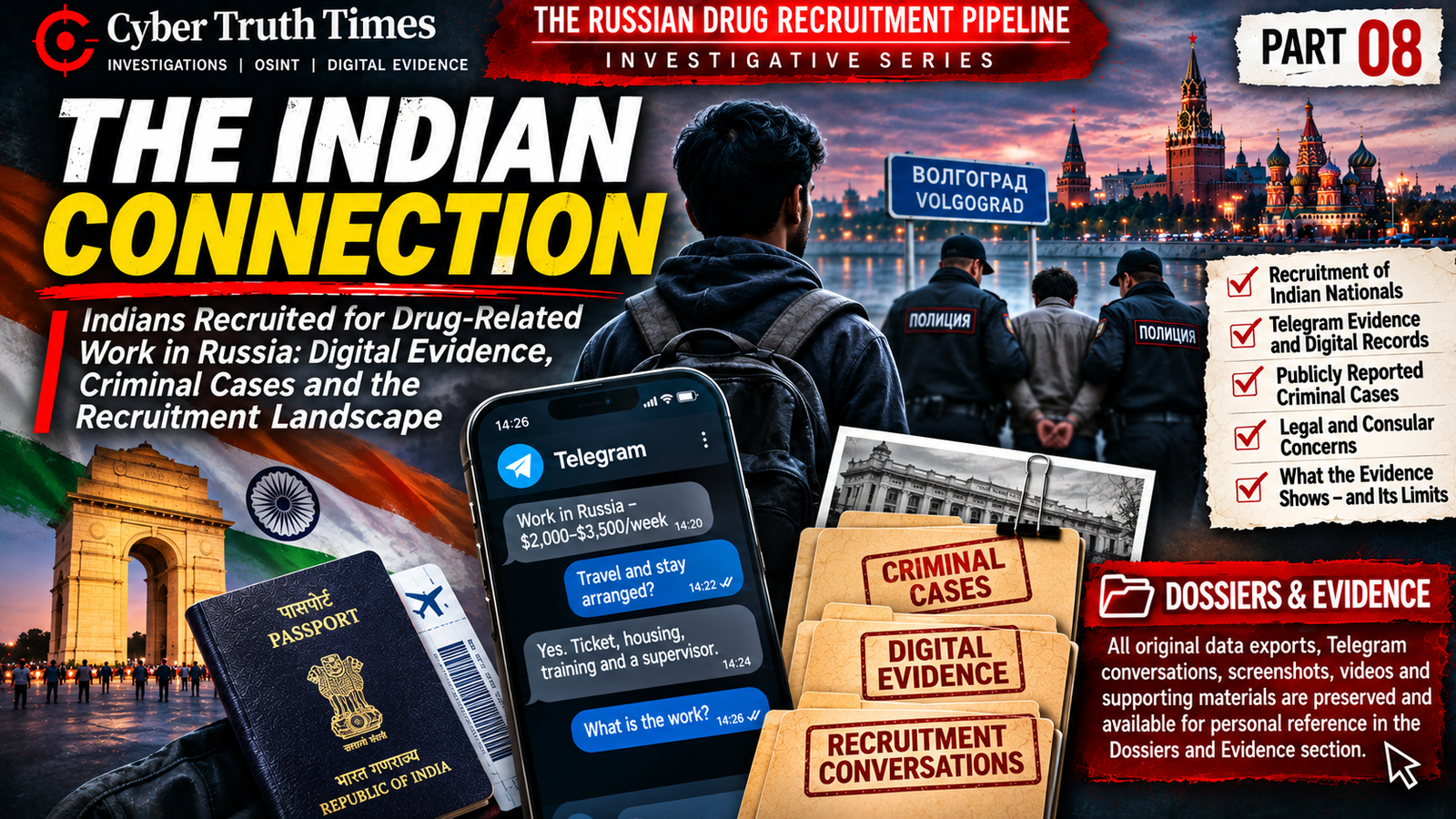
An investigation into documented foreign nationals drug trafficking Russia cases, deceptive job recruitment, legal risks and the evidence behind courier recruitment.
Foreign Nationals and Drug Trafficking in Russia: What the Cases Reveal
Introduction: Foreign nationals drug trafficking Russia
This instalment examines publicly documented cases involving foreign nationals accused of or convicted of drug-related offences in Russia, with particular attention to recruitment circumstances, online job advertisements, migrant vulnerability, alleged courier arrangements and the legal consequences of involvement in drug distribution. It also places the cases in the context of the recruitment patterns documented in Cyber Truth Times’ own Telegram evidence.
The central distinction throughout this article is between documented criminal cases and the broader recruitment hypothesis under investigation. Arrests and prosecutions involving foreign nationals demonstrate that such cases exist; they do not, by themselves, prove that every case arose from deceptive recruitment or that a single recruitment network connects them.
Introduction: The intersection of migration, online recruitment and criminal exposure
Foreign nationals travelling to Russia for employment can encounter a complicated environment involving language barriers, immigration requirements, unfamiliar legal systems, financial pressures and reliance on intermediaries. In certain documented cases, online advertisements promising lucrative work have led prospective workers toward drug-related activities rather than conventional employment.
The problem is not simply that illegal work may be advertised. It is the manner in which some recruitment offers appear to be structured: unusually high remuneration, limited working hours, assurances about accommodation and travel, remote onboarding and communication through messaging platforms.
These characteristics feature prominently in the recruitment communications examined by Cyber Truth Times during its investigation into purported employment opportunities in Russia.
The investigation has identified Telegram accounts that initially present themselves as employment intermediaries. In the conversations reviewed, the recruiters subsequently describe work involving the distribution of narcotics. Some communications include videos, instructions, photographs, payment schedules and assurances concerning travel, accommodation and training.
The existence of a broader recruitment pattern is a hypothesis supported by recurring similarities in the material collected, but it requires corroboration beyond the messages themselves.
Public reporting provides a valuable independent reference point. Investigations by Radio Free Europe/Radio Liberty (RFE/RL), reports from Russian regional media and publicly released police information document cases involving foreign nationals recruited, accused or detained in connection with drug distribution in Russia.
The objective of this article is to examine those documented cases, identify the patterns they reveal and explain what they can — and cannot establish about the wider recruitment environment.
1. High-paying employment advertisements and the courier proposition
One of the clearest publicly documented examples of recruitment involving foreign nationals comes from an investigation published by Radio Free Europe/Radio Liberty in June 2025.
The report, Promises Of High-Paid Work Lure Kyrgyz Into Russian Drug Trade, describes employment advertisements circulated in Bishkek, Kyrgyzstan, offering prospective workers opportunities in Russia.
The advertisements reportedly promised substantial earnings, short daily working hours, accommodation and travel support. RFE/RL contacted an account associated with the advertisements and received confirmation that the work involved transporting illegal drugs.
The report is particularly relevant because it documents the transition from the outward presentation of a job opportunity to the disclosure of drug-related work.
The advertisements reportedly offered approximately $1,000 a week and suggested that the work required only three or four hours a day. These figures and assurances created an employment proposition that appeared significantly more attractive than many conventional opportunities available to prospective migrant workers.
The reporting also examined the serious legal consequences associated with drug trafficking in Russia.
According to the article, an immigration lawyer interviewed by RFE/RL described the severe penalties faced by individuals involved in courier activity and raised concerns about circumstances in which criminal organisers may expose couriers to arrest.
Source: RFE/RL — Promises Of High-Paid Work Lure Kyrgyz Into Russian Drug Trade
The case establishes that employment-style advertising for drug courier work has been publicly documented in a neighbouring country and that an online recruiter contacted by journalists disclosed a drug-related job.
It does not establish that the recruitment accounts examined by Cyber Truth Times are connected to those advertisements.
Nevertheless, the similarities in the employment framing make the report relevant comparative evidence.
2. Recruitment advertisements as a potential entry point into drug distribution
A second RFE/RL report, How Kyrgyz Citizens Are Recruited As Drug Couriers In Russia, provides additional context.
The reporting describes advertisements offering work in Russia and explains how journalists contacted an account associated with one such advertisement. The response confirmed that the advertised work involved drug transportation.
The article situates the recruitment process within a broader environment in which prospective migrant workers may encounter advertisements promising rapid income and assistance with relocation.
The significance of these advertisements is their presentation.
Instead of openly identifying the role as drug distribution from the outset, the initial proposition reportedly resembled a conventional employment opportunity. The distinction between the advertised job and its actual criminal purpose became clearer after contact with the recruiter.
This sequence is important for investigations into deceptive recruitment.
A journalist examining such communications must establish:
- What was advertised initially?
- What information was withheld at the beginning?
- At what point was the actual nature of the work disclosed?
- What remuneration was promised?
- Were travel or accommodation expenses offered?
- Did the recruiter provide a formal employer identity?
- Was the prospective worker asked to provide identity documents?
- Were instructions delivered through messaging applications?
- Was the recruiter identifiable or independently verifiable?
These questions are not merely descriptive. They help establish whether a recruitment proposition was misleading, whether the candidate was knowingly entering a criminal arrangement and how the recruitment process developed.
The RFE/RL reports provide independently documented examples of the broader recruitment phenomenon. Cyber Truth Times’ own material is being examined using similar documentary questions.
Sources:
- RFE/RL — How Kyrgyz Citizens Are Recruited As Drug Couriers In Russia
- RFE/RL — Promises Of High-Paid Work Lure Kyrgyz Into Russian Drug Trade
3. Publicly documented cases involving Indian nationals in Volgograd
A particularly relevant set of reports emerged from Volgograd in 2026.
Russian regional media published reports concerning Indian nationals accused of involvement in drug distribution in the city. These cases are relevant to the investigation because they involve foreign nationals and courier-related activities, although publicly available reporting does not establish that the individuals were recruited through the Telegram accounts examined by Cyber Truth Times.
Case A: A 29-year-old Indian national
According to reporting published in October 2026, investigators in Volgograd completed a criminal investigation involving a 29-year-old Indian national accused of attempted illegal distribution of narcotics in a large quantity, allegedly involving an organised group and internet-based activity.
According to the Russian media report summarising investigators’ account, the man arrived in Volgograd in late July 2026 after responding to a courier job advertisement.
The report states that he subsequently understood that he was participating in a criminal scheme but agreed to the proposed arrangement.
Investigators alleged that he received a synthetic drug, identified in the report as mephedrone, and prepared distribution-related packages. On 5 August 2026, he allegedly established three caches in the Krasnooktyabrsky district of Volgograd.
The report stated that approximately 13 grams of the substance were seized and that the criminal case was forwarded to a district court following the completion of the investigation.
The reported maximum penalty under the provision cited by the authorities was up to 20 years of imprisonment.
Sources:
- RIAC34 — In Volgograd, an Indian citizen will stand trial for organising drug caches
- Gorvesti — Three drug caches prepared in Volgograd by an Indian citizen
- Info-Volga — Investigation completed in a case involving attempted drug distribution by a foreign national
Investigative significance: The reporting explicitly identifies a job advertisement as the entry point to the alleged activity. This makes the case relevant to research examining the transition between employment recruitment and drug distribution.
However, the public reporting does not identify the recruiter, establish the advertisement’s origin or demonstrate that it was part of the recruitment accounts collected by Cyber Truth Times.
Those connections remain unverified.
Case B: A 43-year-old Indian national
Separate reporting published in October 2026 described the detention of a 43-year-old Indian national in Volgograd.
According to the reporting, police discovered a package containing a substance subsequently identified as mephedrone during a personal inspection. Investigators also reportedly located photographs containing cache-related coordinates on the man’s mobile phone and identified another package at a location associated with those coordinates.
The man reportedly admitted to obtaining the substance online for distribution through caches.
The case was reported by several regional outlets.
Sources:
- Kommersant — Indian national detained in Volgograd on suspicion of distributing mephedrone
- Volganet — Indian national detained for drug distribution in Volgograd
The publicly available reporting establishes that authorities accused a second Indian national of involvement in drug distribution in Volgograd.
It does not establish that he was recruited through a deceptive employment advertisement, that his circumstances were identical to those of the 29-year-old or that the two cases were connected.
The two cases must remain separate in the reporting.
The fact that both involve Indian nationals in the same Russian city is a potentially relevant investigative lead, not proof of a common recruitment network.
4. Other documented cases involving foreign nationals
The Volgograd cases are not the only publicly documented examples of foreign nationals facing drug-related criminal proceedings in Russia.
Public reporting and law-enforcement releases describe cases involving foreign nationals in different regions, including allegations of distribution, organised-group activity and online recruitment.
These cases should not be treated as interchangeable. Some concern individuals allegedly recruited through job advertisements, while others describe criminal activity without any documented recruitment deception.
Latin American nationals in Volgograd
In March 2026, Russian police reported the disruption of alleged drug-distribution activity involving seven nationals of a Latin American country in Volgograd.
According to the regional police announcement, the individuals were aged between 22 and 38. Authorities reported seizures of synthetic substances, including N-methylamphetamine-related substances, efedrone and mephedrone, totalling more than 445 grams.
The police announcement stated that criminal cases had been initiated and that investigators were seeking to establish the identity of alleged organisers and accomplices.
This case demonstrates that authorities have publicly reported investigations involving foreign nationals and alleged organised drug distribution in the same city.
It does not establish that the group was connected to the Indian cases or to the recruitment communications examined by Cyber Truth Times.
Foreign nationals and alleged courier recruitment elsewhere in Russia
Other publicly available reporting also describes drug-related activity involving foreign nationals outside Volgograd.
For example, regional reporting and law-enforcement summaries have documented cases in which foreign nationals were accused of participating in drug distribution or courier operations.
Such reporting helps establish the geographical breadth of cases involving foreign nationals. However, the existence of multiple criminal cases across Russia should not automatically be interpreted as evidence of a coordinated recruitment scheme.
The critical distinction is between a broader criminal environment and an identifiable recruitment network.
The latter requires evidence of communication, coordination, shared infrastructure, common operators or another demonstrable connection.
5. What these cases establish about recruitment
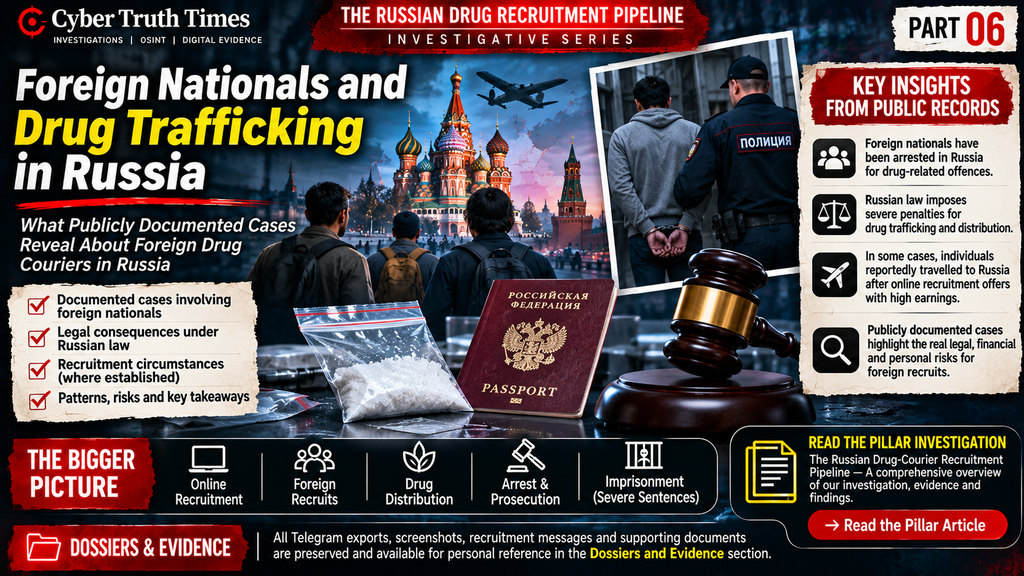
Taken together, the publicly documented cases reveal several important issues.
A. Employment advertisements can conceal criminal work
The RFE/RL investigation provides a documented example in which employment advertisements promising substantial earnings were associated with drug courier activity.
This is an important reference point for the Cyber Truth Times investigation because the Telegram communications reviewed by the newsroom exhibit a comparable progression from employment-related language to explicit drug-related instructions.
The similarity warrants examination, but the connection between the separate sources must not be presumed.
B. Foreign nationals may face serious legal consequences
The cases reported in Volgograd demonstrate that foreign nationals accused of drug distribution may face criminal proceedings involving serious allegations and substantial potential penalties.
For individuals unfamiliar with Russian legal procedures, the consequences may be compounded by language difficulties, limited access to independent legal assistance, immigration issues and geographical distance from family.
These circumstances make independent verification of employment opportunities particularly important.
C. Recruiters may operate through digital communication
The RFE/RL reporting documents contact with a recruiter through Telegram. The Cyber Truth Times investigation also examines Telegram conversations.
Messaging platforms can facilitate recruitment, communication, document exchange, payment discussions and onboarding.
However, the presence of a Telegram account does not establish the identity of its operator, the operator’s location or the existence of an organised network.
Those conclusions require further evidence.
D. The recruiter and the courier may occupy very different positions
A recruitment intermediary who controls the advertisement, communications, payment arrangements and instructions may operate at a different level of a criminal organisation from an individual who performs the advertised work.
Investigations should therefore examine the relationship between recruiters, alleged supervisors, coordinators and prospective workers.
The public cases reviewed in this article do not establish the precise organisational structure of the criminal groups involved.
Nevertheless, the question of who recruits, who directs and who benefits financially remains central to investigating the recruitment pipeline.
6. The hypothesis of deliberate exposure or betrayal of couriers
One of the more disturbing allegations discussed in the RFE/RL reporting is that couriers may, in certain circumstances, be exposed to law enforcement by individuals higher up the criminal chain.
The article quotes an immigration lawyer describing instances in which organisers allegedly turn couriers over to authorities when payment becomes due.
This allegation is relevant to the Cyber Truth Times investigation, which is examining whether some recruitment arrangements may place prospective workers in circumstances where they face disproportionate criminal exposure.
However, the allegation must be treated as a reported account, not as a universally established practice.
The material collected by Cyber Truth Times raises questions about the possible exploitation of recruited workers, but the existence of a deliberate reporting mechanism, whether involving recruiters, rival criminal groups or law-enforcement personnel, would require additional corroboration.
Such corroboration might include:
- Independent testimony from multiple affected individuals.
- Documentary evidence establishing the recruiter–courier relationship.
- Communications indicating deliberate exposure to law enforcement.
- Evidence of payments, financial arrangements or disputes.
- Court records and case documentation.
- Verified evidence linking recruitment intermediaries to subsequent arrests.
- Independent corroboration of alleged coercion or exploitation.
The distinction between an ordinary arrest resulting from criminal activity and a deliberate scheme to expose a courier is fundamental.
The latter is a substantially more serious allegation and cannot be inferred from arrest patterns alone.
7. The legal consequences and the vulnerability of recruited workers
Drug-related criminal offences in Russia can carry severe penalties, depending on the offence, the substance, the quantity, the alleged intent, the circumstances and the applicable provisions of criminal law.
The reports discussed in this article refer to cases involving allegations of attempted distribution, organised-group activity and other drug-related offences.
For a foreign national, criminal proceedings may involve several additional challenges:
- Limited familiarity with Russian criminal procedure.
- Language and translation barriers.
- Difficulty obtaining independent legal advice.
- Financial inability to retain counsel.
- Immigration and residency complications.
- Separation from family and support networks.
- Potential detention while proceedings continue.
- Difficulty accessing consular support.
- Exposure to exploitation by intermediaries.
These are general risk considerations rather than conclusions about every individual case.
The investigative question is whether recruiters knowingly exploit these vulnerabilities when presenting drug-related work as an employment opportunity.
That question requires examining recruitment material, the circumstances of individual recruits and independently corroborated evidence.
8. What Cyber Truth Times has documented
The Cyber Truth Times investigation has collected and examined Telegram communications associated with purported employment offers in Russia.
The material reviewed during the investigation includes:
- Telegram chat exports.
- Screenshots of recruitment conversations.
- Promotional videos.
- Recruitment advertisements.
- Repeated employment-related language.
- Promised remuneration.
- Claims concerning travel and accommodation.
- Onboarding and training communications.
- Messages that disclose drug-related activities.
- Promotional photographs and videos shared by recruiters.
The material contains similarities in language, recruitment presentation and certain promotional elements.
The investigation is examining whether these similarities indicate a recurring recruitment pattern, potentially involving shared intermediaries, infrastructure or promotional material.
The evidence collected so far supports documenting and comparing the recruitment propositions. It does not, on its own, establish the identities of all operators or prove that every account is connected to one organisation.
The newsroom’s analytical approach includes:
- Preserving the original Telegram exports and source files.
- Recording the context in which material was collected.
- Comparing recruitment language across conversations.
- Examining the sequence of recruitment communications.
- Comparing promotional media where appropriate.
- Documenting similarities and differences.
- Distinguishing direct evidence from inference.
- Avoiding unsupported identification of individuals.
- Separating publicly documented criminal cases from the newsroom’s investigative hypothesis.
- Maintaining a record of limitations and unresolved questions.
9. Dossiers and Evidence: Preserving the investigative record
The original data exports and supporting evidence associated with this investigation are preserved and made available for personal reference through the Cyber Truth Times Dossiers and Evidence section.
The archive is intended to provide readers with access to supporting material associated with the investigation, including data exports and relevant documentation where publication and privacy considerations permit.
The evidence archive is important because the investigation relies on documentary comparison rather than solely on narrative claims.
Readers and researchers can consult the relevant materials to understand the evidence underpinning the investigation, examine the documented communications and independently assess the material presented.
Preservation of original exports also helps distinguish the underlying evidence from edited screenshots, selected quotations or narrative summaries.
Where necessary, sensitive personal information may be redacted to protect privacy and avoid exposing uninvolved individuals.
The preservation of source material is not equivalent to independent verification of every claim contained within it.
Telegram conversations can be incomplete, accounts can be impersonated, screenshots can be manipulated, and messages can lack contextual information. Accordingly, the evidence archive should be understood as a documentary resource rather than a definitive determination of criminal responsibility.
Dossiers and Evidence: Cyber Truth Times — Dossiers and Evidence
Readers should navigate to the Dossiers and Evidence section to locate the relevant investigation materials.
10. What this investigation seeks to establish
The investigation into the Russian drug recruitment pipeline is not intended to establish guilt by nationality or to portray foreign nationals involved in criminal cases as members of a single network.
Its purpose is to examine the recruitment mechanisms that may place individuals in criminal situations, document how the recruitment proposition is communicated and investigate whether identifiable accounts or intermediaries are connected.
The investigation seeks to answer several broader questions:
- Are employment advertisements being used to recruit foreign nationals into drug distribution?
- How frequently is the actual nature of the work disclosed?
- What remuneration and travel assurances are offered?
- Are recruiters using similar promotional language?
- Are the same videos or images reused?
- Do the accounts share identifiable digital or operational links?
- Who controls the recruitment process?
- What evidence exists regarding the relationship between recruiters and alleged supervisors?
- Are workers being knowingly recruited, deceived or exploited?
- What independent evidence exists concerning alleged deliberate exposure of couriers to law enforcement?
- What is the documented relationship, if any, between drug-related arrests and subsequent military recruitment or coercion?
These questions will guide subsequent instalments of the series.
The answers will depend on the examination of documentary evidence, public records, independent reporting and corroborated testimony.
Conclusion: Documenting a recruitment environment, not assuming a conspiracy
Publicly documented cases involving foreign nationals accused of drug-related offences in Russia reveal a serious criminal environment in which online recruitment, migrant vulnerability and the promise of lucrative employment can intersect.
The RFE/RL reporting provides an independently documented example of recruitment advertisements that presented work in Russia as an attractive employment opportunity before disclosing a drug-related purpose. Cases reported in Volgograd involving Indian nationals demonstrate that foreign nationals have also been prosecuted or accused of drug-distribution activity in the city.
These findings provide context for the Cyber Truth Times investigation.
The similarities between some public reporting and the recruitment communications collected by the newsroom warrant further investigation. They do not establish a common organisation, a deliberate law-enforcement exposure mechanism or a coordinated pipeline into military service.
Those questions remain under investigation.
Cyber Truth Times will continue examining the communications, promotional material, recruitment accounts, public records and other documentary evidence in an effort to establish what can be independently verified.
This investigation prioritises documentary evidence, corroboration, transparency and the distinction between facts and investigative hypotheses.
About the investigative series
The Russian Drug Recruitment Pipeline is a ten-part investigative series examining purported employment advertisements, Telegram-based recruitment communications, financial inducements, travel arrangements, promotional media and the alleged recruitment of foreign nationals into drug-related work in Russia.
This article is Part 06 of the series.
Read the pillar investigation:
The Russian Drug Recruitment Pipeline — Cyber Truth Times
Refer to the dedicated investigative pillar article for the series introduction, methodology, scope, evidence overview and links to the individual instalments.
Bibliography and external sources
- Radio Free Europe/Radio Liberty (RFE/RL). Promises Of High-Paid Work Lure Kyrgyz Into Russian Drug Trade. June 7, 2025.
- Radio Free Europe/Radio Liberty (RFE/RL). How Kyrgyz Citizens Are Recruited As Drug Couriers In Russia. June 7, 2025.
- RIAC34. In Volgograd, an Indian Citizen Will Stand Trial for Organising Drug Caches. October 3, 2026.
- Gorvesti. Three Drug Caches Prepared in Volgograd by an Indian Citizen. October 2026.
- Info-Volga. Investigation Completed in a Case Involving Attempted Drug Distribution by a Foreign National. October 2026.
- Kommersant. Indian National Detained in Volgograd on Suspicion of Distributing Mephedrone. October 2026.
- Volganet. Indian National Detained for Drug Distribution in Volgograd. October 2026.
- Russian Ministry of Internal Affairs media. Police Disrupted an Alleged Drug Group from Latin America Operating in Volgograd. March 30, 2026.
Editorial note
This article draws upon publicly available media reporting, official law-enforcement announcements and documentary material collected by Cyber Truth Times during its ongoing investigation into purported employment recruitment for drug-related activities in Russia.
Reported allegations, arrest details and descriptions of investigative proceedings are attributed to the sources. The article does not independently establish the guilt of every person described in those reports.
The investigative hypothesis concerning deceptive recruitment, potential exploitation and possible connections between recruitment accounts remains subject to verification. Similarities between advertisements, communications or criminal cases do not independently prove common ownership, coordination or criminal intent.
Cyber Truth Times distinguishes facts, attributed allegations, documentary observations and investigative hypotheses throughout this series.
Disclaimer
This article is intended for journalistic, informational and investigative purposes. It is not legal advice, does not encourage participation in criminal activity and does not provide operational instructions for drug trafficking.
Persons referenced in publicly reported criminal proceedings are discussed in the context of attributed allegations and publicly available reporting. Allegations should not be interpreted as a determination of guilt unless established through the relevant judicial process.
The investigation is ongoing, and additional evidence or findings may change the interpretation of material previously examined.