Investigating allegations about drug courier recruitment in Russia, organisers expose couriers to arrest, examining reporting, recruitment communications and evidentiary limitations.
Introduction: When the courier becomes expendable
In the illicit drug trade, the people who transport or distribute drugs at the lowest levels of a criminal network are often exposed to the greatest immediate risk of arrest, prosecution and imprisonment. Yet the relationship between couriers and the people coordinating criminal activity can be more complicated than a straightforward arrangement in which one party recruits another, and both remain involved until the transaction is completed.
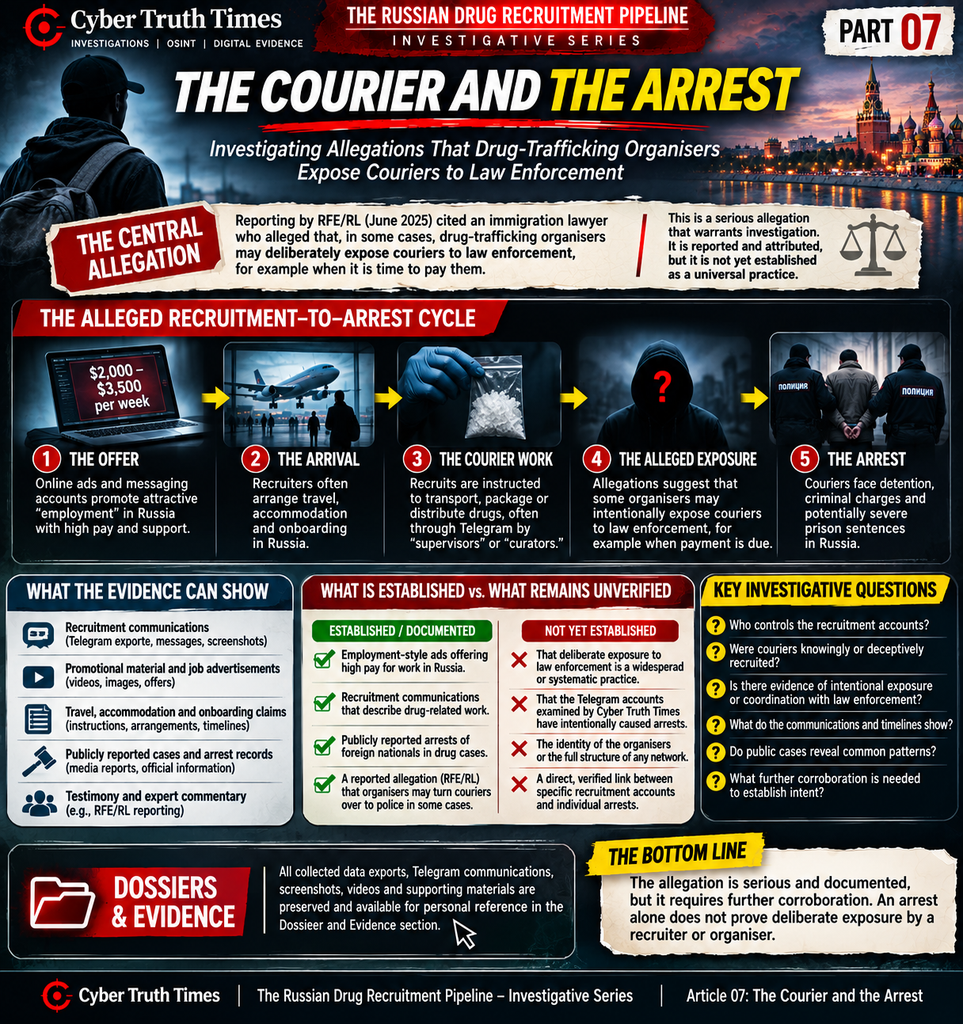
Reporting published by Radio Free Europe/Radio Liberty (RFE/RL) in June 2025 raised a particularly troubling allegation concerning drug-courier recruitment in Russia: that, in some cases, organisers may deliberately expose couriers to law enforcement after recruiting them into the operation.
The allegation is significant because it suggests that the risks faced by a courier may not simply be the inevitable consequence of participating in drug trafficking. In certain circumstances, the courier may allegedly become expendable to the people directing the activity.
This article examines that allegation, the reporting that documents it, the investigative questions it raises and the evidentiary limitations that must be respected.
It also places the allegation within the broader Cyber Truth Times investigation into online employment advertisements, Telegram-based recruitment communications, financial inducements, travel arrangements and purported drug-courier recruitment targeting prospective workers interested in travelling to Russia.
The central allegation examined here is not established as a universal practice, nor is it established that the recruitment accounts investigated by Cyber Truth Times deliberately arrange arrests. Those possibilities require evidence beyond similarities in recruitment language or individual criminal cases.
1. The allegation documented by RFE/RL
One of the most relevant sources for this investigation is RFE/RL’s June 7, 2025 reporting, Promises Of High-Paid Work Lure Kyrgyz Into Russian Drug Trade.
The report documented advertisements in Bishkek offering employment in Russia with attractive financial terms, limited working hours and assurances concerning travel and accommodation. When journalists contacted an advertising account, the work was described as involving illegal drugs.
The article also included testimony from Mirlan Toktobekov, an immigration lawyer, concerning the risks faced by drug couriers and the behaviour of organisers in some criminal schemes.
According to the lawyer quoted by RFE/RL, in some cases organisers allegedly turn couriers over to police when it is time to pay them, resulting in their detention. This is a serious allegation and an important investigative lead. It is not, by itself, proof that every recruiter or drug-distribution network operates in this way.
The distinction matters.
The report provides a published account of an allegation from a named legal professional. It establishes that the allegation has been publicly reported and attributed. It does not automatically establish the frequency of the practice, the identity of specific organisers, the precise circumstances of individual arrests or whether the alleged conduct occurred in every case described by the broader recruitment environment.
Nevertheless, the allegation warrants examination because it introduces a possible dimension of exploitation into the relationship between recruiters and couriers.
2. The courier’s position within a criminal network
The relationship between a recruiter, organiser and courier is often unequal.
A prospective courier may encounter an employment advertisement, communicate with a recruiter, receive assurances about compensation and accommodation, and subsequently be directed by individuals whose identities or organisational roles remain unclear.
The recruiter may be the only person the prospective worker knows. The individual may have no direct contact with the people controlling the wider operation.
This asymmetry is relevant to investigative journalism because it raises questions about the distribution of risk, responsibility and information.
A person recruited into an operation may be exposed to criminal liability while remaining unable to identify the individuals who control the activity. The courier’s visible involvement may be substantially easier for law enforcement to document than the activity of the people coordinating the wider network.
This does not establish that criminal organisations deliberately sacrifice couriers. It does, however, explain why allegations of deliberate exposure require careful investigation.
The questions are not merely whether a courier was arrested, but also:
- What was the recruitment process?
- What information was provided before the person travelled or began working?
- What did the individual understand about the activity?
- Who communicated with the recruit?
- What evidence establishes the recruiter’s role?
- What evidence establishes the organiser’s role?
- Was the arrest associated with a specific operation, and what public records document it?
- Is there evidence of a relationship between the recruiter and the arrest circumstances?
These questions must be answered using documentary evidence, reliable testimony and corroboration wherever possible.
3. Recruitment promises and the risk of deception
The recruitment material examined in the broader Cyber Truth Times investigation contains a recurring proposition: employment in Russia presented as accessible, financially attractive and comparatively uncomplicated.
The communications examined by the investigation include offers involving:
- High advertised earnings.
- Limited working hours.
- Travel arrangements.
- Accommodation.
- Food or other basic provisions.
- Training and onboarding.
- Contact with purported supervisors or curators.
- Instructions communicated through Telegram.
- Descriptions of activities that subsequently involve drug-related work.
The broader investigation has documented conversations in which the employment proposition transitions into explicit drug-related activity.
This is relevant to the question of deliberate exposure because a deceptive recruitment process may create a gap between the recruit’s expectations and the actual nature of the work.
However, deceptive recruitment and deliberate exposure to law enforcement are two distinct allegations. Evidence supporting the first does not automatically prove the second.
A recruiter who conceals the nature of a job may be engaging in deception. An organiser who knowingly causes a courier to be arrested would involve a further allegation requiring a different evidentiary foundation.
Cyber Truth Times therefore treats these as separate investigative questions rather than combining them into a single presumed scheme.
4. Why deliberate exposure is an allegation requiring stronger evidence
The hypothesis that a criminal organiser intentionally exposes a courier to law enforcement is potentially consequential. It could imply that the arrest is not merely an accidental outcome of criminal activity but a deliberate decision by someone exercising control over the operation.
However, an arrest alone cannot establish intent.
Several possible explanations may exist for an arrest associated with a courier’s activities. The arrest could result from ordinary law-enforcement investigation, surveillance, a separate investigation, a participant’s actions, a public tip, investigative intelligence or other circumstances.
The allegation of deliberate exposure requires evidence connecting the alleged organiser to the arrest circumstances and establishing intent or knowledge, rather than merely demonstrating that a courier was arrested.
The investigative distinction:
| Evidence observed | What it may establish | What it does not automatically establish |
|---|---|---|
| Courier arrested | An arrest occurred | Organiser deliberately caused it |
| Recruitment advertisement | A recruitment proposition existed | Advertiser controls a criminal network |
| Telegram communications | Communication between accounts | Common ownership or operational hierarchy |
| Recruiter promises | Representations were made | The promises were fulfilled |
| Arrest after recruitment | Temporal relationship | Causal relationship |
| Testimony alleging deliberate exposure | A reported allegation | Independent corroboration of the allegation |
| Multiple similar advertisements | A recurring recruitment pattern | One coordinated organisation |
This evidentiary framework is central to the investigation.
The purpose is not to dismiss the allegation. It is to investigate it rigorously without treating circumstantial similarities as proof of intent.
5. What publicly reported cases and investigations can contribute
Public reporting provides a starting point for understanding the recruitment environment, but the sources must be interpreted according to what they actually document.
RFE/RL: High-paid work and the courier’s risk
RFE/RL’s reporting documents recruitment advertisements offering prospective workers attractive conditions and confirms that the advertising contact disclosed drug-related work when approached by journalists.
The reporting also includes the allegation from an immigration lawyer that organisers sometimes turn couriers over to authorities when payment is due. This is the most directly relevant public source identified for the central hypothesis examined in this article. RadioFreeEurope/RadioLiberty+1
Broader recruitment into criminal networks
Research and law-enforcement reporting across other jurisdictions have documented recruitment of vulnerable individuals into criminal networks for courier and other operational roles. Europol, for example, has described online recruitment into criminal activity, including drug-related roles, in its reporting on the recruitment of young perpetrators for criminal networks. Such material provides comparative context but does not independently establish the alleged practice in Russia. Europol
Russia’s non-contact drug distribution environment
Russian academic and law-enforcement-oriented literature has also described internet-based non-contact drug distribution, recruitment and hierarchical structures. Such publications may help explain the broader context of online recruitment and the organisation of drug-distribution activities.
They should not be treated as evidence that a specific Telegram account, recruiter or individual examined by Cyber Truth Times belongs to a particular organisation. Волгоградская академия МВД России
The value of these sources is contextual. The investigation must still establish its own documentary record.
6. The Cyber Truth Times investigation: examining the recruitment communications
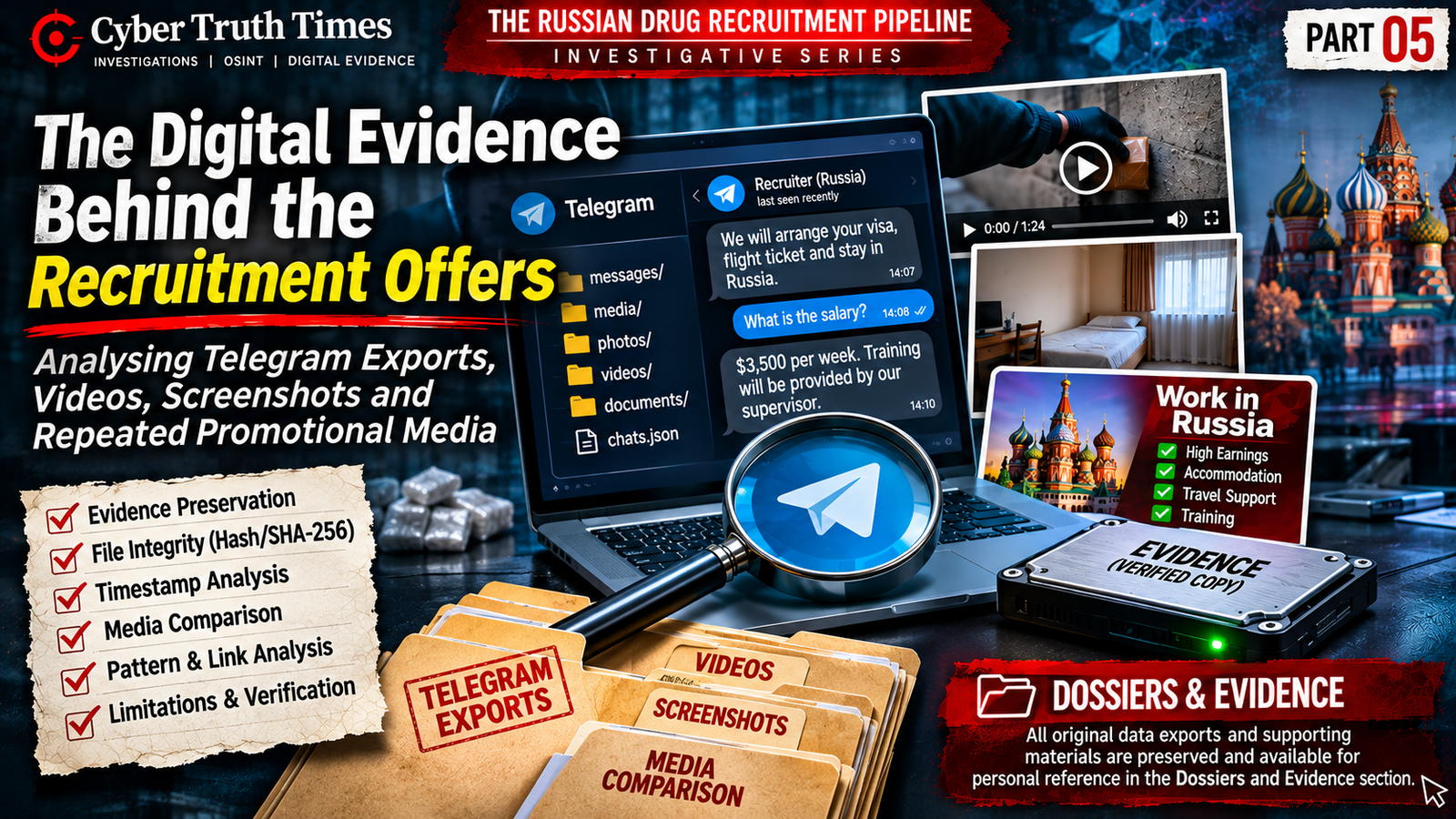
The Cyber Truth Times investigation has examined multiple Telegram recruitment communications, advertisements, promotional videos, screenshots and other material relating to purported employment opportunities in Russia.
Some communications examined by the newsroom transition from employment-related language into explicit descriptions of drug-related activities. In other communications, recruiters describe travel, accommodation, financial compensation, onboarding or training.
These materials are being examined comparatively.
The investigation seeks to determine whether repeated language, promotional materials, contact details, communication patterns, account behaviour and other documentary characteristics indicate recurring recruitment practices.
The purpose of comparison is to identify potentially meaningful similarities and differences.
The investigation does not assume that similar wording proves common ownership.
Recruitment advertisements may be copied, reused, translated, republished or independently adapted. Similar promotional content may be evidence of a shared template or broader recruitment practice without proving a single coordinated organisation.
Likewise, the appearance of multiple recruitment accounts does not automatically establish that the accounts are controlled by the same person.
The investigation therefore separates:
- Directly observed communications.
- Account and message information preserved from exports.
- Similarities in recruitment language.
- Repeated media or promotional content.
- Publicly reported cases.
- Testimony or allegations.
- Investigative hypotheses.
- Confirmed relationships between accounts, if any.
This distinction is particularly important when examining the allegation that couriers are intentionally exposed to arrest.
7. What evidence could substantiate deliberate exposure?
The allegation requires evidence that goes beyond a courier’s arrest and the existence of a recruitment account.
Potentially relevant evidence in an investigative context may include independently corroborated testimony, public court documents, documented communications that establish relevant relationships, records establishing the chronology of events and credible reporting that identifies the circumstances surrounding an arrest.
The evidence must be evaluated for authenticity, context, completeness and reliability.
A screenshot, for example, may provide useful evidence of a conversation but may not independently establish the identity of the account operator. A Telegram export may preserve more contextual information than a single screenshot, but its evidentiary value depends on the integrity and completeness of the export and the circumstances of preservation.
Similarly, an arrest record may establish that an arrest occurred, but it may not establish the identity or intentions of a recruiter.
The investigation will therefore avoid treating any single document or media item as conclusive where corroboration is necessary.
8. The potential consequences for foreign recruits
The consequences of involvement in drug-related activity in Russia can be severe.
Foreign nationals accused of drug trafficking may face arrest, criminal prosecution, imprisonment, immigration consequences and other personal and financial consequences. The precise consequences depend on the alleged conduct, applicable law, case circumstances and judicial proceedings.
The broader recruitment investigation is particularly concerned with prospective workers who may encounter employment advertisements while seeking opportunities abroad.
The combination of attractive remuneration, travel assistance, accommodation and promises of straightforward work may be appealing to individuals seeking employment. Where an advertisement conceals or misrepresents the nature of the activity, the recruit may enter the process without an accurate understanding of the legal and personal risks.
The investigation does not presume that every person accused of drug-related activity was deceived. Nor does it assume that all foreign nationals involved in drug offences are victims of recruitment schemes.
The circumstances of each case matter.
9. Preserving the documentary record
The documentary materials associated with the Cyber Truth Times investigation are preserved as part of the newsroom’s broader investigative record.
The Dossiers and Evidence section provides readers with a reference point for the supporting material associated with the investigation, subject to redaction, privacy, security and editorial considerations.
The materials include Telegram data exports, recruitment communications, screenshots, promotional material and other supporting documentary records collected during the investigation.
The preservation of this material serves several purposes:
- Maintaining a documentary reference for the investigation.
- Preserving communications and supporting material for subsequent review.
- Supporting comparisons between recruitment propositions.
- Separating original documentary material from published interpretation.
- Making supporting records available for personal reference through the Dossiers and Evidence section where publication is appropriate.
Preservation does not automatically mean that every item has been independently authenticated or that every claim contained within a document is established as fact.
The newsroom’s analysis is based on a combination of documentary examination, comparative analysis, publicly available reporting and an assessment of evidentiary limitations.
10. The unanswered questions
The allegation that drug-trafficking organisers deliberately expose couriers to law enforcement remains a serious investigative question.
The publicly reported allegation identified by RFE/RL provides a basis for examining the issue, but additional corroboration would be necessary to establish the extent, mechanisms or specific instances of deliberate exposure within the recruitment networks examined by Cyber Truth Times.
The investigation will continue examining questions including:
- Whether recruitment accounts are associated with identifiable individuals or entities.
- Whether communications demonstrate consistent recruitment practices.
- Whether promotional media or messaging patterns can be independently corroborated.
- Whether publicly documented cases provide evidence of recruitment circumstances.
- Whether testimony concerning deliberate exposure is independently corroborated.
- Whether there is documentary evidence connecting recruitment communications to specific arrest circumstances.
- Whether any relationships between recruitment accounts can be established to a defensible evidentiary standard.
These questions remain open.
The newsroom will not treat a hypothesis as a finding merely because it appears plausible.
Conclusion: The arrest is not the end of the investigation
For a drug courier, arrest may be the most visible consequence of participation in a criminal operation. For investigators examining recruitment networks, however, the arrest may raise additional questions about the circumstances that preceded it.
The allegation that organisers deliberately expose couriers to law enforcement is documented in reporting by RFE/RL through testimony attributed to an immigration lawyer. It is a serious allegation that warrants scrutiny. It should not be presented as a proven universal practice or as fact concerning the Telegram accounts examined by Cyber Truth Times.
The broader investigation has documented employment-oriented recruitment communications that transition into explicit drug-related offers. It is examining repeated language, promotional materials, communication patterns and publicly documented cases to establish what can be verified.
The central objective remains to identify and document the recruitment practices, understand the circumstances in which prospective workers are approached, and determine whether the evidence supports conclusions about the people or entities responsible.
The evidence must lead the conclusions, not the other way around.
About this investigative series
The Russian Drug Recruitment Pipeline is a ten-part investigative series by Cyber Truth Times examining purported employment advertisements, Telegram recruitment communications, financial inducements, travel arrangements, promotional media and allegations involving the recruitment of foreign nationals for drug-related activities in Russia.
This article is Article 07 of the series.
Read the pillar investigation:
The Russian Drug Recruitment Pipeline — Cyber Truth Times
Refer to the pillar article for the investigation’s scope, methodology, background, evidence overview and links to the individual articles in the series.
Bibliography
- Radio Free Europe/Radio Liberty (RFE/RL). Promises Of High-Paid Work Lure Kyrgyz Into Russian Drug Trade. June 7, 2025.
- Radio Free Europe/Radio Liberty (RFE/RL). How Kyrgyz Citizens Are Recruited As Drug Couriers In Russia. June 7, 2025.
- Europol. The Recruitment of Young Perpetrators for Criminal Networks.
- Russian academic publication. Some Peculiarities of Identification, Disclosure and Investigation of Crimes in the Sphere of Illegal Trafficking of Drugs Completed by the Network “Internet” with a Non-Contact Way.
Editorial note
This article examines allegations that drug-trafficking organisers may deliberately expose couriers to law enforcement, alongside reporting and documentary material concerning online recruitment for drug-related activity in Russia.
The central allegation concerning deliberate exposure is attributed to testimony reported by RFE/RL. Cyber Truth Times does not independently establish that this practice is widespread, that it applies to every criminal network or that any recruitment account examined by the newsroom has deliberately caused a courier’s arrest.
The article distinguishes published reporting, attributed testimony, documentary observations, contextual research and investigative hypotheses. Similarities between recruitment advertisements or communications do not independently establish common ownership, coordination or criminal intent.
The investigation remains ongoing.
Disclaimer
This article is intended for journalistic, informational and investigative purposes. It is not legal advice and does not encourage participation in criminal activity.
Allegations concerning individuals or organisations should not be interpreted as findings of guilt unless established through the relevant legal process. The investigation’s conclusions are limited by the available evidence and may be revised if additional credible information emerges.