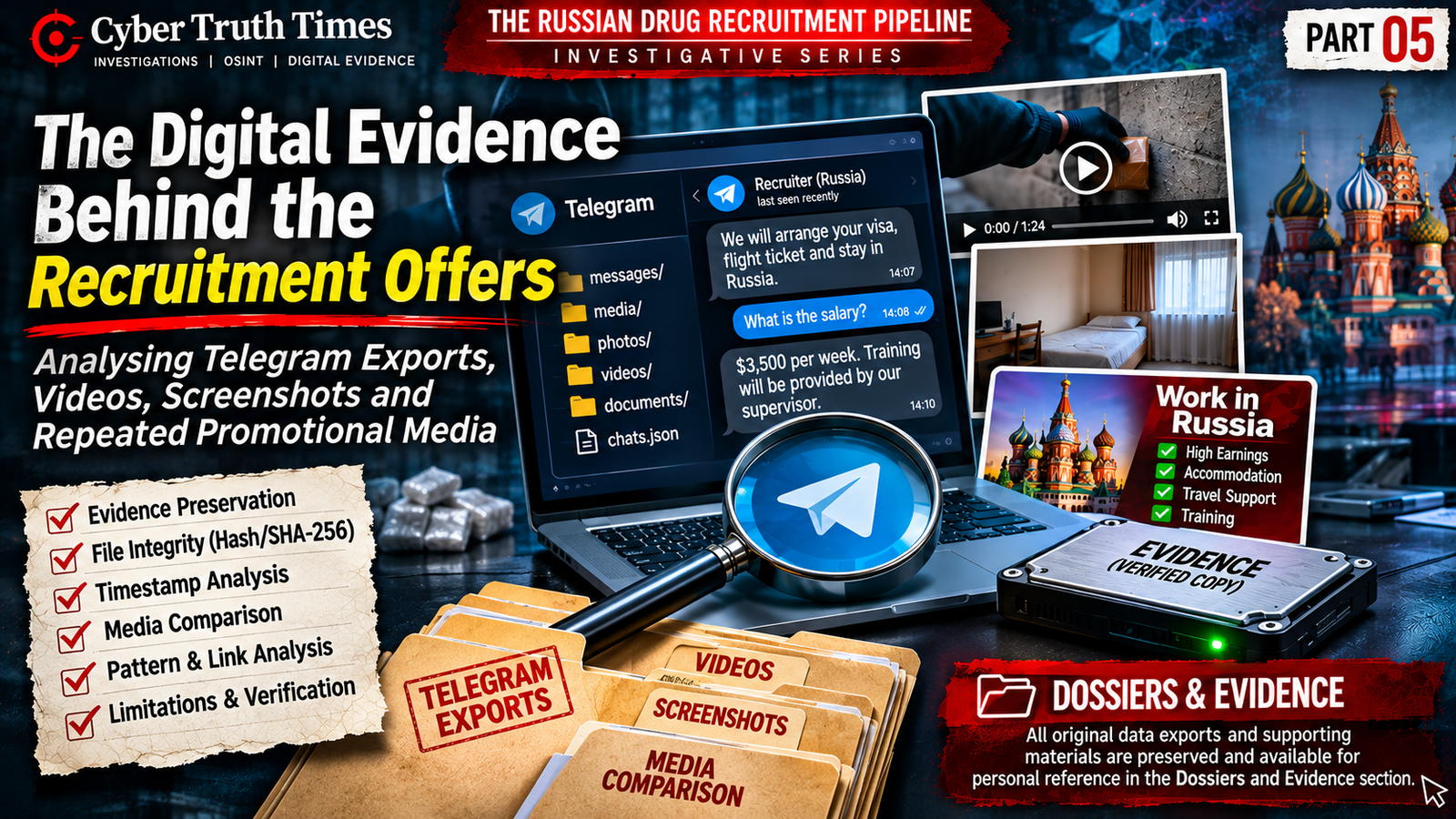
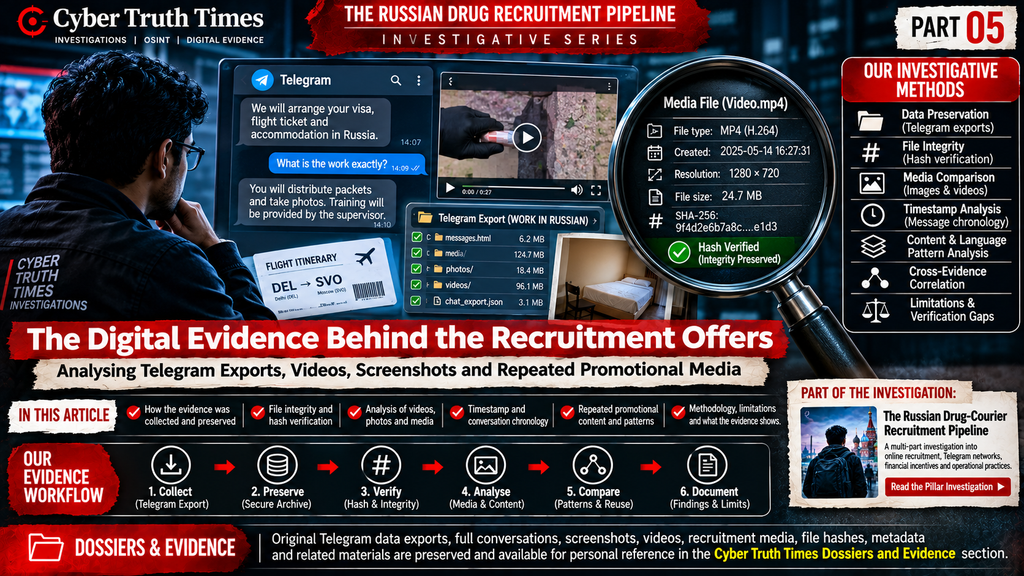
Cyber Truth Times investigated the digital evidence behind Russia recruitment offers by examining Telegram exports, screenshots, videos, timestamps and repeated promotional media behind suspicious recruitment offers involving drug-related work in Russia.
Introduction: Digital Evidence Behind Russia Recruitment Offers
Investigating suspicious online recruitment offers requires more than reading individual Telegram messages. It requires examining the digital materials as a collection of documentary, visual and technical evidence that may reveal recurring patterns, inconsistencies, relationships or changes in the recruitment narrative.
In the ongoing Cyber Truth Times investigation into online recruitment advertisements that transition into drug-related work in Russia, Telegram conversations, promotional videos, screenshots, photographs and other digital materials have become central to the research process.
The investigation has encountered recruitment conversations in which prospective applicants are initially presented with employment-oriented language, attractive remuneration, limited working hours, travel arrangements, accommodation and training. The nature of the proposed work is subsequently disclosed as involving drug distribution.
The investigation is not based on a single message or advertisement. It involves comparing multiple communications, examining the media circulated alongside them, preserving the available digital records and assessing what the materials actually establish.
Digital evidence is not simply about what a screenshot appears to show. It is about establishing what was captured, where it came from, whether the record has changed, what can be corroborated and what remains uncertain.
This article explains the documentary and digital-media methods used in the Cyber Truth Times investigation, including the preservation of Telegram exports, file integrity, timestamp analysis, screenshot examination, video comparison, repeated promotional media and the limitations of digital attribution.
It also explains how the evidence archive is maintained and why preserving the distinction between documented fact, analytical inference and unverified claims is essential to investigative journalism.
1. The investigation and its digital evidence
The investigation examines a collection of digital materials associated with suspicious recruitment advertisements and Telegram conversations.
These materials include:
- Telegram chat exports.
- Recruitment messages and advertisements.
- Screenshots of conversations.
- Photographs shared by recruiters.
- Promotional videos.
- Videos illustrating purported work activities.
- Accommodation photographs.
- Visa and travel-related claims.
- Onboarding and training messages.
- References to purported supervisors or curators.
- Publicly available news reports and related material.
Each category presents a different evidentiary challenge.
A Telegram export may preserve a conversation’s text and message chronology but may not independently establish the identity of the person operating the account.
A screenshot may document what appeared on a screen at a particular moment but may not contain sufficient information to independently verify the original message, its context or its authenticity.
A video may contain visual material that can be compared with other videos, but its appearance alone does not establish who recorded it, where it was recorded or when the underlying activity occurred.
A photograph shared by a recruiter may be relevant to the recruitment proposition but may not establish the existence of the promised accommodation, the identity of its owner or whether it was actually available to an applicant.
The investigation therefore treats each material as an individual evidence item while also examining its relationship to other items in the collection.
The objective is to establish a documented evidentiary framework rather than simply accumulate screenshots.
Preserving Telegram conversations and data exports
The preservation of original digital material is one of the most important aspects of this investigation.
Telegram conversations may contain information that is difficult to reconstruct later. Messages may be deleted, accounts may become unavailable, usernames may change, and media may disappear from accessible sources.
For this reason, Cyber Truth Times has preserved Telegram conversation exports and supporting materials associated with the investigation.
The preserved exports serve as documentary records of the conversations examined by the investigative team.
These records provide a basis for reviewing recruitment language, comparing communications across accounts, examining the sequence of disclosures and identifying statements that may warrant further corroboration.
The preservation process distinguishes the original collected materials from subsequent analytical documents, summaries and publication-ready excerpts.
Where possible, the investigative record retains:
- The original export file.
- The associated media files.
- The account or conversation context available at the time of collection.
- Relevant timestamps as displayed or recorded.
- Supporting screenshots.
- The source of the material.
- Notes concerning the collection and subsequent examination.
- Analytical copies or working documents clearly distinguished from originals.
The purpose is to preserve a record that can be revisited without relying exclusively on recollection or on the screenshots selected for publication.
The investigation also seeks to avoid unnecessarily altering the source material. Working copies are used for examination, annotation, redaction and publication, while original collected files are retained separately where available.
This separation is important because a published image may be cropped, blurred, annotated or reformatted to protect privacy or improve readability. Such editorial changes should not be confused with alterations to the original evidence.
File integrity and digital fingerprints
Digital files can be copied, renamed, compressed, edited or otherwise altered. A file’s name alone does not establish that it is the same file originally collected.
Digital integrity checks can help document whether a file has changed between preservation and subsequent examination.
One commonly used method is cryptographic hashing.
A cryptographic hash function produces a digital fingerprint of a file. The SHA-256 algorithm, for example, produces a hash value based on the contents of the file.
If the contents of a file change, its SHA-256 hash will ordinarily change as well.
Hash values can therefore be used to compare files and document whether their contents remain consistent across different stages of handling.
In an investigative archive, hash records can help distinguish:
- The original collected file.
- A duplicate used for analysis.
- A redacted copy prepared for publication.
- A compressed or converted media file.
- A file subsequently received from another source.
The hash is not proof that the content itself is authentic, truthful or correctly attributed. It is a technical means of identifying a particular file’s contents and checking whether those contents have changed.
For example, if an original Telegram video is preserved and its hash is recorded, the hash can later be compared with another copy of that same video. Matching hash values indicate that the files have identical contents, assuming the same hashing method and file bytes.
If the hash values differ, the files are not byte-for-byte identical. That difference does not automatically mean one file is fraudulent. The difference could result from compression, re-encoding, resizing, metadata changes or an actual alteration to the visual content.
The interpretation of a hash comparison must therefore consider the circumstances in which the files were obtained.
The importance of documenting collection and handling
Digital evidence is more useful when the investigative record explains how it was obtained and subsequently handled.
A collection note may document the source of an item, the date it was obtained, the relevant context and any subsequent processing.
The aim is to maintain a clear distinction between the source material and the investigative work performed upon it.
For an investigative journalism archive, this may involve recording:
- The source from which the material was obtained.
- The date and time of collection.
- The file’s original name, where available.
- The type of material collected.
- Whether the material was subsequently converted, cropped or redacted.
- Where the preserved original is stored.
- Whether the material has been independently corroborated.
- Any known limitations or uncertainties.
A documented collection history does not automatically establish admissibility in court or authenticate every claim contained within the material.
It does, however, improve transparency, reproducibility and the ability to revisit the evidence during the course of an investigation.
Where the materials may eventually be relevant to legal proceedings, journalists should consult appropriate legal and digital-forensics professionals regarding evidence handling, certification and applicable legal requirements.
5. Timestamp analysis: understanding the chronology
Timestamps can help reconstruct the sequence of digital communications and media exchanges, but they must be interpreted carefully.
A Telegram message may display a time within a particular chat interface. An exported record may preserve a timestamp in a different format or timezone. A downloaded photograph or video may contain metadata associated with its file creation or modification.
These different time indicators are not necessarily equivalent.
The investigation distinguishes, where available, between:
- The time displayed in a Telegram conversation.
- The timestamp recorded in a data export.
- The time a file was downloaded or collected.
- Metadata associated with a photograph or video.
- The time a screenshot was created.
- The publication date of an external report.
- The time an investigator recorded an observation.
A timestamp is an indicator requiring interpretation, not an automatic guarantee of when an underlying event occurred.
The date and time embedded in a file may reflect the device that created or processed it. It may be inaccurate, altered, missing or affected by timezone settings.
A screenshot displaying a timestamp can document what the interface showed when the screenshot was captured, but it does not necessarily establish the time of the underlying activity.
Similarly, metadata extracted from a photograph or video should not be treated as definitive proof of location or chronology without corroborating evidence.
The investigation therefore treats timestamps as one component of the documentary record rather than an independent confirmation of events.
Chronological comparison
When multiple conversations are examined, chronology can be relevant to understanding how recruitment communications develop.
The investigation may compare the sequence of:
- Initial contact.
- Employment claims.
- Remuneration disclosures.
- Travel and accommodation assurances.
- Disclosure of the nature of the work.
- Training and onboarding messages.
- Subsequent communication.
The objective is to understand the documented progression of the conversations and identify patterns that can be supported by the records.
Where timestamps are missing, inconsistent or uncertain, those limitations should be stated rather than resolved through assumptions.
Screenshot examination: context matters
Screenshots are among the most common forms of digital material encountered in online investigations.
They can provide a visual record of a conversation, advertisement, profile, video or website. They are particularly useful when a researcher needs to document material as it appeared in an interface.
However, screenshots have inherent limitations.
A screenshot may not preserve the complete conversation. It may omit earlier messages, later responses, the source link or contextual information.
The visible username or profile name may not establish the account operator’s identity.
The screenshot may also have been edited, cropped, resized, compressed or otherwise processed before it was supplied to an investigator.
For this reason, the investigation does not treat every screenshot as a complete or self-authenticating record.
Where an underlying export or original media file is available, it can provide additional context for examining a screenshot.
The documentary comparison may consider:
- Whether the screenshot is consistent with the preserved conversation.
- Whether the visible wording appears elsewhere in the collected communications.
- Whether the screenshot omits material context.
- Whether the displayed account information is consistent with other records.
- Whether the screenshot contains visible signs of processing.
- Whether the screenshot’s claims are corroborated by independent sources.
These considerations do not establish authenticity through visual inspection alone.
A screenshot that appears consistent with a Telegram export may support a comparative assessment, but the evidentiary strength depends on the broader record.
The distinction between an image and its underlying claim
A screenshot may show a recruiter stating that accommodation will be provided.
The screenshot establishes that the statement appears in the captured material, subject to authentication and verification. It does not establish that the accommodation was actually provided.
Similarly, a screenshot showing an advertised salary establishes what the advertisement displayed, not whether the salary was paid.
This distinction is central to the investigation.
The material is being examined to document recruitment claims and communication patterns, not to treat every claim made by an account as a fact.
Video examination: documenting what is visible
Videos have become a significant component of the recruitment material examined by Cyber Truth Times.
The collected communications include videos associated with purported work activities and promotional material presented alongside recruitment messages.
Video analysis can help document the content of a clip, compare visual similarities between recordings and assess whether media appears to have been reused across different communications.
However, video examination must be conducted within the limits of the available material.
A video does not independently establish the identity of the person who recorded it, the location where it was recorded, the date of the underlying activity or the relationship between the person depicted and a recruiter.
The investigation therefore separates observable content from attribution.
Observable content
The initial documentary examination concerns what can reasonably be described as visible or audible in a recording.
For example:
- The presence of objects or surroundings.
- The visible composition of a scene.
- The presence of captions or text.
- The apparent sequence of visual events.
- Whether a clip contains audio.
- Whether the recording is accompanied by a recruitment message.
- Whether the video appears to be a promotional or instructional presentation.
These observations should not be expanded into unsupported claims about identities, locations, intent or ownership.
Media comparison
When multiple videos are available, comparison can help assess whether they contain similar or potentially identical material.
The investigation may examine similarities in the overall visual content, frames, captions, presentation, background and other observable features.
Where a comparison suggests that videos are related, the conclusion should be proportionate to the evidence.
For instance:
- Identical files: Files with matching cryptographic hashes have identical file contents.
- Visually similar videos: Videos may appear to contain the same scenes even if their files differ.
- Related promotional material: Videos may share branding, captions or presentation without necessarily being produced by the same individual.
- Potentially reused media: A video may appear in multiple contexts, but the origin and purpose of the reuse may remain unknown.
These distinctions prevent a visual resemblance from being mistaken for proof of a common operator.
Repeated promotional media and the question of attribution
One of the investigative questions emerging from the collected recruitment communications concerns the repetition of similar messages and promotional media across multiple accounts.
Where recruiters share similar videos, photographs, text or visual material, the repetition may warrant closer examination.
Repeated promotional media can be relevant to assessing whether different recruitment communications are using common material.
However, repeated media is not, by itself, proof of common ownership or coordination.
The same video or photograph may be circulated by unrelated accounts, copied from a public source, reposted by intermediaries or shared without the knowledge of its original creator.
The investigation therefore distinguishes between several levels of observation.
Level 1: Similar language
Different accounts may use comparable employment descriptions, salary claims, work schedules or logistical assurances.
This establishes a similarity in the communication, subject to the accuracy of the collected records.
It does not establish that the accounts share an operator.
Level 2: Similar promotional material
Accounts may circulate visually similar photographs, videos or promotional content.
This establishes a media similarity that may be relevant to further analysis.
It does not automatically establish the origin of the media or a common organisational relationship.
Level 3: Repeated material across communications
The same promotional material may appear across multiple conversations or advertisements.
This may indicate the circulation or reuse of material, depending on the evidence.
The circumstances of that reuse remain relevant.
Level 4: Independently corroborated connections
Stronger attribution may require additional evidence beyond repeated wording or visual similarity.
Such evidence might involve independently corroborated account relationships, reliable records, direct statements, contextual evidence or other verifiable material.
The investigation does not treat similarities alone as sufficient to establish common ownership.
The objective is to identify documented relationships, not to convert similarities into accusations.
Image comparison and perceptual similarity
Photographs and videos may be compressed, resized, cropped or re-encoded before they are circulated.
As a result, two files depicting the same visual content may not have identical hashes.
This is one reason digital-media analysis may involve more than cryptographic hashing.
Visual comparison methods can assist researchers in identifying images or video frames that appear similar despite differences in file format, resolution or compression.
Perceptual similarity is different from file integrity.
A cryptographic hash is intended to identify the contents of a particular file. A perceptual comparison is concerned with whether two media items appear visually similar.
The distinction is important because visually similar images may not be identical, and a similarity score does not independently establish provenance, authorship, intent or ownership.
For the purposes of this investigation, media comparisons are used to identify potential similarities for documentary review.
Any conclusions concerning reuse or common origin require contextual assessment and, where possible, additional corroboration.
The publication of a media comparison should also be accompanied by appropriate privacy safeguards.
Images containing identifiable individuals, personal documents, addresses or sensitive information may require redaction or omission from public-facing material.
The limitations of digital-media analysis
Digital evidence can be valuable, but it is not infallible.
The materials collected during an online investigation may contain gaps, inconsistencies, incomplete records or information that cannot be independently verified.
The investigation acknowledges several limitations.
Account identity
A Telegram username, profile photograph or display name does not necessarily establish the identity of the individual operating an account.
Account ownership
Similar communications across different accounts do not independently establish common ownership.
Location
Visual elements in a video or photograph may suggest a location but cannot automatically establish the precise geographic origin of the material.
Chronology
Timestamps may be affected by device settings, timezone differences, file processing or incomplete records.
Media authenticity
A screenshot or video may have been altered, edited or re-encoded. The availability of a file does not automatically establish that the material is authentic.
Context
An individual screenshot or video may omit information that changes the interpretation of the material.
Attribution
Repeated media, wording or recruitment descriptions may indicate similarity but do not independently establish a common operator or organisation.
Independent corroboration
Claims made by recruiters, including promises concerning salaries, visas, accommodation, travel or training, require corroboration if they are to be presented as established arrangements.
The investigation’s conclusions are therefore limited to the evidence available and the degree to which individual claims can be supported.
Cross-comparison of the collected communications
The broader investigation examines multiple recruitment conversations rather than treating each account as an isolated case.
The comparison seeks to establish whether recurring elements appear in the material, including employment language, salary claims, working-hour descriptions, logistical promises, onboarding language and associated media.
The comparison is intended to identify documented similarities and differences.
For example, the investigation may examine whether:
- Comparable employment descriptions appear in multiple conversations.
- Similar remuneration claims are communicated.
- Comparable logistical assurances are repeated.
- Similar onboarding language is used.
- Promotional media appears in more than one conversation.
- Recruiters refer to purported supervisors or curators.
- The sequence of disclosures is similar or materially different.
The presence of similar language or media may be relevant to further research. It is not sufficient by itself to establish common ownership, coordinated operation or an identifiable organisation.
The investigation will continue to distinguish between similarities that can be documented and relationships that require additional corroboration.
The Dossiers and Evidence archive
Cyber Truth Times has preserved the Telegram data exports, screenshots, videos, photographs and supporting materials associated with this investigation.
The original collected data exports and supporting materials are preserved and available for personal reference through the Dossiers and Evidence section of Cyber Truth Times, subject to privacy, safety and redaction considerations.
The archive is intended to provide readers with a documentary reference point for the investigation and allow the underlying collected material to be examined in context where publication is appropriate.
The preserved materials may include:
- Telegram conversation exports.
- Recruitment advertisements.
- Screenshots of recruiter communications.
- Promotional videos.
- Photographs associated with recruitment offers.
- Accommodation-related imagery.
- Travel and visa-related statements.
- Training and onboarding communications.
- Supporting documentation.
- Investigative notes and comparative material.
The archive is not intended to imply that every statement within the preserved communications has been independently verified.
The distinction between a statement made by a recruiter, a documented communication, an analytical finding and an independently verified fact remains central to this investigation.
Access to the evidence archive
Dossiers and Evidence — Cyber Truth Times
Replace this link with the direct Dossiers and Evidence URL if the archive is accessible through a dedicated section or page.
The archive is being maintained as part of the broader investigative record.
What the evidence establishes—and what remains unresolved
The digital materials examined in this investigation provide a documentary basis for studying recruitment communications and associated media.
They allow researchers to examine what recruiters communicated, compare material across conversations and document the available evidence.
However, the materials do not independently establish every underlying claim.
The evidence currently examined does not automatically establish:
- The verified identity of every recruiter.
- The ownership of every Telegram account.
- The existence of a single organisation controlling all recruitment accounts.
- The origin of every promotional video.
- The location or date of every video or photograph.
- The authenticity of every claim concerning travel, visas or accommodation.
- The identity of every person depicted in the media.
- The criminal liability of any individual.
- The existence of a coordinated mechanism linking drug-related recruitment to subsequent military recruitment.
These questions require evidence beyond similarities in messages, photographs, videos or recruitment language.
The investigation is examining the documented material while seeking further corroboration where necessary.
Why digital evidence matters to investigative journalism
Digital evidence can make online recruitment investigations more transparent and more reproducible.
Instead of relying exclusively on descriptions of suspicious activity, journalists can preserve communications, document what was collected, compare material and explain the methods used to reach their conclusions.
This is particularly important when an investigation concerns multiple accounts and potentially recurring recruitment practices.
The preservation of original materials, the documentation of limitations and the distinction between evidence and inference can strengthen the credibility of an investigative publication.
Digital evidence is not inherently reliable simply because it exists in electronic form. It must be assessed within its context, examined for consistency and corroborated wherever possible.
The value of the evidence lies in its ability to support verifiable findings rather than in the volume of material collected.
Conclusion: Preserving the evidence, examining the patterns
The investigation into suspicious online recruitment offers involving drug-related work in Russia relies on a growing collection of Telegram conversations, screenshots, promotional videos, photographs and supporting material.
The digital evidence provides a basis for examining the recruitment language, the sequence of disclosures, the logistical assurances and the recurring elements present in the collected communications.
Cyber Truth Times is preserving the original collected materials and examining them through documentary comparison, digital-media analysis, file-integrity checks, chronological review and corroboration wherever possible.
These methods do not automatically establish the identity of recruiters, common ownership of accounts or the existence of a coordinated organisation. Those questions remain subject to evidence.
The objective is not to turn digital similarities into allegations. It is to preserve the records, document the findings, identify what the evidence supports and make the investigative process more transparent.
The preserved data exports and supporting materials are available for personal reference through the Dossiers and Evidence section of Cyber Truth Times, subject to appropriate redactions and safety considerations.
This article forms Part 05 of the ongoing investigation into the digital recruitment pipeline.
The Russian Drug-Courier Recruitment Pipeline: Investigating Deceptive Online Job Offers
This pillar investigation examines a collection of online recruitment advertisements and Telegram communications that appear to transition from conventional employment-oriented offers to explicit drug-related work in Russia.
The investigation explores the recruitment language, financial incentives, logistical assurances, digital communication patterns, promotional material and documentary evidence associated with these offers.
Through a multi-part investigative series, Cyber Truth Times documents the collected material, examines recurring patterns, analyses the digital evidence and distinguishes verified findings from unresolved questions.
The investigation seeks to understand how these recruitment propositions are presented, what the available evidence establishes and what remains subject to further verification.
The Russian Drug-Courier Recruitment Pipeline — Cyber Truth Times
Editorial Note
This article forms Part 05 of the Cyber Truth Times investigative series examining suspicious online recruitment advertisements and Telegram communications that appear to transition from employment-oriented offers to explicit drug-related work in Russia.
This instalment explains the documentary and digital-media methods used in the investigation, including evidence preservation, file-integrity checks, screenshot examination, timestamp interpretation, video and image comparison, repeated promotional media and the limitations of digital attribution.
The article distinguishes observable content and documented communications from analytical interpretation and independently verified facts. Cryptographic hashes, metadata, timestamps and visual similarities are described as analytical tools rather than proof of identity, ownership, intent or criminal liability.
The investigation does not assume that similar messages, media or account behaviour establish common ownership or coordination. Conclusions are limited to the evidence available and the extent to which claims can be corroborated.
Original collected Telegram exports and supporting materials associated with this investigation are preserved and available for personal reference through the Dossiers and Evidence section, subject to appropriate redactions and safety considerations.
Cyber Truth Times remains open to additional evidence, clarification and responses that may materially affect the findings.
Disclaimer
This article is published for investigative journalism, public-interest reporting, digital research and informational purposes.
The digital materials discussed in this article concern suspicious recruitment advertisements and communications involving drug-related work. Cyber Truth Times does not endorse, facilitate or encourage drug trafficking, illegal recruitment or criminal activity.
The methods discussed in this article are presented in an investigative and documentary context. The presence of a screenshot, video, photograph, export or metadata record does not automatically establish the authenticity of every underlying claim, the identity of the person responsible, the location of an event or the criminal liability of any individual.
Digital evidence may be incomplete, altered, misattributed, misunderstood or lacking sufficient context. Analytical conclusions are limited by the materials available and the extent of independent corroboration.
Similarities in recruitment messages, promotional media, usernames or communication patterns do not, by themselves, establish common ownership, coordination or affiliation.
The publication of material does not constitute a legal determination of guilt or liability. Where material facts remain unverified, they are not presented as facts.
Readers should not attempt to contact, confront or engage suspected individuals in connection with this investigation.
Bibliography and further reading
- Radio Free Europe/Radio Liberty — Reporting on recruitment advertisements and drug-courier recruitment in Russia — Contextual reporting relevant to online recruitment offers and the transition from job advertisements to drug-related work.
- Radio Free Europe/Radio Liberty — Reporting on drug-mule recruitment advertisements — Additional contextual reporting examining recruitment advertisements and drug-mule recruitment.
- Invar — Telegram Evidence: Preserving Channel Evidence with Hashes — Technical discussion of evidence preservation, recording sources, timestamps, media files, hash values and collection documentation. This is a methodological reference, not an endorsement of the product or a claim that Cyber Truth Times uses it.
- Vesti Volgograd — Indian National Accused in a Drug-Related Case in Volgograd — Regional reporting relevant to the wider investigation.
- Volgograd Bezformata — Reporting on a Drug-Related Case Involving an Indian National — Additional regional reporting.
- The Hindu — Medico from Cuddalore Arrested in Russia, Sends Frantic Message Saying He Was Being Forcibly Sent to Ukraine War Front — Context concerning reported experiences of Indian nationals in Russia.
- The Hindu — Man Detained in Russia, Pressured to Join War, Alleges Family — Additional reporting concerning allegations involving Indian nationals in Russia.
The bibliography contains contextual and methodological sources. They do not independently verify all the findings presented in this article. Attach individual references to the specific claims they support when publishing.