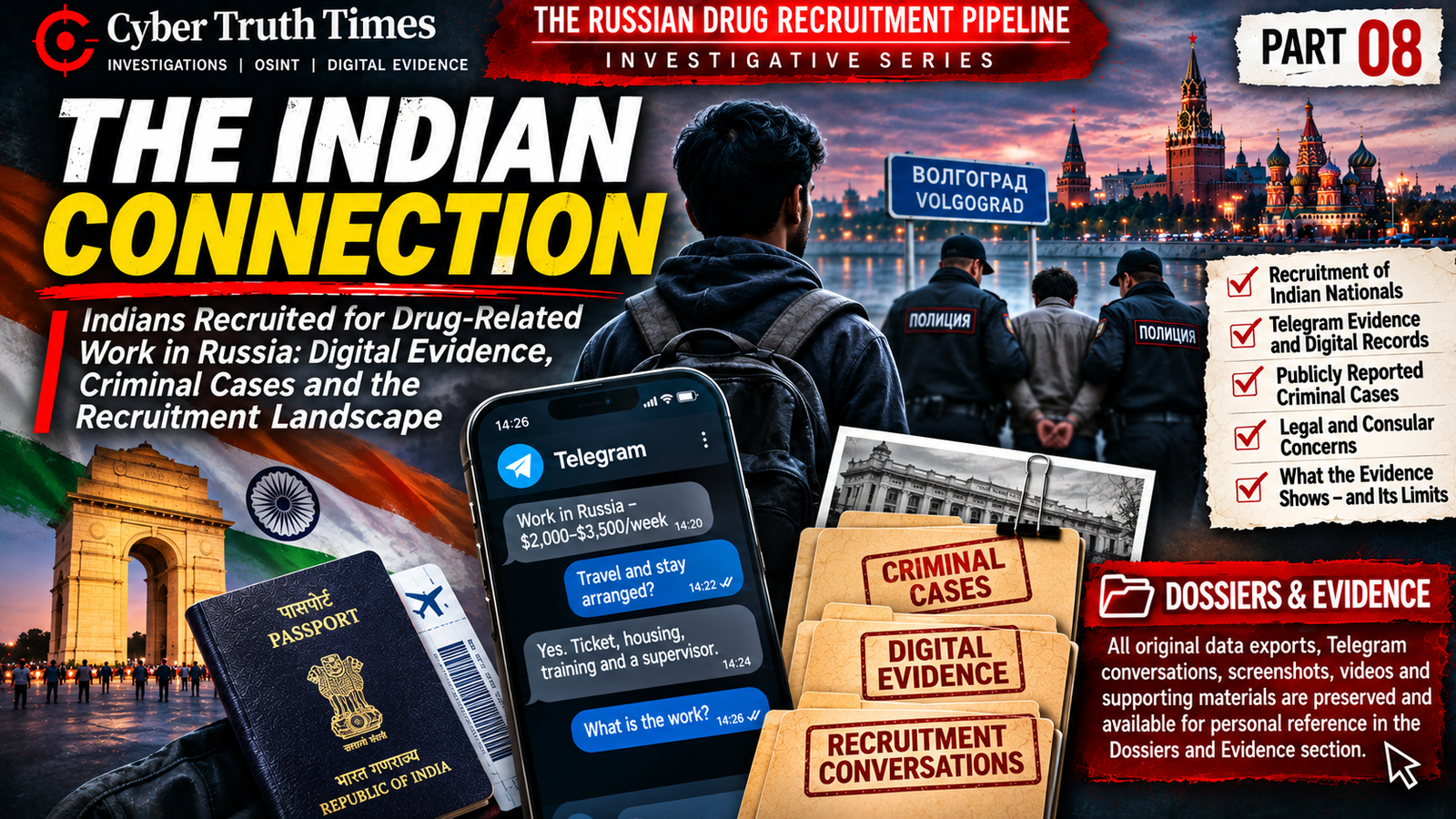
Cyber Truth Times investigates how Indians are recruited for drug-related work in Russia, examining digital evidence, public cases and legal concerns.
Introduction: When an Overseas Job Offer Raises Questions
For many Indians seeking employment abroad, Russia can appear to offer a pathway to financial stability, international experience and a fresh start. Recruitment advertisements circulating online, particularly through messaging platforms and social media, may promise unusually high earnings, minimal working hours, accommodation, travel arrangements and assistance with documentation.
But some recruitment offers investigated by Cyber Truth Times appear to follow a very different trajectory. Conversations examined during this investigation show purported recruiters initially presenting work opportunities in Russia before disclosing that the proposed tasks involve distributing or concealing narcotics.
The Indian connection is particularly significant because publicly reported cases involving Indian nationals travelling to Russia for employment have raised concerns about deceptive recruitment, detention, alleged drug-related offences and, in separate cases, alleged pressure to join the Russian military.
These developments do not establish that every recruitment account investigated by Cyber Truth Times is connected to arrests, military recruitment or a coordinated trafficking organisation. Those connections remain investigative questions that require corroboration.
This article examines the India-specific dimension of the investigation: recruitment communications directed at Indian job seekers, publicly documented cases involving Indian nationals in Russia, the legal and consular concerns arising from these cases, and the evidence required to establish whether the recruitment offers documented by Cyber Truth Times intersect with the experiences reported by affected individuals.
1. The recruitment proposition: employment before disclosure
The Telegram communications examined by Cyber Truth Times contain a recurring recruitment proposition.
Recruiters initiate or respond to contact using language associated with ordinary overseas employment. The conversations may emphasise:
- Attractive salaries or weekly payment structures.
- Limited daily working hours.
- Flexible working schedules.
- Travel arrangements to Russia.
- Accommodation and necessities.
- Training or onboarding through Telegram.
- Assistance with visas or documentation.
- Communication with a supervisor or purported curator.
In one set of communications examined during this investigation, the recruiter initially described employment in Russia without requiring knowledge of the Russian language. The conversation subsequently progressed to a proposal involving the distribution of small medicine packets, photographing locations and providing descriptions.
The recruiter eventually explicitly identified the proposed product as a narcotic substance.
This transition is important from an investigative perspective. The initial employment proposition and the eventual disclosure of criminal activity form separate stages of the communication record. Analysing them together may help establish whether the recruiter used an employment-oriented framing before disclosing the actual nature of the work.
The investigation has preserved Telegram exports and screenshots documenting the conversations examined. These materials are important because the recruitment proposition should be assessed through the full communication sequence rather than through isolated messages.
The India-specific question is whether such offers are being deliberately directed at Indian nationals, whether the accounts involved are connected to other recruitment operations, and whether the experiences described by people detained in Russia provide independently corroborated context.
At this stage, similarity in wording alone does not establish a common recruiter or criminal organisation.
2. Telegram as a recruitment communication channel
Telegram has emerged as a recurring platform within the recruitment communications examined by Cyber Truth Times.
The platform’s messaging environment allows accounts to communicate with prospective recruits, exchange photographs, share videos, discuss remuneration, provide instructions and potentially move conversations into additional groups.
The evidence collected during this investigation includes recruitment conversations in which prospective workers are encouraged to continue through messaging-based onboarding. In some instances, recruiters describe subsequent communication with supervisors or curators who supposedly provide training and operational instructions.
The investigative significance lies not simply in the use of Telegram but in the communication sequence.
The sequence may contain evidence of:
- The initial employment advertisement.
- The recruiter’s account and contact information.
- The progression from employment discussions to criminal-task disclosure.
- The proposed remuneration.
- Travel and accommodation assurances.
- The instructions concerning onboarding.
- Media sent by the recruiter.
- References to other accounts or intermediaries.
Such evidence can help establish what was communicated to an individual before any travel or activity occurred.
However, Telegram communications alone cannot establish the identity of the person controlling an account, the physical location of that person, or the existence of a wider criminal organisation.
Those questions require additional corroboration, potentially including independently verified identities, records obtained through lawful processes, witness testimony, financial evidence or other documentary material.
The India-specific investigation therefore treats Telegram as an evidence source rather than a definitive attribution tool.
3. The Indian cases raising wider questions about overseas recruitment
The recruitment investigation is unfolding against a wider backdrop of publicly reported cases involving Indian nationals in Russia.
These cases are not necessarily connected to the drug-courier recruitment accounts documented by Cyber Truth Times. Nevertheless, they illustrate why overseas recruitment claims, travel arrangements and the circumstances of detention deserve scrutiny.
Case 1: The Bilaspur recruitment and detention allegation
In October 2026, Indian media reported allegations involving Vinit Kumar Dubey, a 21-year-old from Bilaspur district in Chhattisgarh.
According to reports published by Indian media, Dubey travelled to Russia after receiving a job offer through a Telegram group. His family subsequently alleged that he had been detained and tortured in an effort to compel him to join the Russian military.
The allegations were reported by India Today on October 27, 2026, and subsequently by other outlets.
The family’s account, as reported, raised concerns about the circumstances of the recruitment, the loss of contact and the alleged coercion following detention.
These claims remain allegations attributed to the family and should not be treated as independently established findings in every detail.
Nevertheless, the reported use of Telegram in the recruitment process is an important contextual element when examining broader online employment recruitment targeting Indians.
Source: India Today — Chhattisgarh man detained, tortured in Russia to join war, family seeks help
Case 2: Tikeshwar Sahu and the Volgograd detention allegations
In November 2026, media reports described the case of Tikeshwar Sahu, a 38-year-old man from Raipur, Chhattisgarh, who travelled to Russia after receiving a job offer.
According to reporting by PTI and Indian media, Sahu’s family alleged that he had been detained in Volgograd in connection with a narcotics-related case and was subsequently pressured to join the Russian Army.
His family reportedly stated that he had travelled after receiving assurances concerning employment and travel arrangements. The family sought assistance from Indian authorities to facilitate his safe return.
The reports also described the family’s concerns about his legal situation and the assistance they were seeking.
These allegations require careful attribution. The family’s account does not independently establish that the drug-related case was fabricated, nor does it prove that the recruitment offer was connected to an organised drug-trafficking network.
However, the reported circumstances raise questions about the vulnerability of foreign job seekers who travel after receiving informal or inadequately verified employment offers.
Sources: India Today — Indian man detained in Russia, pressured to join Russian Army, family alleges; The Indian Express — Raipur man went to Russia for job and landed in jail
Case 3: The wider pattern of overseas recruitment concerns
Other reporting concerning Indian nationals travelling to Russia has focused on allegations of deceptive recruitment and subsequent military enlistment.
In May 2024, the Central Bureau of Investigation announced arrests in a case involving alleged trafficking of Indian nationals for combat roles in the Russian Army.
According to the CBI’s reported findings, a network allegedly lured Indian nationals through social media platforms and local agents with promises of lucrative employment abroad. The agency stated that the individuals were subsequently trained for combat roles and deployed in the Russia-Ukraine war zone against their wishes.
This case is distinct from the drug-courier recruitment investigation presented in this series.
It is nevertheless an important contextual example of why recruitment advertisements, intermediary relationships, employment assurances and the actual work performed after arrival require independent verification.
4. What these cases establish and what they do not
The publicly reported cases discussed above raise concerns about overseas employment recruitment involving Indian nationals.
They establish that:
- Indian nationals have been publicly reported as travelling to Russia after receiving employment-related offers.
- Families in certain cases have alleged deceptive recruitment or circumstances they considered suspicious.
- Some families have alleged detention in connection with narcotics-related cases.
- In separate cases, families have alleged pressure to join the Russian military.
- Indian authorities have reportedly been approached for assistance in some of these cases.
- India has previously investigated alleged trafficking networks recruiting Indians for combat-related roles in Russia.
However, they do not establish that:
- Every Indian arrested in a drug-related case in Russia was recruited through a deceptive employment advertisement.
- Recruiters investigated by Cyber Truth Times were involved in the arrests discussed in media reports.
- Drug-related arrests are routinely orchestrated to facilitate military enlistment.
- A common organisation controls all the Telegram accounts examined in this investigation.
- The recruitment communications, publicised criminal cases and alleged military coercion constitute a single coordinated pipeline.
These distinctions are fundamental to responsible investigative reporting.
The investigation must examine the possibility of connections without treating the existence of similar cases as proof of a unified operation.
5. The Volgograd cases and the investigative significance of location
The Volgograd region has appeared in multiple elements of the wider research conducted by Cyber Truth Times.
Publicly reported cases involving Indian nationals and alleged drug-related offences in the region provide an additional context for examining recruitment offers that appear to direct prospective workers toward Russia.
In the earlier research undertaken for this investigative series, Cyber Truth Times examined Russian-language reports concerning Indian nationals accused of drug-related offences in Volgograd.
The reports describe arrests, alleged possession or distribution activity and criminal proceedings. These reports should be analysed individually, with careful attention to the charges, the procedural status of the cases, the evidence described by authorities and whether the individuals have been convicted.
Geographic overlap is not proof of a relationship between recruitment accounts and criminal cases.
But geography can be an investigative lead.
When a recruitment conversation proposes work in Russia, and a separate publicly documented case involves an Indian national in a particular region, researchers may examine whether there are demonstrable connections.
Such examination must rely on evidence rather than assumptions.
Relevant questions include whether the recruiter specifically identifies a destination, whether travel arrangements are documented, whether the recruit’s communications establish a timeline, and whether independently verified evidence links the recruiter to the eventual events.
The purpose is to establish facts, not to manufacture a connection.
6. The evidence collected by Cyber Truth Times
The India-specific investigation is supported by a documentary collection containing Telegram communications, screenshots, recruitment material, videos and other digital records gathered during the broader research.
The evidence is examined using a documentary and digital-investigation approach.
Telegram exports
Telegram exports provide a record of the messages included in the exported conversation.
They may help establish:
- The sequence of communications.
- Recruitment language.
- Payment claims.
- The disclosure of drug-related work.
- References to supervisors or curators.
- The communication of travel or accommodation assurances.
Exports must be interpreted within their limitations. An export may not capture every message, deleted content, external communications or all relevant information about the account.
Screenshots
Screenshots can preserve visible message content and contextual information.
However, screenshots may not independently establish authenticity, completeness or account ownership. They are therefore assessed alongside other available records.
Videos and promotional media
Videos and promotional material supplied by recruiters may help document the nature of the recruitment proposition.
Their evidentiary value depends on provenance, context and verification.
Public reporting and criminal cases
Publicly available reporting provides context for the recruitment investigation.
The investigation distinguishes media reporting, official statements, family allegations, criminal accusations and judicial findings. These categories are not interchangeable.
Preservation and documentation
The collected data exports and supporting materials are preserved in the Dossiers and Evidence section of Cyber Truth Times.
This archive allows readers to personally reference the documentary materials associated with the investigation, subject to appropriate redactions and editorial considerations.
The preservation of the underlying material is intended to improve transparency, enable independent scrutiny and provide a documentary basis for future reporting.
7. The legal and consular dimension
Indian nationals facing criminal proceedings abroad may encounter unfamiliar legal systems, language barriers, limited access to information and difficulties communicating with family members.
When allegations involve narcotics, the consequences can be particularly severe. Criminal liability, detention, access to legal representation and procedural rights depend on the applicable law and the facts of each case.
Families seeking assistance may approach Indian diplomatic missions and relevant authorities.
The reported cases discussed in this article demonstrate the importance of timely communication, access to legal assistance and consular engagement when Indian nationals abroad face detention or circumstances raising concerns about their safety.
This article does not attempt to determine the legal merits of any individual criminal case.
Instead, it examines the recruitment context and the documentary evidence relevant to understanding how individuals may arrive in circumstances substantially different from those described in the initial employment proposition.
8. The central investigative questions concerning Indian recruits
The India-specific component of the investigation raises several questions that remain open to examination.
Who is advertising these jobs to Indian nationals?
The investigation seeks to establish the identity, role and relationship of recruitment accounts where evidence permits.
Are recruitment propositions being reused?
Repeated wording, promotional material, salary claims and onboarding language may indicate shared templates or copied advertising. Such similarities do not necessarily prove common control.
What is disclosed before travel?
The chronology of communication is crucial. Investigators must distinguish the information initially provided from information disclosed later.
Are the destinations and employment arrangements verifiable?
Travel assurances, accommodation claims and purported employers should be assessed independently where possible.
Do the recruitment accounts connect to publicly documented criminal cases?
Any such connection requires direct evidence or reliable corroboration. Similar locations, names or recruitment language alone are insufficient.
What happens to recruits after arrival?
The investigation must rely on verified accounts, documented communications, public records and corroborated testimony rather than speculation.
9. Why the Indian connection deserves further investigation
India’s overseas employment market includes legitimate recruitment agencies, employers and international employment opportunities.
The existence of deceptive recruitment offers should not be used to cast suspicion on legitimate employment or migration.
Nevertheless, recruitment offers involving unusually high remuneration, vague job descriptions, informal onboarding, unclear employers and assurances that travel or accommodation will be arranged deserve scrutiny.
The communications examined by Cyber Truth Times demonstrate that some recruiters contacted during this investigation moved from an employment-oriented proposition to explicitly drug-related tasks.
Public reporting concerning Indian nationals in Russia separately documents cases in which families have raised concerns about recruitment, detention and alleged coercion.
These strands of evidence create an important investigative question: whether the recruitment accounts documented by Cyber Truth Times operate independently, share infrastructure, copy one another or are connected to wider criminal recruitment networks.
The answer cannot be assumed.
It must be established through corroboration, digital evidence, testimony and careful documentary analysis.
10. The Dossiers and Evidence archive
The documentary records collected during this investigation are preserved in the Dossiers and Evidence section of Cyber Truth Times.
Readers can refer to the underlying material associated with the broader investigation, including Telegram data exports, screenshots, recruitment communications, videos and supporting documentation, subject to redactions and editorial considerations.
The archive is intended to provide transparency regarding the materials examined and to facilitate personal reference to the evidence supporting the investigation.
The records are not presented as independently proving every allegation discussed in this article. Their significance depends on context, corroboration and further verification.
Conclusion: A recruitment landscape that demands verification
The Indian connection to the Russian drug-recruitment investigation is not a conclusion in itself. It is an investigative dimension that requires careful examination.
The Telegram conversations analysed by Cyber Truth Times document recruitment propositions that progress from employment-oriented language to drug-related tasks.
Separately, publicly reported cases involving Indian nationals in Russia have raised concerns about employment recruitment, detention, alleged drug-related offences and, in other circumstances, alleged pressure to join the Russian military.
These developments should not be conflated into a single proven network.
But they justify further investigation into the people behind recruitment advertisements, the communication infrastructure they use, the promises made to prospective workers and the circumstances experienced by recruits after travel.
The objective of this investigation is to establish what can be demonstrated through documentary evidence, corroborated testimony and independently verifiable records.
The central question remains: what happens when an overseas employment offer conceals a criminal proposition, and what evidence can establish who is responsible?
Cyber Truth Times will continue examining that question through the remaining instalments of The Russian Drug Recruitment Pipeline.
11. The investigative methodology and limits of attribution
The India-specific component of this investigation is based on a comparison of recruitment communications, digital material and publicly available reporting. The methodology is designed to identify patterns without overstating what those patterns establish.
The investigation examines the language used in advertisements and messages, the sequence in which employment details and drug-related tasks are disclosed, the remuneration claims made by recruiters, and the assurances concerning travel, accommodation and onboarding.
Where recruitment messages are similar, the comparison is treated as a lead for further investigation rather than proof of common authorship. Establishing that two accounts are operated by the same person or organisation requires stronger evidence, such as verified account links, corroborated communications, independently established relationships or other reliable records.
Publicly reported cases involving Indian nationals in Russia are examined separately. The article does not infer a relationship between a reported arrest and a recruitment account merely because the location, nationality or circumstances appear similar.
The investigation also recognises the limitations of digital evidence. Telegram exports may omit deleted messages or other communications. Screenshots may not establish the identity of the account holder. Videos may lack reliable provenance. Media reporting may rely on family testimony, official statements or other sources that have not been independently verified by Cyber Truth Times.
These limitations are reflected in the reporting.
The purpose of the investigation is to document the recruitment proposition, preserve supporting records, identify questions that warrant further examination and distinguish evidence from inference.
12. What the investigation seeks to establish
The Indian component of The Russian Drug Recruitment Pipeline is intended to contribute to a wider examination of online recruitment for drug-related work in Russia.
The investigation seeks to establish, where evidence permits:
- The recruitment language used to approach Indian nationals.
- The progression from purported employment to explicit drug-related tasks.
- The recurring remuneration and logistical assurances.
- The communication infrastructure used by recruiters.
- The relationships, if any, between recruitment accounts.
- The extent to which recruitment material is reused or copied.
- Whether independently corroborated evidence connects specific recruiters to criminal cases.
- The risks communicated to prospective recruits, and when those risks are disclosed.
The investigation does not seek to establish guilt through resemblance, nationality, geography or association. It seeks to document what the available evidence supports.
Bibliography
- India Today — Chhattisgarh man detained, tortured in Russia to join war, family seeks help — Reporting on allegations concerning Vinit Kumar Dubey’s detention and alleged pressure to join the Russian military.
- India Today — Indian man detained in Russia, pressured to join Russian Army, family alleges — Reporting on Tikeshwar Sahu’s detention and allegations raised by his family.
- The Indian Express — Raipur man went to Russia for job and landed in jail — Report concerning the recruitment, detention and family allegations surrounding Tikeshwar Sahu.
- Akashvani — CBI arrests four accused in case related to trafficking of Indian nationals for combat roles in Russian Army — Reporting on a CBI investigation into alleged recruitment and trafficking of Indian nationals for combat roles.
- RFE/RL — Promises Of High-Paid Work Lure Kyrgyz Into Russian Drug Trade — Investigative reporting on recruitment advertisements promising high earnings for work in Russia and the disclosure of drug-related work following contact with recruiters. Used as broader regional context, not as proof of Indian recruitment.
Bibliography note: These sources provide contextual reporting. The Telegram conversations and documentary materials collected by Cyber Truth Times constitute the primary evidence examined in the specific recruitment investigation. The publicly reported cases above are not presumed to be connected to the recruitment accounts unless that connection is independently demonstrated.
Editorial note
This article forms Article 08 of The Russian Drug Recruitment Pipeline, an investigative series by Cyber Truth Times.
The investigation examines online recruitment communications, digital evidence, publicly available reporting and allegations concerning recruitment for drug-related work in Russia.
The article distinguishes evidence directly examined by Cyber Truth Times from claims reported by third parties. Allegations involving families, detainees, recruiters or other individuals are attributed where appropriate. The investigation does not presume that the publicly reported cases discussed are connected to the recruitment accounts examined.
The article may be updated if additional credible evidence, documentation or corroboration becomes available.
Disclaimer
This article is published for journalistic, investigative and informational purposes. It is not legal advice and does not constitute an allegation of criminal responsibility against any individual unless specifically supported and appropriately attributed.
The existence of similar recruitment advertisements, publicised criminal cases, or overlapping locations does not establish a common criminal network or causation. Allegations and criminal accusations should not be treated as findings of guilt unless established through the relevant legal process.
For deeper investigations on such topics, see our Cybercrime Investigations & Exposes.