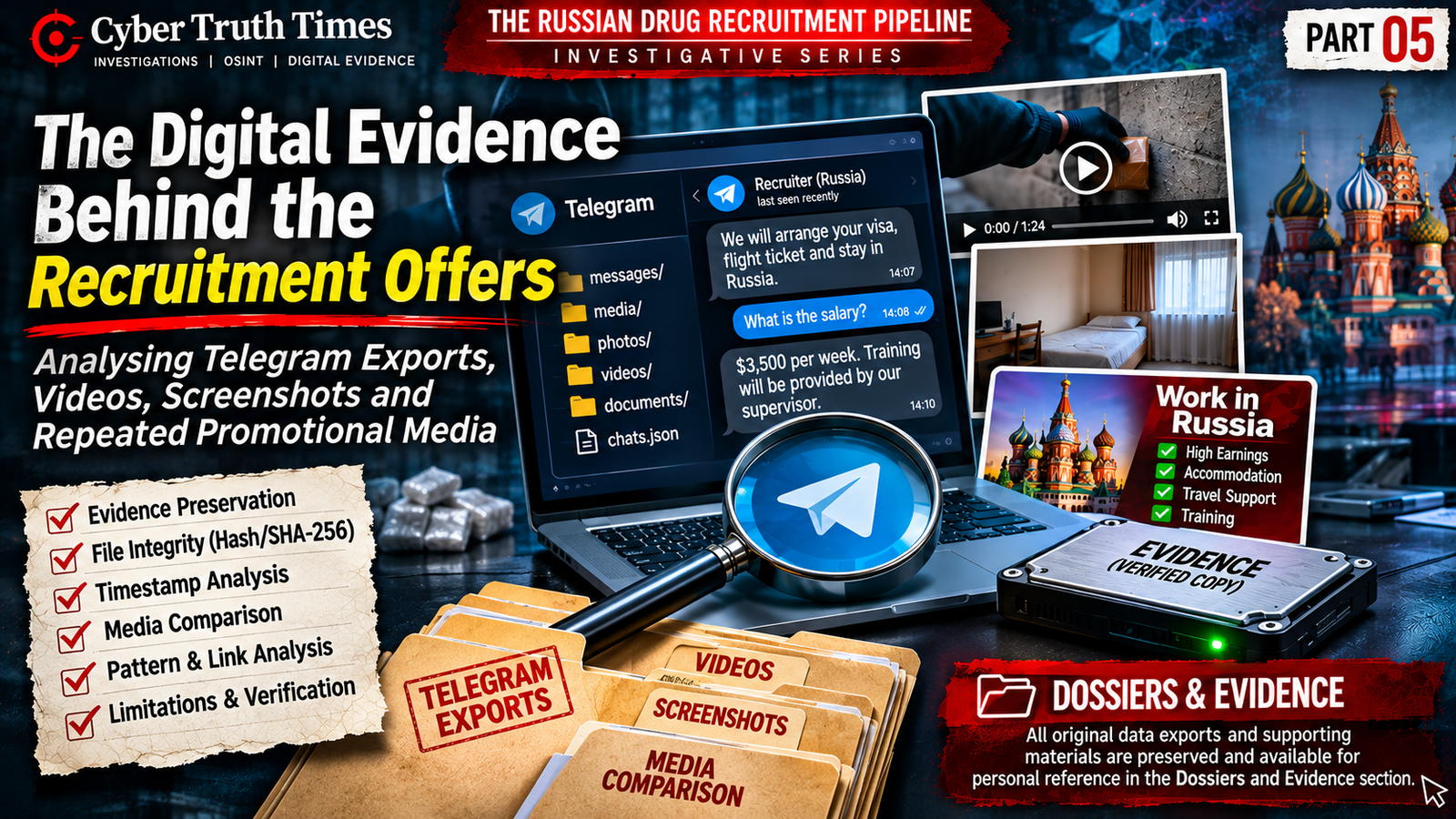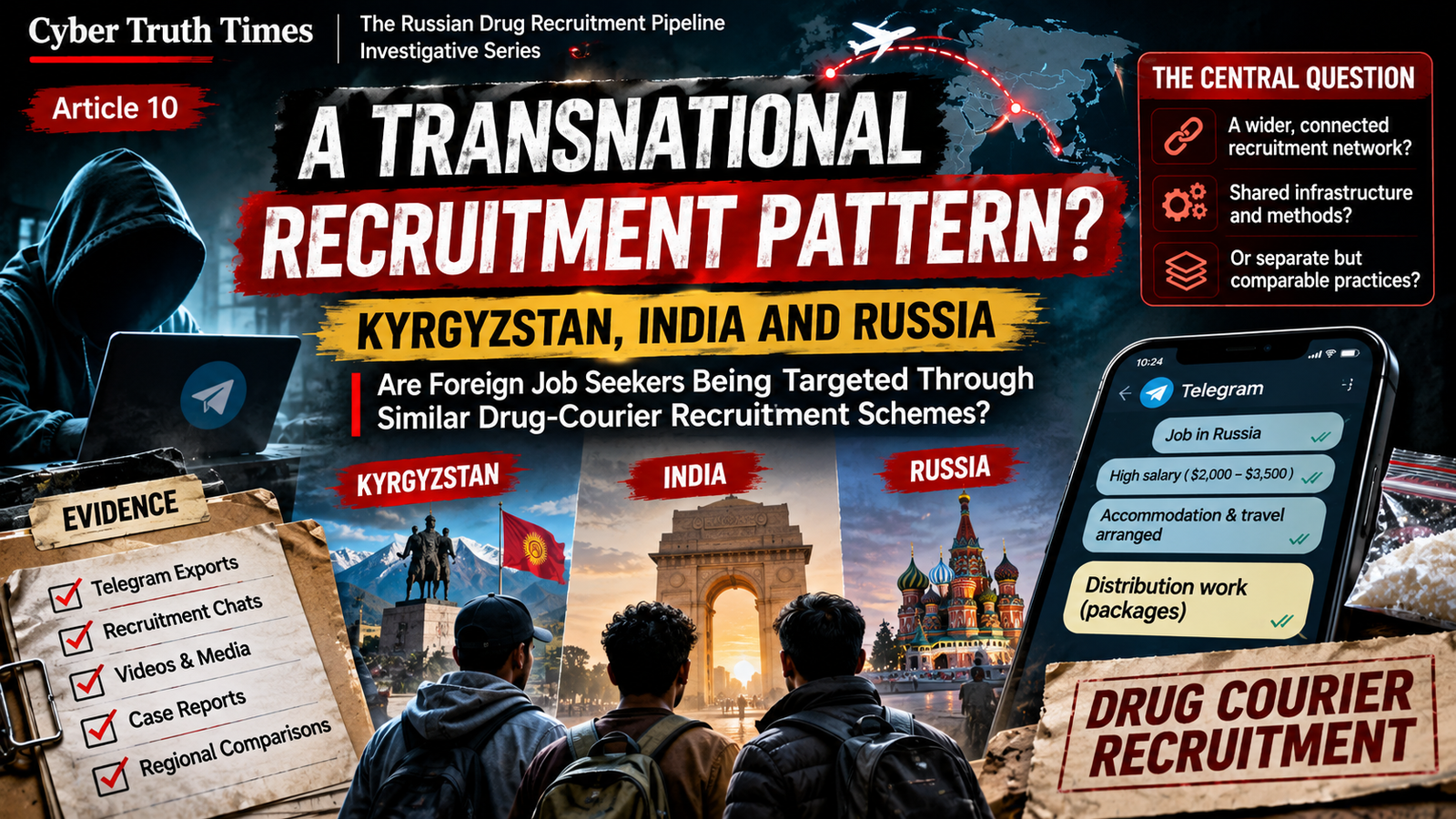
Cyber Truth Times investigates a transnational drug recruitment pattern documented in India, with reporting from Kyrgyzstan, examining whether similar schemes targeting foreign job seekers in Russia are connected.
Introduction: Transnational Drug Recruitment Pattern
Across online messaging platforms, social media advertisements and informal recruitment channels, prospective workers are frequently presented with employment opportunities that promise unusually high salaries, limited working hours and assistance with travel or accommodation. Such offers can be especially attractive to people seeking employment abroad, often without the language skills, local contacts or financial resources needed to independently navigate foreign labour markets.
Cyber Truth Times’ investigation into Telegram recruitment accounts offering purported employment in Russia has uncovered a recurring pattern in the communications examined: conventional employment language, attractive remuneration claims, assurances of logistical assistance and, in some conversations, a subsequent disclosure that the work involves distributing illegal drugs.
The investigation raises a broader question. Are these recruitment offers isolated operations targeting particular individuals, or do they reflect a wider transnational recruitment pattern affecting foreign job seekers?
Publicly available reporting from Kyrgyzstan offers an important point of comparison. In June 2025, Radio Free Europe/Radio Liberty (RFE/RL) reported on advertisements in Bishkek offering lucrative employment in Russia. Journalists contacted an account associated with one advertisement and received confirmation that the work involved transporting illegal drugs. The offers reportedly promised high earnings, short working hours and assistance with travel and accommodation.
Cyber Truth Times has separately documented Telegram communications directed at prospective Indian workers that exhibit similarities in their recruitment language and inducements.
The similarities are investigative leads. They are not, by themselves, proof that the advertisements share an operator, infrastructure, criminal organisation or recruitment chain.
This final instalment of The Russian Drug Recruitment Pipeline brings these strands together to assess what the available evidence establishes, what it suggests and what remains unresolved.
1. The recruitment proposition: A recurring set of inducements
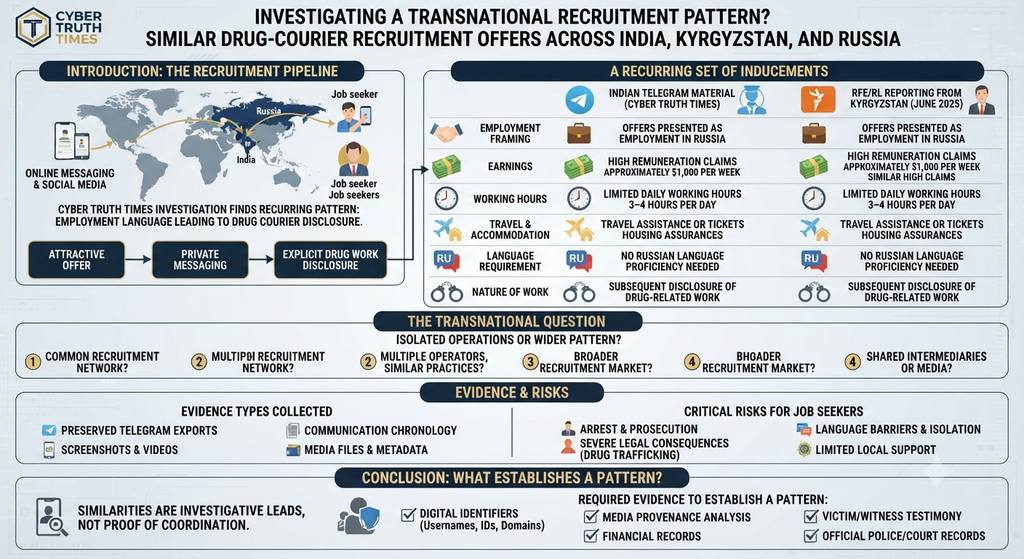
The recruitment communications examined by Cyber Truth Times contain several recurring elements.
These include:
- Offers of employment in Russia.
- High advertised earnings.
- Limited daily working hours.
- Claims that applicants do not need Russian-language proficiency.
- Promises of travel arrangements.
- Assurances of accommodation and basic living necessities.
- References to training, supervisors or coordinators.
- Communication through Telegram.
- A subsequent disclosure that the proposed work involves drug distribution or the concealment and placement of drug packages.
The individual elements are not inherently suspicious in isolation. Overseas employers can legitimately offer accommodation, transport, training and compensation.
The concern emerges from the combination of these elements with the actual nature of the work disclosed during recruitment.
In the communications examined for this investigation, prospective applicants are initially approached through the language of employment. The proposition is presented as an opportunity rather than as participation in a criminal enterprise.
The recruitment process then develops through private messaging, where additional information is disclosed.
This progression matters because the initial advertisement or introductory message may not accurately describe the activity the applicant is ultimately expected to undertake.
A comparison of recruitment language
| Recruitment feature | Indian Telegram material examined by Cyber Truth Times | RFE/RL reporting from Kyrgyzstan |
|---|---|---|
| Employment framing | Offers presented as employment in Russia | Advertisements presented as jobs in Russia |
| Earnings | High remuneration claims | Reported offers of approximately $1,000 per week |
| Working hours | Claims of limited daily working hours | Reported 3–4 hours per day |
| Travel | Travel assistance or ticket arrangements discussed | Travel expenses reportedly offered |
| Accommodation | Accommodation assurances | Housing reportedly offered |
| Communication | Telegram conversations | Telegram account associated with advertisement |
| Nature of work | Drug-related work disclosed in conversations examined | RFE/RL contacted an advertiser who confirmed drug transport |
| Evidence type | Preserved Telegram exports, screenshots and video material | Published journalistic investigation |
The comparison is based on the investigative material examined and published reporting. It does not establish common ownership or coordination.
The similarities are significant enough to justify further investigation. However, the evidentiary question is whether these features are sufficiently distinctive and connected to demonstrate more than a shared recruitment approach.
2. Kyrgyzstan: A publicly documented point of comparison
The RFE/RL investigation published in June 2025 provides one of the clearest publicly reported examples of employment-oriented recruitment advertising leading to an explicit drug-courier proposition.
The report describes advertisements appearing in Bishkek that offered employment in Russia. The advertised conditions reportedly included substantial earnings, limited working hours and assistance with travel and accommodation.
RFE/RL contacted the Telegram account associated with the advertisements. The response confirmed that the work involved transporting illegal drugs. RadioFreeEurope/RadioLiberty+1
The reporting also discusses the wider vulnerability of foreign nationals involved in drug-related activity in Russia and the severe legal consequences associated with drug trafficking.
The article is particularly relevant because it documents the transition between a conventional employment proposition and an explicitly criminal activity.
That transition resembles a key feature of the communications examined by Cyber Truth Times.
Why this comparison matters
The Kyrgyzstan reporting provides an independently documented example of a recruitment proposition in which:
- The offer is initially framed as employment.
- Attractive financial incentives are advertised.
- Relocation to Russia is presented as part of the opportunity.
- The recruiter communicates through a messaging platform.
- The actual work is disclosed as drug transportation.
The comparison strengthens the rationale for examining similar communications directed at Indian applicants.
It does not establish that the same recruiters are involved, that the same criminal organisation operates in both countries or that the recruitment systems are coordinated.
Those questions require additional evidence.
3. India: Recruitment communications and the emerging documentary record
Cyber Truth Times’ investigation has focused on recruitment accounts and Telegram conversations in which applicants are offered employment in Russia.
The material examined includes recruitment messages, screenshots, videos, Telegram exports and communications concerning travel, accommodation, remuneration and onboarding.
In several conversations examined during the investigation, the recruitment proposition follows a similar progression.
The initial approach
The applicant expresses interest in employment in Russia.
The recruiter responds with an employment proposition, sometimes emphasising that knowledge of the Russian language is unnecessary.
The financial inducement
The recruiter presents earnings that appear disproportionately high relative to the stated workload.
The messages may describe short working hours, flexible schedules or payments based on the number of tasks completed.
The logistical assurances
Travel, accommodation, clothing, food, visa arrangements or assistance upon arrival may be discussed.
These assurances create the impression of a structured employment opportunity.
The disclosure
In the Telegram conversations documented by Cyber Truth Times, the work is subsequently described as involving drug-related activity.
The applicant may be asked to undertake tasks involving the placement or distribution of packages.
The investigation has also examined video material shared during these conversations and promotional content describing methods associated with the concealment or placement of packages.
These communications are preserved as part of the documentary record.
The significance of the Indian material
The investigative value of the Indian Telegram material lies in the sequence of communication rather than any single message.
A message promising employment, considered alone, may be ambiguous.
A subsequent message identifying drug-related work changes the context of the earlier recruitment proposition.
The sequence allows investigators to examine whether the employment framing was misleading, whether the recruiter disclosed the nature of the activity before the applicant committed to travel and whether the recruitment process was designed to attract people who would otherwise not knowingly participate in drug trafficking.
The evidence should be evaluated conversation by conversation.
The investigation should not assume that every recruitment account, advertisement or person involved belongs to the same organisation.
4. The recurring digital recruitment environment
Telegram is one of the communication platforms appearing in the material examined by Cyber Truth Times.
The platform’s use is not inherently evidence of criminal activity. Telegram is widely used for ordinary communication, business, community engagement and journalism.
Its relevance in this investigation arises from the specific communications preserved in the dataset.
The recruitment conversations examined include messages describing employment, compensation, travel arrangements, accommodation, training and drug-related work.
The investigation also examines similarities between recruitment messages originating from different accounts.
What the digital evidence can establish
Depending on the integrity and completeness of the available records, Telegram exports and associated media may help establish:
- What a particular account communicated.
- The chronology of messages.
- Whether employment was initially presented in a particular way.
- Whether drug-related work was subsequently disclosed.
- Whether specific remuneration claims were made.
- Whether the recruiter discussed travel or accommodation.
- Whether media files were shared as part of the recruitment process.
- Whether similar wording appears across different conversations.
- Whether particular accounts share identifiable usernames, contact details or other attributes.
What it cannot establish automatically
Similar messages do not prove that the accounts are operated by the same person.
Shared wording does not automatically establish common ownership.
Similar videos do not establish a common source unless their provenance and technical characteristics are examined.
A screenshot alone may not establish the complete chronology of a conversation.
These limitations are particularly important when attempting to map a transnational recruitment network.
5. Similarities, standardisation and the problem of attribution
The similarities identified across the Indian material and the publicly reported Kyrgyzstan case raise several possible explanations.
Hypothesis A: A common recruitment network
The advertisements and communications may originate from a common organisation, connected intermediaries or a shared recruitment infrastructure.
If this hypothesis is correct, investigators would need to identify connections such as shared account identifiers, domains, payment channels, contact details, media files, operational records or other evidence demonstrating a relationship.
Hypothesis B: Multiple operators using similar practices
Different criminal groups may independently employ comparable recruitment strategies.
High earnings, limited working hours, travel assistance and accommodation are persuasive inducements for prospective overseas workers. These features may therefore be adopted by unrelated recruiters.
The existence of similar recruitment language may reflect a shared method rather than common ownership.
Hypothesis C: A broader recruitment market
The advertisements may reflect a wider market in which criminal recruiters use standardised employment propositions.
In this scenario, similar recruitment practices could emerge across different countries, cities and messaging platforms without a single centralised organisation.
Hypothesis D: Shared intermediaries or media
Recruitment accounts may share promotional materials, templates, videos or intermediaries while remaining separate operations.
A shared image, video or phrase could potentially provide a lead for further investigation. But it would not establish the structure of the network without additional corroboration.
The investigation must therefore distinguish between a similarity of method, a connection between actors and a demonstrated organisational relationship.
These are different evidentiary thresholds.
6. What would establish a transnational recruitment pattern?
The question of whether recruitment schemes targeting Indian and Kyrgyz job seekers are connected requires a more rigorous evidentiary approach.
The following categories of evidence would be particularly relevant.
Digital identifiers
Investigators could examine account usernames, Telegram IDs where available, phone numbers, domains, email addresses, website infrastructure and other identifiers.
A verified overlap between accounts operating in different countries would be more probative than a similarity in wording alone.
Media provenance
Videos, photographs and promotional materials could be compared through file hashes, perceptual hashes, metadata where available, visual features, compression patterns and contextual analysis.
Identical or demonstrably derived media may reveal relationships between recruitment accounts.
However, media reuse alone does not necessarily establish common ownership.
Recruitment chronology
The timing of advertisements, account creation, recruitment messages, media sharing and subsequent activity may provide context.
A chronology could reveal whether different accounts operate simultaneously, whether promotional material circulates between them or whether recruitment activity appears to change over time.
Financial records
Payment channels, transaction records, financial intermediaries or documented payment instructions may help establish relationships.
These records would require lawful acquisition and careful verification.
Victim and witness testimony
Statements from applicants, former couriers, families, legal representatives or other witnesses may provide additional context.
Such testimony should be corroborated where possible.
Official records
Police records, court documents, embassy communications, immigration records and official statements may help establish the circumstances of individual cases.
The strongest conclusions would emerge from combining independent evidence rather than relying on one source.
7. The risks facing foreign job seekers
The recruitment material examined by Cyber Truth Times illustrates the risks associated with employment offers that conceal or inadequately disclose criminal activity.
Drug trafficking can expose couriers to arrest, prosecution, imprisonment and other serious consequences.
Foreign nationals may also face additional practical difficulties, including language barriers, unfamiliar legal systems, limited financial resources and restricted access to local support networks.
The RFE/RL reporting from Kyrgyzstan discusses the serious legal consequences of drug trafficking in Russia and the vulnerability of foreign nationals involved in these activities. RadioFreeEurope/RadioLiberty
The broader issue is not limited to one nationality.
The investigation examines recruitment communications directed at Indian applicants while comparing them with publicly documented reporting involving Kyrgyz nationals.
The comparison should not be used to imply that the risks are identical for all foreign nationals or that every applicant recruited through online platforms is vulnerable to the same circumstances.
Rather, it highlights the importance of independently verifying employment opportunities before accepting offers involving international travel, unusually high remuneration or activities that are not clearly described.
8. Preserving the documentary record
Cyber Truth Times has preserved the Telegram exports, screenshots, videos and other documentary material collected during this investigation.
The evidence forms part of the wider Russian Drug Recruitment Pipeline investigative project.
The material is retained for reference, comparison and further analysis.
The investigation’s Dossiers and Evidence section provides readers with access to supporting documentary material where publication is appropriate, subject to editorial considerations, privacy, security and the protection of individuals who may be vulnerable.
The preservation of evidence is important because investigative conclusions may change as additional material becomes available.
A preserved export may allow the chronology of a conversation to be revisited.
A video may be examined again as additional contextual information emerges.
A screenshot may be compared against a subsequently identified account or source.
A media file may be analysed for technical characteristics that were not initially apparent.
The investigation therefore treats the documentary record as an ongoing evidentiary resource rather than as a collection of illustrations supporting a predetermined conclusion.
9. The unresolved question: A network, a method or a market?
The evidence examined by Cyber Truth Times and the publicly documented reporting from Kyrgyzstan establish a basis for comparing recruitment practices.
Both bodies of material describe employment-oriented propositions involving Russia that, in the relevant documented circumstances, lead to drug-related work.
The similarities deserve attention.
But the question of whether the similarities establish a transnational network remains unresolved.
A transnational network would require evidence connecting the relevant actors, accounts, infrastructure or operations across borders.
A common method would require a different conclusion: separate operators may use similar recruitment practices.
A broader recruitment market would represent yet another possibility, in which criminal recruiters adopt comparable approaches without necessarily coordinating with one another.
The investigation does not treat these possibilities as interchangeable.
The next stage of investigative work would involve examining whether specific digital, financial, documentary or testimonial evidence connects the recruitment accounts examined by Cyber Truth Times with independently documented cases elsewhere.
Until such evidence is established, the transnational hypothesis remains a question to be tested.
10. Conclusion: The evidence points to questions that require further investigation
The comparison between recruitment communications examined by Cyber Truth Times and the RFE/RL reporting from Kyrgyzstan reveals similarities in the employment proposition, financial incentives, relocation assurances and the eventual disclosure of drug-related work.
Those similarities are an investigative starting point.
They warrant examination of the accounts involved, the promotional media they share, their communication patterns, their associated websites and any verifiable relationships between intermediaries.
But similarities alone cannot establish a coordinated criminal organisation.
The purpose of this investigation is not to manufacture certainty where evidence remains incomplete.
It is to document recruitment communications, compare them with independently reported cases, preserve the supporting material and identify the questions that remain unanswered.
The central question is whether these recruitment offers represent isolated criminal operations, a broader market employing similar methods or a connected transnational infrastructure.
That question remains open, and answering it requires evidence that demonstrates connections, not merely resemblance.
Bibliography
Primary comparative reporting
Radio Free Europe/Radio Liberty — Promises Of High-Paid Work Lure Kyrgyz Into Russian Drug Trade
Reporting on recruitment advertisements in Bishkek offering high earnings and employment in Russia, and the confirmation obtained by RFE/RL that the advertised work involved transporting illegal drugs. RadioFreeEurope/RadioLiberty
Radio Free Europe/Radio Liberty — How Kyrgyz Citizens Are Recruited As Drug Couriers In Russia
Video and reporting examining advertisements offering employment in Russia, the drug-courier disclosure and the wider recruitment context involving Kyrgyz nationals. RadioFreeEurope/RadioLiberty
Investigative and supporting materials
Cyber Truth Times — The Russian Drug Recruitment Pipeline
Pillar investigation
The overarching investigative project examining recruitment communications, promotional material, digital evidence and related questions involving foreign job seekers.
Cyber Truth Times — Dossiers and Evidence
Supporting Telegram exports, screenshots, videos and documentary material collected for the investigation, where publication is appropriate.
For deeper investigations on such topics, see our Cybercrime Investigations & Exposes.
Editorial note
This article is the tenth and final instalment of The Russian Drug Recruitment Pipeline, an investigative series published by Cyber Truth Times.
The investigation compares recruitment communications examined by Cyber Truth Times in India with publicly documented reporting from Kyrgyzstan concerning employment advertisements in Russia that reportedly led to drug-courier propositions.
The article examines similarities in recruitment language, financial inducements, travel and accommodation assurances, communication platforms and the disclosure of drug-related work.
The investigation does not assume that similar recruitment practices establish common ownership, coordination or a single criminal organisation.
The article distinguishes documentary evidence, publicly reported findings, inference and unresolved hypotheses. Conclusions may be revised as additional corroborating evidence or official records become available.
Disclaimer
This article is published for journalistic, investigative and informational purposes.
It does not establish criminal responsibility against any individual or organisation. Similarities between recruitment advertisements, communications, promotional materials or reported cases do not independently establish common ownership, coordination or a transnational criminal network.
The investigation’s comparative hypothesis remains subject to further verification. Publicly reported cases and investigative material are presented in their respective contexts and should not be interpreted as establishing a connection where no such connection has been independently demonstrated.