
An investigative series by Cyber Truth Times examining the digital recruitment pipeline, websites, digital infrastructure, recruitment intermediaries, financial incentives and international networks involved in attracting foreign nationals to Russian military service.
Introduction: A Military Recruitment Campaign in the Digital Age
Military recruitment has traditionally relied on state institutions, official recruitment offices and established military channels. But the internet has introduced another dimension: a distributed digital recruitment ecosystem capable of reaching potential recruits thousands of kilometres away from the country where they may eventually serve.
Across websites, social media advertisements, messaging applications and third-party recruitment intermediaries, foreign nationals can encounter offers that present Russian military service through the language of employment, financial opportunity, professional development and, in some cases, citizenship.
For an individual searching for overseas employment, these approaches can initially resemble ordinary recruitment campaigns. A website may advertise attractive salaries, accommodation, travel assistance, contractual benefits or opportunities to work in Russia. A prospective candidate may then be directed towards a WhatsApp number, Telegram account or intermediary who handles subsequent communication.
What happens after that initial contact is a much more complicated question.
Who operates these websites? Are the recruitment portals connected to one another? Who pays the intermediaries sourcing candidates? How are prospective recruits approached in different countries? What information are candidates given before travelling? And what happens when a foreign national eventually signs a military contract?
These are the questions at the centre of The Digital Recruitment Pipeline, a 12-part investigative series by Cyber Truth Times.
The investigation examines the digital and commercial infrastructure surrounding international recruitment for Russian military service, with particular attention to the role of online recruitment platforms, third-party intermediaries and cross-border candidate sourcing.
Why Investigate the Digital Recruitment Pipeline?
The international recruitment of foreign nationals for Russian military service has attracted growing scrutiny.
Investigative reporting and open-source research have identified multiple recruitment websites, advertising campaigns, messaging accounts and intermediary operations targeting foreign audiences.
Research published by European and African investigative organisations has documented a broader ecosystem involving multiple recruitment brands and digital assets. These findings raise important questions about how recruitment activity is organised, marketed and facilitated across national borders.
However, identifying several websites or recruitment campaigns does not automatically establish that they share the same ownership, management or command structure.
That distinction is fundamental to this investigation.
Cyber Truth Times intends to examine the evidence behind the apparent connections, separating:
- Organisational connections: Evidence indicating shared ownership, management, personnel or operational control.
- Technical connections: Shared domain infrastructure, website analytics identifiers, hosting arrangements or other digital traces.
- Commercial connections: Recruitment commissions, referral arrangements, payments and candidate-sourcing agreements.
- Operational similarities: Similar advertising strategies, recruitment language, communication methods and candidate-handling procedures.
The objective is not to force every discovered website into one presumed organisation. It is to establish how the broader recruitment ecosystem operates, where its components intersect and where the available evidence indicates that separate operators may be involved.
What Is the Digital Recruitment Pipeline?
For the purposes of this investigation, the digital recruitment pipeline refers to the potential sequence through which a foreign national encounters an online military recruitment offer and progresses towards contact with a recruiter, intermediary or military recruitment authority.
A simplified representation looks like this:
1. Digital visibility
A prospective candidate encounters a recruitment advertisement, website, social media post or online job listing.
2. Initial engagement
The candidate visits a recruitment portal, submits an enquiry or contacts a listed telephone number or messaging account.
3. Intermediary contact
A recruiter, referral partner or local representative may communicate with the candidate and provide additional information.
4. Candidate screening
The prospective recruit may be asked about nationality, age, experience, documentation, travel readiness and other eligibility requirements.
5. Travel and administrative arrangements
Depending on the recruitment channel, the candidate may receive information about travel, documentation, accommodation and the process of reaching Russia.
6. Military contracting
The candidate may eventually encounter official military recruitment authorities and be presented with contractual terms.
7. Deployment and consequences
After entering military service, the foreign national may face military training, assignment and potential deployment. The circumstances and consequences can differ significantly between individuals.
This is an investigative framework, not a claim that every recruitment operation follows an identical process. Each stage must be examined through documentary evidence, first-hand accounts, digital records and independently verifiable information.
The Websites Under Investigation
The initial research for this series examines four principal websites:
These websites provide different entry points into the broader subject of foreign military recruitment.
Their published content, recruitment propositions, contact arrangements and digital infrastructure warrant closer examination.
However, their presence in the same investigation does not establish common ownership or a single coordinated organisation. The relationship between each platform must be evaluated independently.
The investigation will also examine the wider recruitment brands and operations identified in external research, including those documented by the European External Action Service and African investigative researchers.
One important question is whether these platforms represent separate commercial operators participating in a broader recruitment market, partially connected organisations or components of more centralised arrangements.
The evidence must determine the answer.
The 12-Part Investigative Series
The series is organised into four investigative phases. Each article addresses a different component of the recruitment ecosystem.
Phase I: Identifying the Recruitment Infrastructure
Article 01 — Inside Russia’s Digital Military Recruitment Network: The Websites Recruiting Foreign Nationals for the Ukraine War
This opening investigation introduces the online recruitment environment and examines how websites, social media platforms and messaging applications are used to attract foreign nationals.
It establishes the broader context, identifies important recruitment platforms and introduces the questions that guide the subsequent investigations.
Key questions:
- How are foreign nationals being approached online?
- What kinds of employment and military-service propositions are advertised?
- Which recruitment websites and brands are involved?
- What evidence exists of connections between these operations?
Article 02 — Four Websites, One Recruitment Ecosystem? Investigating JoinRussianArmy, Military Staff Agency, Work in Russia and Work Crew Agency
This article examines four recruitment brands and their associated digital platforms.
It investigates reported organisational connections, shared contact infrastructure, technical identifiers and similarities in recruitment practices.
Particular attention is given to the difference between a documented technical connection and proof of common ownership or operational control.
Key questions:
- Are the websites operated by the same organisation?
- Do they share technical infrastructure or contact details?
- Are their recruitment activities connected through intermediaries?
- What can existing investigative research actually establish?
Article 03 — Behind the Recruitment Portals: Who Owns and Operates Russia’s Foreign Military Recruitment Websites?
A recruitment website is only the public-facing part of an operation. Behind it may be domain registrants, website administrators, commercial entities, recruitment agencies and individuals responsible for handling candidate enquiries.
This investigation focuses on attribution and ownership.
It will examine domain-registration records, publicly available corporate information, website infrastructure, contact details and other open-source indicators.
Key questions:
- Who registered the domains?
- Are identifiable companies or individuals associated with the platforms?
- Can website administrators be connected to recruitment operations?
- What remains unknown about the ownership and control of these websites?
Phase II: Exposing the Recruitment Mechanisms
Article 04 — The Digital Bait: How Russia’s Military Recruitment Campaigns Reach Foreign Job Seekers
This article investigates the advertising and audience-acquisition strategies used to reach potential recruits.
It examines social media advertisements, search-engine visibility, recruitment messaging, multilingual websites and the presentation of military service as an employment opportunity.
The objective is to understand how a prospective candidate first encounters these offers.
Key questions:
- Which digital platforms are used to advertise recruitment opportunities?
- Are campaigns tailored to particular nationalities or languages?
- How are salaries, benefits and employment conditions presented?
- Are military responsibilities clearly disclosed in the advertisements?
Article 05 — The Russian Military Recruitment Commissions: Inside Russia’s Military Recruitment Network
Recruitment intermediaries can play an important role in connecting prospective candidates with larger recruitment operations.
This investigation examines the financial incentives that may motivate individuals and agencies to source foreign nationals.
It will look at publicly documented referral arrangements, advertised commissions, payment structures and the commercial relationships between recruiters and candidate-sourcing partners.
Key questions:
- Are intermediaries paid for introducing candidates?
- How are commissions calculated?
- Who pays for travel and recruitment-related expenses?
- Are payments conditional on a candidate signing a military contract?
Article 06 — From Website to WhatsApp: Mapping the Digital Recruitment Chain
A website may generate initial interest, but subsequent communication can move to private messaging platforms.
This investigation follows the digital communication layer of the recruitment process.
It examines publicly available contact information, WhatsApp and Telegram accounts, communication handovers and the possible relationships between website operators and individual recruiters.
Key questions:
- Who responds to initial recruitment enquiries?
- Are candidates redirected to third-party messaging accounts?
- Do multiple websites use shared contact infrastructure?
- Can communication patterns reveal relationships between otherwise separate recruitment operations?
Phase III: Mapping the International Recruitment Reach
Article 07 — From Southeast Asia to the Russian Front: The International Recruitment Pipeline
This article examines recruitment activity directed towards Southeast Asian countries.
It will investigate the use of local intermediaries, online advertisements, employment-related propositions and cross-border recruitment arrangements.
The investigation will distinguish between documented recruitment cases, allegations and broader patterns identified through open-source research.
Key questions:
- Which Southeast Asian countries appear in documented recruitment cases?
- How are prospective candidates approached?
- Are local intermediaries involved?
- What happens when candidates travel to Russia?
Article 08 — Recruiting for Russia: The Expanding Search for Foreign Fighters Across Africa and Latin America
This investigation expands the geographical scope to Africa and Latin America.
It examines how recruitment operations may adapt their messaging to different economic, linguistic and social environments.
The article will also investigate the role of local recruiters, online job advertisements and international recruitment intermediaries.
Key questions:
- Which countries have documented recruitment cases?
- What employment propositions are used?
- Are recruitment intermediaries operating across national borders?
- How do the methods differ between regions?
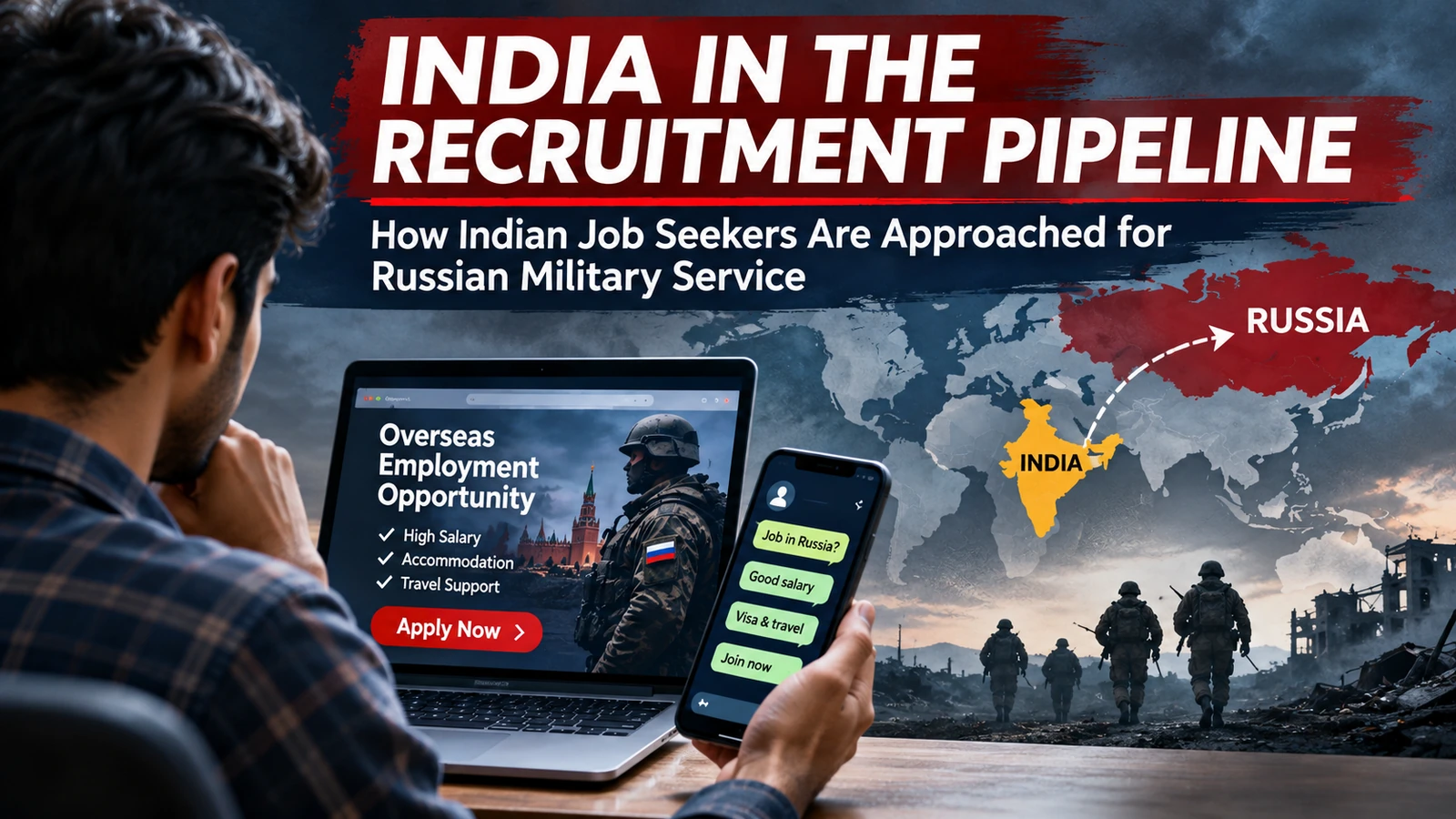
Article 09 — India in the Recruitment Pipeline: How Indian Job Seekers Are Approached for Russian Military Service
This article focuses specifically on India.
It examines recruitment approaches directed towards Indian nationals, the use of overseas employment propositions and the role of intermediaries.
The investigation will also consider documented cases involving Indian citizens who travelled to Russia and subsequently became involved in military service.
Particular attention will be given to the information available to candidates before departure, the contractual arrangements they encounter and the challenges faced by affected families.
Key questions:
- How are Indian nationals approached?
- Are military recruitment opportunities presented as civilian employment?
- What role do travel agents, local contacts or intermediaries play?
- What official warnings and documented cases exist?
- What mechanisms are available to affected individuals and families?
Phase IV: Following the Candidate and Documenting the Consequences
Article 10 — The Candidate Journey: What Happens After a Foreign National Responds to a Russian Military Recruitment Advertisement?
This article reconstructs the potential journey from the first online enquiry to the signing of a military contract.
It will examine recruitment communications, screening procedures, documentation requirements, travel arrangements and the transition from civilian recruitment channels to official military authorities.
The reconstruction will rely on verifiable documents, candidate accounts and independently corroborated evidence.
Key questions:
- What information is requested during initial screening?
- Who arranges travel and documentation?
- At what stage are candidates informed of military obligations?
- What contractual documents are presented?
- Can candidates withdraw from the process, and under what conditions?
Article 11 — The Promise of Russian Citizenship: Examining the Incentives Offered to Foreign Military Recruits
Citizenship, financial compensation and other benefits can form an important part of recruitment messaging.
This investigation examines the promises made to foreign nationals and compares those claims with applicable legal provisions and contractual conditions.
It will distinguish between advertised benefits, legally established entitlements and individual experiences.
Key questions:
- What citizenship-related incentives are advertised?
- What are the applicable legal requirements?
- Are benefits conditional on military service or contract duration?
- How do advertised financial incentives compare with actual contractual terms?
- What risks arise when candidates misunderstand the conditions?
Article 12 — The Human Cost of Recruitment: Foreign Nationals Killed, Missing or Abandoned After Joining Russia’s Military
The final article examines the human consequences of international military recruitment.
It will investigate documented deaths, missing foreign nationals, families seeking information, repatriation difficulties and questions surrounding accountability.
The article will prioritise independently verifiable cases, official records, family accounts and credible investigative reporting.
Key questions:
- What is known about foreign nationals killed during military service?
- How are missing recruits reported and investigated?
- What information do families receive?
- What happens when a foreign national dies or disappears?
- Which authorities are responsible for assistance, investigation and repatriation?
Our Investigative Methodology
The Digital Recruitment Pipeline series will use a combination of open-source intelligence, digital investigation, documentary analysis and conventional investigative journalism.
The methodology will include:
1. Website and domain analysis
Examination of domain-registration information, historical website records, page content, publicly available technical identifiers and changes in website infrastructure.
2. Digital infrastructure analysis
Investigation of hosting arrangements, analytics identifiers, tracking technologies, publicly observable website relationships and other technical indicators.
A shared technical identifier will be treated as a lead, not automatic proof of common ownership.
3. Social media and advertising research
Analysis of publicly accessible recruitment advertisements, social media pages, promotional content and recruitment messaging.
4. Messaging and contact-network analysis
Examination of publicly available telephone numbers, messaging accounts and contact details to identify potential relationships between recruitment platforms and intermediaries.
5. Documentary investigation
Review of official statements, government advisories, contracts where lawfully obtained, court records, corporate information and relevant investigative reports.
6. Cross-border investigative research
Comparison of documented recruitment activity across India, Southeast Asia, Africa and Latin America.
7. Independent verification
Material claims will be assessed against multiple sources wherever possible. Where evidence is incomplete, the limitations will be stated explicitly.
Cyber Truth Times will not publish private personal information without a clear public-interest justification. Sensitive documents and identifying details will be handled with appropriate care, and allegations will be distinguished from facts.
What This Investigation Does Not Assume
The subject involves serious allegations, international security concerns and potentially vulnerable individuals. Accuracy is therefore essential.
This series does not assume that:
- Every website advertising Russian military recruitment belongs to the same organisation.
- Every intermediary is knowingly involved in deceptive recruitment.
- Every foreign national was misled about the nature of military service.
- Shared website technology proves common ownership.
- Every advertised salary, benefit or citizenship promise is fulfilled.
- Every reported recruitment case follows the same sequence.
Instead, each claim will be assessed according to the evidence available.
Where the investigation identifies unanswered questions, those questions will remain unanswered until sufficient evidence is obtained.
Why This Investigation Matters
The recruitment of foreign nationals for military service is not simply a matter of military policy. It intersects with international labour migration, online advertising, cross-border financial transactions, digital platforms, human trafficking concerns and the responsibilities of governments towards their citizens.
When military recruitment is presented through commercial websites and employment-style messaging, prospective candidates may have difficulty distinguishing between ordinary overseas employment and military service.
For governments, the issue raises questions about citizen protection, recruitment regulation and international cooperation.
For digital platforms, it raises questions about the advertising and distribution of military recruitment content.
For journalists and researchers, it presents a complex investigative challenge: identifying the people, organisations and infrastructure behind recruitment campaigns without confusing technical associations with proven operational relationships.
Most importantly, behind every recruitment campaign is a potential human consequence.
A website, advertisement or messaging account may be only the first step in a process that eventually takes a foreign national thousands of kilometres away from home.
Understanding that process requires more than examining the advertisements. It requires following the evidence.
About Cyber Truth Times
Cyber Truth Times is an independent investigative journalism initiative focused on cybercrime, digital investigations, open-source intelligence, online networks and issues that receive insufficient public scrutiny.
Through The Digital Recruitment Pipeline, Cyber Truth Times aims to document the online infrastructure and international mechanisms associated with foreign military recruitment for Russia.
The series will develop as new evidence, records and independently verifiable information become available.
Follow the Investigation
The Digital Recruitment Pipeline is a 12-part investigative series. This page will serve as its central reference point and will be updated as individual investigations are published.
Readers, researchers, journalists and individuals with relevant documentary evidence are encouraged to follow the series and examine the underlying sources.
If you have verifiable information concerning recruitment websites, intermediary arrangements, advertising campaigns or the experiences of foreign nationals recruited for Russian military service, you may contact Cyber Truth Times through its official channels.
The objective is straightforward: follow the digital trail, identify the recruitment mechanisms, establish what the evidence proves and document the human consequences.
For deeper investigations on such topics, see our Cybercrime Investigations & Exposes.


One thought on “The Digital Recruitment Pipeline: Investigating Russia’s Online Military Recruitment Network Targeting Foreign Nationals”