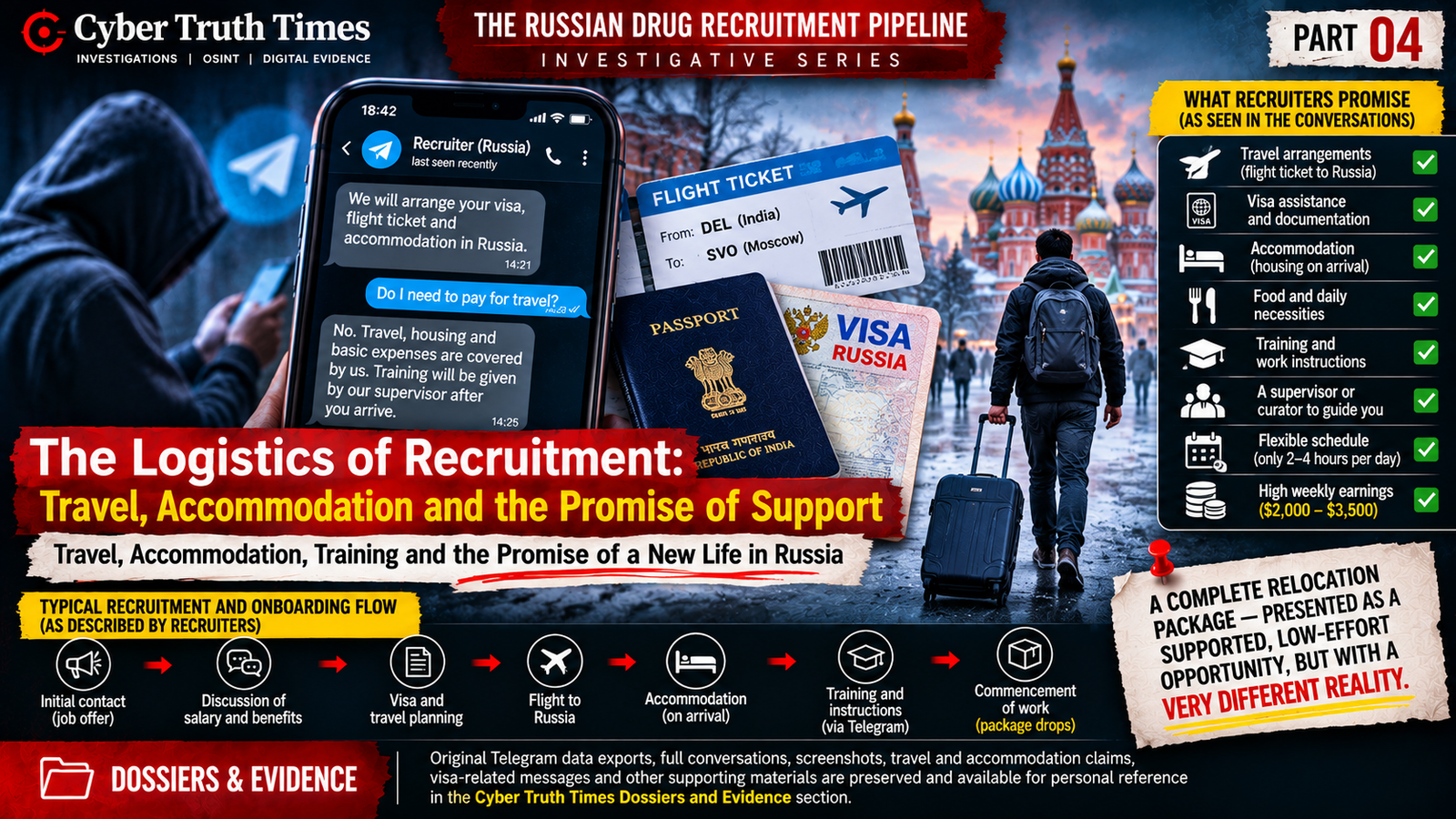
Cyber Truth Times investigates Russia’s drug recruitment pipeline, travel, visas, accommodation, training and support promises.
Introduction: Russia Drug Recruitment Pipeline
An overseas employment advertisement rarely sells only a salary. For prospective migrants, the practical questions can be equally important: Who will arrange the visa? Who will purchase the flight ticket? Where will the applicant stay? Will food and clothing be provided? Is training available? Who will guide the individual after arrival?
In the Telegram recruitment conversations examined by Cyber Truth Times, these questions are addressed through a sequence of assurances that describe an apparently organised journey from initial contact to arrival in Russia. Recruiters discuss travel arrangements, accommodation, necessities, visa procedures, training, supervisors and onboarding. The communications gradually present the recruitment proposition as a complete package rather than a simple job advertisement.
The logistics themselves are part of the recruitment narrative.
This article examines how these assurances are communicated, how they are positioned within the recruitment process, and why they warrant scrutiny when the advertised work eventually involves drug distribution.
Cyber Truth Times is not asserting that every promise in these communications is necessarily false, nor that every account involved in the material belongs to a single organisation. The purpose is to document what recruiters say, compare the language used across conversations and identify the questions that remain unanswered.
The investigation is based on Telegram conversations, screenshots, recruitment messages and other digital materials collected and preserved by Cyber Truth Times, alongside publicly available reporting that provides broader context.
1. A recruitment proposition that addresses the applicant’s practical concerns
The recruitment communications examined in this investigation follow a progression that appears to address increasingly specific questions from the prospective applicant.
The initial proposition introduces the possibility of working in Russia, accompanied by attractive earnings and assurances that language proficiency may not be required. Subsequent messages describe the activity, compensation, logistical arrangements and onboarding.
The logistics become particularly significant after an applicant expresses interest.
In one of the conversations examined by Cyber Truth Times, the recruiter responds to questions about accommodation, visas, flight tickets and other necessities by describing a process in which the company would arrange or cover certain expenses. The messages subsequently describe accommodation after arrival, food, warm clothing and basic necessities.
These assurances appear to address several practical concerns associated with international migration.
A prospective applicant may not have the financial resources to independently arrange:
- International airfare.
- Visa-related expenses.
- Initial accommodation.
- Food and essential supplies.
- Local transportation.
- Other immediate costs associated with relocating.
When a recruiter offers to arrange these necessities, the proposed journey can appear significantly more accessible.
However, the presence of logistical assurances in a recruitment conversation does not independently establish that the arrangements are legitimate, that the promised support will be delivered, or that the applicant will retain control over the circumstances of their employment and residence.
The investigation therefore treats these assurances as documented recruitment claims, not independently verified benefits.
2. The promise of a company-arranged journey
One recurring element in the communications is the promise that travel arrangements will be made by the recruiter or purported employer.
The messages examined in this investigation describe a sequence involving visa processing, a flight to Russia and accommodation upon arrival. The recruiter presents these arrangements as part of a process that would allow the applicant to begin working without having to independently organise every logistical component.
The language is reassuring. It suggests that the applicant will be guided through the process, that arrangements are already being made and that the journey will be coordinated by the people recruiting them.
The apparent convenience is important to the recruitment proposition.
For someone unfamiliar with Russia, its administrative procedures or the practical challenges of relocating internationally, the promise of organised travel may reduce uncertainty.
But several critical questions remain.
- Who is legally responsible for arranging the travel?
- Which entity is paying for the airfare?
- Is the proposed visa appropriate for the activity being offered?
- Is there a written employment contract?
- Does the applicant receive the complete documentation before departure?
- Is the destination city disclosed in advance?
- Are the travel arrangements independently verifiable?
- What happens if the applicant changes their mind before departure?
- What happens if the applicant refuses the work after arriving?
These are not minor administrative details. They concern the legal basis of the journey, the nature of the employment arrangement and the applicant’s ability to make informed decisions.
Cyber Truth Times has not independently verified the travel arrangements described in the recruitment communications.
3. Visas and the language of administrative reassurance
Visa-related assurances occupy an important position in the recruitment conversations.
The recruiters describe a process in which the prospective applicant is expected to participate in a visa-related arrangement before travelling. The communications present the process as something that will be guided or coordinated by the recruiter and subsequently by a purported supervisor.
For an applicant considering international employment, this may appear to resolve one of the most complicated aspects of the journey.
Yet the existence of a promised visa process does not establish the legal validity of the proposed employment.
The investigation raises several questions that should be examined before any recruitment arrangement is treated as credible:
- What visa category is being proposed?
- What purpose of travel is declared?
- What employer or sponsor is identified in the documentation?
- Does the visa permit the activity that the recruiter ultimately describes?
- Is the applicant allowed to independently verify the documentation?
- Are the employment conditions documented in a contract?
- Are the terms of the arrangement consistent with the visa and applicable law?
The distinction between a recruiter promising assistance with documentation and an applicant receiving legally valid employment authorisation is fundamental.
A promised visa is not proof of lawful employment.
This investigation does not independently verify the visa arrangements described in the Telegram conversations. The communications are being examined as part of the broader recruitment process and its presentation to prospective applicants.
4. Accommodation: The promise of a ready-made living arrangement
Accommodation is another recurring element of the recruitment proposition.
In one Telegram conversation reviewed by Cyber Truth Times, the recruiter shared a photograph of a room and described accommodation that would allegedly be available in the destination city. The recruiter also stated that food, warm clothing and basic necessities would be provided during the initial period.
The room photograph establishes what the recruiter shared in the conversation. It does not establish the location, ownership, availability or actual condition of the accommodation.
The accommodation claim is presented as an additional reassurance. It suggests that the prospective worker would not need to independently locate housing immediately after arrival.
For an international migrant, housing can be a substantial expense and a significant source of uncertainty. A ready-made accommodation arrangement may therefore influence the decision to accept an offer.
But the provision of accommodation also raises questions that are particularly relevant when the advertised activity involves criminal conduct.
- Is the accommodation independently identifiable?
- Is the applicant informed of the address before departure?
- Is the housing arrangement voluntary?
- Does the applicant retain access to their passport and personal documents?
- Can the applicant leave the accommodation freely?
- Are housing costs deducted from earnings?
- Is the accommodation shared with other recruits?
- Is the applicant able to independently arrange alternative housing?
- What happens if the applicant refuses the work?
These questions are intended to establish the nature of the arrangement rather than presume that accommodation itself is evidence of wrongdoing.
The investigation has not independently verified the accommodation photograph or the claims associated with it.
5. Food, clothing and basic necessities
The communications also describe assistance with food, warm clothing and other necessities.
These promises are particularly relevant in the context of international recruitment because they address the immediate costs and practical challenges of relocation.
The recruiter describes the proposed support as part of the overall arrangement, presenting the applicant with a package that extends beyond remuneration.
The apparent proposition is that the applicant would arrive in Russia and receive assistance with the essentials required to begin the activity.
However, the extent of this assistance remains unverified.
The messages do not independently establish whether these items would be provided in practice, whether they would be supplied without conditions, or whether the prospective worker would have access to sufficient resources to leave the arrangement if circumstances changed.
The investigation therefore records these statements as promises made in the recruitment communications.
6. Training, supervisors and the purported curator
The recruitment conversations also introduce a supervisory structure.
The recruiters describe a process in which a purported supervisor or curator would provide additional instructions, explain the work and deliver training. In some communications, this training is described as taking place through Telegram.
The language presents onboarding as an organised process. The applicant is told that additional instructions will be provided, that the rules will be explained and that a supervisor will guide the individual through the requirements of the work.
This introduces another layer to the recruitment proposition.
The initial recruiter appears to serve as the point of contact for attracting and communicating with prospective applicants, while the purported supervisor or curator is presented as responsible for providing additional information after the recruitment process progresses.
The existence of a described supervisory structure does not independently establish that the individuals involved are employees of a legitimate organisation or that the accounts share common ownership.
The investigation is examining the communication patterns and references to supervisors across the collected conversations. Similar terminology, repeated onboarding descriptions or comparable account behaviour may be relevant to identifying patterns, but they do not independently establish a common organisational structure.
The questions that remain include:
- Are the purported supervisors identifiable?
- Do different recruitment accounts refer to the same individuals?
- Are the onboarding descriptions materially identical?
- Are the accounts using common communication templates?
- Are applicants directed to additional Telegram accounts?
- Are the relationships between recruiters and supervisors independently verifiable?
These questions will be examined through comparison of the collected digital materials and corroborating evidence.
7. Onboarding as part of the recruitment narrative
The onboarding messages appear to serve an important communicative purpose.
They describe a process in which the applicant is not expected to understand everything immediately. Instead, the recruiter promises that additional instructions, training and explanations will be supplied later.
This approach may help maintain the recruitment conversation by postponing detailed questions until after the applicant has expressed interest.
The communications examined in this investigation include assurances that a supervisor will explain the work, that the applicant will receive instructions and that the process will be presented in detail through further communication.
Cyber Truth Times is examining how this language appears across different accounts and conversations.
The central question is not simply whether training is mentioned. It is whether the onboarding language forms part of a recurring recruitment pattern and how that pattern relates to the eventual disclosure of drug-related activity.
The investigation will distinguish between similarities in the messages and evidence that establishes relationships between the accounts.
8. The significance of the transition from recruitment to drug-related work
The logistics described in the communications cannot be examined in isolation from the nature of the work eventually disclosed.
In the conversations reviewed by Cyber Truth Times, the recruitment proposition begins with employment-oriented language and subsequently moves into explicit descriptions involving drug distribution.
The logistical assurances are communicated within that context.
Travel, accommodation, training and supervisory arrangements may ordinarily be associated with legitimate international employment. Their presence alone does not establish criminality. But when these assurances are part of a recruitment conversation that ultimately describes drug-related activity, the entire proposition warrants scrutiny.
The investigation is particularly concerned with the sequence of disclosures.
At what point does the applicant learn what the work actually involves?
What information is supplied before the applicant is asked to commit to the arrangement?
Are the legal risks discussed before the travel and onboarding promises are made?
Are the assurances about support accompanied by a verifiable employer identity and contract?
These questions matter because a prospective applicant’s decision may be influenced by information presented at different stages of the conversation.
The investigation is not making a general claim that logistical assistance is evidence of deception. It is examining the specific combination of recruitment framing, promises, disclosures and communication patterns documented in the collected material.
9. Independent reporting provides context, not proof of a connection
The recruitment pattern examined by Cyber Truth Times has parallels in independently reported cases involving advertisements for drug-courier work in Russia.
In June 2025, Radio Free Europe/Radio Liberty reported on recruitment advertisements in Bishkek offering prospective workers approximately $1,000 a week, reportedly requiring only three to four hours of work daily, with travel costs and housing covered. When RFE/RL contacted an account associated with the advertisements, the work was described as involving illegal drugs. RadioFreeEurope/RadioLiberty+1
The report provides relevant context for this investigation because it documents a recruitment proposition that similarly combines:
- High remuneration claims.
- Limited daily working hours.
- Travel assistance.
- Housing promises.
- Drug-related work disclosed through recruitment communication.
The similarity of these elements warrants comparative examination.
However, the independently reported case does not establish that the accounts examined by Cyber Truth Times are connected to the individuals or organisations involved in the RFE/RL reporting.
The investigation is therefore using the reporting as contextual evidence of a broader documented phenomenon, rather than as proof of the identity, affiliation or operation of the accounts under examination.
This distinction is essential to maintaining an evidentiary standard that separates comparative analysis from verified attribution.
10. What the logistical assurances establish and what they do not
The collected communications establish that recruiters described logistical support as part of the recruitment proposition.
The documented claims include:
- Assistance with visa-related arrangements.
- A flight to Russia.
- Accommodation after arrival.
- Food and warm clothing.
- Necessities.
- Training and instructions.
- A purported supervisor or curator.
- Onboarding through online communication.
These statements form part of the recruitment narrative presented to prospective applicants.
However, the communications alone do not establish that:
- The travel arrangements were actually completed.
- The visa arrangements were legally valid.
- The accommodation was provided as described.
- The recruiter was affiliated with a legitimate employer.
- The promised support was delivered.
- The applicant would retain control over their documents and freedom of movement.
- The supervisory structure represented a verifiable organisation.
- All accounts examined were connected to a single recruitment network.
The investigation will continue examining these questions through documentary analysis, comparison of communications and corroboration wherever available.
11. Preserving the digital evidence
Cyber Truth Times has preserved the Telegram data exports, screenshots, recruitment messages and supporting materials associated with this investigation.
The original data exports and supporting evidence are available for personal reference through the Dossiers and Evidence section of Cyber Truth Times, subject to appropriate privacy, safety and redaction considerations.
The archive is intended to provide readers with a documentary reference point for the material underpinning this investigation.
The relevant materials may include:
- Telegram conversation exports.
- Screenshots of recruiter messages.
- Travel and accommodation promises.
- Visa-related statements.
- Training and onboarding communications.
- Recruitment advertisements.
- Supporting contextual documents.
- Investigative notes and references.
The archive should not be interpreted as independently verifying every claim contained within the communications. The evidentiary distinction between a recruiter making a statement and the statement being independently established as fact remains central to this reporting.
Explore the Dossiers and Evidence section:
Cyber Truth Times — Dossiers and Evidence.
Conclusion: A journey presented as a complete package
The recruitment communications examined in this article present prospective applicants with more than a salary proposition.
They describe an apparently coordinated journey involving travel, visas, accommodation, food, clothing, training and supervisory support. These assurances are communicated as part of a process intended to make overseas work in Russia appear accessible and manageable.
The significance of these promises lies in their combined presentation and the context in which they are communicated.
Cyber Truth Times has documented messages in which these logistical assurances accompany recruitment offers that ultimately involve drug-related activity. The investigation is examining the language, sequence of disclosures and recurring elements across the collected Telegram conversations.
The evidence reviewed so far establishes what recruiters communicated. It does not independently establish that every promise was fulfilled, that the accounts share common ownership, or that every logistical arrangement was part of a coordinated organisation.
Those questions remain under investigation.
The broader objective is to document how these recruitment propositions are presented, identify recurring patterns supported by evidence, preserve the digital material and examine the risks faced by prospective applicants.
Travel, accommodation and training may be presented as reassuring benefits. In this investigation, they are also part of the recruitment narrative that needs to be documented, tested and independently scrutinised.
Bibliography and further reading
- Radio Free Europe/Radio Liberty — Promises Of High-Paid Work Lure Kyrgyz Into Russian Drug Trade — Reporting on recruitment advertisements offering high remuneration, limited working hours, travel and housing, followed by disclosure of drug-related work. RadioFreeEurope/RadioLiberty
- Radio Free Europe/Radio Liberty — How Kyrgyz Citizens Are Recruited As Drug Couriers In Russia — Reporting and video material examining recruitment advertisements and the recruitment process. RadioFreeEurope/RadioLiberty
- Vesti Volgograd — Indian National Accused in a Drug-Related Case in Volgograd — Local reporting relevant to the broader investigation into Indian nationals and drug-related recruitment or activity in Russia.
- Volgograd Bezformata — Reporting on an Indian National and a Drug-Related Case — Additional local reporting and contextual information.
- The Hindu — Medico from Cuddalore Arrested in Russia, Sends Frantic Message Saying He Was Being Forcibly Sent to Ukraine War Front — Context concerning reported experiences of Indian nationals in Russia.
- The Hindu — Man Detained in Russia, Pressured to Join War, Alleges Family — Additional reporting concerning allegations involving Indian nationals detained in Russia.
- Telegram — Vesti Volgograd — Public Telegram material referenced in the broader investigation.
Editorial note: Bibliographic entries should be checked against the original pages, publication dates, article text and any subsequent corrections before publication. Some sources above describe allegations, not independently established findings.
For deeper investigations on such topics, see our Cybercrime Investigations & Exposes.