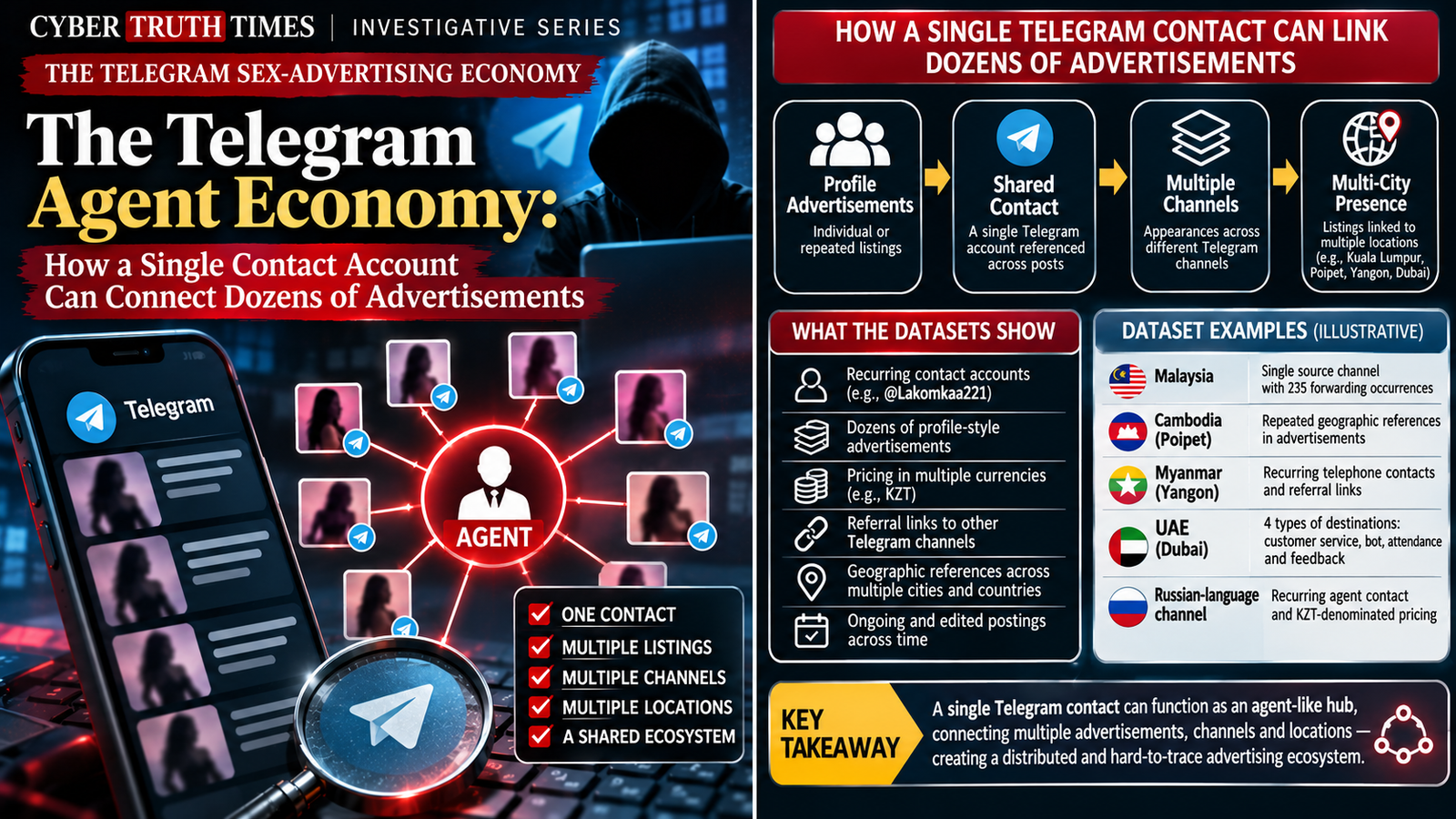
Cyber Truth Times examines the Telegram agent economy, recurring contact references, forwarding records and digital advertising patterns across five Telegram datasets.
Introduction: Telegram Agent Economy
In digital advertising ecosystems operating through messaging platforms, individual advertisements may contain recurring contact references, usernames, links or other identifiers. These references can become useful starting points for investigative research, particularly when promotional content is distributed across multiple posts, channels or datasets.
But identifying a recurring contact reference is not the same as identifying a verified operator.
Cyber Truth Times’ investigation into The Telegram Sex-Advertising Economy examined five Telegram datasets associated with commercial sex advertising across Malaysia, Cambodia, Myanmar, Dubai and a Russian-language advertising channel. Across those datasets, different forms of promotional content, contact references, forwarding relationships and referral links were documented.
Some records contain recurring contact references. Others contain forwarding metadata or references to separate Telegram destinations. The patterns provide material for examining how contact details appear in digital advertising, but they do not independently establish that a single person controls multiple channels, advertisements or commercial operations.
This report examines the concept of the Telegram agent economy as an investigative framework: the observable role recurring contact references may play in promotional material, the questions they raise, the limitations of digital attribution and the evidence required before researchers can responsibly describe an individual as an intermediary.
The investigation does not assume that a recurring username is a verified agent, that repeated advertisements represent a single business or that promotional content establishes trafficking, coercion or exploitation.
Instead, it asks a narrower question: What can investigators establish when the same contact reference appears repeatedly within digital advertising records?
1. Understanding the Contact-Reference Pattern
A contact reference is a digital identifier appearing in promotional material that directs, or appears to direct, audiences toward a communication point.
Within Telegram datasets, such references may take several forms:
- Usernames.
- Links to other Telegram accounts.
- Bot references.
- Channel invitation links.
- Telephone numbers.
- Forwarded-content references.
- Other contact or referral information.
The presence of these identifiers can help researchers document the structure of advertisements.
When a reference appears repeatedly, it becomes a potentially useful investigative lead. Researchers may be able to establish how frequently it appears within a particular dataset, which posts contain it, when those posts were recorded and whether it appears alongside other digital references.
However, recurrence is not attribution.
A username appearing across multiple advertisements does not independently establish that the account holder authored the posts, controlled the channel, managed the people depicted, collected payments or operated a commercial organisation.
The same identifier may be copied, shared, used by multiple people or included in advertisements created by third parties.
The distinction between a recurring reference and a verified intermediary is therefore fundamental to this investigation.
2. Five Datasets, Different Advertising Structures
Cyber Truth Times examined five datasets as part of The Telegram Sex-Advertising Economy. They contain different types of promotional material and different observable digital patterns.
Malaysia: A forwarding relationship in the Kuala Lumpur dataset
The Kuala Lumpur dataset contains a channel titled 在马来的妹子 吉隆坡妹子, approximately translated as “Girls in Malaysia – Kuala Lumpur Girls.”
The records contain 235 occurrences of forwarding metadata associated with another recorded channel identifier.
These occurrences provide a distribution-related lead.
They document a recorded forwarding relationship in the export, but do not establish that the source and destination channels share an owner, that the forwarding represents 235 individual users or transactions, or that the channels are part of a unified commercial operation.
The forwarding records are relevant to examining how promotional content appears to move between recorded digital sources.
However, the metadata should not be interpreted as proof of the identity of the people operating the channels or the commercial relationship between them.
Poipet: Multilingual promotional content and geographic references
The Poipet dataset contains multilingual promotional material and recurring references to Poipet.
The advertisements contain promotional descriptions, pricing claims and references to purported arrangements.
The records provide a basis for examining location-oriented advertising and multilingual content.
They do not establish that the advertisements correspond to a verified physical establishment, that the individuals depicted are located in Poipet or that the promotional claims represent completed transactions.
The dataset’s geographic references are advertising content, not independent location verification.
Yangon: Recurring telephone-number references
The Yangon dataset contains advertisements in which two telephone numbers appear repeatedly.
For publication, the numbers are withheld because recurrence does not establish identity or role, and exposing contact details could facilitate unwanted contact.
The recurring references are nevertheless relevant to documenting the digital advertising pattern.
They may help researchers establish the chronology of advertisements containing the same contact details and identify questions requiring independent corroboration.
The dataset does not establish who owns the numbers, whether they are shared, whether the individuals associated with them control the channel or whether they operate a commercial intermediary business.
Dubai: Customer-service references, bot links and other destinations
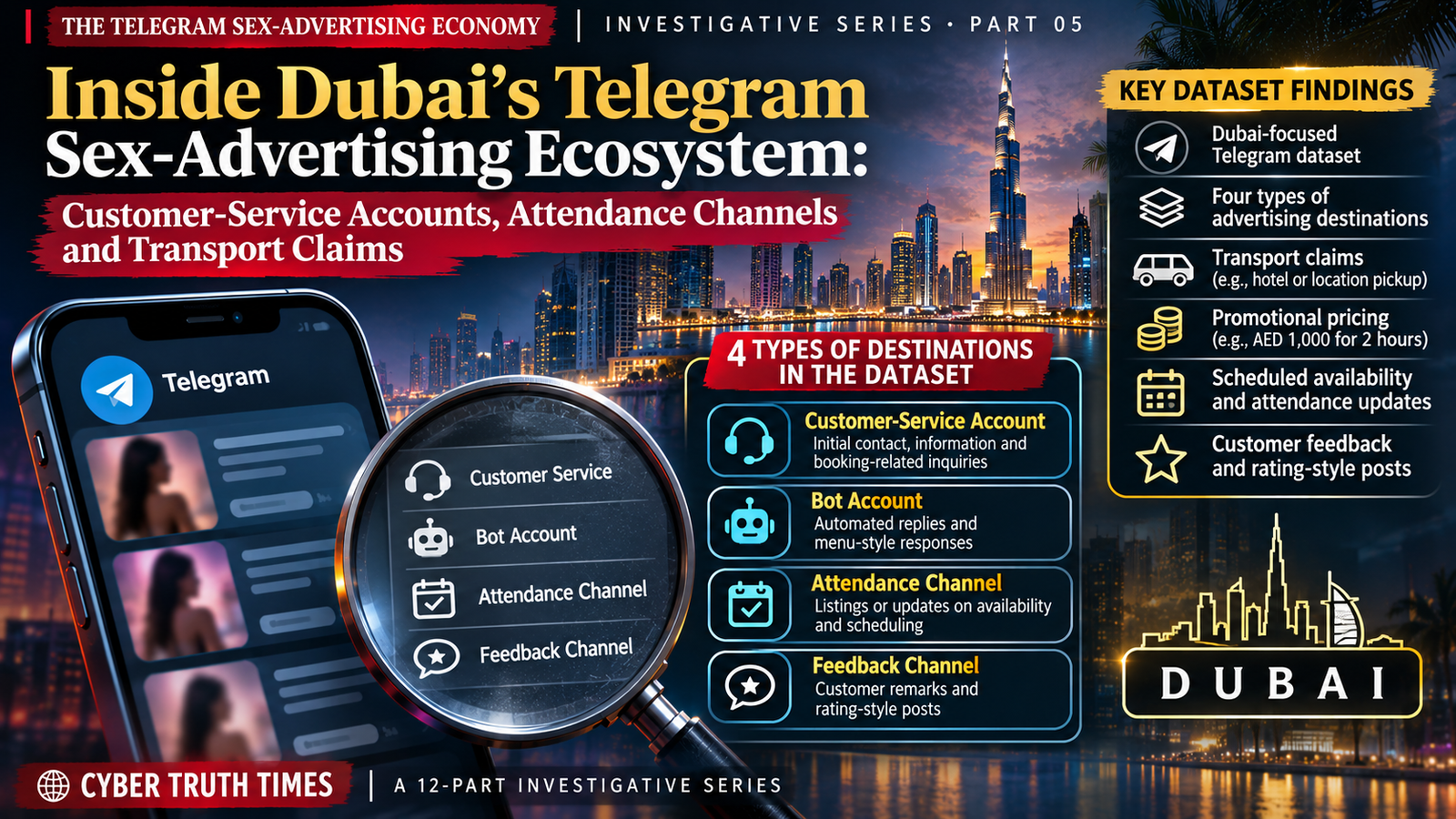
The Dubai dataset contains references to a customer-service account, a contact bot, attendance-related posts and a feedback destination.
These digital references suggest that promotional content directs audiences toward multiple destinations.
However, the records do not independently establish that all referenced accounts are controlled by the same person or organisation, that the destinations operate as a unified system or that the advertised arrangements were delivered.
The dataset provides an observable collection of digital references not verified ownership or operational relationships.
Russian-language dataset: A recurring contact reference
The Russian-language dataset contains profile-style advertisements, KZT pricing claims, a recurring contact reference and a repeated Telegram invitation link.
The recurring username is an investigative lead because it appears across promotional material.
Its recurrence does not independently establish the account holder’s identity, their role, ownership of the channel, control over the profiles or the existence of a unified commercial operation.
The dataset provides a documented example of a contact reference recurring within profile-based advertisements.
Taken together, the five datasets show different forms of advertising-related digital references. They should not be treated as evidence that the datasets belong to one network or that the same individuals control them.
3. What Recurring Contact Details May Reveal
Repeated contact references can provide useful information about the structure of digital advertising records.
The value lies primarily in the pattern that can be documented—not in assumptions about the identity or role of the person behind the identifier.
Repetition
Researchers can document how frequently a contact reference appears within a dataset and which advertisements contain it.
This can help establish a pattern of recurrence.
However, frequency alone does not establish the scale of a business, audience reach, the number of customers, transactions or the number of people involved.
Chronology
The dates associated with advertisements may help researchers document when a contact reference appears in the available records.
A chronology can distinguish a reference appearing in a single post from one recorded repeatedly over a period of time.
The chronology must account for limitations in the dataset, including edits, missing posts, export completeness and the difference between post dates and dates of underlying media.
Context
The content surrounding a recurring contact reference may help establish how it is presented.
For example, a reference may appear alongside profile descriptions, pricing claims, referral links or promotional instructions.
That context can be documented.
But it does not independently establish the actual role of the contact, whether a transaction occurred or whether the person behind the reference is responsible for the advertisement.
Co-occurrence
A contact reference may appear alongside other usernames, links or identifiers.
Researchers can document such co-occurrences within the records.
However, co-occurrence is not proof of common ownership, coordination or a commercial relationship.
Two identifiers appearing in the same post may have been copied, included by a third party or used in a context that cannot be independently verified.
The analytical value of co-occurrence depends on corroboration.
4. The Difference Between an Advertiser, an Intermediary and an Operator
One of the most important challenges in digital investigations is distinguishing the different roles that promotional material may imply.
An advertisement may contain a contact reference presented as a point of communication.
That does not necessarily establish whether the associated account is:
- The person creating the advertisement.
- The person distributing the advertisement.
- An intermediary.
- A channel administrator.
- A contact-management account.
- A person whose identifier was copied into the advertisement.
- Another party whose role is unknown.
The term agent may be useful as a provisional investigative concept, but it should not be used as an established factual description unless evidence supports the attribution.
In this series, recurring contact references are treated as leads.
The records do not independently establish the real-world identities of the individuals associated with them or the precise functions they perform.
A publication that identifies an individual as an agent, operator, recruiter or organiser without corroboration risks converting a digital pattern into an unsupported allegation.
The distinction is not merely linguistic. It is an evidentiary requirement.
5. Why Repeated Advertisements Do Not Automatically Establish a Network
Digital advertising material can appear interconnected for several reasons.
Content may be forwarded, copied, reposted, redistributed or shared through accounts whose administrative relationships are unknown.
A recurring username may appear because it is included in copied promotional content.
A link may be reused by third parties.
A channel may reference another channel without being controlled by it.
These possibilities mean that the appearance of interconnected digital references does not automatically establish a network in the organisational sense.
A network diagram built from recurring usernames, channel IDs, links and forwarding metadata can be useful as a representation of recorded relationships.
But the diagram must distinguish the types of relationships represented.
A documented forwarding relationship is not equivalent to common ownership.
A recurring contact reference is not equivalent to verified control.
A link between two digital destinations is not equivalent to an organisational relationship.
A co-occurrence is not equivalent to coordination.
Without these distinctions, an investigative graphic can unintentionally present hypotheses as facts.
6. The Role of Digital Evidence and Attribution
Digital records can support investigations, but their evidentiary value depends on provenance, completeness, context and corroboration.
A Telegram export may contain message text, timestamps, identifiers, links, media references and forwarding information.
Researchers should document the collection process and avoid treating exported data as automatically complete or authenticated.
Where appropriate, source preservation may include:
- Retaining the original export.
- Recording the collection date.
- Documenting the export method.
- Maintaining the original filenames.
- Recording cryptographic hashes for preserved files.
- Keeping a documented research chronology.
- Distinguishing source data from analytical annotations.
- Recording limitations and uncertainty.
- Preserving corroborating material separately.
The objective is not to make a dataset appear more conclusive than it is.
The objective is to make the research process transparent, reproducible where possible and proportionate to the evidence.
7. Contact References and the Risk of Misidentification
Recurring usernames and telephone numbers can create significant risks when published.
A contact reference may belong to a person who is not responsible for the content in which it appears.
Numbers may be reassigned.
Accounts may be shared.
Identifiers may be copied.
People may be misrepresented in advertisements.
Individuals depicted in promotional material may be vulnerable or unaware of how their images are being distributed.
Publishing contact details may also facilitate unwanted communication, harassment, stalking or exposure.
For these reasons, Cyber Truth Times does not treat the public availability of a contact reference as automatic justification for republishing it.
The publication of identifiers should be based on necessity, proportionality, corroboration and a clear public-interest rationale.
Where the analytical point can be demonstrated without exposing an individual’s contact information, redaction is generally preferable.
8. What the Five Datasets Collectively Show
The five datasets contain different observable patterns associated with Telegram advertising.
Malaysia
Recorded forwarding occurrences provide a distribution-related lead.
Poipet
Multilingual promotional content and recurring geographic references illustrate location-oriented advertising claims.
Yangon
Recurring telephone-number references provide a contact-related investigative lead.
Dubai
Customer-service, bot, attendance-related and feedback references demonstrate multiple digital destinations appearing within promotional material.
Russian-language dataset
Profile-style advertisements, pricing references and a recurring contact reference provide a documented example of contact recurrence.
These findings show that the records contain multiple types of advertising-related digital references.
They do not establish a single network, common ownership, coordinated operations, completed transactions, trafficking or exploitation across the datasets.
The datasets remain separate sources unless independently corroborated evidence establishes relationships between them.
9. What This Investigation Cannot Establish
The comparative analysis does not independently establish:
- The identities of individuals associated with recurring contact references.
- Whether contact accounts are controlled by the same people who operate the channels.
- Whether forwarding relationships represent coordinated distribution.
- Whether the datasets share ownership or administrative control.
- Whether advertisements correspond to real services.
- Whether transactions occurred.
- Whether the individuals depicted are accurately represented.
- Whether cross-border movement occurred.
- Whether coercion, deception or exploitation occurred.
- Whether human trafficking occurred.
- Whether any dataset is connected to a criminal organisation.
The absence of evidence in these records does not establish that exploitation is absent.
It means that the available datasets do not independently demonstrate these allegations.
Commercial sex advertising, recurring contact references or digital forwarding patterns are not, by themselves, proof of trafficking or coercion.
10. Further Investigative Questions
The datasets provide a basis for further research, but additional evidence is required before conclusions can be drawn about identity, ownership or organisational relationships.
Potential research questions include:
- What is the provenance of each dataset?
- How complete are the exports?
- How were recurring contact references identified?
- Are the references preserved in their original context?
- What evidence independently corroborates the identity of an account holder?
- Are there independently documented relationships between channel administrators?
- Are forwarding relationships supported by additional evidence?
- Are claims about physical locations independently corroborated?
- Are media attachments authenticated?
- Could publication of identifiers harm individuals or facilitate unwanted contact?
- Are the findings proportionate to the evidence?
These questions should guide further investigation rather than be treated as conclusions.
Conclusion: Recurrence Is a Lead, Not an Attribution
The Telegram datasets examined by Cyber Truth Times contain recurring contact references, forwarding metadata, referral links, profile-style advertisements, pricing claims and other promotional material.
These records provide investigative leads for examining the digital structure of advertising content.
But the presence of a recurring contact reference does not independently establish a verified agent, an operator, a commercial organisation or a coordinated network.
The five datasets contain different advertising-related patterns, and their relationships remain unverified unless independently corroborated.
Cyber Truth Times’ investigation documents the observable records, identifies the questions they raise and maintains a distinction between digital references, inference and evidence of real-world relationships.
The broader lesson is that digital investigations must not confuse recurrence with identity, links with control or promotional content with proof of wrongdoing.
This report forms Part 07 of The Telegram Sex-Advertising Economy, a 12-part investigative series examining five Telegram datasets and the advertising patterns visible in the records.
Investigative Disclaimer
This report analyses promotional material and records contained in five Telegram datasets supplied for journalistic examination. Advertisements, contact references, forwarding metadata, links, prices, media and geographic claims have not necessarily been independently verified. The presence of commercial sex advertising, recurring contact references or digital forwarding patterns does not, by itself, establish human trafficking, coercion, exploitation, criminal conduct, common ownership or a unified network. Digital identifiers are treated as investigative leads rather than proof of identity or control. Cyber Truth Times distinguishes documented observations, advertiser claims, investigative leads, analytical interpretations and unresolved questions throughout this report.
Bibliography and external references
These sources provide contextual background on trafficking definitions, digital platforms and investigative methodology. They do not independently corroborate the findings of the five datasets.
- UNODC — The Crime of Trafficking in Persons — Legal and conceptual framework for trafficking.
- United Nations — Understanding Human Trafficking — Background on trafficking and exploitation.
- U.S. Department of Justice — What Is Human Trafficking? — Overview of trafficking definitions and distinctions.
- UNODC — Human Trafficking Toolkit — Investigative and response guidance.
- Telegram — FAQ — General information about Telegram.
- Telegram — Channels FAQ — Background on Telegram channels.
For deeper investigations on such topics, see our Cybercrime Investigations & Exposes.