
An investigative series examining the Digital Recruitment Pipeline of the Russian Military, websites, intermediaries, digital advertising, financial incentives and international recruitment routes connecting foreign job seekers to Russia’s military.
Introduction: The Digital Recruitment Pipeline
Cyber Truth Times has completed The Digital Recruitment Pipeline, a 12-part investigative series examining how foreign nationals are approached, recruited and channelled into Russian military service.
The investigation follows a process that can begin with an online advertisement and move through recruitment websites, private messaging applications, local intermediaries, travel arrangements, military contracts and, in some cases, deployment to the war in Ukraine.
Rather than treating foreign recruitment as a collection of isolated incidents, the series examines the wider infrastructure: the digital platforms and websites used to attract applicants, the organisations and intermediaries involved, the financial and citizenship incentives promoted to candidates, and the human consequences reported by recruits and their families.
The project brings together open-source research, website analysis, publicly available recruitment material, investigative reporting, official statements, human-rights research and country-level data. Its purpose is to help readers understand how the recruitment process operates, what has been documented, where the evidence points, and which questions remain unanswered.
Why Cyber Truth Times Investigated the Digital Recruitment Pipeline
The recruitment of foreign nationals into Russia’s military has become an international concern. Public investigations have documented online advertisements offering civilian-sounding employment, recruitment portals operating in multiple languages, private messaging channels, local brokers and travel arrangements that can ultimately lead to military contracts.
The European External Action Service identified at least 35 recruitment websites operating in up to 40 languages. Separate technical research by Code for Africa’s iLAB team identified 289 digital assets and as many as 33 recruitment operations. These findings illustrate the scale and complexity of the online environment in which recruitment takes place.
The central investigative question was therefore not simply how many foreign nationals had joined Russia’s military. It was how the recruitment process worked: how potential candidates were reached, who communicated with them, what they were promised, how they travelled, what contracts they signed, and what happened after they entered the military system.
Cyber Truth Times structured the investigation around those stages.
A 12-part investigation: from the first advertisement to the human cost
The series was designed as a connected investigation. Each chapter examines a different component of the recruitment ecosystem.
1. Inside The Digital Recruitment Pipeline of the Russian Military
The opening chapter introduces the online recruitment environment and examines how websites and digital platforms can be used to attract foreign nationals. It establishes the central question of the series: how does an online employment proposition become a pathway to military service?
Read: Article 01 — Inside Russia’s Digital Military Recruitment Network: The Websites Recruiting Foreign Nationals for the Ukraine War
2. Four Websites, One Recruitment Ecosystem?
The second chapter examines four recruitment brands and websites, comparing their public-facing material, contact routes and technical or organisational connections. It emphasises the difference between evidence of a shared digital relationship and proof of common ownership or control.
Read: Article 02 — Four Websites, One Recruitment Ecosystem? Investigating JoinRussianArmy, Military Staff Agency, Work in Russia and Work Crew Agency
3. Behind the Recruitment Portals: Who Owns and Operates the Websites?
The third chapter moves from what websites advertise to the question of who may operate them. It examines domain infrastructure, technical identifiers, public contact details and the attribution challenges involved in connecting online assets to real-world organisations.
Read: Article 03 — Behind the Recruitment Portals: Who Owns and Operates Russia’s Foreign Military Recruitment Websites?
4. The Digital Bait: How Recruitment Campaigns Reach Foreign Job Seekers
The fourth chapter examines the advertising and audience-acquisition side of the pipeline. It considers multilingual campaigns, civilian-sounding employment propositions, social-media distribution, landing pages and the transition from public advertising to direct contact.
Read: Article 04 — The Digital Bait: How Russia’s Military Recruitment Campaigns Reach Foreign Job Seekers
5. The Recruiter’s Commission: Inside the Business of Sourcing Foreign Nationals
The fifth chapter investigates the financial dimension: recruitment incentives, intermediary payments, commissions and the commercial motivations that can shape the search for foreign candidates. It also examines the need to distinguish advertised benefits from independently verified payments.
Read: Article 05 — The Recruiter’s Commission: Inside the Business of Sourcing Foreign Nationals for Russia’s Military
6. From Website to WhatsApp: Mapping the Digital Recruitment Chain
The sixth chapter follows the movement from public websites to private messaging channels. It examines published contact routes and the evidentiary importance of distinguishing a public business number, a messaging link and the verified identity of the person operating an account.
Read: Article 06 — From Website to WhatsApp: Mapping the Digital Recruitment Chain
7. From Southeast Asia to the Russian Front
The seventh chapter expands the investigation geographically, examining documented recruitment involving nationals from Southeast Asian countries. It presents country-level records while distinguishing identified individuals, contract signings, prisoners of war and other categories.
Read: Article 07 — From Southeast Asia to the Russian Front: The International Recruitment Pipeline
8. Recruiting for Russia: Africa and Latin America
The eighth chapter examines the reported expansion of recruitment across Africa and Latin America. It compares available country-level figures and investigates how recruitment campaigns, intermediaries and employment promises have reached candidates in different regions.
Read: Article 08 — Recruiting for Russia: The Expanding Search for Foreign Fighters Across Africa and Latin America
9. India in the Recruitment Pipeline
The ninth chapter focuses on Indian job seekers and the reported use of overseas employment offers, intermediaries and alleged trafficking networks. It examines official statements, investigations and the difficulties faced by families seeking the return of Indian nationals.
Read: Article 09 — India in the Recruitment Pipeline: How Indian Job Seekers Are Approached for Russian Military Service
10. The Candidate Journey: What Happens After the First Response?
The tenth chapter reconstructs the stages documented in public investigations: advertisement, recruiter contact, screening, document collection, travel, arrival, contract signing, training and possible deployment. It makes clear that no single sequence applies to every recruit.
Read: Article 10 — The Candidate Journey: What Happens After a Foreign National Responds to a Russian Military Recruitment Advertisement?
11. The Promise of Russian Citizenship
The eleventh chapter examines citizenship as a recruitment incentive. It reviews the relevant Russian legal changes, family eligibility provisions, financial offers and the distinction between being eligible to apply for citizenship and actually receiving it.
Read: Article 11 — The Promise of Russian Citizenship: Examining the Incentives Offered to Foreign Military Recruits
12. The Human Cost of Recruitment
The concluding chapter turns from the recruitment infrastructure to its reported consequences. It examines deaths, missing persons, prisoners of war, alleged exploitation, unpaid compensation and families seeking answers across Africa and Latin America.
Read: Article 12 — The Human Cost of Recruitment: Foreign Nationals Killed, Missing or Abandoned After Joining Russia’s Military
What the series set out to document
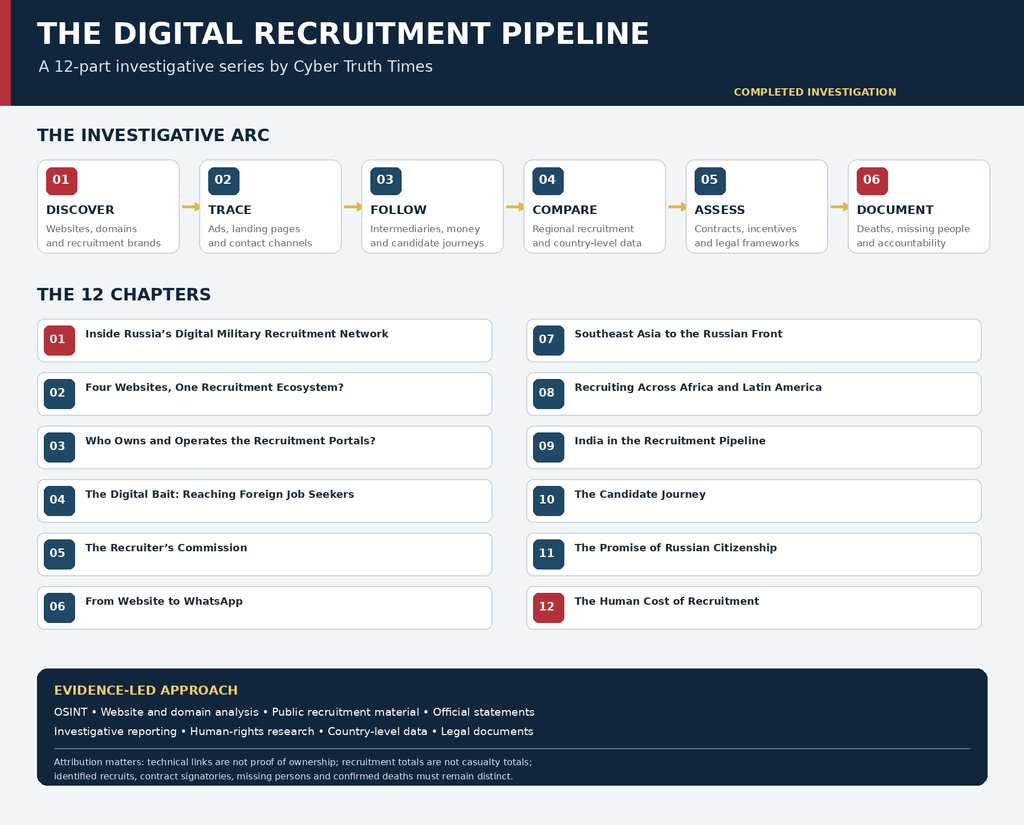
Across twelve chapters, the investigation developed a connected framework for examining the recruitment pipeline.
Digital infrastructure: The series examined recruitment websites, domains, landing pages, social-media advertising and publicly displayed contact routes. It considered how disposable websites and multilingual campaigns can make recruitment activity difficult to track.
Intermediaries and commercial incentives: It examined the role of recruitment brands, local agents, messaging accounts, travel facilitators and possible commission structures. It also highlighted the need to verify ownership and control rather than infer them from superficial similarities.
The candidate journey: The series traced the stages between an initial online response and a possible military contract. It examined the difference between civilian employment promises, informed military enlistment and allegations of deception or coercion.
International reach: Separate chapters focused on Southeast Asia, Africa, Latin America and India. The country-level figures were presented with their source dates and definitions rather than combined into a misleading global total.
Legal and financial incentives: The series examined reported salary and signing-bonus offers, recruitment commissions and simplified citizenship procedures for qualifying foreign military contract personnel.
Human consequences: The final chapters examined the documented experiences of foreign recruits and their families, including people reported killed, missing, captured, wounded or unable to leave military service.
The significance of the evidence
The wider research environment supports the need for this investigation. The EEAS documented a multilingual digital recruitment infrastructure. Code for Africa’s iLAB research mapped a large collection of digital assets and recruitment operations. Human-rights organisations and investigative journalists have documented cases involving civilian job promises, intermediaries, travel arrangements, military contracts and allegations of trafficking.
These findings do not prove that every recruitment website belongs to one organisation, that every intermediary is acting unlawfully, or that every foreign recruit was deceived. The evidence points to a complex environment involving different actors, recruitment models and individual circumstances.
That distinction is central to the Cyber Truth Times approach. A shared contact detail is not proof of common ownership. A technical identifier is not proof of operational control. An advertisement is not proof that a platform knowingly participated in recruitment. A signed contract does not, by itself, establish informed consent.
The series therefore treats attribution, source quality and evidentiary limits as part of the investigation—not as qualifications to be hidden from readers.
An investigative resource, not just a twelve-article series
The Digital Recruitment Pipeline is intended to function as a reference resource for journalists, researchers, civil-society organisations, policymakers and readers seeking to understand the international recruitment of foreign nationals into Russia’s military.
The twelve chapters can be read independently, but together they provide a structured account of the recruitment environment: from the first digital contact to the consequences that may follow military enlistment.
The project also identifies areas requiring further investigation. These include the ownership and operation of recruitment assets, the identity of intermediaries, the movement of money, the accuracy of advertised benefits, the number of recruits who have returned or remain missing, and the accountability of actors involved in deceptive recruitment.
Conclusion: following the evidence beyond the advertisement
Completing The Digital Recruitment Pipeline represents a substantial investigative and editorial undertaking for Cyber Truth Times. It brings together twelve connected chapters examining a complex international issue that spans digital advertising, employment claims, recruitment intermediaries, migration, military service and human rights.
The central lesson is that recruitment does not begin at the military enlistment office. It can begin much earlier when a person encounters an online advertisement, submits a phone number or responds to an overseas employment offer.
Understanding that pathway requires more than counting foreign fighters. It requires examining the websites, messages, intermediaries, contracts, financial incentives and personal consequences that connect the first advertisement to the final outcome.
Cyber Truth Times will continue to treat this subject as an evidence-led investigation. The publication of twelve chapters is not the end of the questions. It is a consolidated record of what has been examined so far and a foundation for further scrutiny.
The Digital Recruitment Pipeline — a twelve-part investigative series by Cyber Truth Times.
Bibliography and further reading
- European External Action Service / EUvsDisinfo — From Social Media to the Front Line: Russia’s Foreign Recruitment Pipeline — Research identifying at least 35 recruitment websites and campaigns in up to 40 languages.
- Institute for Security Studies — Russia’s Military Recruitment Networks Exploit Western Tech Platforms — Analysis of Code for Africa iLAB research into 289 digital assets and up to 33 recruitment operations.
- African Digital Democracy Observatory — Death Benefits: Russia’s War Recruiters Have Gone into Business — Investigation into recruitment operations, digital assets and the commercial incentives surrounding foreign recruitment.
- FIDH — Russia’s War Against Ukraine: Thousands of Foreign Nationals Recruited by Russia in Violation of International Law — Joint research with Truth Hounds and the Kazakhstan International Bureau for Human Rights.
- Amnesty International — Russia: Recruitment of Foreign Nationals to Fight in Ukraine Amounts to Human Trafficking — Interviews and findings concerning deception, coercion and exploitation.
- Atlantic Council — Not Quite Mercenaries: How Russia Lures Thousands of Foreigners to Fight in Its War on Ukraine — Analysis of recruitment methods, financial incentives and foreign recruitment networks.
- The Insider — Through Mordovia to Mordor: How Latin American and African Mercenaries Are Recruited for Russia’s War Against Ukraine — Investigation into recruitment routes and the movement of foreign candidates through Russia.
- Journalists for Justice — The Death Contract: How Russia Recruits Africans to Fight and Die in Ukraine — Country-level African recruitment research and documented human consequences.
Editorial methodology note: The bibliography contains independent research and reporting used to contextualise the series. The existence of a connection, advertisement or recruitment record should not be treated as proof of common ownership, criminal conduct or deception without case-specific evidence.